Low libido in men and testosterone
Reduced sexual desire in men is a common complaint, but it is often attributed to low testosterone too quickly. In reality, many other factors such as poor sleep, abdominal fat, depression, and certain medications all affect desire through independent or overlapping mechanisms.
Updated November 14, 2026Compiled by UK MASTER ACADEMYFor readers aged 18 and over
- The Endocrine Society recommends diagnosing androgen deficiency only when both clinical symptoms and clearly low morning blood testosterone levels, confirmed by a reliable test, are present.
- A 2026 review from multiple specialty societies found late-onset hypogonadism affects approximately 2.1% of men aged 40 to 79, rising to as high as 30% in certain disease-specific groups.
- Abdominal fat increases aromatase enzyme activity in adipose tissue, converting testosterone to estrogen and lowering free testosterone through a feedback loop.
- Testosterone is not the only hormone that regulates libido; anxiety, depression, and sleep quality each affect desire through their own mechanisms, independent of testosterone levels.
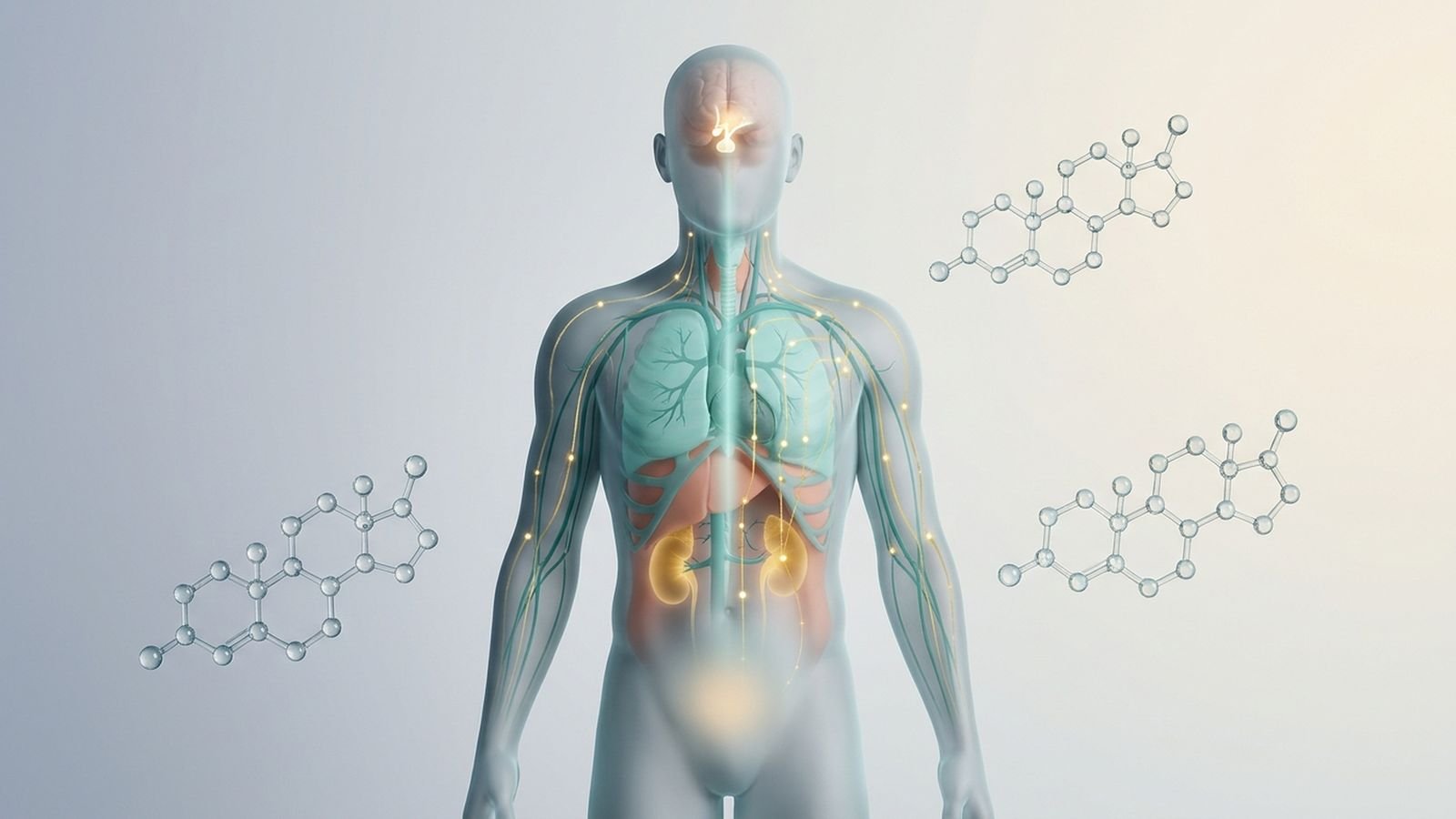
Reduced sexual desire in men
Sexual desire is not a fixed constant. It fluctuates with age, health status, relationship quality, and the level of stress in a person's life. Reduced desire becomes a concern when it lasts three months or more, has no clear cause such as an acute illness or a major life change, and causes distress to the person involved.
Testosterone is the main sex hormone in men, essential for desire, erection, and mood. However, low testosterone is not the only cause of reduced desire. Before considering hormones, more common causes need to be ruled out.
Two perspectives on male libido
Western medicine
Testosterone is produced by the testes under instruction from the hypothalamic-pituitary-testicular axis. Levels are highest in the morning and decline through the day. Libido is influenced by testosterone but also regulated by dopamine, serotonin, emotional state, and relationship context.
The Endocrine Society recommends diagnosing androgen deficiency only when both appropriate clinical symptoms and clearly low blood testosterone levels are present, measured in the morning using a reliable test and confirmed at least twice. A low test result without accompanying symptoms is not sufficient to justify hormone replacement.
Chinese medicine
Traditional Chinese medicine links libido to Kidney essence (jing). The Kidney stores essence, governs growth and reproduction; when Kidney essence declines and the Gate of Life (mingmen) fire weakens, desire loses its vitality. Liver qi stagnation from prolonged stress also blocks the free flow of qi and blood, leading to a state of indifference. The Spleen transforms food into refined substances; poor diet and overexertion weaken the Spleen, leaving the body without enough nourishment to replenish essence.
This is the traditional Chinese medicine view, which has not been validated by clinical trial standards with placebo controls. See the Kidney page and the Spleen page for more.
Common causes beyond testosterone
Many health conditions and lifestyle factors reduce libido through their own mechanisms, not necessarily through testosterone:
- Poor sleep and sleep apnea: testosterone is produced mainly during deep sleep cycles. A 2011 JAMA study found that one week of sleep restriction affected daytime testosterone levels in young healthy men. A 2023 meta-analysis of 24 studies found that men with sleep apnea had significantly lower testosterone levels than those without.
- Abdominal fat: visceral fat contains high levels of aromatase enzyme, converting testosterone to estrogen. As belly fat accumulates, free testosterone falls, the pituitary receives the feedback signal and reduces production further. This cycle sustains itself without lifestyle intervention.
- Depression: depression reduces libido through neurological mechanisms independent of hormones. Selective serotonin reuptake inhibitor antidepressants may improve depression but further reduce libido in some people, which requires careful consideration by a doctor.
- Medications for underlying conditions: some blood pressure, stomach ulcer, epilepsy, and other medications affect libido. Do not stop medication on your own; ask your doctor about alternatives if you suspect your medication is the cause.
- Chronic illness: diabetes, thyroid disease, chronic kidney disease, and heart disease can all affect the hormonal axis and libido.
Why not to self-administer external testosterone
Testosterone sold online or promoted as a prescription-free testosterone booster carries many risks that users are rarely warned about:
- Suppression of natural production: external testosterone sends feedback signals to the hypothalamus and pituitary, suppressing the hormones that stimulate the testes. Testes that are no longer stimulated shrink gradually and reduce or stop producing both testosterone and sperm.
- Difficulty stopping: when external testosterone is stopped after testicular function has declined, natural production recovery can take a long time, and in some cases does not return fully to baseline.
- Other risks: elevated hematocrit thickens the blood and raises the risk of blood clots; effects on PSA require monitoring; effects on cardiovascular health are still being studied and require ongoing surveillance.
When to see a doctor
See a men's health, endocrinology, or urology specialist when:
- Libido has been low for more than three months, accompanied by fatigue, weak erections, muscle loss, or low mood without a clear cause.
- You want a testosterone test and a thorough assessment rather than buying products of unknown origin.
- You are taking medication for an underlying condition and suspect it is affecting your libido.
- You have an underlying condition such as diabetes, obesity, or sleep apnea that is not well controlled.
Questions and answers
Do I need a testosterone test?
Testing is worthwhile if symptoms include persistent fatigue, reduced libido, weak erections, muscle loss, or osteoporosis. The test should be taken in the morning and confirmed at least twice. A low result without symptoms is not enough on its own to justify treatment.
Does poor sleep really lower testosterone?
Yes. Testosterone is produced mainly during deep sleep. Studies show that restricting sleep continuously for several days lowers daytime testosterone levels in young healthy men. Improving sleep is a well-supported first step.
Why should I not buy testosterone without a prescription?
External testosterone signals the pituitary to stop stimulating the testes, causing them to shrink gradually and reduce production of sperm and endogenous testosterone. Stopping abruptly can leave lasting suppression of natural production. A doctor must monitor PSA, hematocrit, and reproductive function.
How long should low libido last before I see a doctor?
If low libido lasts more than three months, has no clear cause, or is affecting quality of life and relationships, see a men's health or endocrinology specialist.
Sources
- Bhasin S, Cunningham GR, Hayes FJ, et al. Testosterone therapy in men with androgen deficiency syndromes: an Endocrine Society clinical practice guideline. Journal of Clinical Endocrinology and Metabolism. 2010;95(6):2536-2559. PubMed 20525905
- Tsampoukas G, Karna S, Morgado A, Minhas S. Variations in diagnostic criteria for male hypogonadism: is there a need for standardizing specialist society guidelines? International Journal of Impotence Research. 2026;38(6):457-463. PubMed 40683978
- Leproult R, Van Cauter E. Effect of 1 week of sleep restriction on testosterone levels in young healthy men. JAMA. 2011;305(21):2173-2174. PubMed 21632481
- Saad F, Aversa A, Isidori AM, Gooren LJ. Testosterone as potential effective therapy in treatment of obesity in men with testosterone deficiency: a review. Current Diabetes Reviews. 2012;8(2):131-143. PubMed 22268394
- Wang H, Lu J, Xu L, et al. Obstructive sleep apnea and serum total testosterone: a systematic review and meta-analysis. Sleep and Breathing. 2023;27(3):789-797. PubMed 35904664
This page is general health information compiled from international medical sources. It has not been reviewed by a physician and is not a diagnosis or a treatment instruction. The content is for readers aged 18 and over. If symptoms persist, please see a doctor.