Prostate and pelvic floor: three conditions to know
The prostate is a small gland just below the bladder, surrounding the urethra. The three most common conditions are benign hyperplasia, chronic inflammation, and chronic pelvic pain syndrome. All three can affect urination and sexual function, and the pelvic floor plays an important role in all three.
Updated November 14, 2026Compiled by UK MASTER ACADEMYFor readers aged 18 and over
- The 2003 MSAM-7 multinational survey of more than 12,800 men aged 50 to 80 found that the severity of lower urinary tract symptoms was an independent risk factor for sexual dysfunction, independent of diabetes, hypertension, or heart disease.
- A 2022 systematic review of pelvic floor physical therapy for hypertonicity found positive outcomes in people with chronic prostatitis, chronic pelvic pain, and pain during intercourse in most of the studies included.
- Benign prostatic hyperplasia is the leading cause of lower urinary tract symptoms in older men, with prevalence increasing progressively with age.
- Chronic pelvic pain syndrome is classified under the UPOINT framework covering six domains, in which domain T (pelvic floor tension) is the priority indication for pelvic floor physical therapy.
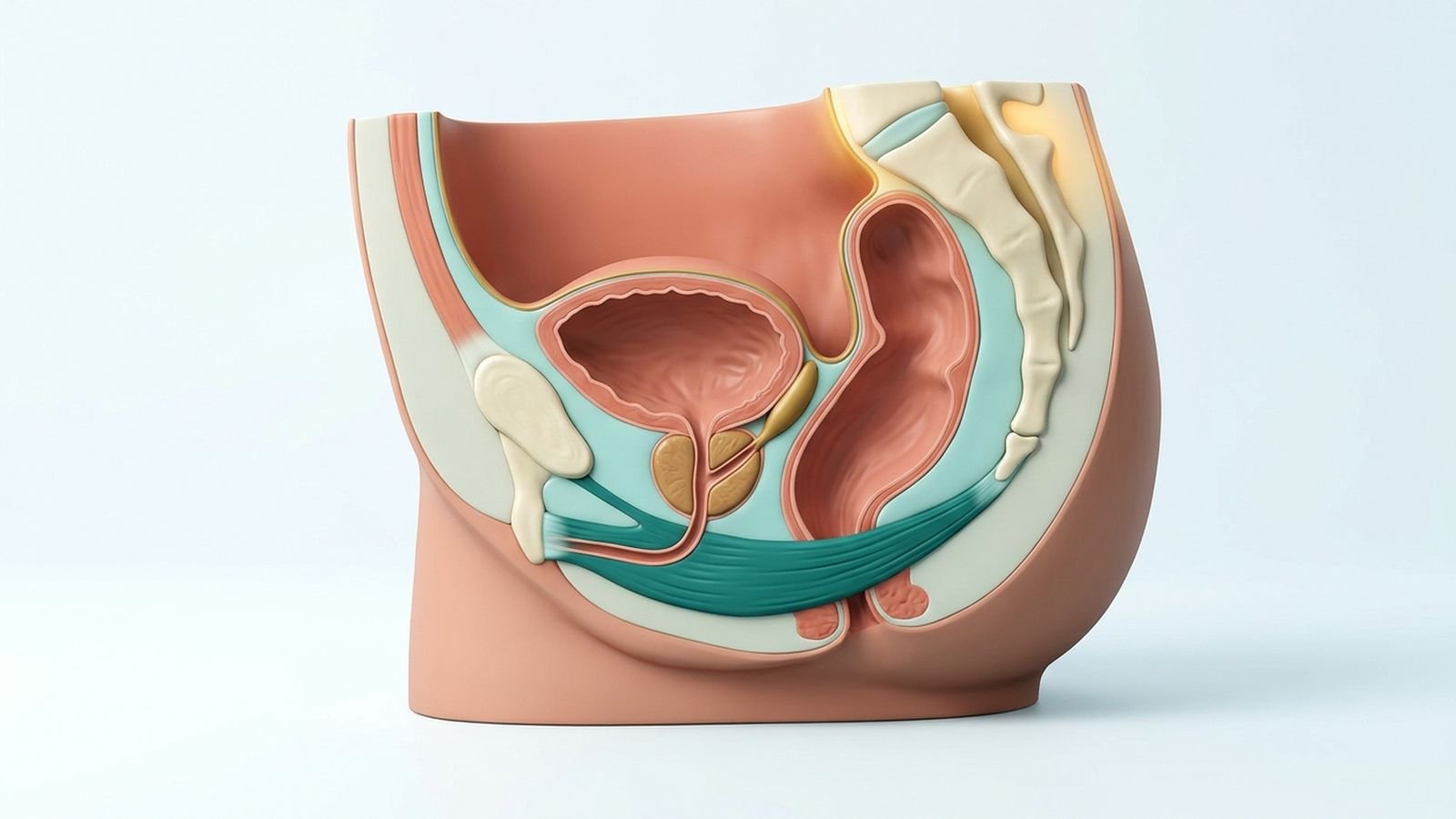
The prostate and its function
The prostate is a small chestnut-shaped gland with a typical weight of 20 to 25 g in a healthy adult, located just below the bladder and surrounding the upper urethra. Its main function is to produce secretions that protect and nourish sperm. Because it surrounds the urethra, when the gland grows larger or becomes inflamed, urination is affected first.
The male pelvic floor consists of a group of muscles at the base of the pelvis, supporting the bladder and rectum, controlling urination, and contributing to erection and ejaculation. The prostate and pelvic floor operate in the same anatomical region, so prostate problems often bring tension or dysfunction in the pelvic floor muscles.
Three common conditions
Western medicine
Benign prostatic hyperplasia (BPH): the gland gradually grows with age, narrowing the urethral lumen. Symptoms include difficulty starting urination, a weak stream, intermittent flow, a sensation of incomplete emptying, and frequent urination at night. BPH is benign and does not progress to cancer, but causes significant discomfort if left untreated.
Chronic prostatitis and chronic pelvic pain syndrome (chronic prostatitis): this is pelvic, perineal, penile, or scrotal pain lasting more than three months, usually accompanied by urinary symptoms and effects on sexual function. The majority of cases show no bacterial cause; contributing factors include tight pelvic floor muscles, central sensitization, and psychosocial factors. This group requires a multi-modal approach rather than antibiotics alone.
Chinese medicine
Traditional Chinese medicine places lower-burner urinary and sexual problems within three organ systems. The Kidney governs both lower orifices: when Kidney qi is deficient, bladder control is weak, causing frequent urination and incomplete emptying. When Kidney yin is deficient, heat accumulates in the lower burner, causing burning pain and painful urination. The Bladder is the organ that holds and discharges urine, dependent on the Kidney's qi transformation. Prolonged stress causes Liver qi stagnation in the pelvic region, contributing to pain and spasm.
This is the traditional Chinese medicine view, which has not been validated by clinical trial standards. See the Kidney page and the Bladder page.
Effects on urination and sexual function
The 2003 MSAM-7 multinational survey of more than 12,800 men aged 50 to 80 in seven countries found that the severity of lower urinary tract symptoms was independently associated with sexual dysfunction, even after adjusting for confounders such as diabetes, hypertension, and cardiovascular disease. This association was consistent across all countries in the study.
People with chronic prostatitis or chronic pelvic pain syndrome often experience additional sexual effects such as pain during ejaculation, erectile dysfunction, reduced libido, or anxiety about sex. These effects usually stem from tight pelvic floor muscles, chronic pain, and associated anxiety rather than structural tissue damage.
The role of pelvic floor physical therapy
For mild to moderate BPH and for chronic prostatitis, pelvic floor physical therapy is increasingly included in treatment guidelines. An important distinction: for people with tight pelvic floor muscles, the goal of exercise is to relax and lengthen the muscles, not to contract them further.
A 2022 systematic review from four controlled trials and five prospective studies found pelvic floor physical therapy to have positive outcomes in people with chronic prostatitis and chronic pelvic pain on measures of pain, urinary function, sexual function, and quality of life. The researchers noted that most studies had small sample sizes and a moderate to high risk of bias, and that higher-quality trials are needed.
A 2026 non-surgical guideline from Chinese authors using the UPOINT framework identifies domain T, meaning pelvic floor tension, as the priority indication for pelvic floor physical therapy in the treatment of chronic prostatitis. Once the pelvic floor has been relaxed, adding Kegel exercises as a supplement is appropriate. See Pelvic Floor Release and Kegel for men.
Prostate screening and when to see a doctor
Many health organizations recommend that men discuss with a doctor when to have PSA screening and a prostate examination based on their individual risk factors. A rising PSA may be caused by BPH, inflammation, or cancer, and needs to be evaluated by a doctor in full clinical context.
See a urologist or men's health doctor when:
- Lower urinary tract symptoms such as difficulty urinating, a slow or delayed stream, frequent nighttime urination, or incomplete emptying that affect quality of life.
- Pelvic, perineal, scrotal, or penile pain lasting more than three months.
- Pain during ejaculation or unexplained decline in sexual function.
- Blood in the urine even once.
- No previous prostate examination and wanting to ask a doctor about the right time to screen.
Questions and answers
Does a high PSA mean prostate cancer?
Not necessarily. PSA can also rise with benign enlargement and prostatitis. The PSA value needs to be assessed together with a clinical examination and individual context by a urologist.
Is chronic prostatitis contagious?
Chronic prostatitis usually has no clear bacterial cause and is not transmitted through sex. Chronic pelvic pain syndrome is largely related to pelvic floor tension and the nervous system, not bacteria.
Can Kegel exercises help with the prostate?
It depends on the cause. People with tight pelvic floor muscles from chronic inflammation or pelvic pain need a pelvic floor release program first; adding contraction exercises may worsen symptoms. Assessment by a pelvic floor physical therapist is recommended.
At what age should prostate screening start?
The right time to start PSA screening depends on individual risk factors. Ask your doctor about the screening schedule that suits your situation.
Sources
- Rosen R, Altwein J, Boyle P, et al. Lower urinary tract symptoms and male sexual dysfunction: the multinational survey of the aging male (MSAM-7). European Urology. 2003;44(6):637-649. PubMed 14644114
- van Reijn-Baggen DA, Han-Geurts IJM, Voorham-van der Zalm PJ, et al. Pelvic floor physical therapy for pelvic floor hypertonicity: a systematic review of treatment efficacy. Sexual Medicine Reviews. 2022;10(2):209-230. PubMed 34127429
- Sun J, Jing S, Fei Y, Zhu J. Non-surgical management of male chronic prostatitis/chronic pelvic pain syndrome: a UPOINT-guided narrative review. Journal of Pain Research. 2026;19:623240. PubMed 42807926
- European Association of Urology (EAU). Guidelines on prostatitis and chronic pelvic pain syndrome. Source page
This page is general health information compiled from international medical sources. It has not been reviewed by a physician and is not a diagnosis or a treatment instruction. The content is for readers aged 18 and over. If symptoms persist, please see a doctor.