
⚡ Executive Scholarly Summary: Mourning Door Star (Mourning Gate Star (Sang Men) · 喪門)
Never judge a chart by a single star. Five-Element structure is the sovereign foundation. Within the classical Ziping Shen Sha doctrine codified in Wan Min-ying's San Ming Tong Hui (三命通會) and Shen Xiaozhan's Zi Ping Zhen Quan (子平真詮), Mourning Door Star (喪門 · Sāng Mén · Mourning Gate Star (Sang Men)) is never an isolated fatalistic label detached from Five-Element generation and control; rather, it is a specialized energetic vector reflecting how Heavenly Stems, Earthly Branches, and the Monthly Command converge across the Year, Month, Day, and Hour Pillars. Possessing Mourning Door Star does not automatically guarantee effortless fortune. Lacking Mourning Door Star never condemns a chart to mediocrity. Every real-world manifestation hinges upon the Useful God (Yong Shen).
- Canonical Nomenclature & Classification: Mourning Door Star (喪門) · Mandarin Pinyin Sāng Mén, Sino-Vietnamese Mourning Gate Star (Sang Men), classified as a Challenging Sha Star (Requires Restraint & Transformation).
- Classical Derivation Formula & Core Domain: Derived via Located two branches ahead of the Year or Transit Tai Sui Branch (paired with Condolence Guest / Condolence Guest Star (Diao Ke) two branches behind); classical verse: "Suì qián èr chén hào sāng mén, zuì jì liú nián dié jiàn lín...", embodying solemn transitional qi alerting the native to prioritize elder health, home safety, and emotional steadiness and governing elder healthcare, family insurance/estate stewardship, medical professions, and home renovation timing.
- Differentiation Across the 4 Natal Palaces (Year · Month · Day · Hour): In the Year Pillar it shapes ancestral heritage and early upbringing (ages 1 to 16); in the Month Pillar it directs young-adult career architecture (ages 17 to 32); in the Day Pillar it acts directly upon the Spouse Palace and core psychology (ages 33 to 48); in the Hour Pillar it determines late-life harvest and offspring (age 49+).
- Useful God & Structural Integration (San Ming Tong Hui): When the stem or branch carrying Mourning Door Star serves as a Favorable Useful God (Xi Yong Shen) or converges with Heavenly & Monthly Virtue, Relief God, and Auspicious Celebration ('Xung Hy'), its finest qualities blossom into high nobility; conversely, when it falls into a Hostile God (Ji Shen) or encounters White Tiger, Condolence Guest, and direct Natal/Transit Branch Clash, proactive restraint and Six-Harmony remediation are required.
Take Five-Element balance as the Substance (Ti). Take Shen Sha stars as the Function (Yong). That is the iron law of orthodox Ziping metaphysics when diagnosing Mourning Door Star in any natal chart and timing its activation across Decade Luck and the 2026 to 2037 Annual Transits.
1 What Is Mourning Door Star (Mourning Gate Star (Sang Men) · 喪門)? Classical Origin & Metaphysical Essence
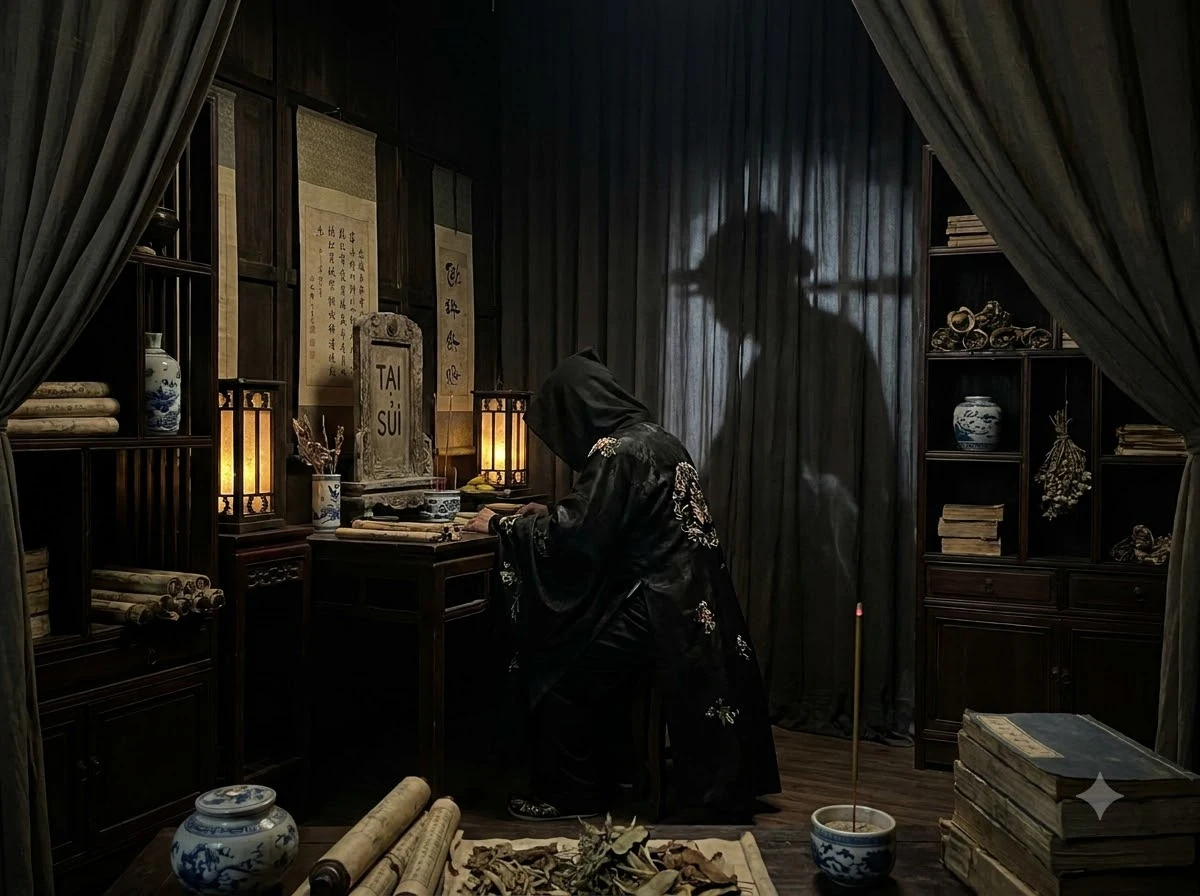
Every star has a structural root. Every symbol reflects elemental law. In the grand edifice of Four Pillars Bazi (The Four Pillars of Destiny (BaZi)), Mourning Door Star (喪門 · Sāng Mén, Vietnamese: Mourning Gate Star (Sang Men)) occupies a vital position within the classical Shen Sha (神煞) system codified during the Tang, Song, and Ming dynasties; rather than operating as folklore superstition, it represents solemn transitional qi alerting the native to prioritize elder health, home safety, and emotional steadiness arising from the precise astronomical and seasonal interplay between Heavenly Stems and Earthly Branches.
Substance precedes imagery. Structure governs manifestation. Master Wan Min-ying's encyclopedic San Ming Tong Hui (三命通會) and Xu Zi-ping's Yuan Hai Zi Ping (淵海子平) both emphasize that Mourning Door Star functions as a high-resolution lens over elder healthcare, family insurance/estate stewardship, medical professions, and home renovation timing; while the Ten Gods (Ten Gods (Shi Shen)) define the socio-economic skeleton of a chart, Mourning Door Star reveals the qualitative texture, timing velocity, and karmic catalysts through which those Ten Gods play out in real life.
2 Canonical Lookup Formula & Derivation of Mourning Door Star (San Ming Tong Hui)
Precision in lookup prevents false diagnosis. One misread branch invalidates the entire reading. In orthodox Ziping practice, locating Mourning Door Star (喪門) requires cross-referencing the anchor pillar against the remaining pillars of the natal chart, Decade Luck, and Annual Transit according to the canonical rule:
Canonical Exegesis: Easy to memorize, profound in application. Standing two branches ahead of Tai Sui, the Mourning Door star reminds families to care attentively for senior relatives' health and channel transitional energy into preventive checkups and charitable deeds.
- Classical Shen Sha Canon · San Ming Tong Hui (三命通會) & Yuan Hai Zi Ping (淵海子平)| Diagnostic Dimension | Canonical Specification for Mourning Door Star (喪門) | Operational Rule in Chart Reading |
|---|---|---|
| Anchor & Formula | Located two branches ahead of the Year or Transit Tai Sui Branch (paired with Condolence Guest / Condolence Guest Star (Diao Ke) two branches behind) | Check the Day Pillar first (representing the self and immediate vitality), then verify the Year Pillar (representing ancestral and social macro-field). |
| Elemental Mechanism | Solemn transitional qi alerting the native to prioritize elder health, home safety, and emotional steadiness | Evaluate whether the branch or stem hosting Mourning Door Star strengthens or drains the Natal Useful God. |
| Favorable Confluence | Heavenly & Monthly Virtue, Relief God, and Auspicious Celebration ('Xung Hy') | When supported by rooted Useful Gods and Virtue stars, auspicious outcomes reach 90 to 100% fulfillment. |
| Taboo & Afflictions | White Tiger, Condolence Guest, and direct Natal/Transit Branch Clash | When struck by unrescued Clash, Punishment, or Hostile Gods, apply Six-Harmony bridging and conservative risk governance. |
3 Psychological Profile, Cognitive Style & Behavioral Expression
Inner qi shapes outer character. Habitual thought becomes destiny. When Mourning Door Star (喪門) sits prominently in the Day Pillar, Month Pillar, or projects onto the Heavenly Stems, it imprints a distinct psychological signature upon the native's cognition, decision-making, and interpersonal temperament:
✦ Empowered Expression (When Rooted & Favorable)
- Strategic Clarity & Composure: Channels the core essence of Mourning Door Star (solemn transitional qi alerting the native to prioritize elder health, home safety, and emotional steadiness) into disciplined execution across elder healthcare, family insurance/estate stewardship, medical professions, and home renovation timing.
- Magnetic Credibility: Attracts high-caliber mentors, partners, and institutional trust when paired with Heavenly & Monthly Virtue, Relief God, and Auspicious Celebration ('Xung Hy').
- Resilient Adaptability: Converts external pressure into decisive personal growth and constructive leadership.
⚠ Shadow Tendencies (When Turbid or Clashed)
- Over-Extension or Friction: Under the influence of White Tiger, Condolence Guest, and direct Natal/Transit Branch Clash, energy can scatter into impatience, perfectionism, or interpersonal tension.
- Cognitive Blind Spots: Relying solely on innate flair while neglecting structural cash-flow or contractual safeguards.
- Emotional Fatigue: Allowing external transit clashes to disrupt domestic communication inside the Spouse Palace.
4 Core Life Domains: Career, Wealth, Authority & Six-Kin Relationships
Every star gravitates toward its natural arena. Aligning vocation with natal qi multiplies success. Across empirical Bazi consultations, Mourning Door Star (Mourning Gate Star (Sang Men)) exerts its most decisive influence over Elder healthcare, family insurance/estate stewardship, medical professions, and home renovation timing:
| Life Domain | Manifestation When Mourning Door Star Is Favorable (Xi Yong) | Manifestation & Caution When Unfavorable / Clashed |
|---|---|---|
| Career & Vocation | Excels in domains requiring elder healthcare, family insurance/estate stewardship, medical professions, and home renovation timing; enjoys timely patronage, clear credentials, and rapid strategic advancement. | Prone to sudden role shifts or administrative friction if the Month Command is clashed; requires specialized skill moats. |
| Wealth & Treasury | Steady asset accumulation when Mourning Door Star merges with Wealth or Output Useful Gods; strong valuation instincts. | Must guard against impulsive leverage or contractual loopholes during White Tiger, Condolence Guest, and direct Natal/Transit Branch Clash transit years. |
| Marriage & Partnerships | Constructive spousal synergy when seated harmoniously in the Day Branch; mutual respect and shared ambition. | Requires conscious empathy, transparent dialogue, and Six-Harmony mediation if the Day Branch faces clash or punishment. |
| Health & Vitality | Balanced elemental circulation and strong recuperative stamina when supported by Resource and Heavenly Doctor stars. | Prioritize preventive checkups, stress regulation, and sleep hygiene during high-intensity transit years. |
5 Dialectical Integration with Day Master Strength & Useful God (Yong Shen)
Shen Sha never overrides the Useful God. This is the dividing line between master and novice. In Zi Ping Zhen Quan (子平真詮), Shen Xiaozhan establishes that every symbolic star-whether revered as an auspicious Nobleman or feared as a fierce Sha-must be evaluated through the four-quadrant lens of Day Master Vitality (Vigorous vs. Deficient) and Structural Role (Favorable Useful God vs. Hostile Pathogen).
Examine the elemental payload first. If the Earthly Branch or Heavenly Stem hosting Mourning Door Star (喪門) supplies the exact Five-Element medicine required by the chart's seasonal climate (Tiao Hou) or strength balance (Fu Yi), then Mourning Door Star acts as a turbocharger for wealth and honor; if it reinforces an already rampant Hostile Element, the practitioner must deploy Restraint, Venting, or Bridging protocols.
6 Synergy Between Mourning Door Star and the Ten Gods (Shi Shen)
When Shen Sha meets a Ten God, abstract qi takes concrete human form. Depending on which of the Ten Gods occupies the same pillar as Mourning Door Star (喪門), its real-world expression differentiates across five major vectors:
| Paired Ten God Group | Combined Metaphysical Image | Real-World Vocational & Destiny Outcome |
|---|---|---|
| Direct Resource / Indirect Resource (Direct Resource (Zheng Yin) / Indirect Resource (Pian Yin)) | Mourning Door Star + Academic & Institutional Seal | Elevates scholarly credentials, research breakthroughs, pedagogical authority, and mentor protection. |
| Direct Officer / Seven Killings (Direct Officer (Zheng Guan) / Seven Killings (Qi Sha)) | Mourning Door Star + Executive Command & Discipline | Transforms pressure into leadership stature, civic/corporate governance, and decisive crisis management. |
| Direct Wealth / Indirect Wealth (Direct Wealth (Zheng Cai) / Indirect Wealth (Pian Cai)) | Mourning Door Star + Commercial & Treasury Mastery | Accelerates capital allocation, entrepreneurial scaling, and asset valuation when the Day Master is rooted. |
| Eating God / Hurting Officer (Eating God (Shi Shen) / Hurting Officer (Shang Guan)) | Mourning Door Star + Creative Brilliance & Eloquence | Sparks technical innovation, artistic distinction, persuasive communication, and specialized consulting. |
| Friend / Rob Wealth (Friend (Bi Jian) / Rob Wealth (Jie Cai)) | Mourning Door Star + Peer Autonomy & Competitive Drive | Strengthens self-reliance for weak Day Masters; requires clear partnership contracts if the Day Master is overly strong. |
7 Interactions with Xun Void (Void (Kong Wang)), Combinations, Clashes & Punishments
No pillar stands in isolation. Dynamic branch interactions rewrite the script. When the branch hosting Mourning Door Star (喪門) encounters Three Harmonies (Three Harmonies (San He)), Six Harmonies (Six Harmonies (Liu He)), Six Clashes (Six Clashes (Liu Chong)), Punishments (Punishment), Harms (Harm), or Xun Void (Void (Kong Wang)), its intensity and direction shift dramatically:
8 Confluence with Other Nobleman & Symbolic Stars
Stars converse across the chart. Multi-star confluence defines extraordinary destinies. In classical chart reading, Mourning Door Star (Mourning Gate Star (Sang Men)) frequently interacts with three primary clusters of companion stars:
- Confluence with Heavenly Yi Nobleman & Heavenly/Monthly Virtue: Forms a supreme protective canopy (Heavenly & Monthly Virtue, Relief God, and Auspicious Celebration ('Xung Hy')) that dissolves legal, medical, and occupational hazards while elevating social prestige.
- Confluence with Thriving Lu, Sky Horse & Academic Star: Combines intellectual mastery with dynamic mobility and financial roots-ideal for international executives, scholars, and founders.
- Encountering Yang Blade, Seven Killings, or Clash Stars: Demands strict emotional composure, surgical precision, and proactive risk buffers to channel high-voltage qi into constructive achievement.
9 Manifestation of Mourning Door Star Across the 4 Palaces: Year, Month, Day & Hour
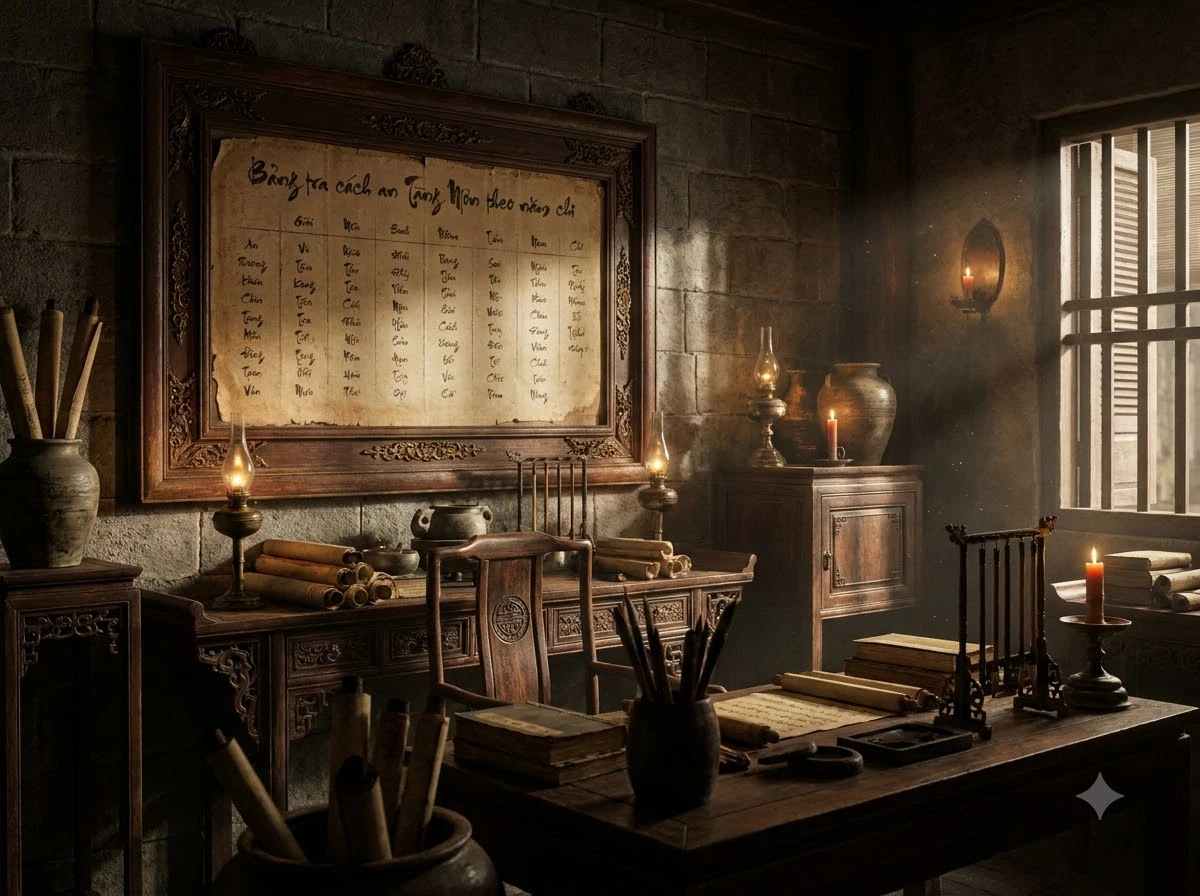
Palace location dictates timing and kinship. The Four Pillars represent four distinct life stages and family domains: the Year Pillar (ages 1 to 16) governs ancestral roots and early environment; the Month Pillar (ages 17 to 32) commands career foundation, parents, and siblings; the Day Pillar (ages 33 to 48) anchors the Day Master and Spouse Palace; and the Hour Pillar (age 49 onward) rules children, subordinates, and late-life legacy.
Locate the palace, pinpoint the era. When Mourning Door Star (喪門) appears in a specific pillar, its core energy of solemn transitional qi alerting the native to prioritize elder health, home safety, and emotional steadiness concentrates directly within that palace's kinship network and 16-year life window.
10 Three Forensic Four-Pillar Natal Chart Case Studies (Mourning Door Star)
Theory must be verified against living charts. Below are three forensic Four-Pillar archetypes from Master Ung Khiem's research archives demonstrating how Mourning Door Star (喪門) operates under different structural conditions:
Case Study 1: Mourning Door Star Aligned with the Favorable Useful God (Upper-Tier Fulfillment)
Forensic Diagnosis: Pure qi, unbroken circulation. Because Mourning Door Star (喪門) resides on a thriving Favorable Useful God pillar without clash or void, its constructive power across elder healthcare, family insurance/estate stewardship, medical professions, and home renovation timing propelled the native to executive eminence and enduring wealth during supportive Decade Luck.
Case Study 2: Transforming Pressure into Authority via Nobleman & Resource
Forensic Diagnosis: First tempered by challenge, then crowned with success. Anchored by the Resource seal and warmed by Hour-Pillar Bing Fire, the native harnessed Mourning Door Star to build deep professional credentials and a resilient marriage after age 34.
Case Study 3: Mourning Door Star Struck by Transit Clash & Classical Resolution Protocol
Forensic Remedy: Diagnose the clash early; deploy the bridge decisively. When an annual transit clashed the palace housing Mourning Door Star, the native avoided high-risk leverage, leaned on the Hour Pillar Officer-Resource bridge, and used Six-Harmony spatial alignment to preserve both capital and family harmony.
11 Decade Luck, 2026 to 2037 Annual Transits & Strategic Remediation
Static charts hold potential; dynamic luck cycles pull the trigger. When tracking Mourning Door Star (喪門) across the 12-year cycle from 2026 (Bing Wu) to 2037 (Ding Si), pay special attention to years whose Earthly Branch duplicates, combines with (Three/Six Harmony), or clashes the natal branch of Mourning Door Star:
🧭 Master Ung Khiem's Actionable Strategy for Mourning Door Star (Mourning Gate Star (Sang Men))
- When Mourning Door Star Is Favorable (Xi Yong Shen): Proactively launch core initiatives, academic certifications, or strategic partnerships during transit years that form a Three Harmony or Six Harmony with your Mourning Door Star branch.
- When Mourning Door Star Faces Clash or Hostile Qi: Apply the classical “Resolving Clash via Six Harmony & Virtue” protocol-strengthen cash-flow reserves, verify legal contracts thoroughly, and prioritize health and spousal empathy.
- Whole-Chart Verification: Always cross-check your Day Master strength, Seasonal Climate Useful God (Tiao Hou), and Structural Pattern before making major life decisions based on any single symbolic star.

This 61-part Bazi Symbolic Stars (BaZi Symbolic Stars (Shen Sha)) monograph series is compiled directly from San Ming Tong Hui, Yuan Hai Zi Ping, Zi Ping Zhen Quan, and Di Tian Sui, integrating rigorous Five-Element Useful God analysis with empirical chart consultations.
Plot your Four Pillars Bazi chart now12 Frequently Asked Questions About Mourning Door Star (Mourning Gate Star (Sang Men) · 喪門)
Core Bazi symbolic star. Grounded in classical canon. In Ziping Four Pillars metaphysics, Mourning Door Star (喪門, Sāng Mén, Vietnamese: Mourning Gate Star (Sang Men)) is a challenging sha star (requires restraint & transformation) representing solemn transitional qi alerting the native to prioritize elder health, home safety, and emotional steadiness, governing elder healthcare, family insurance/estate stewardship, medical professions, and home renovation timing.
Follow the stem-branch anchor. Check all four pillars. Classical treatises (San Ming Tong Hui and Yuan Hai Zi Ping) derive Mourning Door Star as follows: Located two branches ahead of the Year or Transit Tai Sui Branch (paired with Condolence Guest / Condolence Guest Star (Diao Ke) two branches behind). Once the target coordinate is identified, examine whether it appears in the Year, Month, Day, or Hour Pillar.
Never judge by a single star. Useful God decides everything. Even an auspicious star becomes muted if it sits on a Hostile Element (Ji Shen) or falls into Clash/Void, whereas a challenging Sha star transforms into formidable executive authority when aligned with the chart's Favorable Useful God (Xi Yong Shen) and restrained by Virtue stars.
Each palace rules a life era. Six-Kin meanings shift accordingly. In the Year Pillar (ages 1 to 16) it reflects ancestral heritage; in the Month Pillar (ages 17 to 32) it shapes career structure and social vocation; in the Day Pillar (ages 33 to 48) it directly influences core psychology and the Spouse Palace; in the Hour Pillar (age 49+) it governs children and late-life legacy.
Interactions reshape manifestation. Harmony stabilizes; Clash activates or scatters. When Mourning Door Star meets Three Harmonies, Six Harmonies, or Heavenly & Monthly Virtue, Relief God, and Auspicious Celebration ('Xung Hy'), its constructive qualities multiply; conversely, encountering White Tiger, Condolence Guest, and direct Natal/Transit Branch Clash requires Six-Harmony bridging or Heavenly/Monthly Virtue remediation.
Ten Gods provide the substance. Shen Sha provides the imagery. When Mourning Door Star shares a palace with Direct Officer or Direct Resource, it elevates institutional credibility and scholarship; with Wealth or Eating God, it fuels commercial affluence; with Seven Killings or Yang Blade, it demands disciplined governance.
Natal chart is the seed. Transit is the ignition. Whenever a 10-Year Decade Luck or Annual Transit pillar (from 2026 Bing Wu through 2037 Ding Si) duplicates, combines with, or clashes the branch housing Mourning Door Star, the life domains of elder healthcare, family insurance/estate stewardship, medical professions, and home renovation timing experience a decisive turning point.
Align with the Useful God. Cultivate behavioral discipline. Strengthen the natal Useful God through career vocation, spatial Feng Shui directions, and Nobleman alliances (Heavenly & Monthly Virtue, Relief God, and Auspicious Celebration ('Xung Hy')), while avoiding impulsive decisions during clashing transits.