Every chart in Purple Star Astrology, BaZi Four Pillars, Qi Men Dun Jia, and Date Selection is a function of astronomical time. A child born at 11:15 AM standard clock time in Ho Chi Minh City or Dien Bien is actually born in the Si Hour (09:00 to 11:00 True Solar Time), not the Wu Hour. This monograph details the mathematical astronomy of the Lunisolar Calendar, the 24 Solar Terms along the 360-degree ecliptic, the True Solar Time equation, and the 28 Lunar Mansions.
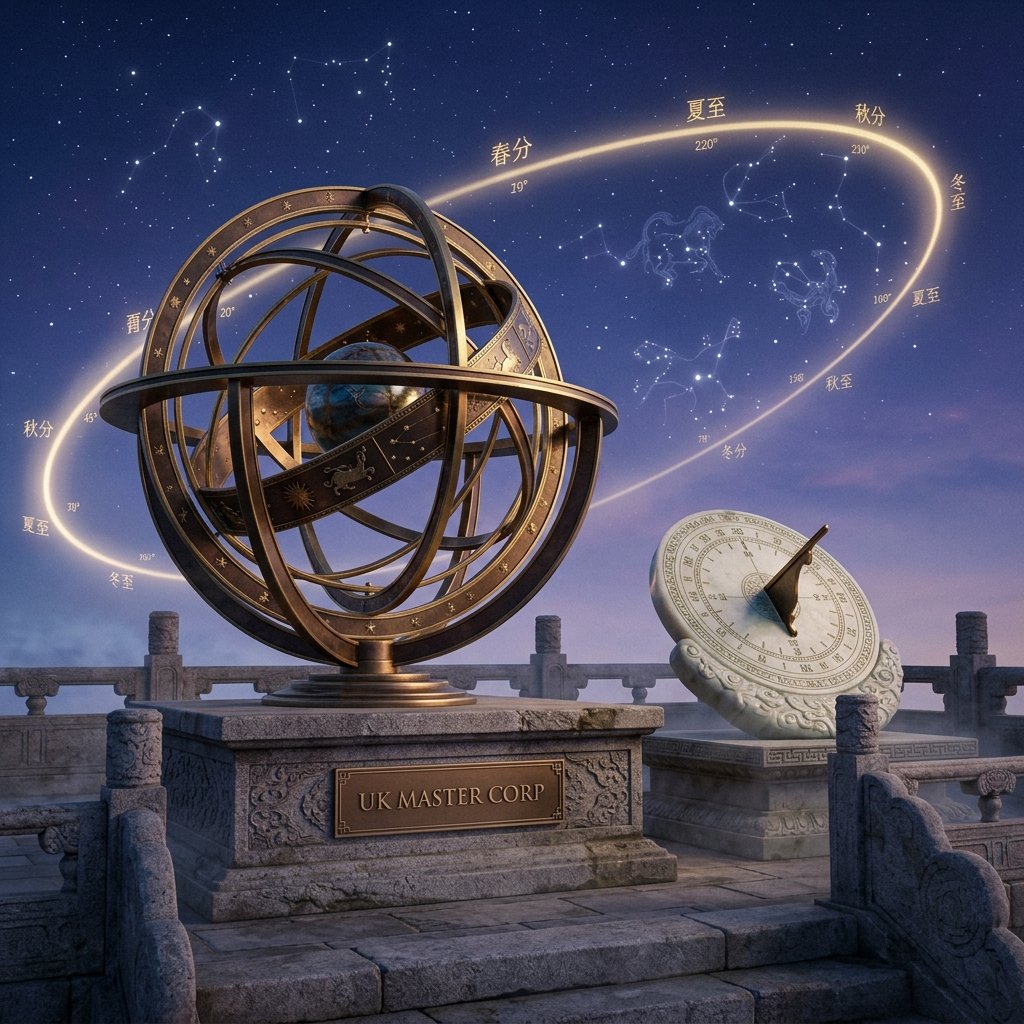
I. The Lunisolar Calendar: Why the 24 Solar Terms Are Purely Solar
Traditional Eastern calendars harmonize Lunar phases (new moon at Shuo, full moon at Wang, averaging 29.53059 days per synodic month) with the purely Solar 24 Terms (Jie Qi), which divide the Earth's 360-degree ecliptic orbit into 24 segments of 15 degrees each. The 12 odd-numbered nodes (Jie, starting with Li Chun at 315 degrees) govern month transitions in BaZi and Qi Men Dun Jia.
II. Mathematical Formula for True Solar Time (Apparent Solar Time)
Standard clock time uses a fixed timezone meridian (such as 105 degrees East for UTC+7). True Solar Time applies two astronomical corrections: (1) Longitude Offset = 4 minutes multiplied by (Birthplace Longitude minus Timezone Standard Longitude), and (2) Equation of Time (EoT), which accounts for Earth's orbital eccentricity and 23.44-degree axial tilt, ranging from minus 14m15s in mid-February to plus 16m25s in early November.
III. Early Zi Hour (00:00-01:00) vs. Late Zi Hour (23:00-24:00)
When a birth occurs between 23:00 and 23:59 True Solar Time, classical treaties distinguish Late Zi (keeping the current Day Pillar while advancing the Hour Pillar to the Zi hour of the next day's stem cycle) from full day rollover at 23:00. Cross-verifying both charts against past life events is mandatory.
IV. The Three Enclosures & Twenty-Eight Lunar Mansions (Er Shi Ba Xiu)
Ancient Chinese uranography organizes the sky into the Three Enclosures (Purple Forbidden, Supreme Palace, Heavenly Market) surrounded by 28 Lunar Mansions divided into four directional constellations of seven mansions each: Azure Dragon of the East, Black Tortoise of the North, White Tiger of the West, and Vermilion Bird of the South.
24 Solar Terms by Ecliptic Longitude, 12 Earthly Branch Months, and Longitude Offsets
| Earthly Branch Month | Jie (Month-Start Node) | Jie Ecliptic Longitude | Qi (Mid-Month Node) | Qi Ecliptic Longitude |
|---|---|---|---|---|
| Yin Month (Month 1) | Li Chun (Start of Spring / BaZi Year) | 315° Ecliptic | Yu Shui (Rain Water) | 330° Ecliptic |
| Mao Month (Month 2) | Jing Zhe (Awakening of Insects) | 345° Ecliptic | Chun Fen (Vernal Equinox) | 0° Ecliptic |
| Chen Month (Month 3) | Qing Ming (Pure Brightness) | 15° Ecliptic | Gu Yu (Grain Rain) | 30° Ecliptic |
| Si Month (Month 4) | Li Xia (Start of Summer) | 45° Ecliptic | Xiao Man (Grain Buds) | 60° Ecliptic |
| Wu Month (Month 5) | Mang Zhong (Grain in Ear) | 75° Ecliptic | Xia Zhi (Summer Solstice) | 90° Ecliptic |
| Wei Month (Month 6) | Xiao Shu (Minor Heat) | 105° Ecliptic | Da Shu (Major Heat) | 120° Ecliptic |
| Shen Month (Month 7) | Li Qiu (Start of Autumn) | 135° Ecliptic | Chu Shu (End of Heat) | 150° Ecliptic |
| You Month (Month 8) | Bai Lu (White Dew) | 165° Ecliptic | Qiu Fen (Autumnal Equinox) | 180° Ecliptic |
| Xu Month (Month 9) | Han Lu (Cold Dew) | 195° Ecliptic | Shuang Jiang (Frost Descent) | 210° Ecliptic |
| Hai Month (Month 10) | Li Dong (Start of Winter) | 225° Ecliptic | Xiao Xue (Minor Snow) | 240° Ecliptic |
| Zi Month (Month 11) | Da Xue (Major Snow) | 255° Ecliptic | Dong Zhi (Winter Solstice) | 270° Ecliptic |
| Chou Month (Month 12) | Xiao Han (Minor Cold) | 285° Ecliptic | Da Han (Major Cold) | 300° Ecliptic |
Frequently Asked Academic Questions (FAQ)
If someone is born after Lunar New Year's Day but before Li Chun (Start of Spring), which year animal applies?
In BaZi Four Pillars, Feng Shui (Eight Mansions and Flying Stars), and Qi Men Dun Jia, the new year begins strictly at the astronomical instant of Li Chun (315 degrees ecliptic longitude, around February 4). Traditional Purple Star Astrology uses Lunar New Year's Day, though births between the two dates should always be cross-checked.
Why must births in Saigon prior to 1975 often be adjusted by nearly one hour?
During periods before June 13, 1975, South Vietnam used the UTC+8 timezone (120 degrees East meridian). Because Saigon sits at 106.66 degrees East, standard clock time ran approximately 53 minutes ahead of local True Solar Time.
When is True Solar Time conversion most critical?
Whenever a birth occurs within 30 minutes of any odd-hour boundary (such as 10:40-11:30 or 22:40-23:30), longitude offset and the Equation of Time can shift the birth chart into the adjacent two-hour Earthly Branch.
UK MASTER ACADEMY Monograph Series
Explore the complete series of flagship academic monographs from the UK Master Academy curriculum: