Sexual physiology in Chinese medicine
Traditional Chinese medicine does not use concepts such as blood vessels or nerves as Western medicine does. Instead, sexual physiology is viewed through the movement of essence, qi, and blood among the organ systems. This is a distinct conceptual framework that does not translate directly into modern anatomy.
Updated November 14, 2026Compiled by UK MASTER ACADEMYFor readers aged 18 and over
- According to traditional Chinese medicine, the Kidney stores essence (jing) and governs reproductive function in both men and women.
- Tian gui is a refined substance from the Kidney that emerges at puberty and declines with age, described in classical texts through the seven-year cycle in women and the eight-year cycle in men.
- The Liver governs the free flow of qi to keep qi and blood circulating smoothly, and Heart and Kidney communicate to maintain balance between emotion and physiology.
- These concepts have not been validated by clinical trial standards and belong to a different system of thought from Western anatomy.
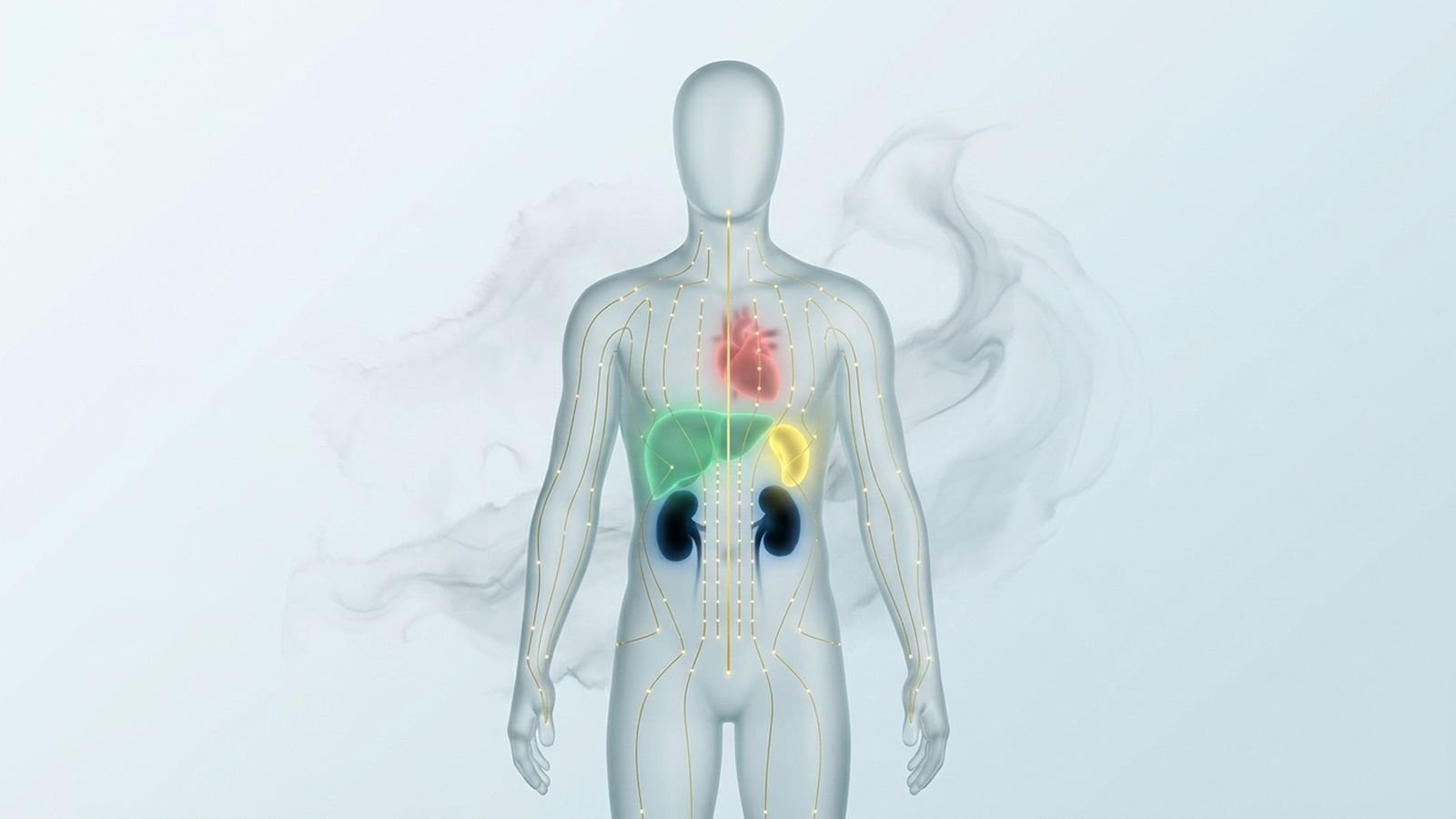
The Kidney stores essence and tian gui
In traditional Chinese medicine, the Kidney is regarded as the storehouse of innate essence (jing) and of essence acquired through food and drink throughout life. Kidney essence is the foundational substance for growth, reproduction, and vitality. When Kidney essence is sufficient, the body develops well, reproduction is normal, and endurance is good. When Kidney essence declines, all these functions diminish.
Tian gui is a refined substance derived from the Kidney, emerging when Kidney qi reaches adequate strength. According to classical texts, tian gui marks reproductive capacity: in women it relates to the onset of menstruation; in men it relates to the capacity for sperm production. As age increases and Kidney essence gradually declines, tian gui also diminishes and reproductive capacity decreases accordingly.
An important clarification: the Kidney in Chinese medicine is not the anatomical kidney. It is a functional concept encompassing the reproductive system, the endocrine system, and part of the nervous system in the traditional view. See also the the Kidney page in the Five Elements section.
The seven-year and eight-year cycles
Classical Chinese medicine texts contain passages describing human development and decline in cycles. Women follow a seven-year cycle; men follow an eight-year cycle. The following is a paraphrase of the classical content, not a direct quotation.
The seven-year cycle in women
As described in classical texts: by around age seven, Kidney qi begins to become sufficient. Around age fourteen, tian gui arrives, menstruation begins, and the body becomes capable of reproduction. Around age twenty-one, Kidney qi stabilizes and the body is fully developed. From around age thirty-five, Kidney qi begins to decline through each successive seven-year cycle, manifesting in changes to hair, skin, and reproductive function; around age forty-nine tian gui is exhausted and menstruation ceases.
The eight-year cycle in men
As described in classical texts: by around age eight, Kidney qi begins to become sufficient. Around age sixteen, tian gui arrives and the body becomes capable of producing sperm. Around age twenty-four, Kidney qi peaks and the body is fully developed. From around age forty, Kidney qi begins to decline through each successive eight-year cycle, manifesting in gradually decreasing strength, hair quality, and reproductive capacity.
This description reflects ancient observations about the physiological life cycle. However, these concepts have not been validated by clinical trial standards and should not be used for diagnosis or treatment.
The Liver governs the free flow of qi and its role in physiology
The Liver in Chinese medicine has the function of governing the free flow of qi, that is, regulating the smooth circulation of qi throughout the body. When the Liver's governing function is working normally, qi and blood circulate smoothly, emotions are stable, and physiology functions well. When Liver qi becomes stagnant due to stress or suppressed emotions, the smooth flow of qi and blood is obstructed.
The Liver also governs the sinews, meaning it manages tendons and ligaments throughout the body, including the muscles of the pelvic region. When Liver blood is sufficient, sinews are supple and flexible. When Liver blood is deficient, sinews lack nourishment and may become tight or weak.
In traditional clinical practice, Liver qi stagnation is often associated with reduced desire, tension along the rib area, and difficulty relaxing during sex. See also the Liver page in the Five Elements section.
Heart and Kidney communicate, and the Spleen generates blood
Heart and Kidney communicate is one of the central concepts in traditional Chinese medicine when discussing internal organ balance. In this view, the Heart belongs to the Fire element and the Kidney belongs to the Water element. When the two organ systems coordinate well, Heart fire does not flare excessively and Kidney yin is not deficient; the body is in a balanced state.
When Heart and Kidney lose their communication, Chinese medicine holds that a person may show signs of insomnia, vivid dreams, palpitations, fatigue, and reduced desire. This reflects the view that mental state and physiological function are closely linked. See also the Heart page in the Five Elements section.
The Spleen generates blood: the Spleen in Chinese medicine transforms food into blood and qi, supplying nourishment to the whole body. When the Spleen is deficient, blood is insufficient to nourish the other organ systems, including the Kidney and the Liver, leading to declining physiological function. See also the Spleen page in the Five Elements section.
This is the traditional Chinese medicine view and has not been validated by clinical trial standards. These organ-system concepts belong to a different system of thought and are not directly equivalent to modern anatomy or physiology.
How to use Chinese and Western medicine together
Chinese medicine and Western medicine view the body from two different frameworks. Many people use both, and this is not inherently contradictory. However, note the following:
- Inform both your Western medicine doctor and your Chinese medicine practitioner about every method you are using.
- Some herbal medicines interact with pharmaceutical drugs and need to be evaluated individually.
- When symptoms are serious or acute, see a Western medicine doctor first to rule out conditions requiring timely treatment.
See the article Comparing Chinese and Western medicine for a clearer picture of where the two systems meet and where they differ.
When to see a doctor
See the full list at the article When to see a doctor.
Questions and answers
Is the Kidney in Chinese medicine the same as the anatomical kidney?
No. The Kidney in Chinese medicine is a much broader concept, encompassing reproductive, endocrine, and neurological functions as understood in the traditional view. It is entirely different from the anatomical kidney in modern anatomy.
What is tian gui?
According to classical texts, tian gui is a refined substance that emerges when Kidney qi is sufficiently strong, marking the onset of reproductive capacity. In women tian gui arrives at around age 14; in men at around age 16. This concept has no direct equivalent in modern physiology.
What does Heart and Kidney communicate mean?
This concept describes the balance between the Heart and the Kidney organ systems. When Kidney yin is insufficient to nourish the Heart, Heart fire may flare upward, potentially causing insomnia, palpitations, and reduced desire. This is the traditional Chinese medicine view and has not been verified by clinical trials.
Can Chinese medicine and Western medicine be used together?
Patients should inform all their practitioners about every method they are using. Some herbal medicines interact with pharmaceutical drugs. The decision to use both approaches requires evaluation by a doctor.
Sources
- Wang F, Colonnello E, Zhang H, et al. Comparing Western and traditional Chinese medicine for male sexual dysfunction: can Klotho represent a silk road? Andrology. 2024;12(6):1215-1223. PubMed 38155398
- World Health Organization. WHO Traditional Medicine Strategy 2014-2023. Source page
- Basson R. Human sexual response. Handbook of Clinical Neurology. 2015;130:11-18. PubMed 26003236
This page is general health information compiled from international medical sources. It has not been reviewed by a physician and is not a diagnosis or a treatment instruction. The content is for readers aged 18 and over. If symptoms persist, please see a doctor.