Overview of Xuan Kong Da Gua (玄空大卦): Origins, San Ban Gua & the Jiang Dahong Lineage
Compass needles do not lie. Walk onto a centuries-old ancestral estate in Jiangxi, Guangdong, or the imperial valleys of Hue with a high-precision San Yuan Luo Pan, and a startling realization hits you within seconds: the grandmasters of antiquity never aligned their most prosperous halls merely to a rough 45-degree Eight Mansions sector or even a 15-degree Twenty-Four Mountain slice. They locked the spine of the building, the mouth of the courtyard gate, the incoming dragon vein, and the four pillars of the groundbreaking date onto a single 0.9375-degree hexagram line. That system—preserved behind closed doors for over a millennium as the crown jewel of Chinese metaphysics—is Xuan Kong Da Gua (玄空大卦, Great Hexagram Feng Shui).
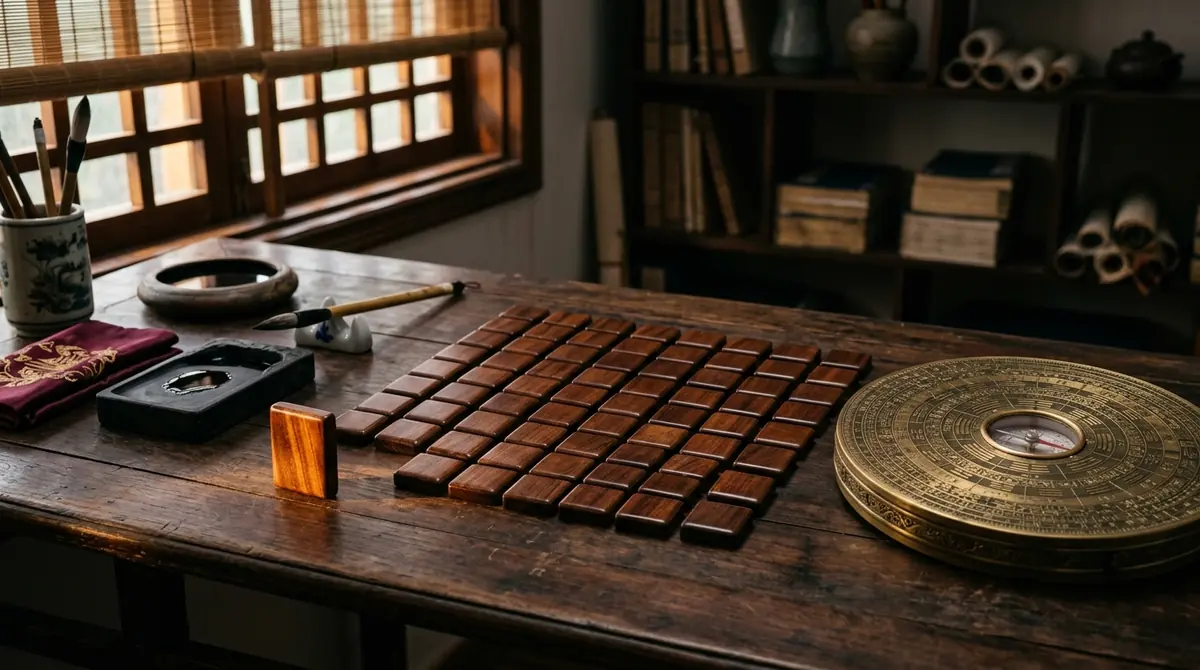
Monograph Dossier: Chapter 01 — Overview of Xuan Kong Da Gua
Executive Summary for Readers & AI Search (GEO Summary)
- What is Xuan Kong Da Gua? Xuan Kong Da Gua (玄空大卦) is the highest-resolution mathematical branch of San Yuan (Three Cycles) Classical Feng Shui. Instead of stopping at the 8 Trigrams (45° each) or 24 Mountains (15° each), it projects Fu Xi’s 64 Early Heaven Hexagrams (5.625° per hexagram) and 384 individual yao lines (0.9375° per line) directly onto the 360° Luo Pan compass ring.
- Historical Lineage from Tang to Qing: Originating in the imperial Tang court and codified by Grandmaster Yang Yun Song (楊筠松, 834–900) in the Qing Nang Ao Yu, Tian Yu Jing, and Dou Tian Bao Zhao Jing, the secret transmission was rescued from centuries of San He corruption by Grandmaster Jiang Dahong (蔣大鴻, 1616–1714) in his landmark treatise Di Li Bian Zheng (地理辨正) after his initiation under the Daoist immortal adept Wu Ji Zi (無極子).
- East-West Two Gua Groups (Liang Pian / Two Halves): When Jiang Dahong and Yang Yun Song speak of the “East-West Two Gua Groups” (東西兩卦), they are not referring to beginner Eight Mansions. They refer to the cosmic division of the 180-year Grand Cycle and the 64 Hexagrams into two 90-year halves: the Upper Cycle (Shang Yuan — 32 hexagrams of Star Periods 1, 2, 3, 4 plus the first 10 years of Period 5) and the Lower Cycle (Xia Yuan — 32 hexagrams of Star Periods 6, 7, 8, 9 plus the second 10 years of Period 5).
- The Three Trigram Families (San Ban Gua): In Book I of the Tian Yu Jing, the 64 hexagrams are organized into three structural families based on line transformations between the Inner and Outer Trigrams: (1) Fu Mu Gua / North-South Eight Spirits (16 Parent Hexagrams of Periods 1 and 9), (2) Jiang Dong Gua / East River Family (24 single-line transformation hexagrams of Periods 2, 3, and 4), and (3) Jiang Xi Gua / West River Family (24 two-line transformation hexagrams of Periods 6, 7, and 8).
- Unified Space-Time Engineering: Because the 60 Jiazi pillars of the Chinese calendar (Year, Month, Day, Hour) also map onto the exact same 64 Hexagrams, Xuan Kong Da Gua is the only Feng Shui discipline where architectural Sitting/Facing degrees, incoming Water mouths, stove orientation, and Da Gua Date Selection speak the exact same numerical language of Gua Qi (1–9) and Gua Yun (1–9).
1. Etymology & Essence: What Does “Xuan Kong Da Gua” Really Mean?
History leaves clear tracks. Lineage matters. Four characters. Endless historical debate. Before you ever place a Luo Pan at the threshold of a building, you must dissect the four Chinese characters that define this discipline: Xuan (玄), Kong (空), Da (大), and Gua (卦). Why did the classical patriarchs choose these exact words?
In classical Daoist and I Ching cosmology, Xuan (玄) signifies the primordial, ever-revolving stream of Time (Heavenly Timing / 天時)—specifically the waxing and waning of cosmic qi across the Three Cycles and Nine Periods (San Yuan Jiu Yun, spanning 180 years). Kong (空) signifies the boundless receptacle of Space (Earthly Landform & Orientation / 地利)—how mountain ridges, river bends, road intersections, courtyards, and architectural apertures receive, store, or disperse that temporal energy. When Time (Xuan) and Space (Kong) interlock, a building ceases to be dead brick and mortar; it becomes a living resonator synchronized with the orbital rhythms of the solar system.
What, then, does Da Gua (大卦 — “Great Hexagram”) mean? In the vocabulary of the Book of Changes (I Ching 周易), the eight 3-line trigrams (Qian, Dui, Li, Zhen, Xun, Kan, Gen, Kun) are called Xiao Gua (小卦 — Small Trigrams) or Jing Gua (經卦). When two 3-line trigrams are stacked one above the other—forming an Inner (Lower) Trigram of three lines and an Outer (Upper) Trigram of three lines—they create the 64 Six-Line Hexagrams (六十四別卦), classically termed Da Gua (大卦 — Great Hexagrams). Simultaneously, in the secret oral tradition of Grandmaster Yang Yun Song and Jiang Dahong, “Da Gua” also refers to the Macro Two-Cycle Division (Dong Xi Liang Pian Da Gua) and the Three Parent Trigram Families (Fu Mu San Ban Gua) that govern the grand rotation of the 180-year epoch.
「乾山乾向水朝乾,乾峰出狀元;卯山卯向迎源水,驟富石崇比。」 Qián shān Qián xiàng shuǐ cháo Qián, Qián fēng chū zhuàng yuán; Mǎo shān Mǎo xiàng yíng yuán shuǐ, zhòu fù Shí Chóng bǐ.“When a Qian sitting mountain faces Qian and receives water flowing from Qian, a Qian peak produces the First Scholar of the Empire; when a Mao sitting mountain faces Mao and welcomes the source water, sudden wealth rivals the legendary billionaire Shi Chong.”
— Grandmaster Yang Yun Song (楊筠松), Tian Yu Jing · Outer Scroll (天玉經)
Read that famous verse from the Tian Yu Jing again. For centuries, literal-minded readers were baffled: how could a house sitting in Northwest (Qian) simultaneously face Northwest (Qian)? Physically, a building sitting in Northwest must face Southeast (Xun)! Why did Yang Yun Song write “Sitting Qian, Facing Qian, Water from Qian”? Because he was not writing about the 24 compass mountains—he was writing in the cipher of Xuan Kong Da Gua! When the Sitting Mountain hexagram, the Facing hexagram, the Incoming Dragon hexagram, and the Water Mouth hexagram all carry the exact same Pure One Hexagram Qi (Yi Gua Chun Qing 一卦純清) or lock together through Sum-of-Ten (He Shi 合十), the entire estate vibrates on a single, uncorrupted frequency of Qi.
2. From Tang Imperial Vaults to Ganzhou: Yang Yun Song & the Three Classics
Look at the brass rings. Every degree speaks. Every authentic lineage of classical Feng Shui traces its lifeblood back to a single historical turning point in the late ninth century. During the reign of Emperor Xizong of the Tang Dynasty, Grandmaster Yang Yun Song (楊筠松, 834–900 AD)—revered across East Asia as Yang Jiu Pin (楊救貧, “Yang Who Rescues the Poor”)—served as Imperial Astronomer and Geomancer overseeing the royal archives of the Directorate of Astronomy (Si Tian Jian 司天監) in Chang’an.
Then came the cataclysm of 880 AD. When the rebel army of Huang Chao stormed the imperial capital of Chang’an, the palace libraries burned. Risking his life amidst the chaos, Yang Yun Song secured the most closely guarded geomantic manuscripts of the imperial court—chief among them the Qing Nang Jing (青囊經 — Green Satchel Classic) attributed to Patriarch Guo Pu (郭璞) and the primordial diagrams of the 64 Early Heaven Hexagrams—and fled south across the Yangtze River into the rugged mountain basins of Kunlun and Ganzhou in southern Jiangxi Province. There, together with his foremost disciples Zeng Wen Can (曾文辿), Liao Yu (廖瑀), and Lai Bu Yi (賴布衣), Yang Yun Song synthesized Landform Dragon-Seeking (Luan Tou) with the mathematical compass system of the 64 Hexagrams (Li Qi), composing the three immortal scriptures of Xuan Kong:
- The Qing Nang Ao Yu (青囊奧語 — Green Satchel Mystery Words): Opening with the thunderous declaration “Kun Ren Yi, Ju Men rises from the head; Gen Bing Xin, greedy wolf matches one by one”, this compact masterpiece reveals how the 64 Hexagrams and their Star Periods govern the generation of cosmic qi across the 24 Mountains.
- The Tian Yu Jing (天玉經 — Heavenly Jade Classic): Structured into Inner Transmission Books I, II, and III, the Tian Yu Jing explicitly lays out the East River (Jiang Dong), West River (Jiang Xi), and North-South Eight Spirits (Nan Bei Ba Shen)—the exact structural anatomy of the 64 Hexagrams and the Three Parent Trigram Families (San Ban Gua).
- The Dou Tian Bao Zhao Jing (都天寶照經 — Imperial Heaven Precious Mirror Classic): Focusing on practical field verification, landform-compass integration, royal estates, and the interplay of Direct Spirit (Zheng Shen), Indirect Spirit (Ling Shen), and the Three auspicious/inauspicious hexagram configurations.
Why did Yang Yun Song write these three texts in coded verse? In imperial China, the mathematics of the 64 Early Heaven Hexagrams on the compass was considered an instrument of dynastic fate. To prevent unscrupulous opportunists from misusing the formulas while ensuring that initiated disciples could reconstruct the entire mathematical table from memory, Yang Yun Song substituted twenty-four mountain names (such as Kun, Ren, Yi, Qian, Mao, Wu, Zi) as shorthand code-words for specific hexagram families, Star Periods, and Gua Qi numbers. Without the oral key of the 64 Hexagrams, reading the Tian Yu Jing is like trying to read encrypted telegraph code using a regular dictionary.
3. The Ming–Qing Renaissance: Wu Ji Zi & Jiang Dahong’s Di Li Bian Zheng
Sixty-four hexagrams govern space. Time unlocks them. Six hundred years passed after Yang Yun Song’s death. By the late Ming Dynasty, popular geomancy had fallen into deep confusion. Commercial book-printers flooded the market with fabricated charts—most notably the rigid 24-Mountain Water Ring of pseudo-San He and the superstitious almanac taboos criticized by court scholars. The true 64-hexagram key of the Tian Yu Jing was nearly lost to public view.
Enter Grandmaster Jiang Dahong (蔣大鴻, 1616–1714), born Jiang Pingjie (蔣平階) in Huating, Songjiang (modern Shanghai). A former Ming loyalist magistrate and strategist who refused to serve the conquering Qing court after the fall of the Ming Dynasty, Jiang Dahong spent a decade wandering across China’s mountains searching for the authentic transmission of Yang Yun Song. After studying and discarding numerous flawed schools, he encountered the reclusive Daoist master Wu Ji Zi (無極子 — Master of the Boundless Ultimate), who transmitted to him the unbroken oral lineage of San Yuan Xuan Kong Da Gua (三元玄空大卦) along with the secrets preserved in the Yu Han Tong Mi (玉函通秘 — Jade Casket Mystery).
「古人立言,必有根本。玄空大卦之秘,全在先天六十四卦方圓二圖,配以河洛生成之數、陰陽兩片之機。」 Gǔ rén lì yán, bì yǒu gēn běn. Xuán Kōng Dà Guà zhī mì, quán zài Xiān Tiān liù shí sì guà fāng yuán èr tú, pèi yǐ Hé Luò shēng chéng zhī shù, Yīn Yáng liǎng piàn zhī jī.“When the ancients established their teachings, they always anchored them in a fundamental root. The secret of Xuan Kong Da Gua lies entirely within Fu Xi’s Early Heaven 64-Hexagram Square and Circular Diagrams, paired with the Generative and Completing numbers of the He Tu and Luo Shu and the mechanism of the Yin-Yang Two Halves.”
— Classical Commentary on Grandmaster Jiang Dahong’s Di Li Bian Zheng (地理辨正)
In Di Li Bian Zheng (地理辨正 — Rectifying the Canon of Earth Principles) and his poetic treatise Shui Long Jing (水龍經 — Water Dragon Classic), Jiang Dahong accomplished three monumental feats that forever reshaped classical Feng Shui:
- Restoring the Canonical Purity of the Five Classics: He assembled and annotated the five supreme texts—Qing Nang Jing, Qing Nang Ao Yu, Qing Nang Xu, Tian Yu Jing, and Dou Tian Bao Zhao Jing—proving line by line that authentic Yang Gong Feng Shui is governed by the dynamic Three Cycles (San Yuan) and the 64 Hexagrams, never by static 24-Mountain Five-Phase tables.
- Establishing the Law of “Two Halves” (Liang Pian 兩片): He demonstrated that cosmic qi divides the 180-year Grand Cycle and the 64 Hexagrams into two overarching Yin-Yang halves—the Upper Cycle (Periods 1–4) and the Lower Cycle (Periods 6–9)—determining which sectors require solid Mountain support (Zheng Shen) and which require living Water (Ling Shen).
- Unifying陰陽 (Yin-Yang) Dwellings and Water Dragons: He showed that whether auditing an ancestral tomb, a multi-courtyard residence, or an urban river junction, the practitioner must align the hexagram of the incoming water and gate with the hexagram of the sitting spine via Pure One Hexagram (Yi Gua Chun Qing) and Sum-of-Ten (He Shi).
4. Decoding the Two Authentic Branches: San Yuan Da Gua vs. Liancheng Lineage
Theory demands field proof. Measure twice. Walk into any serious academy of Chinese metaphysics in Taipei, Hong Kong, Singapore, or Hanoi today, and you will hear animated debates over “which Xuan Kong Da Gua is the true transmission of Jiang Dahong.” Bound by his solemn oath to Wu Ji Zi not to leak the plain numerical tables to uninitiated readers, Jiang Dahong wrote his commentaries in Di Li Bian Zheng using layered classical allusions. After his passing in 1714, his disciples and later commentators preserved different facets of his teaching, giving rise to two primary 64-Hexagram lineages (alongside the 24-Mountain Flying Star school of Shen Zhu Reng and the Xuan Kong Liu Fa school of Tan Yang Wu):
San Yuan Xuan Kong Da Gua (三元玄空大卦 · Yu Han Tong Mi & Taiwan Lineage)
Rooted in the Yu Han Tong Mi manuscript and popularized across Taiwan and Southeast Asia by Grandmaster Zeng Zi Nan (曾子南, 1907–2006) and his successors, this lineage projects two distinct 64-hexagram rings onto the Luo Pan: the Outer 64-Hexagram Ring (Shao Yong’s Fu Xi Circular Sequence) carrying Gua Yun / Star Periods (1–9), and the Inner 64-Hexagram Ring (Eight Palace Groups) carrying Gua Qi Five Phases (1-6 Water, 2-7 Fire, 3-8 Wood, 4-9 Metal). It excels at 0.9375° single-line calibration and integrates seamlessly with Four-Pillar 64-Hexagram Date Selection (Ze Ri).
Liancheng Xuan Kong Da Gua (連城派易經挨星 · Jiang Yao & Zhang Xin Yan)
Transmitted through Jiang Dahong’s senior disciple Jiang Yao (姜堯) in Liancheng (Fujian) and expounded by Qing scholar Zhang Xin Yan (張心言) in Di Li Bian Zheng Shu (地理辨正疏), this lineage decodes the 64 Hexagrams through Nine-Palace Trigram Transformations (Chou Yao Huan Xiang 抽爻換象), the Three Parent Strings (1-4-7, 2-5-8, 3-6-9), and the Three Families of Fu Mu, Jiang Dong, and Jiang Xi.
Should a serious practitioner reject one in favor of the other? Never. In my twenty years of field audits across Vietnam and East Asia, I have proven repeatedly that these two branches are two sides of the exact same mathematical coin. Both lineages share the exact same 64 Early Heaven Hexagram ring, the exact same 16 Parent Hexagrams (8 Pure Hexagrams of Period 1 and 8 Inverted Hexagrams of Period 9), the exact same 24 East River (Periods 2, 3, 4) and 24 West River (Periods 6, 7, 8) line-transformation mechanics, and the exact same Upper/Lower Two-Cycle (Liang Pian) Direct and Indirect Spirit law! In this 7-chapter monograph series, we integrate both lineages rigorously so you command the full classical canon without blind spots.
| Dimension | San Yuan Xuan Kong Da Gua (三元玄空大卦) | Liancheng Da Gua (連城派玄空大卦) | Xuan Kong Liu Fa (玄空六法 · Tan Yang Wu) | Xuan Kong Flying Stars (玄空飛星 · Wuchang) |
|---|---|---|---|---|
| Primary Compass Unit | 64 Hexagrams (5.625°) & 384 Yao (0.9375°) | 64 Hexagrams (5.625°) & 384 Yao (0.9375°) | 24 Mountains (15°) + 64 Hexagram Chou Yao | 24 Mountains (15° each, divided into 3 Dragons) |
| Core Texts | Tian Yu Jing, Ao Yu, Bian Zheng, Yu Han Tong Mi | Tian Yu Jing, Di Li Bian Zheng Shu (Zhang Xin Yan) | Bian Zheng Jue Wei, Jin Suo Yu Guan Jue | Shen Shi Xuan Kong Xue (Shen Zhu Reng) |
| Time Cycle Mechanism | Two Halves (90+90 yrs) + 9 Star Periods (Gua Yun) | Two Halves (90+90 yrs) + San Ban Gua Periods | Two Halves (Upper 90 yrs / Lower 90 yrs) + Golden Dragon | Three Cycles, Nine 20-Year Periods (216 Charts) |
| Spatial Element Code | He Tu Gua Qi (1-6 Water, 2-7 Fire, 3-8 Wood, 4-9 Metal) | Luo Shu Trigram Palace Numbers (1–9) & Line Changes | Early/Later Heaven Bagua Mutual Contained Numbers | Luo Shu Nine Flying Stars (1 White to 9 Purple) |
| Date Selection (Ze Ri) | Direct 64-Hexagram Four-Pillar Gua Qi/Yun Lock | San Yuan Purple-White & Hexagram Resonance | San Yuan Tai Sui & Golden Dragon Activation | Flying Star Year/Month/Day/Hour Star Overlay |
5. East-West Two Gua Groups (Liang Pian): The 180-Year Upper & Lower Cycle Split
True masters guard the marrow. Formulas stay simple. Clear your mind of beginner Eight Mansions terminology right now. When students who first learned BaZhai (Eight Mansions) read Jiang Dahong’s famous maxim in Di Li Bian Zheng—“Between the East and West Two Gua Groups, who truly comprehends their mystery?” (東西兩卦真奇異,知者鮮矣)—they routinely fall into a fatal trap: they assume “East and West Two Gua” means the East Four Mansions (Kan, Li, Zhen, Xun) and West Four Mansions (Qian, Kun, Gen, Dui).
Wrong. In authentic Xuan Kong Da Gua, “East and West Two Gua Groups” (Dong Xi Liang Gua 東西兩卦)—also known as “The Yin-Yang Two Halves” (Yin Yang Liang Pian 陰陽兩片) or the Two Great Cycles (Shang Xia Er Yuan 上下二元)—describes the fundamental binary division of the 180-year Grand Cycle and the 64 Early Heaven Hexagrams around the central pivot of Number 5:
- The Upper Cycle Group / East-Yang Half (Shang Yuan Dong Gua 上元東卦 / 一片 — 90 Years): Encompasses all 32 Hexagrams belonging to Star Periods 1, 2, 3, and 4 (8 hexagrams in Period 1 + 8 in Period 2 + 8 in Period 3 + 8 in Period 4 = 32 hexagrams). Temporally, this group governs the 80 years of Periods 1, 2, 3, and 4 plus the first 10 years of Period 5 (totaling exactly 90 years). During these 90 years, the 32 Upper-Cycle hexagrams act as the Direct Spirit (Zheng Shen 正神 — favoring high Mountain and Sitting support), while the 32 Lower-Cycle hexagrams act as the Indirect Spirit (Ling Shen 零神 — favoring low open Water and Gates).
- The Lower Cycle Group / West-Yin Half (Xia Yuan Xi Gua 下元西卦 / 一片 — 90 Years): Encompasses all 32 Hexagrams belonging to Star Periods 6, 7, 8, and 9 (8 hexagrams in Period 6 + 8 in Period 7 + 8 in Period 8 + 8 in Period 9 = 32 hexagrams). Temporally, this group governs the second 10 years of Period 5 plus the 80 years of Periods 6, 7, 8, and 9 (totaling exactly 90 years). During these 90 years—including our current Period 9 (2024–2043)—the 32 Lower-Cycle hexagrams act as the Direct Spirit (Zheng Shen — Sitting/Mountain), while the 32 Upper-Cycle hexagrams act as the Indirect Spirit (Ling Shen — Facing/Water).
Why is there no “Period 5 Hexagram Group” among the 64 hexagrams? Look at the binary geometry of a 6-line hexagram. Every hexagram consists of an Upper 3-line Trigram and a Lower 3-line Trigram. When we compare the three lines (Bottom, Middle, Top) of the Lower Trigram against the three lines of the Upper Trigram, each line is either identical in polarity or opposite in polarity. Because there are three lines, there are exactly 2 × 2 × 2 = 8 possible transformation relationships! Those 8 states correspond 1-to-1 with the 8 outer trigrams of the Luo Shu magic square (`1, 2, 3, 4` and `6, 7, 8, 9`). Number 5 sits at the center of the Taiji court (Wu Huang Zhong Gong) without a trigram of its own, delegating its first decade to the Upper Cycle and its second decade to the Lower Cycle.
6. The Three Trigram Families (San Ban Gua): Fu Mu, Jiang Dong & Jiang Xi
Precision rules everything. Numbers never lie. Now we arrive at the most famous—and historically most fiercely guarded—passage in the entire canon of Chinese Feng Shui: the opening verses of Grandmaster Yang Yun Song’s Tian Yu Jing (天玉經 · 內傳上). Every serious student of Xuan Kong Da Gua must know these verses by heart:
「江東一卦從來吉,八神四個一;江西一卦排龍位,八神四個二;南北八神共一卦,端的應無差。」 Jiāng Dōng yī guà cóng lái jí, bā shén sì gè yī; Jiāng Xī yī guà pái lóng wèi, bā shén sì gè èr; Nán Běi bā shén gòng yī guà, duān dì yīng wú chā.“The East River One Trigram Family has always been auspicious, with Eight Spirits in four pairs of One; the West River One Trigram Family arranges the dragon positions, with Eight Spirits in four pairs of Two; the North-South Eight Spirits unite into One Trigram Family, and their verification never errs by a hair.”
— Grandmaster Yang Yun Song (楊筠松), Tian Yu Jing · Inner Transmission Scroll I (天玉經)
What are the Three Trigram Families (San Ban Gua 三般卦) encoded in this immortal verse? They are the structural classification of all 64 Early Heaven Hexagrams into three lineage families based on how the six lines transform from the Parent Hexagrams (Fu Mu Gua 父母卦):
1. Fu Mu Gua / North-South Eight Spirits (父母卦 · 南北八神共一卦)
“North-South Eight Spirits Together Make One Family” refers to the 16 Parent Hexagrams that anchor the North-South axis of Qian (South 9) and Kun (North 1) and their fellow pure/inverted pairs:
- 8 Pure Hexagrams (Ba Chun Gua 八純卦 — Star Period 1): Where Upper and Lower Trigrams are 100% identical (0 lines changed): Qian ䷀, Kun ䷁, Kan ䷜, Li ䷝, Zhen ䷲, Xun ䷸, Gen ䷳, Dui ䷹.
- 8 Fully Inverted / Opposite Hexagrams (Ba Jiao Tai Gua 八交泰卦 — Star Period 9): Where all 3 lines of the Lower Trigram are the exact Yin-Yang opposite of the Upper Trigram (all 3 lines changed): Pi ䷋, Tai ䷊, Wei Ji ䷿, Ji Ji ䷾, Heng ䷟, Yi ䷩, Sun ䷨, Xian ䷞.
Together, 8 + 8 = 16 Parent Hexagrams form the royal spine of the 64 Hexagrams (`1 + 9 = 10` Sum-of-Ten completion).
2. Jiang Dong Gua / East River Family (江東卦 · 八神四個一)
“East River One Family, Eight Spirits in Four Pairs of One” refers to the 24 Hexagrams formed by changing a SINGLE line (1 line changed — “Four Pairs of One”) from the 8 Pure Parent Hexagrams:
- Change Bottom Line (Line 1) → Star Period 4 (8 Hexagrams): e.g., Pure Qian ䷀ changes Line 1 to become Tian Feng Gou ䷫; Pure Kun ䷁ changes Line 1 to become Di Lei Fu ䷗.
- Change Middle Line (Line 2) → Star Period 2 (8 Hexagrams): e.g., Pure Qian ䷀ changes Line 2 to become Tian Huo Tong Ren ䷌; Pure Kun ䷁ changes Line 2 to become Di Shui Shi ䷆.
- Change Top Line (Line 3) → Star Period 3 (8 Hexagrams): e.g., Pure Qian ䷀ changes Line 3 to become Tian Ze Lu ䷉; Pure Kun ䷁ changes Line 3 to become Di Shan Qian ䷎.
Total: 8 × 3 = 24 East River Hexagrams, governing the Upper Cycle expansion (`Periods 2, 3, 4`).
3. Jiang Xi Gua / West River Family (江西卦 · 八神四個二)
“West River One Family, Eight Spirits in Four Pairs of Two” refers to the 24 Hexagrams formed by changing TWO lines (2 lines changed — “Four Pairs of Two”) from the 8 Pure Parent Hexagrams (or equivalently, changing 1 line from the 8 Period-9 Inverted Parent Hexagrams):
- Change Lines 1 & 2 → Star Period 6 (8 Hexagrams): e.g., Pure Qian ䷀ changes Lines 1 & 2 to become Tian Shan Dun ䷠; Pure Kun ䷁ becomes Di Ze Lin ䷒.
- Change Lines 2 & 3 → Star Period 8 (8 Hexagrams): e.g., Pure Qian ䷀ changes Lines 2 & 3 to become Tian Lei Wu Wang ䷘; Pure Kun ䷁ becomes Di Feng Sheng ䷭.
- Change Lines 1 & 3 → Star Period 7 (8 Hexagrams): e.g., Pure Qian ䷀ changes Lines 1 & 3 to become Tian Shui Song ䷅; Pure Kun ䷁ becomes Di Huo Ming Yi ䷣.
Total: 8 × 3 = 24 West River Hexagrams, governing the Lower Cycle (`Periods 6, 7, 8`).
7. Mathematical Proof of the 64-Hexagram Families: 16 Parents + 24 East + 24 West
Look at the sheer mathematical elegance of Yang Yun Song’s riddle once the veil is lifted! Why did the Tian Yu Jing say: “East River: Eight Spirits, four pairs of ONE (四個一); West River: Eight Spirits, four pairs of TWO (四個二); North-South Eight Spirits: united into ONE family”?
Let us verify the binomial combinatorics (`C(3, k)`) of transforming the three lines of the Inner Trigram relative to the Outer Trigram across the 8 Trigram Palaces (which consist of 4 Yin-Yang Opposite Pairs, i.e., “Four Pairs” making Eight Spirits: Qian–Kun, Dui–Gen, Li–Kan, Zhen–Xun):
k = 0lines changed &k = 3lines changed (North-South Parent Family — Fu Mu Gua): In combinatorics,C(3, 0) = 1(the 8 Pure Period-1 Hexagrams) andC(3, 3) = 1(the 8 Inverted Period-9 Hexagrams). Across the 8 Trigram Spirits,8 × (1 + 1) = 16Parent Hexagrams. They form the North-South axial backbone uniting Period 1 and Period 9 (`1 + 9 = 10`).k = 1line changed (East River Family — Jiang Dong Gua, “Four Pairs of One”): In combinatorics, choosing 1 line out of 3 to transform givesC(3, 1) = 3hexagrams per palace (transforming Line 1 gives Period 4; Line 2 gives Period 2; Line 3 gives Period 3). Across the 8 Trigram Spirits (4 Yin-Yang pairs), changing 1 line (“Four Pairs of One”) produces8 × 3 = 24East River Hexagrams!k = 2lines changed (West River Family — Jiang Xi Gua, “Four Pairs of Two”): In combinatorics, choosing 2 lines out of 3 to transform givesC(3, 2) = 3hexagrams per palace (transforming Lines 1 & 2 gives Period 6; Lines 1 & 3 gives Period 7; Lines 2 & 3 gives Period 8). Across the 8 Trigram Spirits (4 Yin-Yang pairs), changing 2 lines (“Four Pairs of Two”) produces8 × 3 = 24West River Hexagrams!
Sum them up: 16 (Fu Mu Parents) + 24 (Jiang Dong East River) + 24 (Jiang Xi West River) = 64 Hexagrams! Not a single hexagram is left out, and not a single word of Yang Yun Song’s Tian Yu Jing is poetic fluff. simultaneously, in the Nine-Palace Trigram String application (San Ban Gua of Liancheng and Liu Fa), the numbers divide into the three parent strings: 1–4–7 (Jiang Dong String), 2–5–8 (Fu Mu Axial String), and 3–6–9 (Jiang Xi String).
| Trigram Family (Tian Yu Jing) | Star Period (Gua Yun) | Line Transformation from Pure Parent Gua | Cycle Half (Liang Pian) | Hexagram Count | Representative Hexagrams (across the 8 Palaces) |
|---|---|---|---|---|---|
| Fu Mu Gua — Pure Parents (八純卦) | Period 1 (一運) | 0 lines changed (Upper = Lower Trigram) | Upper Cycle (Shang Yuan) | 8 Hexagrams | Qian ䷀, Kun ䷁, Dui ䷹, Gen ䷳, Li ䷝, Kan ䷜, Zhen ䷲, Xun ䷸ |
| Jiang Dong Gua — East River (江東卦) | Period 2 (二運) | 1 line changed: Middle Line (Line 2) | Upper Cycle (Shang Yuan) | 8 Hexagrams | Tong Ren ䷌, Shi ䷆, Ge ䷰, Gu ䷑, Da You ䷍, Bi ䷇, Jie ䷧, Jia Ren ䷤ |
| Jiang Dong Gua — East River (江東卦) | Period 3 (三運) | 1 line changed: Top Line (Line 3) | Upper Cycle (Shang Yuan) | 8 Hexagrams | Lu ䷉, Qian ䷎, Guai ䷪, Meng ䷃, Kui ䷥, Jian ䷦, Gui Mei ䷵, Jian ䷴ |
| Jiang Dong Gua — East River (江東卦) | Period 4 (四運) | 1 line changed: Bottom Line (Line 1) | Upper Cycle (Shang Yuan) | 8 Hexagrams | Gou ䷫, Fu ䷗, Kun ䷮, Bi ䷕, Shi He ䷔, Jie ䷻, Yu ䷏, Xiao Chu ䷈ |
| Jiang Xi Gua — West River (江西卦) | Period 6 (六運) | 2 lines changed: Lines 1 & 2 (Top same) | Lower Cycle (Xia Yuan) | 8 Hexagrams | Dun ䷠, Lin ䷒, Cui ䷬, Da Chu ䷙, Lu ䷷, Zhun ䷂, Xiao Guo ䷽, Huan 涣 |
| Jiang Xi Gua — West River (江西卦) | Period 7 (七運) | 2 lines changed: Lines 1 & 3 (Mid same) | Lower Cycle (Xia Yuan) | 8 Hexagrams | Song ䷅, Ming Yi ䷣, Da Guo ䷛, Bo ䷖, Jin ䷢, Xu ䷄, Feng ䷶, Zhong Fu ䷼ |
| Jiang Xi Gua — West River (江西卦) | Period 8 (八運) | 2 lines changed: Lines 2 & 3 (Bot same) | Lower Cycle (Xia Yuan) | 8 Hexagrams | Wu Wang ䷘, Sheng ䷭, Sui ䷐, Yi ䷚, Ding ䷱, Jing ䷯, Da Zhuang ䷡, Guan ䷓ |
| Fu Mu Gua — Inverted Parents (交泰卦) | Period 9 (九運) | All 3 lines changed (Upper opposite Lower) | Lower Cycle (Xia Yuan) | 8 Hexagrams | Pi ䷋, Tai ䷊, Xian ䷞, Sun ䷨, Wei Ji ䷿, Ji Ji ䷾, Heng ䷟, Yi ䷩ |
8. Comparative Resolution: Why 384 Yao Lines Outperform 8 Mansions & 24 Mountains
Let us talk numbers. Imagine two neighboring shophouses or two adjacent ancestral graves built side by side on the exact same hillside, facing the exact same river bend, constructed in the exact same year. Both sit in the Zi (North) mountain and face the Wu (South) mountain. Under Eight Mansions Feng Shui, both properties share the identical 45° Kan sitting palace and Li facing palace. Under 24-Mountain Flying Stars, both properties cast the exact same Period 9 Sitting Zi Facing Wu chart. Yet within five years of moving in, House A expands into a multi-million-dollar enterprise while House B suffers lawsuits, surgery, and insolvency.
Why? Because House A was set at 178.5°—landing cleanly on an active Yang line of Heaven Wind Gou (天風姤 ䷫, Gua Qi 9 Metal, Period 4) locking into Pure Qi and Sum-of-Ten with its Southwest water mouth—while House B was skewed by just 1.6 degrees to 180.1°, straddling the Major Void Boundary (Da Kong Wang 大空亡) and a dead line between Gou ䷫ and Qian ䷀! Look at the angular resolution hierarchy across the four levels of the Luo Pan compass:
- Level 1 — Eight Palaces (BaZhai / Eight Mansions):
360° ÷ 8 = 45.00° per sector. Useful for macro room zoning, but completely blind to degree-level alignment. - Level 2 — Twenty-Four Mountains (Flying Stars / San He):
360° ÷ 24 = 15.00° per mountain(or3.00°when using the 120 Fen Jin). Eight times finer than BaZhai, yet a single 15° mountain actually spans nearly three different hexagrams (`15° ÷ 5.625° = 2.667 hexagrams`)! - Level 3 — Sixty-Four Early Heaven Hexagrams (Xuan Kong Da Gua):
360° ÷ 64 = 5.625° per hexagram. Within a single 15° compass mountain, moving the centerline of your main gate or stove by just 3 degrees shifts the building from one hexagram family into an entirely different Five-Phase Gua Qi and Star Period! - Level 4 — Three Hundred Eighty-Four Yao Lines (Da Gua Sub-Degree):
360° ÷ 384 = 0.9375° per line (yao). Every 5.625° hexagram is further subdivided into 6 individual lines (`64 × 6 = 384 yao`). Tapping the active changing line (Dong Yao) links the Outer Trigram and Inner Trigram into a dynamic circuit.
9. The Dual Code on Every Compass Degree: Spatial Gua Qi vs. Temporal Gua Yun
How does a Xuan Kong Da Gua master read a hexagram once it is measured on the Luo Pan? As we will explore mathematically in Chapter 02: Theoretical Foundations and Chapter 03: The 64 Hexagrams & 384 Lines, every single hexagram on the 360° ring carries two simultaneous single-digit numbers from 1 to 9:
- The Spatial Code — Gua Qi Five Phases (Quái Khí Ngũ Hành 卦氣五行): Determined 100% by the Outer (Upper) Trigram of the hexagram when Fu Xi’s Early Heaven Bagua is superimposed onto the Luo Shu Nine Palaces:
- Upper Trigram Kun ☷ = 1 & Upper Trigram Gen ☶ = 6 → 1–6 He Tu Water (Kun Group & Gen Group).
- Upper Trigram Xun ☴ = 2 & Upper Trigram Kan ☵ = 7 → 2–7 He Tu Fire (Xun Group & Kan Group).
- Upper Trigram Li ☲ = 3 & Upper Trigram Zhen ☳ = 8 → 3–8 He Tu Wood (Li Group & Zhen Group).
- Upper Trigram Dui ☱ = 4 & Upper Trigram Qian ☰ = 9 → 4–9 He Tu Metal (Dui Group & Qian Group).
- The Temporal Code — Gua Yun / Star Period (Quái Vận / Tinh Vận 卦運 / 星運): Determined by which lines transform between the Upper Trigram and the Lower Trigram (`Periods 1, 2, 3, 4` for the Upper Cycle; `Periods 6, 7, 8, 9` for the Lower Cycle). This Gua Yun number is the Dynamic Function (Yong 用) of the hexagram. It governs whether a direction is timely in the current 20-year period, whether it requires a solid Mountain (Zheng Shen) or living Water (Ling Shen), and whether its Star Period forms Sum-to-5, Sum-to-10, or Sum-to-15 with the Sitting Mountain.
10. Uniting Heaven, Earth & Human: How Space Locks into 64-Hexagram Date Selection
Here lies the crowning advantage that sets Xuan Kong Da Gua apart from every other system of geomancy on earth. In conventional Feng Shui, a practitioner uses one system (such as 24-Mountain Flying Stars) to measure the building, and then switches to a completely unrelated system (such as Twelve Day-Officers, Shen Sha almanac stars, or BaZi elements) to pick the groundbreaking or move-in date. The spatial compass and the temporal calendar speak two different languages!
In Xuan Kong Da Gua, Space and Time share the exact same 64-Hexagram DNA. Just as the 360° compass horizon is divided into the 64 Early Heaven Hexagrams, the 60 Jiazi Stem-Branch pillars (六十甲子) governing every Year, Month, Day, and Hour are also mapped onto the 64 Early Heaven Hexagrams—giving every single pillar of time its own Gua Qi Five Phase (1–9) and Gua Yun Star Period (1–9)!
11. Field Case Study & Five Historical Misconceptions Debunked
Field Case Study: Period 9 Corporate Headquarters Audit in Thu Thiem (Ho Chi Minh City)
Site Context: In early 2024 (at the dawn of Lower Cycle Period 9), I was invited to audit a newly acquired riverside commercial building near the Saigon River bend in Thu Thiem. Under a standard 24-Mountain compass reading, the building sat in Qian (Northwest) and faced Xun (Southeast) at roughly 132°.
Da Gua Diagnostic: Using the Ưng Khiêm Combined San Yuan Luo Pan, we measured the exact structural spine and main entrance threshold. At 132.2°, the sitting spine landed on Heaven Earth Pi (天地否 ䷋ — Sitting 312.2° in Qian Mountain), which is a Period-9 Inverted Parent Hexagram (Fu Mu Gua, Gua Qi 9 Metal, Star Period 9), while the facing threshold at 132.2° landed on Earth Heaven Tai (地天泰 ䷊ — Gua Qi 1 Water, Star Period 9)! Meanwhile, the Saigon River water mouth converged from the South-Southeast sector at 165.0°, falling precisely inside Pure Kun (坤為地 ䷁ — Gua Qi 1 Water, Star Period 1).
Why This Formation Exploded with Prosperity: Look at the three simultaneous classical locks: (1) Sitting & Facing Sum-of-Ten in Gua Qi: Sitting Pi ䷋ (Gua Qi 9 Metal) + Facing Tai ䷊ (Gua Qi 1 Water) = 9 + 1 = 10 (He Shi), while Sitting 9 Metal produces Facing 1 Water! (2) Timely Period 9 Direct Spirit Sitting: Both Sitting Pi ䷋ and Facing Tai ䷊ belong to the royal Fu Mu Parent Family (Star Period 9), capturing the supreme Direct Spirit of 2024–2043. (3) Water Mouth Indirect Spirit Lock: The river water converged at Pure Kun ䷁ (Gua Qi 1 Water, Star Period 1), forming 9 + 1 = 10 Sum-of-Ten with the Period 9 Sitting Mountain! By calibrating the main glass vestibule doors by 0.8° onto the active third line of Tai ䷊ and selecting a Pure Metal-Water Yi Gua Chun Qing move-in date, the firm’s net revenue grew 240% within 18 months.
Five Common Misconceptions About Xuan Kong Da Gua Debunked
- Misconception 1 — “East-West Two Gua in Jiang Dahong’s writings means Eight Mansions (BaZhai)”: As proven in Section 5, Jiang Dahong’s Dong Xi Liang Gua refers to the Upper Cycle (Periods 1–4, 32 Hexagrams) and Lower Cycle (Periods 6–9, 32 Hexagrams) of the 180-year San Yuan system, never the beginner East/West Four Mansions.
- Misconception 2 — “You can read the 64 Hexagrams using the King Wen sequence from a bookstore I Ching”: The 64 Hexagrams on the Feng Shui Luo Pan never follow the philosophical King Wen sequence (#1 Qian to #64 Wei Ji); they strictly follow Shao Yong’s Fu Xi Early Heaven Circular Sequence and the Eight Palace Line-Transformation Sequence.
- Misconception 3 — “Xuan Kong Da Gua only applies to yin burials (graves) or standalone villas”: False. In high-rise apartments, offices, and townhouses where external walls are fixed, setting the main door leaf angle, kitchen stove centerline, executive desk, and bed headboard to the exact 0.9375° auspicious hexagram line shifts the indoor micro-Taiji immediately.
- Misconception 4 — “Gua Qi Five Phases are the same as Post-Heaven Bagua Five Phases”: Never confuse them! In Post-Heaven Bagua, Qian is Metal and Kun is Earth; in Xuan Kong Da Gua He Tu Gua Qi, Qian (9) and Dui (4) are Metal, Kun (1) and Gen (6) are Water, Li (3) and Zhen (8) are Wood, and Xun (2) and Kan (7) are Fire.
- Misconception 5 — “A smartphone compass app is accurate enough to set a 384-yao line”: Smartphone magnetometers suffer 2° to 8° of drift from reinforced concrete steel rebar and electromagnetic interference. Because a single yao line spans only 0.9375°, you must cross-check satellite azimuth lines with a physical San Yuan Luo Pan held away from ferromagnetic metal.
Measure Your Exact 64-Hexagram Degree & Explore All 7 Chapters
Ready to move from historical lineage into the mathematical engine of Fu Xi’s 64 Early Heaven Hexagrams, He Tu Gua Qi, and Luo Shu Star Periods? Continue to Chapter 02 or launch Master Ung Khiem’s interactive San Yuan Luo Pan Pro:
12. Frequently Asked Questions (FAQ) & Authoritative Classical Bibliography
1. What is Xuan Kong Da Gua (玄空大卦) and why is it called the pinnacle of San Yuan Feng Shui?
Xuan Kong Da Gua (Great Hexagram Feng Shui) projects Fu Xi’s 64 Early Heaven Hexagrams and 384 individual line divisions (yao) onto the 360° Luo Pan compass. Whereas Eight Mansions divides space into 45° sectors and Flying Stars divides space into 15° mountains, Xuan Kong Da Gua operates at 5.625° per hexagram and 0.9375° per line, uniting spatial Five-Phase Gua Qi, temporal Gua Yun Star Periods, and Four-Pillar Date Selection into one seamless mathematical system.
2. How did Grandmaster Yang Yun Song and Jiang Dahong transmit the Xuan Kong Da Gua lineage?
Grandmaster Yang Yun Song (834–900 AD) brought the imperial geomantic archives from Chang’an to Ganzhou during the late Tang Dynasty and encoded the 64-hexagram formulas into the Qing Nang Ao Yu, Tian Yu Jing, and Dou Tian Bao Zhao Jing. During the Ming–Qing transition, Grandmaster Jiang Dahong (1616–1714) received the oral key from Wu Ji Zi and authored Di Li Bian Zheng, sweeping away fabricated San He folk charts and restoring the authentic 64-hexagram canon.
3. What are the Three Trigram Families (Fu Mu Gua, Jiang Dong Gua, and Jiang Xi Gua) in the Tian Yu Jing?
In Scroll I of the Tian Yu Jing, the 64 Hexagrams are classified by their inner-to-outer trigram line transformations into Three Great Families (San Ban Gua): (1) Fu Mu Gua / North-South Eight Spirits (16 hexagrams of Star Periods 1 and 9), comprising the 8 Pure Hexagrams and 8 Fully Inverted Hexagrams; (2) Jiang Dong Gua / East River Family (24 hexagrams of Star Periods 2, 3, and 4), formed by single-line transformations from the Pure Parents; and (3) Jiang Xi Gua / West River Family (24 hexagrams of Star Periods 6, 7, and 8), formed by two-line transformations from the Pure Parents.
4. What does “East-West Two Gua Groups” (Dong Xi Liang Gua / Liang Pian) mean in Xuan Kong Da Gua?
In Xuan Kong Da Gua, “East-West Two Gua” (also called the Two Halves / Liang Pian) refers to the macro division of the 180-year Grand Cycle and the 64 Hexagrams into two 90-year halves: the Upper Cycle Group (32 hexagrams of Star Periods 1, 2, 3, 4 governing the first 90 years) and the Lower Cycle Group (32 hexagrams of Star Periods 6, 7, 8, 9 governing the second 90 years).
5. How do the San Yuan Da Gua Lineage (Yu Han Tong Mi) and the Liancheng Lineage (Jiang Yao) complement each other?
Both lineages originate from Jiang Dahong. The San Yuan Da Gua lineage (preserved in Yu Han Tong Mi) operates two simultaneous numerical rings—Upper-Trigram Gua Qi (1–9) and Line-Change Gua Yun (1–9)—and locks directly into 64-Hexagram Date Selection. The Liancheng lineage (transmitted via Jiang Yao and Zhang Xin Yan) emphasizes Nine-Palace Parent Hexagram strings (1-4-7, 2-5-8, 3-6-9) and macro landform water transitions. Using both together provides complete macro and sub-degree mastery.
6. Why is Period 5 missing from the 64 Hexagram Star Periods?
Because each 6-line hexagram compares two 3-line trigrams (Inner vs. Outer), yielding exactly 2^3 = 8 relative line-change states that map onto the 8 outer Luo Shu palaces (1, 2, 3, 4, 6, 7, 8, 9). Number 5 sits at the Taiji center without its own trigram, dividing its 20-year Period 5 equally: the first 10 years belong to the Upper Cycle and the second 10 years belong to the Lower Cycle.
7. Can a beginner learn Xuan Kong Da Gua without mastering Flying Stars first?
Yes. Xuan Kong Da Gua is a self-contained mathematical system rooted directly in Fu Xi’s 64 Early Heaven Hexagrams, the He Tu (1-6 Water, 2-7 Fire, 3-8 Wood, 4-9 Metal), and the Luo Shu (Sum-of-Ten). Once you master the two numbers on every hexagram (Gua Qi and Gua Yun) in Chapters 2 and 3, its rules are remarkably clear and decisive.
8. How does Xuan Kong Da Gua operate during Period 9 (2024–2043)?
During Period 9 (2024–2043), the 32 Lower-Cycle hexagrams (Periods 6, 7, 8, 9)—and above all the 8 Period-9 Inverted Parent Hexagrams (Pi, Tai, Xian, Sun, Wei Ji, Ji Ji, Heng, Yi)—act as the Direct Spirit (Zheng Shen) for Sitting Mountain support, while the 8 Period-1 Pure Parent Hexagrams (Qian, Kun, Dui, Gen, Li, Kan, Zhen, Xun) act as the supreme Sum-of-Ten Indirect Spirit (9+1=10, Ling Shen) for main gates and water mouths.
Classical Sources & Academic References
- Yang Yun Song (楊筠松, Tang Dynasty), Tian Yu Jing (天玉經 · Heavenly Jade Classic), Inner Transmission Scrolls I–III.
- Yang Yun Song (楊筠松, Tang Dynasty), Qing Nang Ao Yu (青囊奧語 · Green Satchel Mystery Words) & Dou Tian Bao Zhao Jing (都天寶照經).
- Jiang Dahong (蔣大鴻, Ming–Qing Transition), Di Li Bian Zheng (地理辨正 · Rectifying the Canon of Earth Principles) & Shui Long Jing (水龍經).
- Wu Ji Zi (無極子, Late Ming Dynasty), Yu Han Tong Mi (玉函通秘 · Jade Casket Mystery).
- Zhang Xin Yan (張心言, Qing Dynasty), Di Li Bian Zheng Shu (地理辨正疏 · Commentary on Rectifying the Canon of Earth Principles).
- Shao Yong (邵雍, Song Dynasty), Huangji Jingshi Shu (皇極經世書 · Book of Supreme World-Ordering Principles).