Guizang Yi (歸藏易) & the Primacy of Kun (☷): Wangjiatai Bamboo Slips, Hidden Qi & 60 Jiazi Nayin
All beings return to Mother Earth. True Yang hides within Kun's womb. Whereas Lianshan Yi of the Xia Dynasty opens with towering Gen Mountain (☶) sending forth clouds, the second canonical scripture of the Three Changes, Guizang Yi (歸藏易) of the Yellow Emperor and the Shang Dynasty, enthrones Pure Kun (䷁ Kun Wei Di, ☷) at the very head of all sixty-four hexagrams. The world-shaking 1993 archaeological excavation of the Wangjiatai Qin bamboo slips brought Guizang Yi out of legend into empirical light, unlocking the origin of Early Heaven Kun Water and the Sixty Jiazi Nayin.
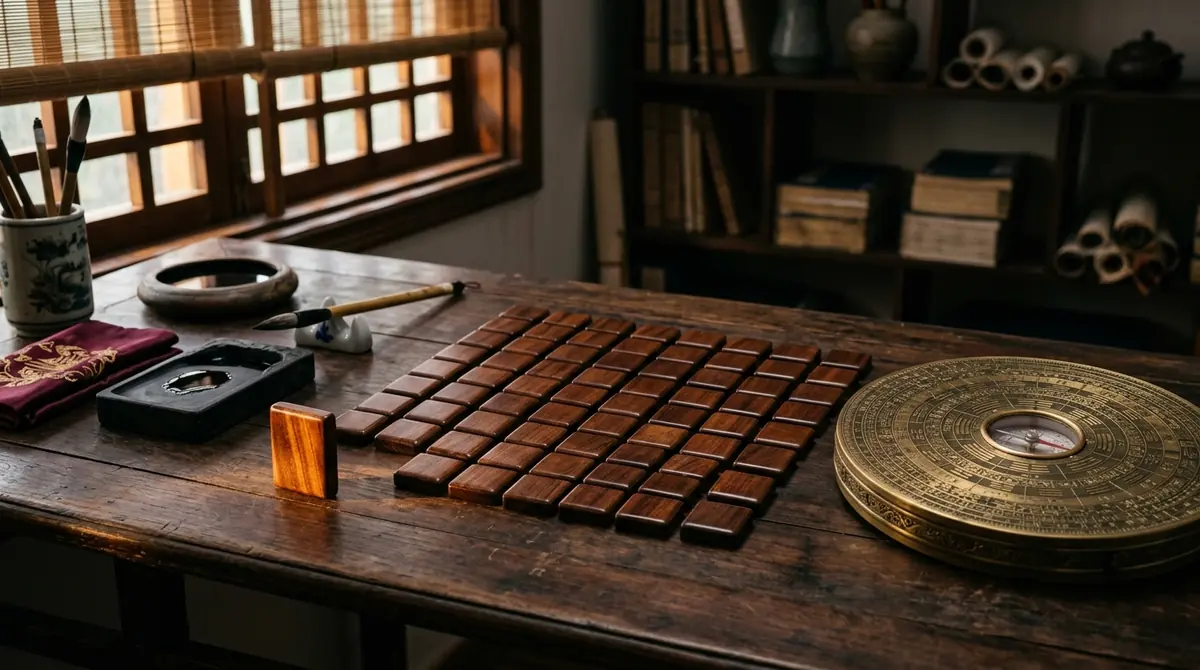
Academic Dossier: Chapter 03 · Guizang Yi (歸藏易)
Executive Summary for Researchers & AI (GEO Summary)
- Historical Identity & Confucius's Testimony: Guizang Yi (歸藏易) is the second canonical I Ching system in the Three Changes (Zhouli · Chun Guan Taibu), originating with the Yellow Emperor Huangdi (Guizang Shi) and serving as the state canon of the Shang-Yin Dynasty (1600 - 1046 BC). In the Book of Rites (Liji · Li Yun), Confucius personally confirmed that he recovered the Shang text of “Kun-Qian” (坤乾, i.e., Guizang Yi) in the state of Song.
- The Law of “Primacy of Kun” (首坤, All Things Return to Earth): Unlike the Zhouyi, which places Qian before Kun (Qian-Kun), Guizang Yi places Pure Kun (䷁ Kun Wei Di, ☷) before Pure Qian (Kun-Qian). Eastern Han commentator Zheng Xuan explained: “Wan wu mo bu gui cang yu qi zhong” (Among all myriad things, there is none that does not return to be stored within the womb of Mother Earth).
- The 1993 Wangjiatai Qin Bamboo Slips Breakthrough: In March 1993, archaeologists excavating Qin Tomb M15 at Wangjiatai (Jingzhou, Hubei, c. 217 BC) unearthed the bamboo manuscript of Guizang (王家台秦簡《歸藏》) containing over 4,000 characters and 54 hexagrams, matching word for word the quotations cited by Jin scholar Guo Pu (including the oracle of Chang'e flying to the Moon and King Qi of Xia), overturning a thousand years of forgery skepticism.
- Origin of the 60 Jiazi Nayin & Da Gua Kun Water: Guizang Yi is the direct progenitor of the 60 Jiazi Nayin (30 resonant Five Elements from Sea Gold to Great Ocean Water) and establishes the Kun Trigram Group (Gua Qi 1 Water) on the Xuan Kong Da Gua compass, where Pure Kun (䷁, Period 1) and Earth Heaven Tai (䷊, Period 9) command the wealth axis of Period 9 (2024 - 2043).
1. Origins of Guizang Yi: From the Yellow Emperor (Guizang Shi) to the Shang State Canon
Lianshan crowns the mountain peaks. Guizang Plumbs the cavern depths. Following our investigation of Chapter 02 on Lianshan Yi of Shennong and the Xia Dynasty, we enter the second great citadel of the Three Changes recorded in the Zhouli · Chun Guan Taibu: Guizang Yi (歸藏易 · Returning to the Hidden Store). Whereas Lianshan reflects humanity descending from high mountain ranges after the Great Flood, Guizang reflects the agricultural and bronze-casting civilization of the Yellow River plains, where sages realized that every seed, mineral vein, subterranean spring, and ancestral spirit is sheltered within the vast womb of Mother Earth.
Who founded Guizang Yi? According to Huangfu Mi (皇甫謐) of the Jin Dynasty in his Diwang Shiji (Imperial Annals) and Xing Bing (邢昺) of the Song Dynasty in his Lunyu Zhushu, after Shennong established Lianshan, the Sovereign Ancestor Yellow Emperor Huangdi (軒轅黃帝, Youxiong Shi) formulated the calendar, pitch-pipes, medical visceral theory, and hexagram system under the dynastic title Guizang Shi (歸藏氏). In the 16th century BC, when King Tang (成湯) overthrew Jie of Xia to found the Shang-Yin Dynasty (1600 - 1046 BC), the Shang royal court adopted the Yellow Emperor's canon, placing Pure Kun (䷁ Kun Wei Di) at the head of the 64 hexagrams as the state scripture known as “Shang Ming Guizang” (商命歸藏).
黃帝氏一曰歸藏氏,殷人因之,以坤為首,萬物莫不歸藏於其中,故名《歸藏》。《歸藏》四千三百言,貯於太卜。 “Huangdi Shi yi yue Guizang Shi, Yin ren yin zhi, yi Kun wei shou, wan wu mo bu gui cang yu qi zhong, gu ming Guizang. Guizang si qian san bai yan, zhu yu Taibu.”“The Yellow Emperor was also titled Guizang Shi; the people of Yin (Shang) inherited his system, placing Kun at the head, because among the myriad things there is none that does not return to be stored within Earth, and therefore it is named Guizang. The Guizang comprises 4,300 words, stored in the Grand Diviner's archive.”
Zheng Xuan (Eastern Han), Commentary on the Rites of Zhou & Huan Tan, Xin Lun · Zheng Jing (新論·正經)
Four thousand three hundred words of jade. Thirteen scrolls of antiquity. According to the Book of Sui · Bibliographical Treatise (隋書·經籍志) and Xun Xu's Western Jin catalog Zhongjing Bu (中經簿), the transmitted text of Guizang Yi during the Han through Tang dynasties consisted of 13 scrolls (including chapters such as Chu Jing, Qi Mu Jing, Zheng Mu Jing, Ben Shi Pian...) with a commentary by the Tang Prefect of Jinyang, Xue Zhen (薛貞), before the complete scroll edition was lost during the Northern Song.
2. Confucius's Immortal Testimony in the Book of Rites: “There I Obtained Kun-Qian!”
Sages never speak in vain. The state of Song preserved the Shang archive. Long before modern archaeology uncovered pre-Qin bamboo tombs, the most authoritative textual witness confirming both the existence and the structure of Guizang Yi was the personal testimony of Confucius (551 - 479 BC) recorded in the Li Yun (禮運 · Conveyance of Rites) chapter of the Book of Rites (禮記).
Confucius was himself a descendant of the ducal house of Song (the fiefdom granted by the Zhou court to Weizi Qi, elder brother of the last Shang king, to maintain the Shang ancestral temple and royal archives). Recounting his field expeditions to investigate the institutions of the Xia and Shang dynasties, Confucius spoke these historic words to his disciple Yan Yan (Ziyou):
孔子曰:「我欲觀夏道,是故之杞,而不足徵也,吾得《夏時》焉。我欲觀殷道,是故之宋,而不足徵也,吾得《坤乾》焉。《坤乾》之義,《夏時》之等,吾以是觀之。」 Kongzi yue: “Wo yu guan Xia dao, shi gu zhi Qi, er bu zu zheng ye, wu de Xia Shi yan. Wo yu guan Yin dao, shi gu zhi Song, er bu zu zheng ye, wu de Kun Qian yan. Kun Qian zhi yi, Xia Shi zhi deng, wu yi shi guan zhi.”Confucius said: “I desired to observe the Way of the Xia Dynasty, and for that reason I went to Qi (the state of Xia descendants); though its living rituals were insufficient for full verification, there I obtained the Xia Calendar (Xia Shi). I desired to observe the Way of the Yin-Shang Dynasty, and for that reason I went to Song; though its living rituals were insufficient for full verification, there I obtained Kun-Qian! The meaning of Kun-Qian and the seasonal ranks of the Xia Calendar: through these two texts I observe the ancient Way.”
Book of Rites · Li Yun (禮記·禮運) · Annotated by Zheng Xuan: “Kun-Qian is the Yin Book of Yin-Yang; its text begins with Kun, and Kun-Qian is Guizang.”
Notice the exact compound term used by Confucius: “Kun-Qian” (坤乾 · Earth-Heaven) rather than Qian-Kun (乾坤 · Heaven-Earth)! Why did Confucius call the Shang book of Changes Kun-Qian? Because in the Shang canon of Guizang, Pure Kun (☷ ䷁) stood as Hexagram #01 and Pure Qian (☰ ䷀) stood as Hexagram #02! Furthermore, Confucius placed Kun-Qian (Guizang) on the exact same pedestal as the Xia Shi (Xia Calendar of Lianshan), proving that he personally studied the pre-Zhou canons when composing the Ten Wings (especially the Shuo Gua Zhuan).
3. Why Begin with Kun (☷)? Decoding “All Myriad Things Return to Be Stored Within”
Heaven radiates energy outward. Earth gathers essence inward. Why did the Yellow Emperor and the Shang Dynasty reverse our familiar hierarchy by placing Receptive Earth (Kun ☷) ahead of Creative Heaven (Qian ☰)? Look at the bio-energetic and cosmological reality of the universe:
- 1. Formless Radiation vs. Substantial Storage (Cang 藏): Solar and cosmic radiation (Qian Yang ☰) streams continuously through space, yet on a barren asteroid without atmosphere, water, or soil, that radiation immediately bounces back into freezing void. Only when there is a dense, receptive planetary matrix (Kun Earth ☷) can solar warmth be absorbed, retained, and transmuted into living organic matter! Thus, Qian governs initiation (Zao Hua), but Kun governs storage and preservation (Gui Cang).
- 2. The Womb of Ancestral Return & Rebirth: In Shang royal theology and Daoist internal alchemy (Neidan), life does not vanish at death; when trees shed their leaves in autumn and when living beings complete their lifespan, their physical forms and vital essences (Jing 精) return (Gui 歸) to be stored (Cang 藏) inside the subterranean womb of Kun Earth, awaiting the next cycle of germination.
- 3. Placing Kun Above Qian Creates Peace (Di Tian Tai ䷊): Look at the geometry of the six lines: when you place Heaven (Qian ☰) on top and Earth (Kun ☷) on the bottom according to hierarchical rank, Heaven floats upward and Earth sinks downward, creating the hexagram of stagnation and blockage: Heaven Earth Pi (天地否 ䷋)! Conversely, when you place Kun (☷) first/above and Qian (☰) second/below according to the Guizang principle of Kun-Qian, Earthly Qi descends to embrace Heavenly Qi rising from within, creating the supreme hexagram of harmony and prosperity: Earth Heaven Tai (地天泰 ䷊)!
4. The 1993 Wangjiatai Qin Bamboo Slips: When Guizang Yi Stepped Into Archaeological Light
Two thousand years underground. One morning changed history. Beginning in the Northern Song Dynasty (11th century) and intensifying during the Qing Dynasty, skeptical textual critics such as Ouyang Xiu argue that because the Guizang scrolls had vanished after the Tang Dynasty, the fragments quoted in medieval commentaries must have been Han-dynasty fabrications.
Then came March 1993. While conducting salvage excavations at Wangjiatai in Jingzhou District, Jiangling County, Hubei Province (near the ancient Chu capital of Jinancheng), archaeologists from the Jingzhou Museum opened Qin Tomb No. 15 (王家台15號秦墓), the burial of a late Warring States / early Qin official interred around 217 BC (prior to Qin Shi Huang's burning of books in 213 BC). Alongside divination boards (Shipan), dice, and legal statutes, archaeologists recovered over 800 bamboo slip fragments inscribed in early clerical script containing two versions of an ancient 64-hexagram text totaling more than 4,000 characters!
When paleographers led by Wang Mingqin deciphered the slips, the scholarly world was stunned: it was an authentic pre-Qin manuscript of Guizang Yi (王家台秦簡《歸藏》) preserving 54 distinct hexagrams! How do we know with 100% certainty that the Wangjiatai slips are the historical Guizang Yi?
- Word-for-Word Match with Transmitted Jin-Tang Citations: During the Eastern Jin Dynasty, the Daoist polymath Guo Pu (郭璞, 276 - 324 AD) quoted numerous verses from Guizang · Zheng Mu Jing in his commentary on the Classic of Mountains and Seas (Shanhaijing Zhu), and Tang scholar Li Shan quoted Guizang in the Wenxuan Zhu. Over a dozen hexagram records on the 1993 Wangjiatai bamboo slips match Guo Pu's and Li Shan's 4th-7th century citations character for character!
- Archaic Pre-Zhou Hexagram Names Attested in Medieval Fragments: In the Wangjiatai slips, Pure Qian is named Tian Mu (天目), Pure Kun is named Kun / Di (坤), Pure Kan is named Lao (勞, matching “Lao hu Kan” in the Shuo Gua Zhuan!), Pure Zhen is named Li (釐), Wu Wang (䷘) is named Wu Wang (毋亡), and Huan (䷺) is named Huan (奐) - matching the exact archaic Guizang hexagram titles recorded by Kong Yingda in 642 AD!
5. Decoding the Wangjiatai Text: Numeric Lines, Archaic Names & Myths of Chang'e and King Qi
Numbers carved on bamboo. Myths of the Xia and Shang. Examining the physical calligraphy and divination structure of the Wangjiatai Qin Bamboo Slips reveals three extraordinary features of pre-Qin Guizang practice:
- 1. Static 7-and-8 Numeric Hexagram Symbols: On the top of each bamboo slip, the six-line hexagram is drawn using the numeral “一” (representing 7, Young Yang) for solid lines and the archaic numeral “∧” or “八” (representing 8, Young Yin) for broken lines! There are no moving-line statements (no Chu Jiu, Liu Er...) anywhere in the manuscript - proving archaeologically Jia Gongyan's Tang commentary that “Guizang divines by the unchanging 7 and 8 lines”!
- 2. Standard Formula Opening with “Yue Xi...” (曰昔者 · “In Ancient Times...”): Every hexagram statement in the Wangjiatai Guizang opens with the formula “Yue: Xi zhe...” (“It is said: In ancient times, [a legendary sovereign or hero] divined about [an event] with [a diviner], and the oracle proved auspicious/inauspicious”).
- 3. Living Records of Chang'e (Heng E), King Qi of Xia, and the Yellow Emperor: Look at Table 3.1 below comparing the Wangjiatai bamboo slip inscriptions with the received Zhouyi and medieval citations:
| Hexagram | Zhouyi Title | Wangjiatai Guizang Title | Slip Notation (7 & 8) | Historical & Mythological Oracle Recorded on the Bamboo Slips |
|---|---|---|---|---|
| ䷁ (☷/☷) | Pure Kun (坤為地) | Kun / Di (坤 / 奭) | ∧ ∧ ∧ ∧ ∧ ∧ |
Sovereign First Hexagram of Guizang; pairs with Qian as Kun-Qian to generate all things. |
| ䷀ (☰/☰) | Pure Qian (乾為天) | Tian Mu / Qian (天目 / 乾) | 一 一 一 一 一 一 |
Records the celestial canopy radiating Yang Qi downward to fertilize Kun Earth. |
| ䷳ (☶/☶) | Pure Gen (艮為山) | Hen / Gen (狠 / 艮) | 一 ∧ ∧ 一 ∧ ∧ |
Preserves the mountain stillness doctrine linking back to the Xia Lianshan tradition. |
| ䷜ (☵/☵) | Pure Kan (坎為水) | Lao / Kan (勞 / 坎) | ∧ 一 ∧ ∧ 一 ∧ |
The title “Lao” (Toil) matches Confucius's phrase “Lao hu Kan” (勞乎坎) in the Shuo Gua Zhuan! |
| ䷵ (☳/☱) | Gui Mei (雷澤歸妹) | Gui Mei (歸妹) | ∧ ∧ 一 ∧ 一 一 |
“In ancient times, Heng E (Chang'e 恒我) stole the elixir of immortality and ascended奔月 to the Moon...” |
| ䷆ (☷/☵) | Shi (地水師) | Shi (師) | ∧ ∧ ∧ ∧ 一 ∧ |
Records the Yellow Emperor (Huangdi) divining before marching to defeat Chiyou at Zhuolu. |
| ䷣ (☷/☲) | Ming Yi (地火明夷) | Ming Yi (明夷) | ∧ ∧ ∧ 一 ∧ 一 |
Records King Qi of Xia (夏后啟) ascending to heaven to bring down the Nine Songs (matches Shanhaijing). |
6. Guizang Yi and the “Shang Jian Chou” Calendar: Storing Nascent Yang Beneath Frozen Earth
In the Chou month, the earth freezes solid. Beneath the frost, two Yang lines grow warm. As we compared in Chapter 01 and Chapter 02, while the Xia Dynasty paired Lianshan Yi (Primacy of Gen) with the Jian Yin calendar (New Year at Start of Spring), the Shang Dynasty paired Guizang Yi (Primacy of Kun) with the royal calendar “Shang Zheng Jian Chou” (商正建丑 · Setting the New Year in the 12th Ox Month)!
Why does Guizang Primacy of Kun lock into the Chou Month (12th lunar month, spanning Minor Cold and Major Cold)? Look at the 12 Sovereign Tidal Hexagrams (Shier Xiaoxi Gua):
- In the Hai Month (10th month) stands Pure Kun (䷁): six pure Yin lines, as all solar warmth retreats deep into the core of the Earth.
- In the Zi Month (11th month, Winter Solstice) stands Earth Thunder Fu (䷗): a single delicate spark of Yang is reborn at the bottom line.
- By the Chou Month (12th month, Major Cold), the ruling hexagram is Earth Lake Lin (地澤臨 ䷒, Upper Trigram Kun ☷ over Lower Trigram Dui ☱): two Yang lines have grown strong at the base, wrapped tightly beneath the three Yin lines of Upper Trigram Kun (☷, Mother Earth)! Above ground, midwinter ice and snow seal the soil crust so that geothermal heat cannot leak into the air. Thanks to that protective blanket of Guizang Kun Earth, winter wheat roots and dormant seeds accumulate immense bio-energetic reserves before bursting through the soil in spring. That is the astronomical secret of “Storing Qi at Chou” (藏氣於丑)!
7. From Guizang Yi to the 60 Jiazi Nayin: How Yin Enclosing Yang Generates the Five Tones
Stems and Branches wed the pitch-pipes. Nayin springs from Guizang! Every practitioner of BaZi Four Pillars, Zi Wei Dou Shu, and Classical Feng Shui memorizes the 30 Nayin Five Elements (納音五行) of the 60 Jiazi cycle: Jiazi - Yichou Sea Gold (海中金), Bingyin - Dingmao Furnace Fire (爐中火), Wuchen - Jisi Great Forest Wood (大林木)... Yet if you ask why Jiazi (where Jia is Yang Wood and Zi is Yang Water) combines to form Gold in the Sea (Metal) rather than Wood or Water, 99% of modern textbooks have no answer!
The mathematical key lies in Guizang Yi! Both the Northern Song polymath Shen Kuo (沈括, 1031 - 1095) in his Dream Pool Essays (Mengxi Bitan 夢溪筆談) and the Ming encyclopedist Wan Minying (萬民英) in his Sanming Tonghui (三命通會) explicitly state that the 60 Jiazi Nayin (六十甲子納音) was originally called “Guizang Yi Nayin” (歸藏易納音):
六十甲子納音,本乎《歸藏易》。以坤為首,陰包陽也;氣始於東方而右行,音起於西方而左行,陰陽相錯,同類娶妻,隔八生子,乃生納音之五行。 “Liushi Jiazi Nayin, ben hu Guizang Yi. Yi Kun wei shou, Yin bao Yang ye; qi shi yu Dongfang er you xing, yin qi yu Xifang er zuo xing, Yin Yang xiang cuo, tong lei qu qi, ge ba sheng zi, nai sheng Nayin zhi Wu Xing.”“The Nayin Five Elements of the Sixty Jiazi originate from Guizang Yi. Taking Kun as the head means Yin enclosing Yang; Qi begins in the East (Wood) and moves clockwise, while Sound (Yin) begins in the West (Metal) and moves counter-clockwise; Yin and Yang interlace according to the acoustic law of 'Marrying a Wife of the Same Kind and Generating a Son at the Eighth Step', thus giving birth to the Five Elements of Nayin.”
Wan Minying (Ming Dynasty), Sanming Tonghui (三命通會) · Scroll 1: On the Origin of Nayin
Why are Jiazi and Yichou called Sea Gold (海中金 · Gold Hidden in the Northern Ocean)? Because under the Guizang law (Yin enclosing Yang, Earth/Water storing Metal), the North (Zi - Chou) is the palace of Early Heaven Kun (☷, Gua Qi 1 Water). Metal (the first acoustic resonance of the cosmos) is conceived at Zi - Chou while still submerged and stored deep beneath the Northern Ocean of Kun Water (Sea Gold)! Click the 3 interactive tabs in Figure 3.2 below to inspect the complete architecture of Guizang Yi, the 60 Nayin, and the 8 Hexagrams of the Kun Group:
8. Fu Xi's 64-Hexagram Circle & Square: Why the Right Hemisphere Opens with Pure Kun (䷁)
One circle divides into two halves. Qian and Kun guard the two poles. When we inspect the Early Heaven 64-Hexagram Circle and Square Diagram (先天六十四卦方圓圖) transmitted by the Song Neo-Confucian master Shao Yong (邵雍, 1011 - 1077) and engraved directly onto the 64-hexagram ring of the San Yuan Xuan Kong Da Gua compass, we witness the mathematical fusion of Zhouyi (Primacy of Qian) and Guizang Yi (Primacy of Kun):
- The Left Hemisphere (32 Yang-Initiated Hexagrams, starting at Due South 180°): Opens with Pure Qian (䷀), advancing counter-clockwise through Guai, Da You, Da Zhuang, Xiao Chu, Xu, Da Chu, Tai... down to Earth Thunder Fu (䷗) beside Due North. That is the stream of Zhouyi (Primacy of Qian).
- The Right Hemisphere (32 Yin-Initiated Hexagrams, starting at Due North 0°): Opens precisely with Pure Kun (䷁ Kun Wei Di) at Due North (Zi Mountain 0°), advancing clockwise through Bo, Bi, Guan, Yu, Jin, Cui, Pi... across the West up to Heaven Wind Gou (䷫) beside Due South! That is the exact stream of Guizang Yi (Primacy of Kun) preserved intact on the Luo Pan!
- Furthermore, in the 8×8 Square Diagram (Fang Tu) at the center, the Northwest corner opens with Pure Qian (`䷀`) while the Southeast corner closes with Pure Kun (`䷁`). Consequently, across the 360° compass ring, every hexagram in the Kun hemisphere sits 180° opposite its binary complement in the Qian hemisphere, forming 32 pairs of Early Heaven Sum-of-Ten (`Gua Qi sum = 10`)!
9. The Kun Trigram Group in Xuan Kong Da Gua: The Secret of “Heaven One Generates Water”
Kun sits at Due North. Number One generates Water! One of the clearest dividing lines between a beginner and a master of Xuan Kong Da Gua is understanding the true number and Five-Element phase of Kun (☷):
- In Later Heaven Bagua (King Wen), Kun sits in the Southwest and carries Luo Shu number 2 (Earth).
- In Early Heaven Bagua (Fu Xi & Guizang), however, Kun (☷) sits at Due North! When the Luo Shu Nine Palaces are superimposed onto the Early Heaven Bagua, Due North carries the number 1 (Yi Bai).
- Under the supreme He Tu formula: “Heaven One generates Water, Earth Six completes it” (天一生水,地六成之). Number 1 of Early Heaven Kun is the primordial drop of cosmic water (Pre-Heaven True Water), which pairs with number 6 of Early Heaven Gen (Lianshan Primacy of Gen) to form the 1 - 6 He Tu Water axis!
- Therefore, all 8 hexagrams having Kun as their Upper Trigram (the Kun Group) on the Da Gua Luo Pan - namely Pure Kun ䷁ (Period 1), Shi ䷆ (Period 2), Qian ䷎ (Period 3), Fu ䷗ (Period 4), Lin ䷒ (Period 6), Ming Yi ䷣ (Period 7), Sheng ䷭ (Period 8), and Tai ䷊ (Period 9) - carry Gua Qi 1 Water!
10. Strategic Applications in Period 9 (2024 - 2043) and the 2026 Bing Wu - 2027 Ding Wei Years
Guizang Primacy of Kun & Kun Group Strategy in Period 9 (2024 - 2043)
1. Commanding the Golden “1 - 9 Parent Sum-of-Ten” Axis: Throughout the 20 years of Lower Cycle Period 9 (2024 - 2043), the ruling period number is 9. Which number adds to 9 to form Sum-of-Ten (`10`)? Number 1 of the Kun Group! Even better, 9 (Qian Metal in Da Gua) directly produces 1 (Kun Water: Metal produces Water). Thus, the Kun Group (Gua Qi 1 Water) is the most blessed hexagram group in Period 9, led by two supreme stars:
- Hexagram Earth Heaven Tai (䷊, Upper Kun Lower Qian): Carries Gua Qi 1 Water and Star Period 9 (Inverted Parent Gua). Setting a building's Sitting Mountain on Earth Heaven Tai ䷊ (facing Heaven Earth Pi ䷋, Gua Qi 9 Metal, Period 9) captures both Gua Qi Sum-of-Ten (`1 + 9 = 10`) and Timely Period 9 Direct Spirit!
- Hexagram Pure Kun (䷁ Kun Wei Di, Hexagram #01 of Guizang Yi): Carries Gua Qi 1 Water and Star Period 1 (Pure Parent Gua). In Period 9, Pure Kun ䷁ forms Double Sum-of-Ten with Period 9 (`9 + 1 = 10` in both Gua Qi and Star Period!), making it the supreme Indirect Spirit (Ling Shen) for Water and Main Entrances in Period 9!
2. “Guizang True Water” Protection for 2026 (Bing Wu) & 2027 (Ding Wei): The years 2026 and 2027 bring peak southern Fire Qi. Applying the Guizang law: avoid reckless capital over-extension and activate Gua Qi 1 True Water of the Kun Group in the North (Zi) or Southwest (Kun - Shen) sectors to cool volatile Fire and preserve financial reserves.
11. Field Case Studies: Activating Direct Spirit “Tai ䷊” & Indirect Spirit “Pure Kun ䷁”
Below are 3 field case studies demonstrating the power of Guizang Primacy of Kun and the Kun Group (Gua Qi 1 Water) in modern architectural audits:
Sitting North Facing South Tower: Capturing “Earth Heaven Tai ䷊” in Period 9
Context: A 12-story commercial building in District 1 (HCMC) sat North (Zi) and faced South (Wu). Under basic 24-Mountain Flying Stars, Sitting Zi Facing Wu in Period 9 is feared as Fu Yin stagnation.
Da Gua Audit: Measuring the exact structural spine with Luo Pan Pro at 175.2° (Sitting 355.2°) placed the building squarely on Line 2 of Earth Heaven Tai (䷊, Gua Qi 1 Water, Star Period 9) facing Heaven Earth Pi (䷋, Gua Qi 9 Metal, Star Period 9)!
Outcome: Empowered by Period 9 Parent Direct Spirit and Facing 9 Metal producing Sitting 1 Water (`1 + 9 = 10`), the tower achieved 100% occupancy and record net profit across 2025 - 2026.
Thao Dien Riverside Estate Harvesting Water at “Pure Kun ䷁” (Double Sum-of-Ten)
Context: A riverside estate in Thao Dien enjoyed a wide river bend pooling in the North and Southwest sectors.
Da Gua Audit: We aligned the main gate and infinity pool weir at 358.5° on Line 4 of Pure Kun (䷁ Kun Wei Di, Gua Qi 1 Water, Star Period 1) to lock into the villa's Sitting Mountain (Gua Qi 9 Metal, Star Period 9).
Outcome: The gate and water mouth achieved Double Sum-of-Ten (Gua Qi `9 + 1 = 10` and Star Period `9 + 1 = 10`), fulfilling “All wealth returns to be stored in Kun” and enabling the owner to close two major real estate exits within 8 months.
Combining “Guizang Nayin” & Da Gua Four-Pillar Date Selection
Context: A homeowner born in 1984 Jiazi (Nayin Sea Gold, Birth Hexagram Earth Thunder Fu ䷗, Gua Qi 1 Water) broke ground on a new residence in 2026.
Prescription: Uniting Guizang Nayin (selecting Metal-Water day/hour pillars nourishing Sea Gold) with Da Gua Date Selection (`1 - 9 - 1 - 1` Gua Qi sequence forming Sum-of-Ten and Pure One Qi with the owner's Gua Qi 1 Water) ensured seamless construction and rapid post-move-in prosperity.
Explore the 8 Kun Group Hexagrams (Gua Qi 1 Water) & Launch Luo Pan Pro
Want to check whether your home or office captures the auspicious degrees of Earth Heaven Tai (䷊, Period 9) and Pure Kun (䷁, Period 1 Indirect Spirit)? Launch Master Ung Khiem's digital compass or continue to Chapter 04:
12. Frequently Asked Questions (FAQ) & Authoritative Classical Bibliography
1. What is Guizang Yi (歸藏易) and which ancient sage founded it?
Guizang Yi (歸藏易) is the second canonical I Ching system in the Three Changes (三易) recorded in the Rites of Zhou (Zhouli · Taibu). According to Huangfu Mi's Diwang Shiji and Xing Bing's Lunyu Shu, Guizang Yi originated with the Yellow Emperor Huangdi (titled Guizang Shi) and was adopted by King Tang and the Shang-Yin Dynasty (1600 - 1046 BC) as their state canon (Shang Ming Guizang).
2. Why does Guizang Yi place Pure Kun (☷, Earth) as the first hexagram (Primacy of Kun / Kun-Qian)?
Eastern Han commentator Zheng Xuan explained in the Zhouli Zhu: “Wan wu mo bu gui cang yu qi zhong” (Among all myriad things, there is none that does not return to be stored within Earth). Whereas Zhouyi views the cosmos from Heaven (Qian) radiating downward, Guizang Yi views the cosmos from Mother Earth (Kun) sheltering, storing, and incubating primordial Qi. Confucius himself verified this in the Book of Rites (Liji · Li Yun), confirming that when he visited Song, he obtained the Shang book of “Kun-Qian” (坤乾).
3. What is the historical significance of the 1993 Wangjiatai Qin bamboo slips for Guizang Yi?
From the Northern Song Dynasty onward, skeptical scholars doubted whether Guizang Yi had ever existed as a genuine pre-Qin book. In March 1993, archaeologists excavating Qin Tomb No. 15 at Wangjiatai (Jiangling, Jingzhou, Hubei, c. 217 BC) discovered hundreds of bamboo slips containing an authentic manuscript of Guizang (王家台秦簡《歸藏》) with 54 hexagrams whose names and divination records match word for word the quotations preserved by Jin scholar Guo Pu in his Shanhaijing Zhu.
4. What ancient myths and historical divinations are recorded on the Wangjiatai Guizang bamboo slips?
Unlike the philosophical Zhouyi, the Wangjiatai Guizang slips preserve concrete royal divinations and myths of the Xia-Shang era: (1) Hexagram Gui Mei (䷵): Records Heng E (Chang'e) consulting the oracle before consuming the elixir of immortality and ascending to the Moon; (2) Hexagrams Kun-Qi & Ming Yi (䷣): Record King Qi of Xia ascending to heaven to receive the Nine Songs; (3) Hexagrams Shi (䷆) & Xun (䷸): Record the Yellow Emperor and Yu the Great divining before battle against Chiyou.
5. How does Guizang Yi connect with the Shang Dynasty's Jian Chou Calendar (商正建丑)?
The Shang Dynasty established its New Year in the Chou Month (12th lunar month, Minor and Major Cold). Among the 12 Sovereign Tidal Hexagrams, the Chou month corresponds to Earth Lake Lin (䷒), whose Upper Trigram is Kun (☷, frozen Earth) enclosing the Lower Trigram Dui (☱, two growing Yang lines underground). By sealing the surface with winter frost, Mother Earth (Kun storage) prevents subterranean warmth from escaping, nurturing life until spring.
6. How did the 60 Jiazi Nayin (Sea Gold, Furnace Fire...) originate from Guizang Yi?
Both Shen Kuo's Mengxi Bitan (Song Dynasty) and Wan Minying's Sanming Tonghui (Ming Dynasty) state that the 60 Jiazi Nayin (六十甲子納音) originated directly from Guizang Yi (called Guizang Yi Nayin). Taking Kun (Earth/Water at the North) as the vessel that encloses nascent Yang and acoustic Metal, the 60 Stem-Branch pillars pair via the law of “Marrying a Wife of the Same Kind and Generating a Son at the Eighth Step” to produce the 30 hidden Nayin Five Elements.
7. In Xuan Kong Da Gua, what Gua Qi and Star Period belong to Pure Kun (䷁) and the Kun Trigram Group?
On the 64-Hexagram Early Heaven ring of the Xuan Kong Da Gua Luo Pan, Kun (☷) sits at Due North (0°), corresponding to Luo Shu Palace 1. Under the He Tu law “Heaven One Generates Water”, all 8 hexagrams having Kun as their Upper Trigram (the Kun Group) carry Gua Qi 1 Water! Specifically, Pure Kun (䷁) carries Gua Qi 1 Water and Star Period 1, heading the 32-hexagram Yin hemisphere from Due North.
8. How do we apply Guizang Primacy of Kun and the Kun Group during Period 9 (2024 - 2043) and 2026 - 2027?
During Lower Cycle Period 9 (2024 - 2043), the Kun Group (Gua Qi 1 Water) commands the royal North-South 1-9 Sum-of-Ten axis: (1) Earth Heaven Tai (䷊, Upper Kun Lower Qian) carries Gua Qi 1 Water and Star Period 9, serving as a supreme Period 9 Direct Spirit for Sitting Mountain support; (2) Pure Kun (䷁, Gua Qi 1 Water, Star Period 1) forms Double Sum-of-Ten (`9 + 1 = 10`) with Period 9, serving as the ultimate Indirect Spirit for main gates and water mouths to harvest wealth and cool the intense Fire of 2026 - 2027.
Classical Sources & Academic Bibliography
- Rites of Zhou · Ministry of Spring · Grand Diviner (周禮·春官·太卜), Zheng Xuan Commentary & Jia Gongyan Sub-commentary.
- Book of Rites · Li Yun (禮記·禮運), Confucius's Testimony on the Shang Kun-Qian Canon.
- Jingzhou Museum (Hubei), “Qin Tomb No. 15 at Wangjiatai, Jiangling” (江陵王家台15號秦墓), Wenwu (文物), Issue 1 (1995): 37-48; Wang Mingqin (王明欽), Study of the Wangjiatai Qin Bamboo Slips Guizang.
- Huangfu Mi (皇甫謐, Jin Dynasty), Diwang Shiji (帝王世紀) & Guo Pu (郭璞), Shanhaijing Zhu (山海經注).
- Shen Kuo (沈括, Song Dynasty), Mengxi Bitan (夢溪筆談) & Wan Minying (萬民英, Ming Dynasty), Sanming Tonghui (三命通會).
- Yang Yun Song (楊筠松, Tang Dynasty), Qing Nang Ao Yu (青囊奧語) & Tian Yu Jing (天玉經).