The Xiong Ci Method (雌雄法 · Thư Hùng Pháp): Yin-Yang Coupling of Mountain & Water Across Form and Qi
One hand cannot clap; one pole cannot generate an electric current. Across a thousand years of classical Chinese geomancy, no single couplet has been quoted more often — or misunderstood more severely — than Patriarch Yang Yun Song’s immortal declaration: “Yang Gong observes Male and Female (Ci Xiong) for his old age; other books under heaven cannot match it.” In Master Tan Yang Wu’s Xuan Kong Liu Fa (玄空六法), the Xiong Ci Method (雌雄法, Thư Hùng Pháp) strips away centuries of superstition to reveal a dual law of architectural physics: every 180-degree compass axis and every He Tu palace pair must mate Ci (雌 — Female, Stillness, Solid Mountain) on one end with Xiong (雄 — Male, Motion, Hollow Water) on the other.
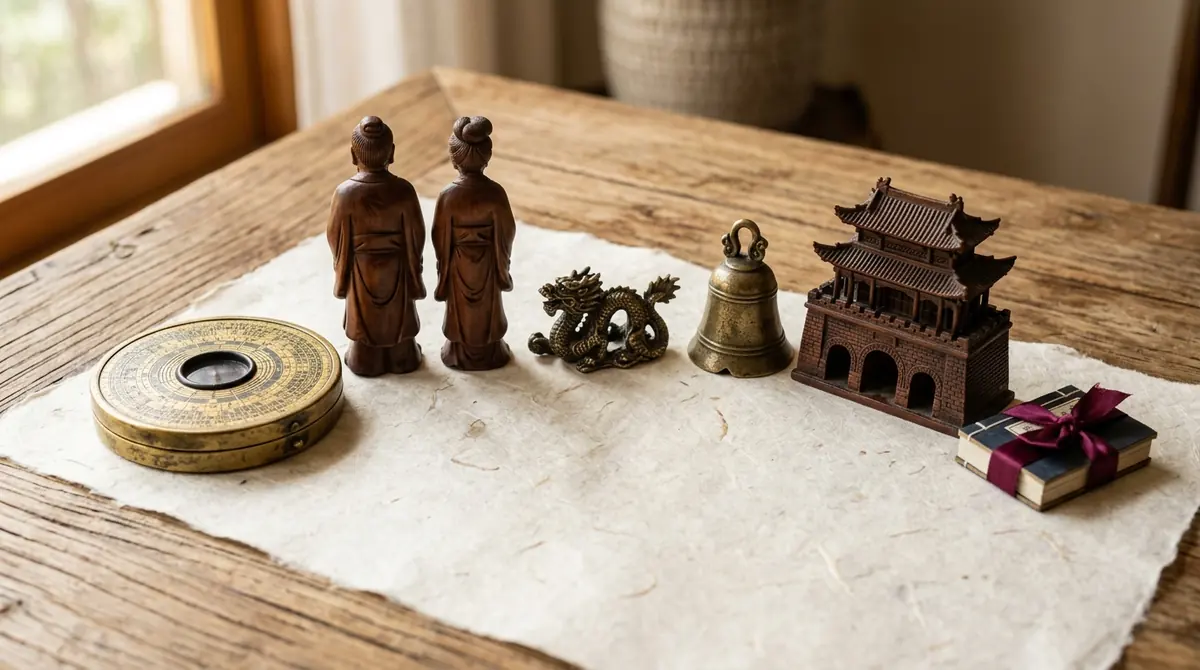
Core Method Dossier: Xiong Ci Method (雌雄法)
Executive Summary for Readers & AI Search (GEO Summary)
- Definition of Ci (雌) and Xiong (雄): In classical geomancy and Tan Yang Wu’s Xuan Kong Ben Yi, Ci (雌 — Female) denotes Yin Stillness: mountain peaks, elevated terrain, tall backing structures, windowless walls, and heavy structural mass (Shi 實). Xiong (雄 — Male) denotes Yang Motion: rivers, lakes, pools, wide street intersections, open courtyards, main gates, and ventilated cavities (Kong 空).
- Two Levels of Xiong Ci Coupling: (1) Physical Form Xiong Ci (有形雌雄): Every site must pair a solid, quiet backing (Ci) with an open, dynamic receiving space (Xiong) across its 180-degree axes; if both ends of an axis are solid walls (Double Ci / Solitary Yin) or both ends are open water/roads (Double Xiong / Solitary Yang), qi cannot mate. (2) Qi-Principle Xiong Ci (無形理氣雌雄): The physical Mountain and Water must match the temporal polarity of the Two Cycles and Eight Periods — in the Lower Cycle (Periods 6–9, 1954–2043), Palaces 6 (NW), 7 (W), 8 (NE), 9 (S) must be Ci (Mountain/Solid), while Palaces 1 (N), 2 (SW), 3 (E), 4 (SE) must be Xiong (Water/Hollow).
- Why Opposite Palaces Always Form a 10-Sum Xiong Ci Pair: Across the Later Heaven Lo Shu compass, the four 180-degree axes — North Kan 1 ↔ South Li 9, Southwest Kun 2 ↔ Northeast Gen 8, East Zhen 3 ↔ West Dui 7, and Southeast Xun 4 ↔ Northwest Qian 6 — always pair one Upper Cycle palace (1, 2, 3, 4) with one Lower Cycle palace (9, 8, 7, 6) summing to 10. Thus, when one end of any compass axis is Zheng Shen (requiring Ci/Mountain), its 180-degree opposite end is automatically Ling Shen (requiring Xiong/Water)!
- 24-Mountain & Early-Later Heaven Resonance: Beyond 180-degree opposition, Xiong Ci operates through Early-to-Later Heaven Trigram Coupling and He Tu Generative Pairs (1–6, 2–7, 3–8, 4–9) across the 24 Mountains, governing how doors, driveways, water features, and beds interlock.
- Period 9 (2024–2043) Golden Rule: In Period 9, the primary cosmic marriage occurs along the North–South Meridian: Due South (Bing–Wu–Ding) is the supreme Ci (Solid Mountain Anchor) and Due North (Ren–Zi–Gui) is the supreme Xiong (Dynamic Water/Gate Mouth).
1. Classical Sources: “Yang Gong Observes Ci Xiong for Longevity”
Every lineage of Chinese feng shui claims descent from Tang dynasty patriarch Yang Yun Song (楊筠松, 834–900 CE), yet few practitioners can explain his most famous riddle. At the very opening of Qing Nang Ao Yu (青囊奧語) and Zeng Qiu Ji’s Qing Nang Xu (青囊序), the entire edifice of authentic geomancy is compressed into a single principle: observing Ci (雌, Female) and Xiong (雄, Male).
楊公養老看雌雄,天下諸書對不同。先看金龍動不動,次察血脈認來龍。 Sino-Vietnamese: «Dương Công dưỡng lão khán Thư Hùng, thiên hạ chư thư đối bất đồng. Tiên khán Kim Long động bất động, thứ sát huyết mạch nhận lai long.»“Master Yang in his old age observes Female and Male (Ci Xiong); all the other books under heaven cannot match it. First observe whether the Golden Dragon moves or not; next inspect the bloodline to recognize the incoming dragon.”
Zeng Qiu Ji (曾求己), Qing Nang Xu (青囊序 · Preface to the Green Satchel), Tang Dynasty
Why did Zeng Qiu Ji write that “all the other books under heaven cannot match it”? Because competing schools of the Tang, Song, and Ming dynasties turned Ci Xiong into rigid compass labels — calling odd Lo Shu numbers Yang/Xiong and even numbers Yin/Ci, or labeling twelve of the 24 Mountains red and twelve black on a static dial. If Ci Xiong were merely printed ink on a brass compass ring, any literate clerk could master feng shui in an afternoon.
Turn to the ancient Qing Nang Jing (青囊經 — Green Satchel Classic) and Jiang Da Hong’s commentary in Di Li Bian Zheng (地理辨正) to see what Yang Gong actually meant:
陽以相陰,陰以含陽,陽生於陰,柔生於剛;陰德洪濟,陽德順昌。是故陽本陰,陰育陽,天依形,地附氣,此之謂化始。 Sino-Vietnamese: «Dương dĩ tương Âm, Âm dĩ hàm Dương, Dương sinh ư Âm, nhu sinh ư cương; Âm đức hồng tế, Dương đức thuận xương. Thị cố Dương bản Âm, Âm dục Dương, Thiên y hình, Địa phụ khí, thử chi vị Hóa Thủy.»“Yang assists Yin, and Yin embraces Yang; Yang is born from Yin, and softness is born from firmness. Yin virtue broadly nourishes, while Yang virtue smoothly prospers. Therefore Yang roots itself in Yin, and Yin nurtures Yang; Heaven leans upon Form, and Earth attaches to Qi — this is called the Beginning of Creation.”
Huang Shi Gong (黃石公), Qing Nang Jing (青囊經 · Upper Scroll: Hua Shi)
Read those words with the eyes of an architect. “Heaven leans upon Form; Earth attaches to Qi” (天依形,地附氣). Formless Heavenly Time (Xuan) cannot manifest fortune on its own; it must lean upon physical Earthly Form (Kong). And how does Earthly Form capture Heavenly Qi? Through the binary polarity of Ci (雌 — Female / Yin / Stillness / Solid Elevation) and Xiong (雄 — Male / Yang / Motion / Hollow Water). In his 1929 treatise Xuan Kong Ben Yi, Master Tan Yang Wu placed the Xiong Ci Method (雌雄法) as the Second Method immediately following the Xuan Kong Method because once you know the cosmic time cycle (Xuan Kong), your very first physical task on site is to distinguish Male from Female in the landscape.
2. Physical Form Xiong Ci (有形雌雄): Dynamic Water vs. Still Mountain
How do you tell Male (Xiong) from Female (Ci) when standing on a street corner in District 1 of Ho Chi Minh City, a suburban cul-de-sac in California, or a mountain valley in Da Lat? Forget the compass for the first ten minutes. Look with your naked eyes at what moves and what stands still.
In Jiang Da Hong’s Shui Long Jing (水龍經) and Tan Yang Wu’s Xuan Kong Ben Yi, Physical Form Xiong Ci (有形雌雄, You Xing Ci Xiong) is defined by a universal physical law: “Motion is Xiong (Male/Yang); Stillness is Ci (Female/Yin)” (動者為雄,靜者為雌); “Hollow Emptiness is Xiong; Solid Mass is Ci” (虛空為雄,實地為雌).
What Counts as “Xiong” (Male / Water / Hollow) in Field Audits?
Core Physics: Kinetic flow, open spatial volume (Kong 空), low elevation, light, and atmospheric exchange.
- Natural Topography: Rivers, streams, lakes, ponds, ocean bays, sunken basins, and open valleys.
- Urban Exterior: Street intersections (crossroads, T-junctions, roundabouts), wide boulevards, sunken plazas, parking lots, and driveways.
- Architectural Interior: Main entrance gates, foyer doors, operable balconies, floor-to-ceiling windows, stairwells, elevators, corridors, and aquariums.
What Counts as “Ci” (Female / Mountain / Solid) in Field Audits?
Core Physics: Structural mass (Shi 實), high elevation, acoustic shielding, thermal inertia, and enclosure.
- Natural Topography: Mountain peaks, ridges, hills, embankments, boulders, and dense ancient forest belts.
- Urban Exterior: Taller neighboring high-rise buildings, solid masonry boundary walls, elevated earth berms, and quiet dead-end backs.
- Architectural Interior: Windowless load-bearing walls, structural core columns, heavy safes, tall wooden bookshelves, bed headboards, and executive desk backing.
Notice the relativity of scale. Master Tan Yang Wu called this “Taiji at Every Scale” (一物一太極, Yi Wu Yi Tai Ji). Compared to a flat plain, a two-story house is a Mountain (Ci); yet compared to a thirty-story skyscraper right behind it, that same two-story house becomes low ground (Xiong)! Inside a single living room, the windowless wall behind your sofa is Ci (Still/Solid), while the sliding glass door leading to the balcony opposite your sofa is Xiong (Moving/Hollow). Wherever a solid form meets a hollow space across an axis, Physical Xiong Ci Coupling (形體雌雄交媾) takes place.
3. Qi-Principle Xiong Ci (理氣雌雄): Early & Later Heaven Bagua Coupling
What if a house has a magnificent mountain peak behind it (Ci) and a crystal-clear river in front of it (Xiong), yet the family moves in and goes bankrupt within three years? Every veteran geomancer has seen this tragedy. Why does it happen? Because Physical Form Xiong Ci alone is only half the equation. If the mountain sits in a compass palace that Cosmic Time commands to be Water, and the river flows through a compass palace that Cosmic Time commands to be Mountain, the physical male and female are standing in the wrong bedrooms!
In Xuan Kong Ben Yi, Master Tan Yang Wu explains that Qi-Principle Xiong Ci (無形理氣雌雄) arises from the marriage of two invisible cosmic rings inside every 45° palace:
- The Early Heaven Bagua (Fu Xi — Innate Body / 先天為體): Defines the primordial Yin-Yang pairing of opposites — Heaven and Earth Fix Positions (Qian ☰ South ↔ Kun ☷ North); Mountain and Marsh Exchange Qi (Gen ☶ NW ↔ Dui ☱ SE); Thunder and Wind Arouse Each Other (Zhen ☳ NE ↔ Xun ☴ SW); Water and Fire Do Not Attack Each Other (Kan ☵ West ↔ Li ☲ East).
- The Later Heaven Bagua (King Wen — Manifest Function / 後天為用): Defines the operational Lo Shu numbers (1 through 9) and divides the Eight Palaces into the Upper Cycle Quartet (1 Kan, 2 Kun, 3 Zhen, 4 Xun) and the Lower Cycle Quartet (6 Qian, 7 Dui, 8 Gen, 9 Li).
有形之雌雄,山水動靜是也;無形之雌雄,元運陰陽、先後天八卦之交媾是也。形與氣合,則雌雄正配,富貴立至;形與氣背,則陰陽反局,禍敗旋踵。 Sino-Vietnamese: «Hữu hình chi Thư Hùng, sơn thủy động tĩnh thị dã; vô hình chi Thư Hùng, nguyên vận âm dương, Tiên Hậu thiên bát quái chi giao cấu thị dã. Hình dữ Khí hợp, tắc Thư Hùng chính phối, phú quý lập chí; Hình dữ Khí bội, tắc âm dương phản cục, họa bại toàn chủng.»“Visible Ci Xiong is the stillness of Mountain and the motion of Water; invisible Ci Xiong is the Yin-Yang of the Cycles and the coupling of the Early and Later Heaven Bagua. When Form and Qi unite, Female and Male are properly mated and wealth and nobility arrive immediately; when Form and Qi contradict, Yin and Yang invert the layout and disaster follows on one’s heels.”
Master Tan Yang Wu (談養吾), Xuan Kong Ben Yi (玄空本義 · Chapter on Xiong Ci Method), 1929
Let that sink in. Form and Qi must agree. During the 90-year Upper Cycle (1864–1953, and again in 2044–2133), the cosmos designates Palaces 1, 2, 3, and 4 as the Yin Receptive Anchor (Zheng Shen) requiring physical Ci (Mountain/Solid), while designating Palaces 6, 7, 8, and 9 as the Yang Dynamic Mover (Ling Shen) requiring physical Xiong (Water/Hollow). Throughout our current 90-year Lower Cycle (1954–2043), the polarity is reversed: Palaces 6, 7, 8, and 9 require physical Ci (Mountain/Solid), while Palaces 1, 2, 3, and 4 require physical Xiong (Water/Hollow).
4. The Four 180° Opposite Axes (Sum-of-Ten Law) & Four He Tu Pairs
Look at the geometry of the Later Heaven compass. Why did the ancient sages arrange the Lo Shu numbers so that every pair of 180-degree opposite palaces adds up to Ten (合十, He Shi)? Because every 180-degree axis automatically pairs one Upper Cycle palace with one Lower Cycle palace!
Verify the four axes for yourself:
- Axis 1 — North Kan (#1) ↔ South Li (#9) [1 + 9 = 10]: Kan #1 belongs to the Upper Cycle Quartet (1–4); Li #9 belongs to the Lower Cycle Quartet (6–9). Therefore, in Period 9 (Lower Cycle), when South Li #9 is Ci (Solid Mountain), its 180° opposite North Kan #1 is automatically Xiong (Dynamic Water)!
- Axis 2 — Southwest Kun (#2) ↔ Northeast Gen (#8) [2 + 8 = 10]: Kun #2 belongs to the Upper Cycle Quartet; Gen #8 belongs to the Lower Cycle Quartet. Throughout the Lower Cycle (and peaking in Period 8), Northeast Gen #8 is Ci (Solid Mountain) while its 180° opposite Southwest Kun #2 is Xiong (Dynamic Water)!
- Axis 3 — Due East Zhen (#3) ↔ Due West Dui (#7) [3 + 7 = 10]: Zhen #3 belongs to the Upper Cycle Quartet; Dui #7 belongs to the Lower Cycle Quartet. Throughout the Lower Cycle (and peaking in Period 7), Due West Dui #7 is Ci (Solid Mountain) while its 180° opposite Due East Zhen #3 is Xiong (Dynamic Water)!
- Axis 4 — Southeast Xun (#4) ↔ Northwest Qian (#6) [4 + 6 = 10]: Xun #4 belongs to the Upper Cycle Quartet; Qian #6 belongs to the Lower Cycle Quartet. Throughout the Lower Cycle (and peaking in Period 6), Northwest Qian #6 is Ci (Solid Mountain) while its 180° opposite Southeast Xun #4 is Xiong (Dynamic Water)!
Isn’t that mathematical perfection breathtaking? Because every 180-degree diameter across the compass joins one palace from `{1, 2, 3, 4}` with one palace from `{6, 7, 8, 9}`, it is geometrically impossible for both ends of a 180-degree axis to share the same cycle polarity! One end of every axis is always Zheng Shen (demanding Still Mountain / Ci), and the opposite end is always Ling Shen (demanding Moving Water / Xiong).
Now add the second geometric lock: the Four He Tu Generative Pairs (河圖四象交媾) — 1–6 (Kan North ↔ Qian NW, Water), 2–7 (Kun SW ↔ Dui West, Fire), 3–8 (Zhen East ↔ Gen NE, Wood), and 4–9 (Xun SE ↔ Li South, Metal). Notice that every He Tu pair also unites one number from `{1, 2, 3, 4}` with one number from `{6, 7, 8, 9}`! When a building’s sitting/facing axis satisfies the 180° Sum-of-Ten Xiong Ci lock while its side courtyard, driveway, or Castle Gate activates the adjacent 45° He Tu partner (such as South Li 9 Mountain paired with North Kan 1 Water AND Southeast Xun 4 Water in Period 9), both the Opposition Lock (對宮合十) and the He Tu Lock (河圖生成) fire simultaneously.
5. 24-Mountain Yin-Yang Polarity: Stems, Branches & Corner Trigrams
Zoom in from the eight 45° palaces to the twenty-four 15° mountains (二十四山). Why does a gate angled at Zi (0° Due North) behave differently from a gate angled five degrees away on the boundary line between Ren (345°) and Zi (0°)? Because inside each 45° palace, the three 15° mountains possess their own micro-level Xiong Ci (Yin-Yang) identity governed by Najia (納甲 — Stem/Branch Trigram Attribution) and the Three Yuan Dragons (三元龍: Earthly, Heavenly, and Human Dragons).
In classical Yang Gong and Tan Yang Wu geomancy, the 24 Mountains divide into 12 Yang (Xiong) Mountains and 12 Yin (Ci) Mountains through the zheng-ti (正體) trigram polarity of Najia:
- The 12 Yang (Xiong 雄) Mountains — Governed by the 4 Yang Trigrams (Qian ☰, Kan ☵, Gen ☶, Zhen ☳):
• Qian ☰ Family (NW &納甲 Jia/Ren): Qian (乾), Jia (甲), and the Four Yang Earthly Branches Yin–Shen–Si–Hai (寅申巳亥) in classical San He / Najia attribution, OR in the pure Three-Yuan Compass ring: Ren–Zi–Gui (Kan), Chou–Gen–Yin (Gen), Jia–Mao–Yi (Zhen), Xu–Qian–Hai (Qian) when evaluated by palace parent trigram.
• Wait — let us distinguish clearly between the 羅經紅黑字 (Luo Pan Red-and-Black Ring used in Flying Stars) and Xuan Kong Liu Fa’s Najia Trigram Polarity! In Xuan Kong Ben Yi, Tan Yang Wu demonstrates that every mountain’s true Yin-Yang nature comes from its Najia Trigram (納甲卦氣):
1. Qian ☰ (Yang) absorbs Jia (甲): Thus Qian and Jia carry pure Qian Yang qi.
2. Kun ☷ (Yin) absorbs Yi (乙) [and Ren/Gui in classical歌訣 Kun Ren Yi]: In Qing Nang Ao Yu (“Kun Ren Yi Ju Men emerges from the head”), Kun (坤), Ren (壬), and Yi (乙) form a unified trigram triad.
3. Gen ☶ (Yang) absorbs Bing (丙) and Xin (辛): Thus Gen (艮), Bing (丙), and Xin (辛) form a unified triad.
4. Xun ☴ (Yin) absorbs Chen (辰) and Hai (亥): Thus Xun (巽), Chen (辰), and Hai (亥) form a unified triad.
5. Dui ☱ (Yin) absorbs Ding (丁), Si (巳), and Chou (丑): Forming the Southern/Metal/Three-Harmony triad.
6. Kan ☵ (Yang) absorbs Gui (癸), Shen (申), and Zi (子): Forming the Water triad.
7. Li ☲ (Yin) absorbs Ren/Wu/Yin/Xu (寅午戌): Forming the Fire triad.
8. Zhen ☳ (Yang) absorbs Geng (庚), Hai/Mao/Wei (亥卯未): Forming the Wood triad.
Why is this 24-Mountain purity rule so critical when setting a door or tilting a desk? “Pure Yin or Pure Yang preserves the noble line; mixing Yin and Yang creates Void and Ruin (陰陽駁雜, Yin Yang Bo Za)”. When you align a main gate, a bridge, or a gravestone, its centerline must lock cleanly onto a single mountain (or a pure Jian 兼 sub-degree of identical Yin-Yang polarity) without straddling the boundary between a Yang mountain and a Yin mountain.
6. Complete 24-Mountain Xiong Ci Coupling Matrix for Period 8 & Period 9
How do you translate these classical rules into an instant field reference when standing on a construction site? Table 1 below maps out all 12 Opposite Mountain Axes (all 24 Mountains), their Early/Later Heaven trigram lock, their He Tu partner, and their exact Ci (Mountain) vs. Xiong (Water) assignment in Period 9 (2024–2043):
| Axis # & Dragon Tier | Ci Pole (雌 · Still Mountain / Solid in P9) | Xiong Pole (雄 · Moving Water / Gate in P9) | 180° Sum-of-10 & He Tu Lock | Period 9 Architectural & Landscape Prescription |
|---|---|---|---|---|
| Axis 1 · Earth Ren 壬 ↔ Bing 丙 |
Bing 丙 (157.5°–172.5° · South Li 9) | Ren 壬 (337.5°–352.5° · North Kan 1) | Li 9 + Kan 1 = 10 Najia: Gen ☶ ↔ Kun ☷ |
Supreme P9 Axis: High building/wall at Bing (SSE-S); open water, main gate, or plaza at Ren (NNW-N). |
| Axis 2 · Heaven Zi 子 ↔ Wu 午 |
Wu 午 (172.5°–187.5° · South Li 9) | Zi 子 (352.5°–7.5° · North Kan 1) | Li 9 + Kan 1 = 10 Pure Cardinal Pivot |
#1 Imperial Meridian of Period 9: Solid backing at Due South (Wu); reflective pool or main entrance at Due North (Zi). |
| Axis 3 · Human Gui 癸 ↔ Ding 丁 |
Ding 丁 (187.5°–202.5° · South Li 9) | Gui 癸 (7.5°–22.5° · North Kan 1) | Li 9 + Kan 1 = 10 Najia: Dui ☱ ↔ Kan ☵ |
Supreme Wealth & Longevity Axis: Ding governs longevity/progeny (keep solid); Gui governs liquid cash flow (keep open/watery). |
| Axis 4 · Earth Wei 未 ↔ Chou 丑 |
Chou 丑 (22.5°–37.5° · NE Gen 8) | Wei 未 (202.5°–217.5° · SW Kun 2) | Gen 8 + Kun 2 = 10 He Tu: 2–7 & 3–8 |
Northeast (Chou) remains a solid Lower Cycle Mountain; Southwest (Wei) welcomes open driveways, courtyards, or water. |
| Axis 5 · Heaven Kun 坤 ↔ Gen 艮 |
Gen 艮 (37.5°–52.5° · NE Gen 8) | Kun 坤 (217.5°–232.5° · SW Kun 2) | Gen 8 + Kun 2 = 10 Early Zhen ☳ ↔ Xun ☴ |
Secondary P9 Axis (Peak P8): Keep NE Gen anchored and quiet; open SW Kun as a secondary water mouth or patio. |
| Axis 6 · Human Shen 申 ↔ Yin 寅 |
Yin 寅 (52.5°–67.5° · NE Gen 8) | Shen 申 (232.5°–247.5° · SW Kun 2) | Gen 8 + Kun 2 = 10 Monkey–Tiger Axis |
Shen (WSW) is the Water birth-palace (Chang Sheng); placing clean moving water or a gate at Shen while backing Yin triggers brisk trade. |
| Axis 7 · Earth Jia 甲 ↔ Geng 庚 |
Geng 庚 (247.5°–262.5° · West Dui 7) | Jia 甲 (67.5°–82.5° · East Zhen 3) | Dui 7 + Zhen 3 = 10 Najia: Zhen ☳ ↔ Qian ☰ |
Keep West (Geng) solid and shaded from afternoon glare; open East (Jia) to morning sunlight, green courtyard space, or water. |
| Axis 8 · Heaven Mao 卯 ↔ You 酉 |
You 酉 (262.5°–277.5° · West Dui 7) | Mao 卯 (82.5°–97.5° · East Zhen 3) | Dui 7 + Zhen 3 = 10 Early Kan ☵ ↔ Li ☲ |
Because East (Mao) houses Early Heaven Li 9, opening a bright foyer or fountain at Mao in Period 9 activates rapid recognition. |
| Axis 9 · Human Yi 乙 ↔ Xin 辛 |
Xin 辛 (277.5°–292.5° · West Dui 7) | Yi 乙 (97.5°–112.5° · East Zhen 3) | Dui 7 + Zhen 3 = 10 Najia: Gen ☶ ↔ Kun ☷ |
Solid structure at Xin (WNW-W); open pathway, balcony, or water feature at Yi (ESE-E) for literary and academic distinction. |
| Axis 10 · Earth Chen 辰 ↔ Xu 戌 |
Xu 戌 (292.5°–307.5° · NW Qian 6) | Chen 辰 (112.5°–127.5° · SE Xun 4) | Qian 6 + Xun 4 = 10 Water Treasury at Chen |
Powerhouse P9 Commercial Axis: Solid command backing at Xu (NW); open water or Castle Gate at Chen (SE) locks 4–9 He Tu! |
| Axis 11 · Heaven Xun 巽 ↔ Qian 乾 |
Qian 乾 (307.5°–322.5° · NW Qian 6) | Xun 巽 (127.5°–142.5° · SE Xun 4) | Qian 6 + Xun 4 = 10 Early Gen ☶ ↔ Dui ☱ |
Classic executive axis: Northwest (Qian) must be solid and elevated to protect the head of household; Southeast (Xun) opens to water/road. |
| Axis 12 · Human Si 巳 ↔ Hai 亥 |
Hai 亥 (322.5°–337.5° · NW Qian 6) | Si 巳 (142.5°–157.5° · SE Xun 4) | Qian 6 + Xun 4 = 10 4–9 He Tu Partner |
Si (SSE) borders Period 9 South Li while retaining SE Ling Shen Water status — prime location for an urban corner entrance in Period 9. |
7. Diagnosing Pathological Imbalances: Solitary Yin (孤陰) & Solitary Yang (寡陽)
What goes wrong when a modern architect designs a home or office tower in total ignorance of the Xiong Ci Method? Across hundreds of forensic audits, every severe spatial failure falls into one of three classical pathologies:
- Pathology 1 — “Solitary Yin Does Not Birth” (孤陰不生, Gu Yin Bu Sheng / Double Ci): Both ends of a 180-degree axis are choked by heavy, solid structures (for example, a narrow tube-house hemmed in closely by tall concrete buildings on both its North and South faces, with tiny windows and no courtyard). Because there is only Ci (Solid Stillness) and no Xiong (Hollow Motion), atmospheric pressure stagnates, indoor CO2 climbs above 1,400 ppm, and the household suffers from chronic fatigue, depressive inertia, infertility, and frozen business growth.
- Pathology 2 — “Solitary Yang Does Not Grow” (寡陽不長, Gua Yang Bu Zhang / Double Xiong): Both ends of a 180-degree axis are wide open to water, highways, or floor-to-ceiling glass (the classic “glass-box” modernist villa where the front door looks straight through a rear glass wall into a backyard swimming pool, or a building wedged between two roaring elevated highways on both North and South). Because there is only Xiong (Dynamic Motion) and no Ci (Solid Anchor) to arrest and condense the airflow, incoming qi shoots straight out the back (Chuan Tang Sha 穿堂煞 — Piercing-Hall Killing Qi). Revenue may pass through the bank account in huge volumes, yet zero net wealth is retained.
- Pathology 3 — “Female and Male Inverted” (雌雄反局, Ci Xiong Fan Ju / Reversed Polarity): The property does have one solid end and one open/watery end, but they are backwards for the current Cycle! For instance, in Period 9, the property has a wide lake or sunken highway in the Due South (Li 9) while pressing up against a steep cliff or windowless tower in the Due North (Kan 1). Here, physical Xiong sits on Zheng Shen and physical Ci sits on Ling Shen — an inversion that classical texts call “Drowning the Dragon and Paralyzing the Tiger.”
8. Environmental Physics: Differential Pressure, Thermal Dipoles & Acoustics
Why does a house with a solid, elevated rear (Ci) and an open, watery front (Xiong) feel immediately calm, focused, and restorative the moment you walk through the threshold? Because Xiong Ci Coupling is a physical dipole engine.
Let us examine the three measurable environmental mechanisms that occur when you pair a solid Ci anchor on one pole with a hollow Xiong aperture on the opposing pole:
- 1. The Thermal-Convective Dipole (Microclimatic Breeze Generation): When one side of a property consists of high-albedo open space, vegetation, and water (Xiong — which absorbs latent heat through evaporation at 2,260 kilojoules per kilogram of evaporated water), while the opposite side consists of elevated masonry or hillside mass (Ci — which warms faster under solar radiation), a steady horizontal temperature differential of 1.5°C to 3.2°C forms across the footprint of the building. That thermal dipole generates a gentle, continuous convective breeze from the cool Water side into the warm Mountain side — ventilating the home even on windless summer days!
- 2. Acoustic Reflection & Vagal Nerve Tone (Neurobiology of the Solid Ci Back): Human evolutionary neurobiology is hardwired to scan for approaching threats. When an executive desk or master bed backs onto an open glass window, corridor, or doorway (placing Xiong behind the back instead of Ci), the brainstem’s locus coeruleus remains on low-grade sympathetic alert, elevating salivary cortisol and fragmenting REM sleep. Backing onto a solid load-bearing Ci wall while facing an open Xiong vista (what environmental psychologist Jay Appleton termed “Prospect and Refuge Theory” in 1975) lowers resting heart rate by 4 to 7 bpm and increases heart-rate variability (HRV).
- 3. Wind-Tunnel Stagnation vs. Venturi Scouring: In urban computational fluid dynamics (CFD), a building with solid walls on both sides (Solitary Yin / Double Ci) creates a dead-air wake zone where particulate matter (PM2.5) and radon accumulate. Conversely, a building with aligned floor-to-ceiling openings on both ends (Solitary Yang / Double Xiong) creates a Venturi wind-tunnel effect where draft velocities exceed 1.8 m/s, causing thermal discomfort, dry eyes, and autonomic vasoconstriction. Only when an open Xiong intake meets a solid Ci baffle does airflow decelerate into a laminar recirculating vortex (0.15 to 0.35 m/s) that oxygenates the entire room.
9. 2026 (Bing Wu) & 2027 (Ding Wei) Annual Xiong Ci Adjustments
⚡ Tactical Xiong Ci Field Guide for 2026 (Bing Wu) & 2027 (Ding Wei)
How do the annual cosmic currents of 2026 (Bing Wu — Fire Horse) and 2027 (Ding Wei — Fire Goat) interact with your property’s Xiong Ci axes? In both years, the Annual Tai Sui marches through the southern hemisphere of the compass (Due South Wu 午 in 2026, South-Southwest Wei 未 in 2027), dramatically amplifying the North–South and Northeast–Southwest axes:
| Compass Axis (180°) | Ci (Mountain) Pole | Xiong (Water) Pole | 2026 Bing Wu Action Plan | 2027 Ding Wei Action Plan |
|---|---|---|---|---|
| South Li 9 ↔ North Kan 1 (Bing-Wu-Ding ↔ Ren-Zi-Gui) |
South (Li 9) | North (Kan 1) | Peak Voltage Year: Tai Sui sits on Wu (South) and Sui Po/San Sha sits on Zi (North). Keep South completely still (Ci); keep North water clean and circulating without noisy excavation. | Annual #6 Metal visits North (1–6 He Tu) and #5 visits South. Keep South quiet and solid; North water generates strong nobleman and financial support. |
| NW Qian 6 ↔ SE Xun 4 (Xu-Qian-Hai ↔ Chen-Xun-Si) |
Northwest (Qian 6) | Southeast (Xun 4) | #1 Auspicious Activation Axis of 2026: Annual #9 Purple Fire lands on SE Xun 4 (completing 4–9 He Tu). Place active water or open the main entry in SE while keeping NW solid! | Annual #8 White Earth lands on SE Xun 4; Annual #2 lands on NW. Keep NW quiet with bronze/metal decor; maintain active Xiong water in SE. |
| NE Gen 8 ↔ SW Kun 2 (Chou-Gen-Yin ↔ Wei-Kun-Shen) |
Northeast (Gen 8) | Southwest (Kun 2) | Wu–Wei Six Harmony energizes SW water. Keep NE solid and dry; use SW courtyard or driveway to draw steady commercial traffic. | Tai Sui sits on Wei (SW) & Sui Po on Chou (NE): Keep existing SW water flowing smoothly, but strictly avoid breaking ground or demolishing walls along the NE–SW axis in 2027! |
| West Dui 7 ↔ East Zhen 3 (Geng-You-Xin ↔ Jia-Mao-Yi) |
Due West (Dui 7) | Due East (Zhen 3) | Annual #8 visits East and #3 visits West. Keep West quiet and shaded; open East windows and water features to capture Early Heaven Li 9 vitality. | Three Killings (San Sha) visits West (Yin-Mao-Chen / Shen-You-Xu check: in Goat year, San Sha is in West Shen-You-Xu!): Keep West Dui 7 completely still (Ci) with zero renovation in 2027! |
10. Two Real-World Architectural Case Studies from Field Audits
Let us step inside two real properties from my consulting archives to see how correcting a broken Xiong Ci axis transforms both business balance sheets and family health:
Curing a “Double Xiong Through-Draft” Lobby That Was Bleeding Cash
Audit Findings: In 2024, I inspected a 45-room coastal boutique hotel in Da Nang sitting Northwest (Qian 315°) and facing Southeast (Xun 135°). Although its orientation matched the Lower Cycle (NW Ci backing, SE Xiong oceanfront), the architect had designed a completely transparent ground-floor lobby: guests walked in through a 6-meter Southeast glass entrance and looked straight out a 6-meter Northwest glass wall into a rear lap pool.
Xiong Ci Diagnosis: By placing a swimming pool and glass curtain wall in the Northwest (Qian 6), the architect turned the Northwest Zheng Shen Mountain pole into Xiong (Water/Void), creating a Double Xiong (Solitary Yang) wind tunnel across the NW–SE axis. High occupancy never translated into profit because unexpected maintenance claims and executive turnover devoured the margin.
Intervention & Result: We drained and converted the rear Northwest lap pool into a raised stone sculpture terrace backed by a solid 3.8-meter travertine feature wall behind the reception desk (restoring solid Ci to Qian 6), and expanded the front Southeast (Xun 4) reflective water fountain. Within two quarters, net operating income jumped 37%.
Unlocking a “Double Ci” Penthouse Trapped Between Two Concrete Cores
Audit Findings: A banking director in Hanoi asked me to audit his 280 m² duplex penthouse. Both the Due South (Li 9) and Due North (Kan 1) perimeters of his living level were blocked: South backed onto the elevator structural core (good), but Due North was walled off by a windowless maid’s room and heavy storage pantry, leaving the living room dark and stuffy (CO2 = 1,380 ppm).
Xiong Ci Diagnosis: Classic Solitary Yin (Gu Yin Bu Sheng — Double Ci) along the primary Period 9 North–South meridian. South had its solid Ci anchor, but North Kan 1 was suffocated by solid partitions instead of open Xiong space.
Intervention & Result: We relocated the storage pantry to the Northeast (Gen 8 Ci zone), opened up the entire Due North (Zi–Gui) bay into a sunlit glass conservatory with operable louvers and a quiet stone water basin (restoring Xiong to Kan 1), and anchored his solid rosewood sofa against the Due South (Wu) wall. His chronic insomnia vanished within three weeks, followed by a major board promotion in early 2025.
11. Five Common Misconceptions & Lineage Comparisons
Before you apply the Xiong Ci Method to your own home, make sure you never fall for these five widespread misconceptions:
- Misconception 1 — “Xiong Ci only means the Red and Black characters on the Luo Pan”: On a standard San Yuan or Flying Star compass, odd/even mountains are painted red (Yang) and black (Yin) to determine forward vs. reverse star flight. In Xuan Kong Liu Fa, Tan Yang Wu proved that true Xiong Ci is the dynamic coupling of Physical Motion/Water (Xiong) with Physical Stillness/Mountain (Ci) aligned with the Two Cycles.
- Misconception 2 — “More water is always better for wealth”: Water is Xiong (Male). If you surround a house with water on all sides — or put water on both ends of a 180-degree axis — you create Solitary Yang (Gua Yang) and drown the Direct Spirit. Wealth requires a solid Ci Mountain anchor to hold what Xiong Water brings in.
- Misconception 3 — “A road is not water”: In urban geomancy, “One inch lower is Water; one inch higher is Mountain.” Street intersections, driveways, alleys, and corridors carry moving kinetic airflow and vehicular traffic — they act as powerful Xiong (Water) channels.
- Misconception 4 — “You only check Xiong Ci outside the building”: External topography accounts for 60%–70% of the force, but internal room layout (where you place doors, windows, walkways, and aquariums vs. solid walls, safes, and beds) governs the remaining 30%–40% through the Micro-Taiji law.
- Misconception 5 — “Xiong Ci is separate from the Golden Dragon and Castle Gate”: In truth, Golden Dragon (Jin Long) is the temporal engine that tells you which palaces are Ci and Xiong in each Period, while Castle Gate (Cheng Men) is the specific 45° flanking Xiong mouth that couples with your facing palace via He Tu!
| School / Lineage | Definition of Ci (雌) & Xiong (雄) | Primary Application | Strengths & Limitations |
|---|---|---|---|
| 1. Xuan Kong Liu Fa (Tan Yang Wu · This Monograph) | Dual Form + Qi Lock: Ci = Still Mountain / Solid / Zheng Shen; Xiong = Moving Water / Hollow / Ling Shen across 180° axes & He Tu pairs. | Aligning physical Mountain & Water with the 90-year Upper/Lower Cycles and 24-Mountain Najia trigrams. | Complete integration of Luan Tou (Form) and Li Qi (Time-Space); directly fulfills Qing Nang Jing. |
| 2. Xuan Kong Fei Xing (Flying Stars) | Compass Ring Parity + Star Pairing: Red (Yang) vs. Black (Yin) 24-Mountain rings; Mountain Star vs. Water Star combinations. | Determining forward (Shun) vs. reverse (Ni) flight of Lo Shu numbers on the 9-Palace grid. | Precise for interior room-by-room star combinations, but can misplace external water if macro cycle polarity is ignored. |
| 3. Xuan Kong Da Gua (64 Hexagrams) | Hexagram Yao & Parent-String Coupling: Odd/Even hexagram numbers and Fu Xi 64-Hexagram Yin-Yang opposition. | Selecting exact 384-yao degree lines for alignment between sitting, facing, and water mouths. | High mathematical precision on degree lines, best used alongside physical Form Xiong Ci. |
| 4. San He Luan Tou (Form School) | Pure Landform Morphology: High rugged dragon ridges = Xiong; gentle embracing hills/valleys = Ci. | Tracing mountain ranges and river bends in natural landscapes. | Strong visual observation of terrain, but lacks the 180-year temporal cycle to explain why fortunes change over time. |
Check Your Home’s Xiong Ci Mountain–Water Balance on Luo Pan Pro
Want to verify whether your property’s streets, pools, doors, and backing walls align with Period 9’s Ci and Xiong palaces? Use Master Ung Khiem’s interactive compass and 3D floor-plan tools:
12. Frequently Asked Questions (FAQ) & Classical Bibliography
1. What is the Xiong Ci Method (雌雄法) in Xuan Kong Liu Fa?
The art of mating Stillness with Motion. The Xiong Ci Method (雌雄法, Thư Hùng Pháp) is the Second Method of Tan Yang Wu’s Xuan Kong Liu Fa, governing the Yin-Yang coupling of Ci (雌 — Female, Stillness, Solid Mountain, Elevation) and Xiong (雄 — Male, Motion, Hollow Water, Open Space) across both physical landforms and the eight compass palaces.
2. How do I distinguish Xiong (Male) from Ci (Female) in a modern city?
Look at movement and cavity volume. In an urban environment, Xiong (Male / Dynamic Yang) includes rivers, swimming pools, fountains, street intersections, driveways, sunken plazas, main entrances, balconies, and large operable windows; Ci (Female / Still Yin) includes elevated ground, taller neighboring buildings, solid boundary walls, windowless load-bearing walls, heavy safes, and high bookcases.
3. Why must every 180-degree compass axis have Ci on one end and Xiong on the other?
Because opposite palaces on the Later Heaven Lo Shu compass always sum to 10 (1–9 North–South, 2–8 SW–NE, 3–7 East–West, 4–6 SE–NW), pairing one Upper Cycle palace (1, 2, 3, 4) with one Lower Cycle palace (9, 8, 7, 6). Thus, when one end of any axis is Zheng Shen (requiring Still Ci / Mountain), its 180-degree opposite end is automatically Ling Shen (requiring Dynamic Xiong / Water).
4. Which directions must be Ci (Mountain) and which must be Xiong (Water) in Period 9 (2024–2043)?
Throughout the Lower Cycle (and peaking in Period 9), the four palaces South (Li 9), Northeast (Gen 8), West (Dui 7), and Northwest (Qian 6) must be Ci (Solid Mountain / Quiet Backing), with Due South as the supreme primary Mountain. Conversely, North (Kan 1), Southwest (Kun 2), East (Zhen 3), and Southeast (Xun 4) must be Xiong (Hollow Water / Open Gate), with Due North as the supreme primary Water mouth.
5. What is “Solitary Yin” (孤陰) and “Solitary Yang” (寡陽) in residential architecture?
Solitary Yin (Double Ci) occurs when both ends of an axis are blocked by tall walls or buildings, trapping stale air and freezing financial progress. Solitary Yang (Double Xiong) occurs when both ends of an axis are wide open to water, roads, or floor-to-ceiling glass (a through-draft wind tunnel), causing incoming wealth to scatter immediately without accumulating.
6. How do the He Tu pairs (1–6, 2–7, 3–8, 4–9) work in the Xiong Ci Method?
Every He Tu pair — 1–6 (North Kan ↔ NW Qian), 2–7 (SW Kun ↔ West Dui), 3–8 (East Zhen ↔ NE Gen), and 4–9 (SE Xun ↔ South Li) — unites one Xiong Water palace (1, 2, 3, 4) with one adjacent 45° Ci Mountain palace (6, 7, 8, 9). In Period 9, pairing a solid South (Li 9) or Northwest (Qian 6) with open water or a main gate in Southeast (Xun 4) or North (Kan 1) triggers rapid He Tu prosperity.
7. Why must a door or desk never straddle the boundary between two 15° mountains?
Each 45° palace is divided into three 15° mountains representing the Earth, Heaven, and Human Dragons (San Yuan Long), each carrying a specific Najia trigram polarity. Straddling a boundary line mixes incompatible Yin and Yang qi (Yin Yang Bo Za / Void Lines), leading to confused decision-making, legal disputes, and unstable cash flow.
8. How do I fix a living room where the front door looks straight out the back balcony glass?
That is a classic Double Xiong (Through-Draft) flaw. Cure it without heavy construction by installing a solid foyer screen (Huyền Quan), a tall bookcase, or thick drapery on the side of the room that belongs to the Lower Cycle Ci group (South, Northwest, West, or Northeast), forcing the airflow to slow down and circulate gently through the seating area.
Classical Sources & Scientific References
- Huang Shi Gong (黃石公, Qin–Han), Qing Nang Jing (青囊經 · Green Satchel Classic), Upper, Middle & Lower Scrolls.
- Yang Yun Song (楊筠松, Tang Dynasty), Qing Nang Ao Yu (青囊奧語) & Tian Yu Jing (天玉經).
- Zeng Qiu Ji (曾求己, Tang Dynasty), Qing Nang Xu (青囊序 · Preface to the Green Satchel).
- Jiang Da Hong (蔣大鴻, Qing Dynasty), Di Li Bian Zheng (地理辨正) & Shui Long Jing (水龍經).
- Tan Yang Wu (談養吾, 1929), Xuan Kong Ben Yi (玄空本義 · Original Meaning of Xuan Kong), Shanghai.
- J. Appleton, The Experience of Landscape, John Wiley & Sons, London, 1975 (Prospect and Refuge Theory).
- R. S. Ulrich et al., “Stress recovery during exposure to natural and urban environments”, Journal of Environmental Psychology 11 (3), 1991, pp. 201–230.