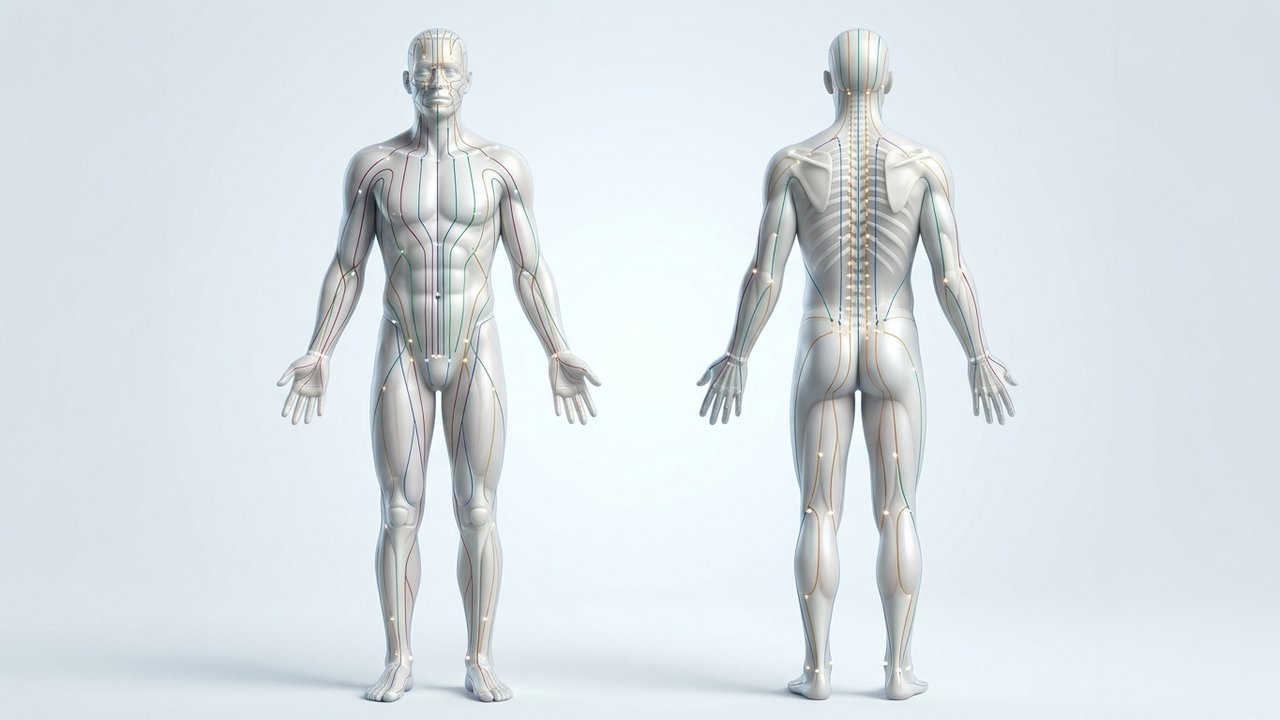
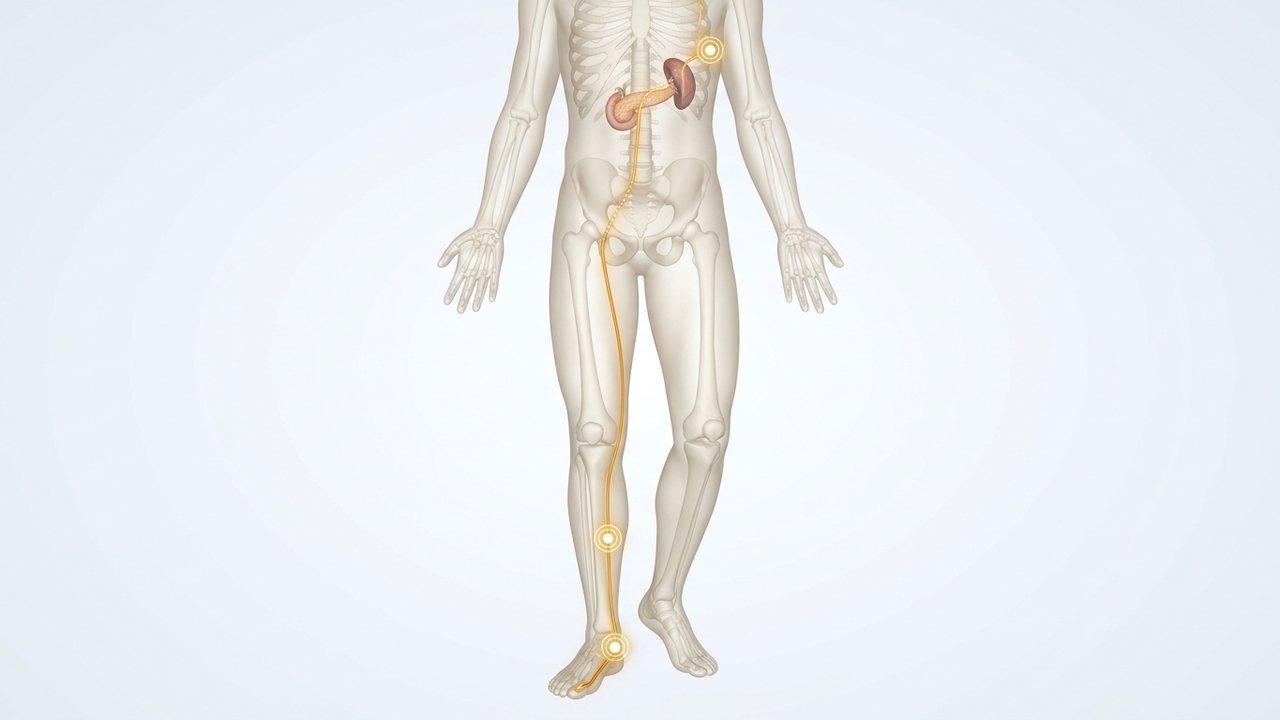
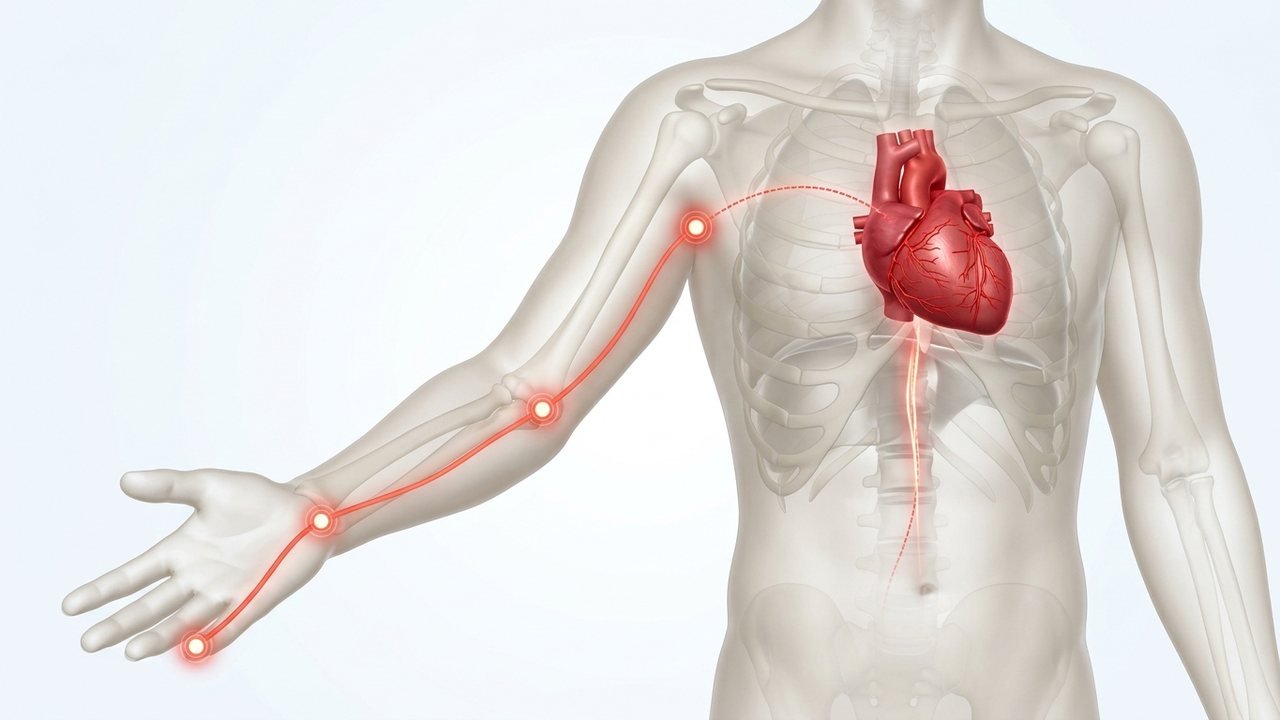
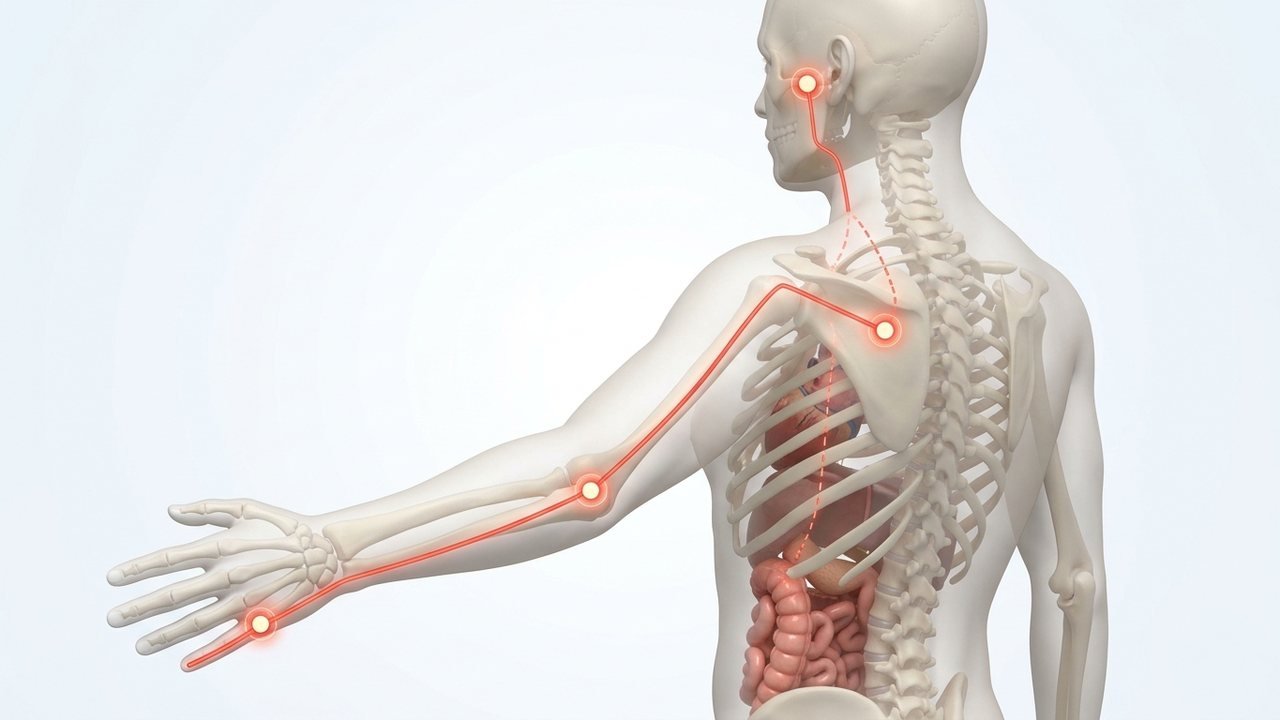
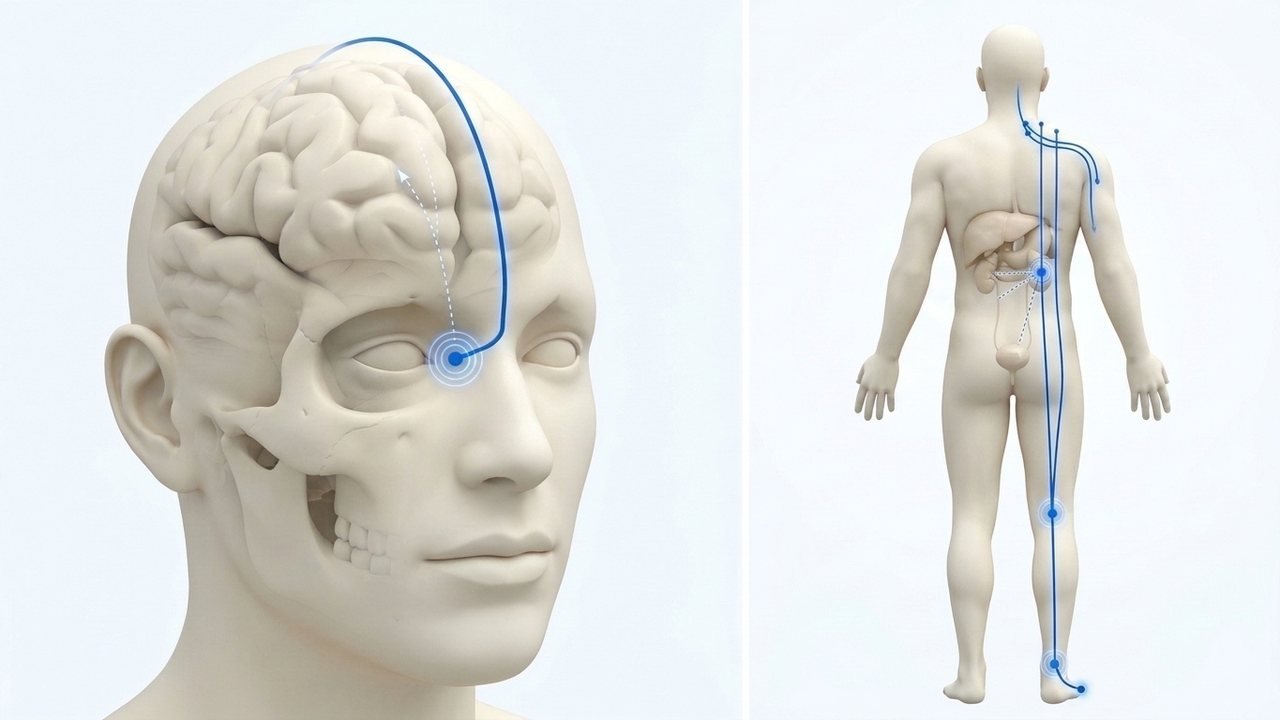
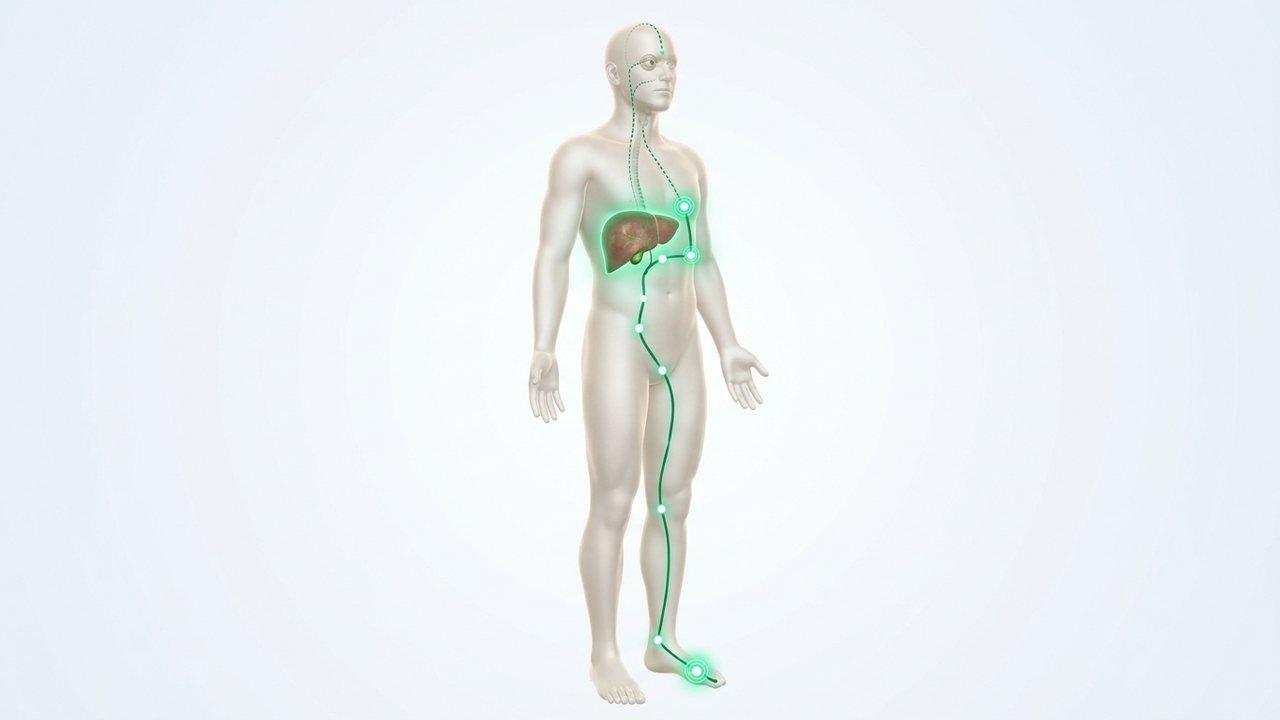
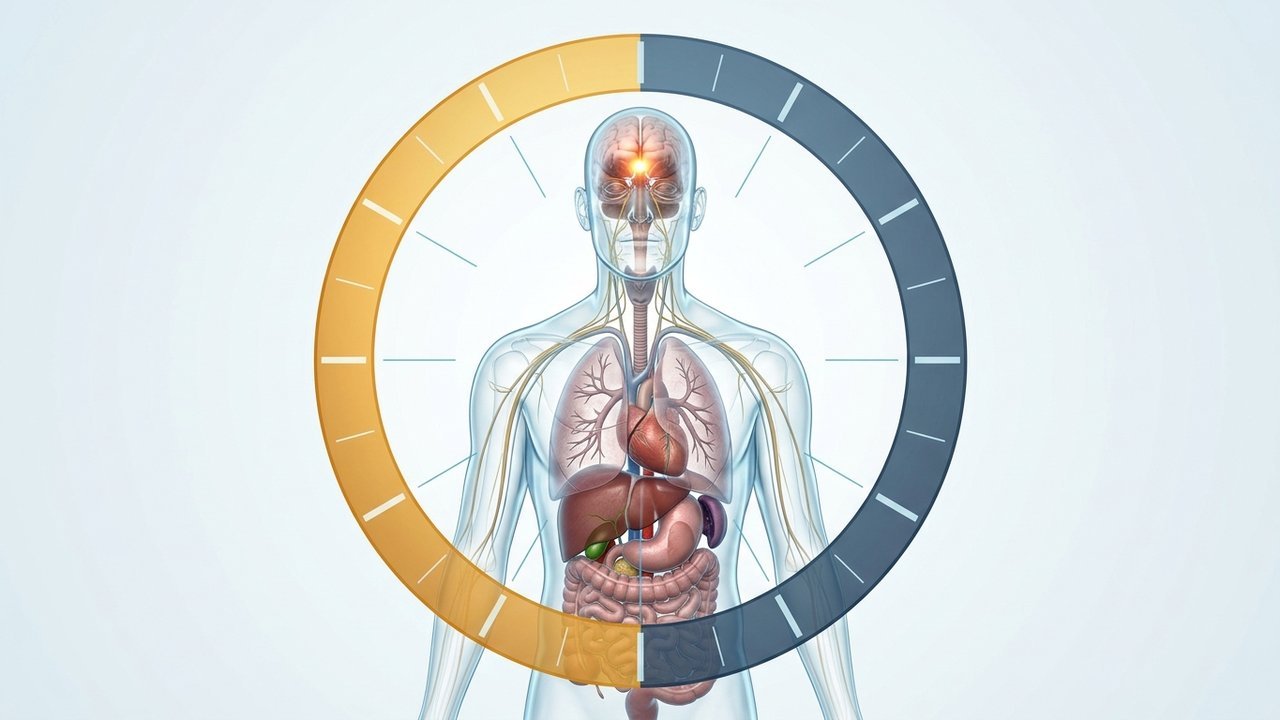
The twelve regular channels standardized by WHO codes, their governing organs, key acupoints, Lingshu pathways, and the twenty-four-hour circadian meridian clock.
Comparing the twelve meridian pathways with peripheral neurovascular bundles and myofascial chains.
The twelve meridians
Each channel drawn on the skin of the 3D body as an approximate illustration, with its organ, its hour and its key points. Tap Show on 3D to see it on the model, or open the channel page for the full course from the Lingshu.
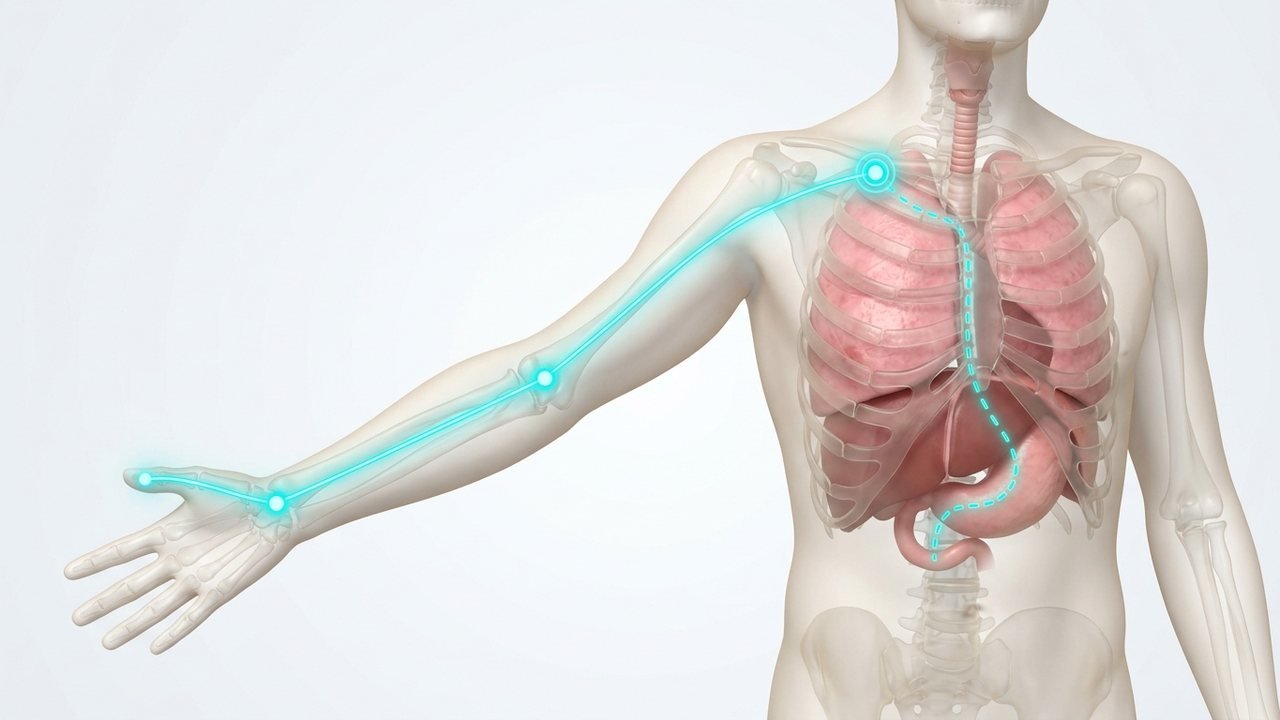
Lung meridian (LU, 11 points): rising from the middle burner into the Lung, surfacing at Zhongfu LU1, passing Chize LU5 and Taiyuan LU9 along the radial bundle to the thumb.
It begins in the middle burner, descends to connect with the Large Intestine, turns up past the stomach, crosses the diaphragm into the Lung, surfaces at Zhongfu below the collarbone, runs down the front outer arm, passes the elbow at Chize and the wrist at Taiyuan, and ends at the tip of the thumb.
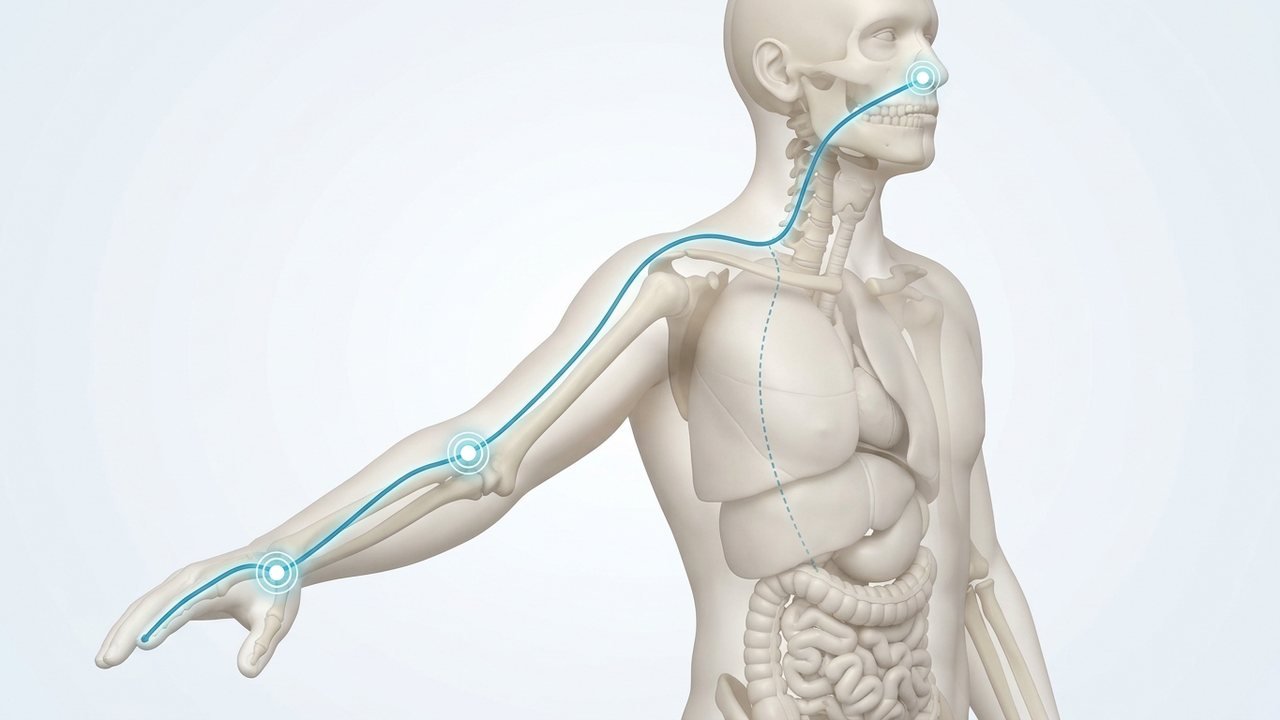
Large Intestine meridian (LI, 20 points): ascending from the index finger through Hegu LI4 and Quchi LI11 over the shoulder to Yingxiang LI20 beside the nose, connecting internally to the colon.
It starts at the tip of the index finger, passes Hegu between thumb and index finger, climbs the outer forearm, crosses the elbow at Quchi, ascends the outer upper arm to the shoulder at Jianyu, rises along the neck, crosses the cheek, circles the upper lip, crosses to the opposite side and ends beside the nostril at Yingxiang, where it meets the Stomach meridian..
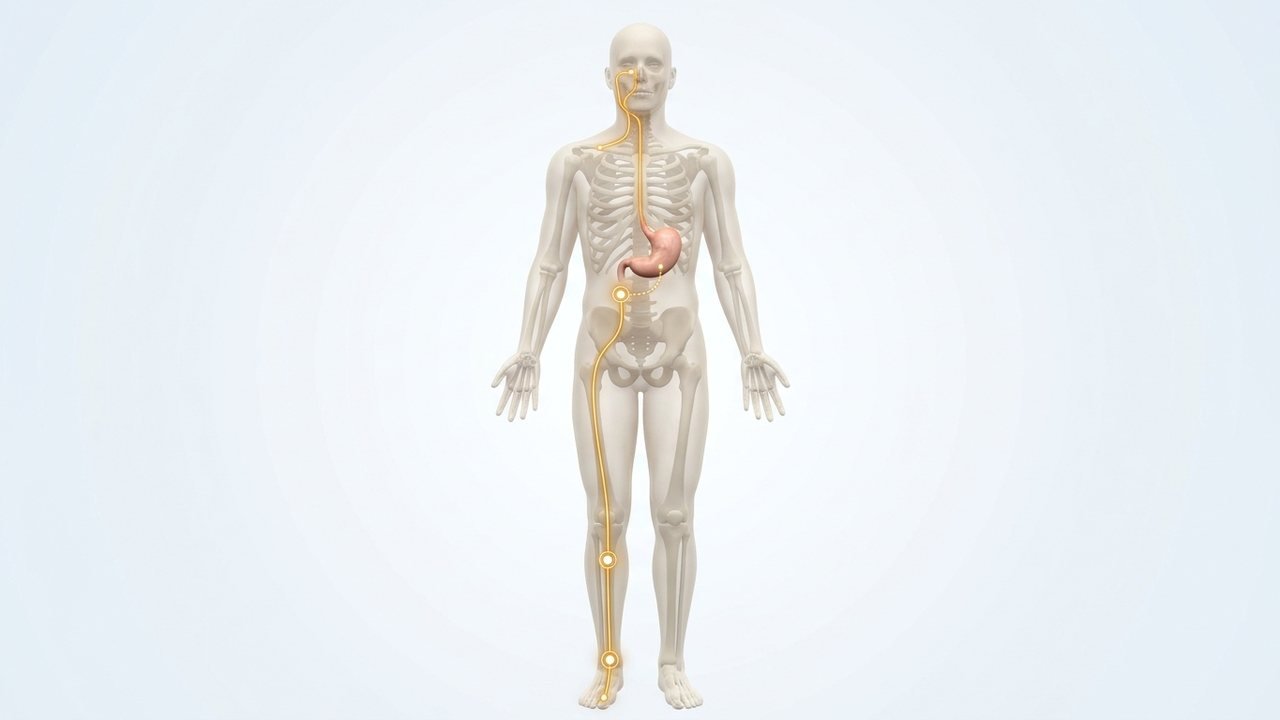
Stomach meridian (ST, 45 points): descending the anterior trunk past Tianshu ST25, down the tibialis anterior through Zusanli ST36 and Jiexi ST41 to the second toe.
It begins beside the nose, rises to the inner canthus, descends below the eye, circles the mouth, passes the angle of the jaw with a branch to the corner of the forehead.
Spleen meridian (SP, 21 points): rising from the big toe through Taibai SP3 and Sanyinjiao SP6 up the medial leg into the Spleen system, ending on the lateral flank at Dabao SP21.
It begins at the tip of the big toe, follows the inner edge of the foot, rises in front of the inner ankle, passes Sanyinjiao three cun above it, runs up the inner shin, inner knee and thigh, enters the abdomen to belong to the Spleen and connect with the Stomach, crosses the diaphragm, runs along the side of the chest and ends on the flank at Dabao.
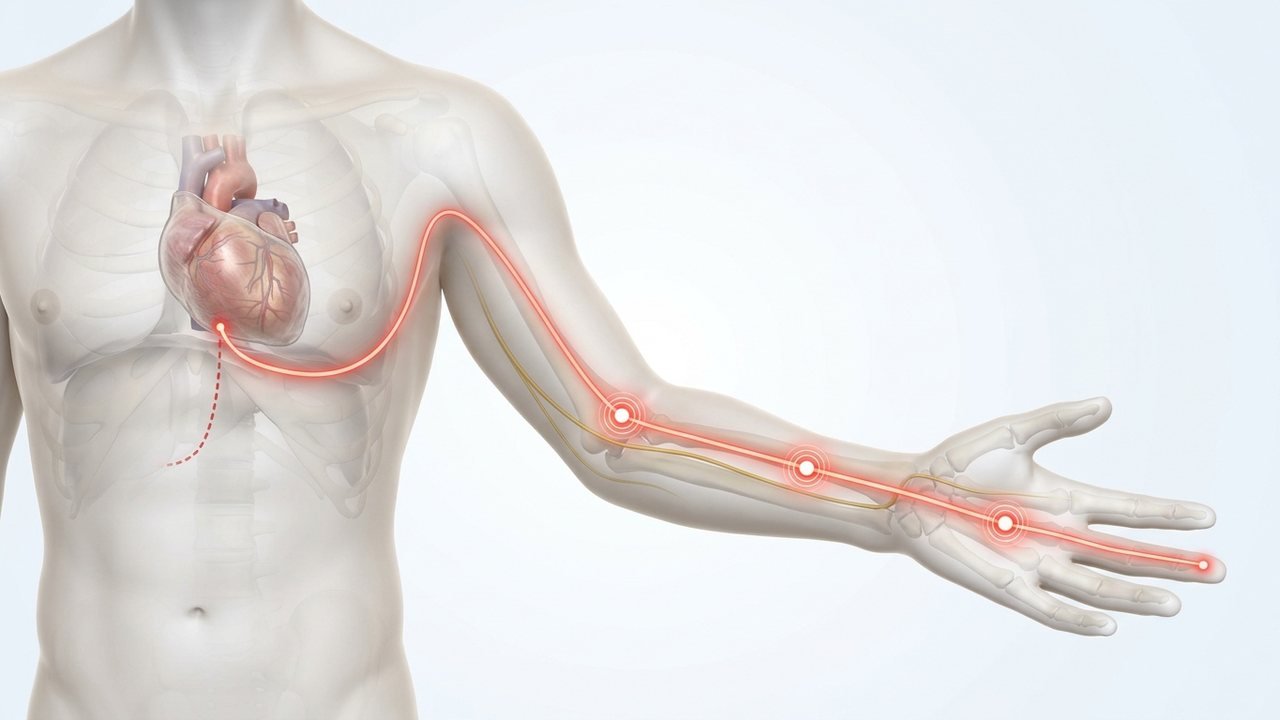
Heart meridian (HT, 9 points): emerging from the Heart at Jiquan HT1 in the armpit, following the ulnar border past Shaohai HT3 and Shenmen HT7 at the wrist to the little finger.
It begins in the Heart, emerges into the vessels around the heart, descends through the diaphragm to connect with the Small Intestine.
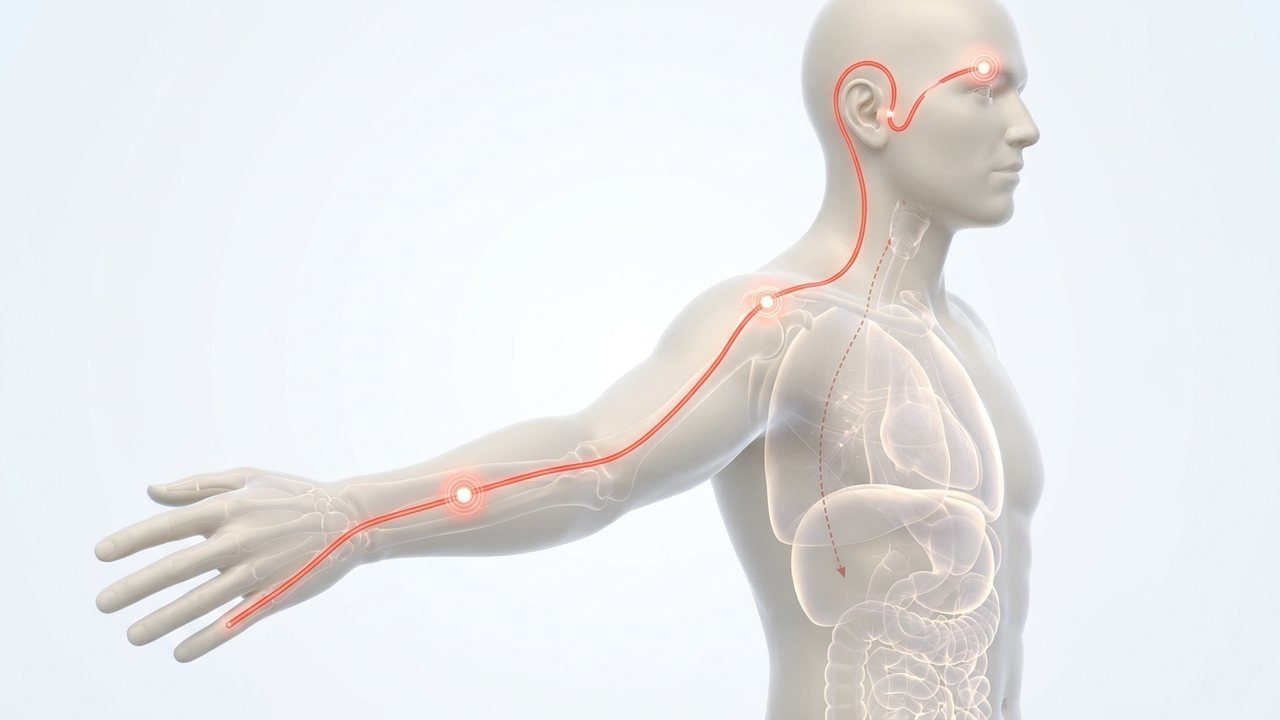
Small Intestine meridian (SI, 19 points): ascending from the little finger past Houxi SI3 across the shoulder blade at Tianzong SI11 to end before the ear tragus at Tinggong SI19.
It starts at the outer tip of the little finger, follows the ulnar edge of the hand through Houxi, rises past the wrist along the back inner forearm, passes the elbow between the olecranon and the inner epicondyle, ascends the back of the arm to the shoulder, zigzags over the shoulder blade at Tianzong, rises along the neck, crosses the cheek to the outer canthus, turns into the ear and ends in front of it at Tinggong.
Bladder meridian (BL, 67 points): arching from Jingming BL1 over the crown into two paraspinal lines past Shenshu BL23, meeting at Weizhong BL40 and passing Kunlun BL60 to the little toe.
It begins at the inner canthus at Jingming, rises over the forehead, meets at the vertex with a branch into the brain, and the main line descends the nape and splits into two lines running parallel on either side of the spine to the lower back.
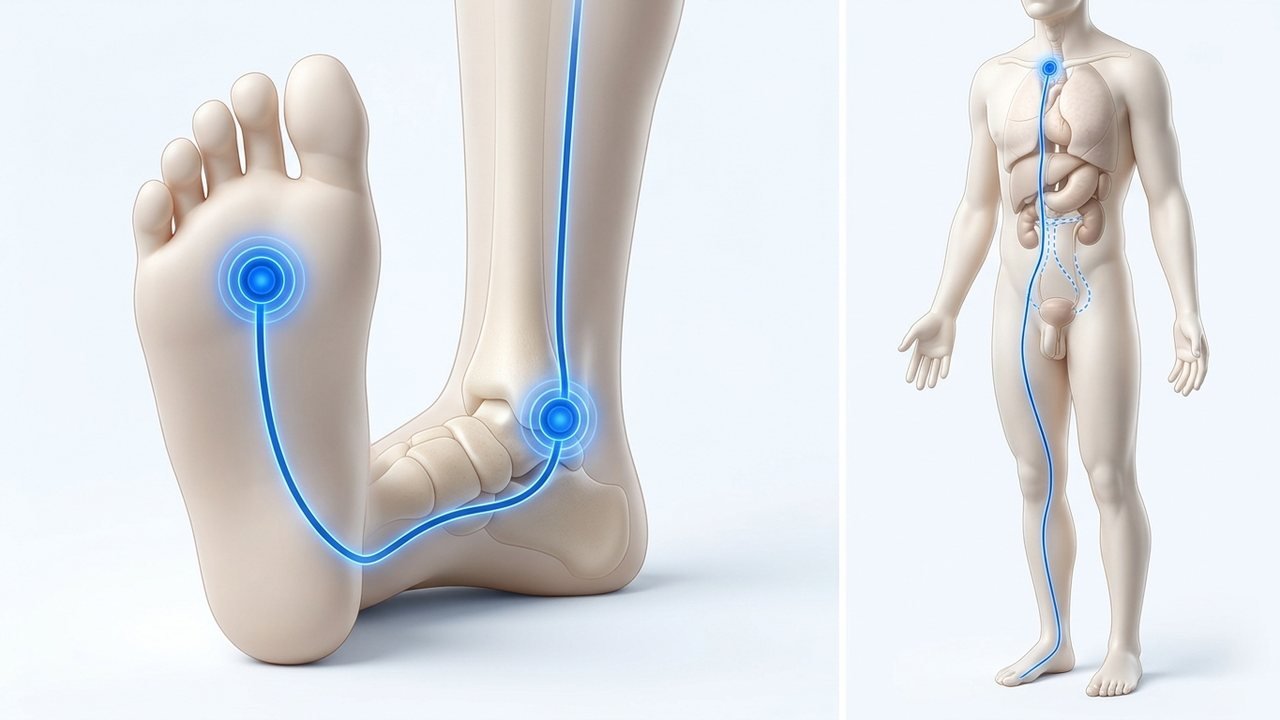
Kidney meridian (KI, 27 points): originating on the sole at Yongquan KI1, circling Taixi KI3 behind the inner ankle, entering the Kidneys and ascending the paramedian chest to Shufu KI27.
It begins under the little toe, slants into the centre of the sole at Yongquan, emerges below the navicular bone, circles behind the inner ankle at Taixi, enters the heel, ascends the inner calf, the inner back of the knee and thigh, threads through the spine, belongs to the Kidney and connects with the Bladder.
Pericardium meridian (PC, 9 points): emerging from the pericardium down the volar forearm midline over the median nerve through Quze PC3, Neiguan PC6 and Laogong PC8 to the middle finger.
It begins in the chest, belongs to the Pericardium, descends through the diaphragm to connect with the three burners.
Triple Burner meridian (TE, 23 points): ascending from the ring finger along the dorsal forearm midline past Waiguan TE5 and Jianliao TE14, looping behind the ear to Sizhukong TE23.
It begins at the tip of the ring finger, rises on the back of the hand between the two metacarpals, passes the wrist, runs up the middle of the back of the forearm through Waiguan, past the elbow and the back outer arm to the shoulder, enters the hollow above the collarbone, spreads in the centre of the chest, connects with the Pericardium and threads the diaphragm to belong to the three burners.
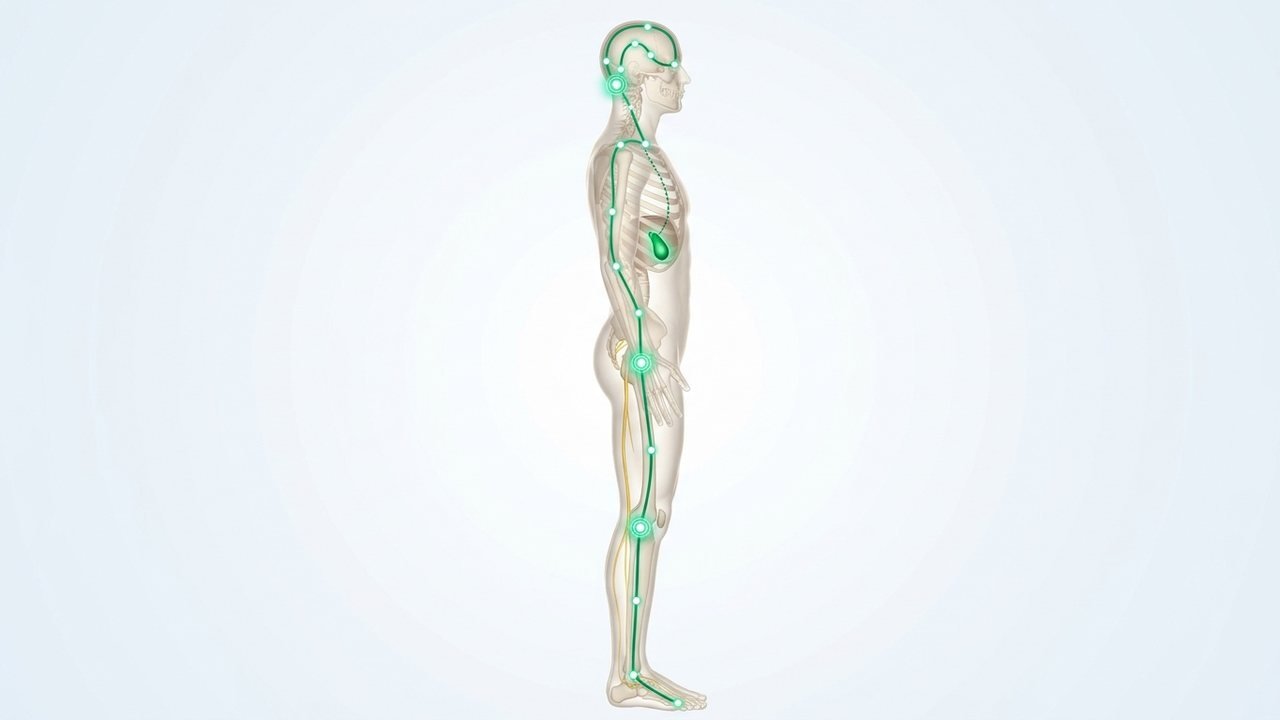
Gallbladder meridian (GB, 44 points): traversing the lateral body from temple to Fengchi GB20, down the flank past Huantiao GB30 and Yanglingquan GB34 below the fibular head to the fourth toe.
It begins at the outer canthus, rises to the corner of the forehead, descends behind the ear, zigzags several times over the head, descends the nape at Fengchi, crosses the shoulder at Jianjing and enters the hollow above the collarbone.
Liver meridian (LR, 14 points): ascending from the big toe past Taichong LR3 up the medial leg to Zhangmen LR13 and Qimen LR14, with deep branches entering the Liver and rising to the eye and vertex.
It begins at the hair tuft of the big toe, rises over the foot through Taichong, in front of the inner ankle, up the inner shin where it crosses the Spleen channel, past the inner knee and thigh into the pubic region, circles the genitals, rises to the lower abdomen beside the Stomach, belongs to the Liver, connects with the Gallbladder, threads the diaphragm, spreads in the ribs, rises behind the throat into the nasopharynx, joins the vessels of the eye, climbs the forehead and meets the Governing vessel at the vertex.
See which organ system your birth chart loads on the 3D Body
Enter your solar birth date, birth hour, and house facing to compute Zi Wei, BaZi, He Luo, and Feng Shui simultaneously across 6 anatomical stations and unlock your personal remedy dossier.