IQuick read in five sentences
Taoism is the native religion of China. It takes the Tao as its root and holds that the universe runs by a natural order that people should follow rather than resist. Taoism has two layers that readers often confuse: the philosophical layer of Laozi and Zhuangzi in the Spring and Autumn and Warring States periods, and the organized religious layer that appeared much later, usually dated to 142 CE when Zhang Daoling founded the Way of the Celestial Masters. Taoism worships the Three Pure Ones at the head of a very large pantheon, has its own scriptures gathered into the Daozang, and has priests, temples, talismans and ritual liturgies. Taoism has no unified worldwide church and no required initiation for lay people, so its followers can hardly be counted by ordinary statistical methods. For Vietnamese people, Taoism rarely appears under its own name. It lives inside things so familiar that nobody recognizes them as Taoist anymore: the Kitchen God, the Earth God, the paper talisman on the door, the bagua mirror, and the language of the five phases generating and overcoming one another.
This article moves through sixteen sections, from the setting in which Taoism was born to the point where it touches feng shui. Wherever there is disagreement, the article splits into two boxes: the according to the tradition box records what Taoism itself says about itself, and the according to the historical record box records what archaeology and textual scholarship can establish. The two accounts do not cancel each other out. They answer two different questions, and the reader should know which one they are reading.
IIThe setting in which it arose
To understand why Taoism says what it says, one has to look at the age that produced it. From 770 to 221 BCE the Zhou dynasty declined, power passed to the feudal states, and China entered more than five hundred years of continuous warfare that history calls the Spring and Autumn period and then the Warring States period. Fields lay fallow, people fled the fighting, and a single lifetime could see several changes of ruler. In that setting, the biggest question among thinkers was not how the universe was created, but how to bring peace to the world.
Each school answered in its own way. The Confucians said the rites and music must be restored and the hierarchy of superior and inferior rebuilt. The Mohists said one must practice universal love, caring for strangers as for one's own family. The Legalists said strict laws must be set down with clear rewards and punishments. The school later called Taoist gave an answer that ran the opposite way: the world is in chaos precisely because those above interfere too much. The more laws are added, the more people find ways around them. The more the worthy are exalted, the more rivalry is born. Leave all things to their own natural course and peace will come of itself. That is the root of the two words wu wei.
Three streams merging into one religion
The Taoism that came later did not spring from a single source. It is the confluence of at least three streams that were originally separate:
The thought of Laozi, Zhuangzi and Liezi on the Tao, Te, wu wei and naturalness. This is the theoretical part, and at first it carried no religious color.
The fangshi, or masters of techniques, of the Warring States, Qin and Han periods, who searched for elixirs of long life, refined cinnabar, and sailed in search of three islands of the immortals in the eastern sea. This is the practical part and the longing for immortality.
The worship of heaven and earth, rivers and mountains, ancestors, the kitchen god and the earth god, together with the divination, exorcism and rain-making of the shamans. This is the ritual part and the pantheon.
In the Western Han there was also a fourth stream called Huang-Lao thought, which joined the name of the Yellow Emperor to that of Laozi. The court used it as the guiding policy in the early years of the Han: lower taxes, lighter punishments, and letting the people recover their strength after the wars. It was the prestige of Huang-Lao that raised Laozi from the author of a book to a figure of divine stature, opening the way for his later elevation as Taishang Laojun, the Most High Lord Lao.
IIILaozi and Zhang Daoling
Taoism has two figures who are often both loosely called its founder. Laozi is the one who laid the intellectual foundation and was later worshipped as a god. Zhang Daoling is the one who founded the religious organization. The two roles are entirely different and stand more than six hundred years apart.
Laozi
According to Taoist tradition, Laozi's family name was Li, his given name Er, and his courtesy name Dan. He came from Ku county in the state of Chu and served as keeper of the archives of the Zhou court. Seeing the Zhou in decline, he rode a green ox westward. At the Hangu Pass, the keeper of the pass, Yin Xi, read in the sky that a true man was about to pass through, and detained him to ask for teaching. Laozi left five thousand characters and departed, and nobody knows where he went. Those five thousand characters are the Tao Te Ching. Taoism later honored him as Taishang Laojun, the Most High Lord Lao, one of the Three Pure Ones, and holds that Lord Lao has descended to the world many times across the ages to teach the Way.
The Records of the Grand Historian by Sima Qian, written around 100 BCE, already several centuries after Laozi, is the oldest source that writes about him. What stands out is that Sima Qian himself was not sure: he gives three different possibilities for Laozi's identity and closes with a very honest remark that the world does not know whether any of them is right.
As for the text, two excavations have completely changed scholarly understanding. In 1973 at Mawangdui, Changsha, two copies of the Tao Te Ching written on silk were found, buried around the early Han, in which the Te section comes before the Tao section, the reverse of the received text. In 1993 at Guodian, Jingmen, bamboo slips were found carrying part of the content, dated to around 300 BCE. They are the oldest version now in existence, and their content is much shorter than today's eighty-one chapters.
Since then most scholars have leaned toward the view that the Tao Te Ching was not written by one person at one time, but is an anthology of teachings built up gradually over several generations and then attributed to a single name, Laozi. This does not diminish the value of the book, but it does mean that the question of whether Laozi really existed will never have a definitive answer.
Zhang Daoling
In 142 CE, at Mount Heming in the land of Shu, Zhang Daoling founded the Way of the Five Pecks of Rice, named after the rule that anyone joining contributed five pecks of rice. This is the true moment when Taoism became a religion: it had a leader, a ranked organization, membership registers, its own rites, and scriptures and talismans handed down through a lineage.
What set this organization apart from the other mystical groups of its time was that it also took on administration and relief. In the territory governed by the Way of the Five Pecks of Rice there were roadside lodges that gave free meals to travelers, and a rule that those who committed offenses confessed and did public work to atone instead of suffering heavy punishment. Zhang Daoling's grandson Zhang Lu held the land of Hanzhong for more than twenty years as a genuine theocratic government, submitting to Cao Cao only in 215. From then on the Zhang family held the hereditary title of Celestial Master, and the Way of the Celestial Masters became the root of today's Zhengyi school.
Alongside Zhang Daoling there was also the Way of Great Peace of Zhang Jue, which was the force behind the Yellow Turban uprising of 184. The two groups were contemporaries and both carried a Taoist color, but they were different and did not descend from one another. Popular books often lump them together, leading to the misunderstanding that Taoism began with a rebellion. The Way of Great Peace dissolved after the uprising failed. The line that survives to this day is the Celestial Masters line.
IVA two thousand year timeline
Taoism did not travel in a straight line. It rose and fell with each dynasty, at times a state religion, at times suppressed, at times almost dissolved into folk belief before crystallizing again. Below are the turning points large enough to change the direction of the whole stream.
- khoảng 300 TCNThe Guodian bamboo slipsThe oldest surviving version of the Tao Te Ching, written on bamboo slips and excavated in 1993. Its content is shorter than the received text, showing that the book was still taking shape.
- khoảng 168 TCNThe Mawangdui silk manuscriptsTwo copies written on silk and buried in a tomb, excavated in 1973. The Te section comes before the Tao section, unlike the order familiar today.
- Thế kỷ 2 TCNHuang-Lao thought flourishesThe Western Han court adopts a policy of minimal interference so the people can recover. Laozi is raised to divine stature.
- 142Zhang Daoling founds the Way of the Five Pecks of RiceThe moment Taoism becomes an organized religion. The Celestial Masters line begins here.
- 184The Yellow Turban uprisingThe Way of Great Peace under Zhang Jue rises up, shakes the Eastern Han and is crushed. One branch of Taoism ends here.
- khoảng 317Ge Hong writes the BaopuziThe book systematizes alchemy and the arts of nourishing life, turning the pursuit of immortality from rumor into a discipline with methods.
- Thế kỷ 4 tới 5The Shangqing and Lingbao scriptures appearTwo great scriptural corpora take shape, opening two separate traditions of practice. Lu Xiujing edits the Lingbao texts, and Tao Hongjing founds the Maoshan school.
- 618 tới 907The Tang dynasty claims Laozi as its ancestorThe Tang imperial house bore the surname Li and adopted Laozi as its ancestor. Taoism rose to the rank of state religion, its scriptures entered the civil service examinations, and Emperor Xuanzong of Tang wrote his own commentary on the Tao Te Ching.
- 1167Wang Chongyang founds the Quanzhen schoolIn Shandong a new line is born that has its priests leave home, keep precepts, eat vegetarian food, live in monasteries and practice inner alchemy. This is the greatest turning point of the second millennium.
- 1222Qiu Chuji meets Genghis KhanThe Quanzhen master travels tens of thousands of li to Central Asia and urges the Mongol ruler to reduce the killing. Quanzhen is exempted from tax and corvée and spreads across the north.
- Thế kỷ 15The Ming venerates Zhenwu and builds WudangThe Yongle Emperor builds the temple complex on Mount Wudang and makes Zhenwu, the Perfected Warrior, the protector deity of the state.
- 1445The Zhengtong Daozang is printedThe vast Daozang of more than five thousand fascicles is printed, the foundation of all Taoist studies to this day. In 1607 a supplement was added in the Wanli reign.
- 1966 tới 1976The Cultural RevolutionTemples are destroyed, scriptures burned, and priests forced to return to lay life. Taoism in mainland China nearly loses its line of transmission within a single generation.
- Từ 1980 tới nayRevival and international scholarshipTemples reopen and training schools for priests resume, while Taoism becomes an independent field of study in Western universities.
VHow it spread beyond China
Taoism spread in a way quite unlike Buddhism or Christianity. It had almost no missionary movement: it sent nobody to preach in other lands, translated no scriptures into foreign languages to propagate the faith, and set up no rite of conversion. It followed Chinese migrants, followed books written in Chinese characters, and seeped into local beliefs and stayed there under another name.
| Region | Period | Traces that remain |
|---|---|---|
| Taiwan | From the 17th century with settlers from Fujian | The place where Taoism has kept its most continuous line. Zhengyi temples and rites remain intact and registered adherence is high |
| Hong Kong and Macau | 19th to 20th century | Large temples still active, with many altars and charitable societies |
| Vietnam | From the period of Chinese rule, deepening from the 10th century | Not a separate church, but dissolved into folk belief, Đạo Mẫu (the Mother Goddess religion), sorcery, and the whole system of feng shui and divinatory arts |
| Korea | The Three Kingdoms period of Korea | Influence on thought and medicine, without becoming an independent church |
| Japan | The Nara and Heian periods | Yin-yang and five-phase theory became Onmyodo, the Way of Yin and Yang, within the court, and the onmyoji was an official post |
| Overseas Southeast Asia | 19th to 20th century | Temples of Chinese communities in Singapore, Malaysia, Indonesia and Thailand |
| The West | From the 19th century, growing from the 1960s | Mainly through translations of the Tao Te Ching, qigong, tai chi, and academic study in universities |
One thing is worth saying about the book: the Tao Te Ching is one of the most translated Chinese books in the world. But most Western readers approach it as a work of philosophy or literature, detached from Taoism as a religion with gods and rituals. Hence the paradox: the founding book of Taoism is famous across the world, while Taoism itself is understood only thinly.
VICore teachings
Taoism has no creed that every follower must learn by heart. But a few ideas run all the way from the Tao Te Ching to the rituals performed in temples today.
The Tao
The word Tao 道 literally means the way or the road. In Taoism it refers to the principle that exists before heaven and earth, gives birth to all things and moves all things, yet cannot be properly named. The opening line of the Tao Te Ching says exactly that: the Tao that can be spoken is not the eternal Tao. This is the fundamental difference from religions that worship a creator god with a will and a spoken word. The Tao gives no commands, rewards and punishes nobody, and hears no prayers. It simply operates.
Te
Te 德 is the Tao as it appears in each individual thing. A tree has the te of a tree, water has the te of water, a person has the te of a person. To live with te in the Taoist sense is not to do many good deeds so that others will praise you, but to keep true to the nature heaven gave you, without embellishment and without straining to be something you are not.
Wu wei and naturalness
Wu wei 無為 is the most misunderstood idea of all. It does not mean doing nothing. It means not doing what goes against the natural order, not forcing, not adding to what is already sufficient. The gardener who waters at the right time practices wu wei. The one who pulls on the seedling to make it grow faster practices its opposite, and the plant dies. Bound up with wu wei is ziran 自然, whose original sense is being so of itself, not the natural world of trees and grass as the word is understood today.
Reversal and softness
Taoism perceives a law: whatever reaches its extreme turns back. The moon waxes and then wanes, the tide rises and then ebbs, power grows and then declines. Because it trusts this law, Taoism prizes the soft, the low and what stands behind. Water is the image most often invoked: the softest thing, content to stay in the lowest place, yet nothing can defeat it as it wears away stone. From this come the three treasures named in the Tao Te Ching: first compassion, second frugality, third not daring to put oneself ahead of the world.
Jing, Qi, Shen and the cultivation of the body
At the religious layer, Taoism adds a level of practice that the philosophical layer lacks: cultivation in order to live long and become an immortal. The human body is seen as made of three precious things, called the three treasures: Jing, the essence, is the material foundation, Qi, the vital breath, is the operating force, and Shen, the spirit, is the luminous awareness. Cultivation means conserving jing, refining qi and nourishing shen.
Refining elixirs from minerals such as cinnabar, sulfur, lead and mercury in the hope that drinking them would grant immortality. It flourished under the Tang and was also what poisoned more than a few emperors. From the Song onward it gradually faded.
Using one's own body as the furnace and jing, qi and shen as the ingredients, refined through breathing, seated meditation and guiding qi with the mind. This became the main current from the Song onward and is the root of today's qigong.
Moderate eating and drinking, sleep in step with the seasons, daoyin exercises to stretch the sinews and bones, and keeping the heart free of excessive desire. This part soaked deep into traditional East Asian medicine.
Many scriptures, most clearly the Taishang Ganying Pian, teach that fortune and misfortune are brought on by oneself and that every good and evil deed is recorded in a ledger. To live long, one must first refrain from doing evil.
VIIThe pantheon
This is where new readers are easily overwhelmed. Taoism has a pantheon so large that no book lists it in full, and its arrangement mirrors the earthly bureaucracy exactly: there is a court in heaven, with ministries, offices, registers and reporting deadlines. Once that principle is grasped, every deity has a clear place.
The Three Pure Ones, the three highest
| Rank | Full title | Role |
|---|---|---|
| Jade Purity | Yuanshi Tianzun, the Celestial Worthy of Primordial Beginning 元始天尊 | The first rank, representing the origin of the universe, before heaven and earth were separated |
| Highest Purity | Lingbao Tianzun, the Celestial Worthy of Numinous Treasure 靈寶天尊 | The middle rank, representing the moment when qi divided into yin and yang, keeper and transmitter of the scriptures |
| Great Purity | Daode Tianzun, the Celestial Worthy of the Tao and Te 道德天尊, that is, Taishang Laojun | The third rank, who descends to the world in human form to teach, the deified Laozi |
The Four Sovereigns and the governing deities
Below the Three Pure Ones are the Four Sovereigns, the four who directly oversee the affairs of heaven and earth. The most familiar of them to Vietnamese people is the Jade Emperor. One point is often confused: in the Taoist system the Jade Emperor is not the highest rank. He is the head of the governing apparatus, while the Three Pure Ones are the supreme rank. In Vietnamese and Chinese folk belief it is the reverse, and the Jade Emperor is treated as almost the highest, because ordinary people find it easier to picture a king in heaven than an abstract principle.
Also called the Supreme Emperor of the Dark Heaven, guardian of the north, in charge of exorcism and military affairs. Venerated by the Ming dynasty and linked to Mount Wudang.
The Official of Heaven bestows blessings, the Official of Earth pardons sins, the Official of Water dispels misfortune. They correspond to the three great full moon festivals of the year: the Upper, Middle and Lower Primes.
Governs Mount Tai and also human life and death, keeping the register of lifespans.
In charge of letters and examinations. Candidates in the old days would pray to him before sitting the exams.
None other than Guan Yu of the Three Kingdoms era, brought into the Taoist pantheon as the patron of righteousness and loyalty, later a god of wealth for merchants.
Eight immortals: Lü Dongbin, Zhang Guolao, He Xiangu, Zhongli Quan, Cao Guojiu, Li Tieguai, Lan Caihe and Han Xiangzi. More famous in folk art and opera than in ritual.
The god of the stove, who ascends to heaven each year to report on the household. This is the Ông Táo whom Vietnamese families send off on the twenty-third day of the twelfth lunar month.
Gods who govern a plot of land and a community respectively, the lowest and yet closest to the people in the whole apparatus.
Many people think Taoism worships the Buddha because Chinese temples often show a statue of Guanyin standing beside the Jade Emperor. In fact this is religious syncretism at the folk level, where people worship whichever deity is believed to answer prayers, not Taoist doctrine admitting the Buddha into its pantheon. In a properly constituted Taoist temple, the main altar is still the Three Pure Ones.
VIIIScriptures and the Daozang
All Taoist scriptures are gathered into one enormous collection called the Daozang 道藏, structured as Three Caverns and Four Supplements: three main sections corresponding to the three great scriptural traditions, and four supplementary sections. The Zhengtong Daozang printed in 1445 contains more than five thousand fascicles, and in 1607 a supplement was added in the Wanli reign.
| Scripture | Date | Core content |
|---|---|---|
| Tao Te Ching | Took shape around the 4th to 3rd century BCE | Five thousand characters in eighty-one chapters, on the Tao, Te, wu wei, and the soft overcoming the hard. The foundation of everything that followed |
| Zhuangzi | 4th to 3rd century BCE | The book of Zhuangzi, also known as the Nanhua Zhenjing. On the absolute freedom of the spirit and the relativity of every distinction between right and wrong, life and death |
| Chongxu Zhenjing | Took shape late, around the 4th century | The book of Liezi. Contains many famous parables such as the Foolish Old Man who moved the mountains and the man of Qi who feared the sky would fall |
| Yinfu Jing | Disputed, possibly Tang dynasty | Just over three hundred characters, extremely condensed, on the way of heaven and the workings of change. Used by military strategists and inner alchemists alike |
| Qingjing Jing | Around the Tang dynasty | The most widely used daily recitation scripture, teaching how to still the heart and unite with the Tao |
| Huangting Jing | 3rd to 4th century | The foundational scripture of visualization practice and inner alchemy, describing the gods dwelling in each part of the body |
| Taishang Ganying Pian | Around the Song dynasty | A morality book that spells out good and evil deeds and their consequences. The most widely circulated Taoist text among ordinary people |
| Zhouyi Cantong Qi | 2nd century | Joins the Book of Changes to the art of alchemy, regarded as the ancestor of all alchemical texts |
| Baopuzi | Around 317 | Ge Hong's systematic account of the arts of the immortals, medicinal substances, talismans, and how to keep oneself safe in the world |
One thing to know before reading: Taoist scriptures are not the pronouncements of a supreme being in the sense of the monotheistic religions. Most are presented as a Celestial Worthy expounding to an assembly of immortals, or as the notes of a practitioner recording what they have realized. This is why the Daozang contains philosophy, medical books, alchemical manuals, ritual handbooks and even maps of mountains. It resembles a library more than a single holy book.
IXIncantations and talismans
Besides scriptures to read and understand, Taoism has incantations to recite and talismans to draw. Both belong to the practical side, and both are the most misread when taken out of context.
Incantations
Taoist incantations are for the most part intelligible Chinese, not transliterations from another language as most Buddhist mantras are. An incantation usually has a three-part structure: it names the deity being invoked, states what needs to be done, and ends with a command. The most familiar closing line is ji ji ru lü ling, "quickly, quickly, in accordance with the statutes and ordinances," which was originally the closing formula of Han dynasty administrative documents, meaning carry this out at once as the law requires. That small detail says a great deal about how Taoism pictures the sacred realm: a system with rules and procedures, in which the officiant is someone with the authority to send official dispatches to it.
Recited before a rite to keep one's speech clean. Belongs to the same group as the incantations for purifying the heart and purifying the body.
The most widely used incantation for personal protection, opening with a line on the root of heaven, earth and all breaths.
Recited when breaking ground, setting up an altar, or installing a new shrine, to settle the earth god of that place.
Used when inviting a deity to take its seat and when consecrating a statue, tablet or ritual implement by dotting the eyes.
Talismans and registers
Fu 符 originally meant a tally: in ancient times it was split in two, each party kept one half, and when the halves matched, trust was established. The Taoist talisman carries exactly that meaning: it is a token of trust between the officiant and the sacred realm. Lu 籙 is the register listing the divine generals that a priest is permitted to command, conferred according to the rank of ordination. In Taoism's own understanding, a person who has not received a register cannot draw an effective talisman.
Three things commonly said wrongly about talismans and incantations. First, talismans are not meaningless scribbles: most are stylized Chinese characters, names of deities and astral symbols, following their own rules. Second, within the Taoist system itself, a talisman has no power of its own. Its efficacy comes from the register and the moral discipline of the one who draws it, so buying a mass-printed talisman at the market lies outside the teaching altogether. Third, Taoism does not teach the use of talismans to harm people: its codes of precepts all class the use of magic to do harm as a grave offense. What folk usage calls harmful sorcery and charms mostly belongs to local shamanic traditions, not to Taoism.
XRituals and ritual implements
Taoist ritual is known collectively as zhaijiao 齋醮. Zhai is the purification before the rite: bathing, eating vegetarian food, avoiding idle talk, and repenting past faults. Jiao is the main altar ceremony, in which the priests present memorials, invoke the deities, perform music and pace out ritual diagrams. A large ceremony can last several days and nights with dozens of officiants.
Documents presented to the deities, written in administrative form, stating clearly the name, place of origin and request. After being read they are burned, that is, sent up by fire.
A pattern of steps tracing the shape of the Big Dipper during the rite, said to imitate the gait of Yu the Great. This is one of the oldest features still preserved.
Implements for exorcism. Peachwood was held in ancient belief to carry strong yang qi, and the blade is engraved with the seven stars of the Big Dipper.
Objects symbolizing the authority conferred through the register, like the seal of an official post.
Hung above the door to reflect harmful qi. This implement passed from Taoism into folk feng shui and became so common that nobody remembers its origin.
Both the medicine container of the immortals and a symbol of the universe in miniature, narrow at the mouth and wide in the belly, drawing in good qi and holding it.
The hand-held whisk carried by priests, symbolizing the sweeping away of worldly dust from the heart.
A Taoist altar ceremony has its own orchestra. Temple music is listed as intangible cultural heritage in many places.
The three greatest festivals of the year are the Three Primes: the full moon of the first lunar month is the Upper Prime, when the Official of Heaven bestows blessings, the full moon of the seventh month is the Middle Prime, when the Official of Earth pardons sins, and the full moon of the tenth month is the Lower Prime, when the Official of Water dispels misfortune. Vietnamese people still keep the full moons of the first and seventh months very strongly, though most now understand them in the Buddhist sense as the Vu Lan festival. The two layers of meaning have been laid over one another across many centuries.
XIThe schools
From the Yuan dynasty onward Taoism settled into two great lines, and that division is still used today. The difference between them lies not in whom they worship but in how their priests live.
| Aspect | Zhengyi | Quanzhen |
|---|---|---|
| Origin | The Way of the Celestial Masters of Zhang Daoling, 142 CE | Founded by Wang Chongyang in 1167 in Shandong |
| Priests | Live at home, may marry, eat meat, and pass the vocation down through the family | Leave home, keep precepts, eat vegetarian food and live in monasteries |
| Focus | Talismans and registers, altar ceremonies, exorcism, serving the needs of the people | Inner alchemy, seated meditation, cultivating the heart and refining the nature |
| Ancestral seat | Mount Longhu, Jiangxi | The White Cloud Temple in Beijing, with the Longmen branch the most prominent |
| Strongholds | Southern China, Taiwan, and overseas Chinese communities | Northern China |
Formed in the 4th century and systematized by Tao Hongjing. It emphasized visualization and scripture recitation over talismans, and had great influence on the scholar-official class.
Arose in the same period, strong in altar rites and the salvation of the dead. Many funeral rites today still bear Lingbao traces.
The largest branch of Quanzhen, founded by Qiu Chuji, with its center at the White Cloud Temple.
Linked to Mount Wudang and the cult of Zhenwu, famous for its internal martial arts.
Of the Song and Yuan periods, it made loyalty and filial piety the foundation of cultivation, close to Confucian ethics.
XIIFollowers, and why they cannot be counted
This is the section where the library must say something plainly: there is no reliable figure for the number of Taoists in the world, and any page that offers a neat round number should be read with caution.
Four reasons the count does not work
Ordinary people burn incense at temples, draw fortune sticks and make offerings to the stars without ever registering as followers. Only ordained priests are on any register.
An East Asian family may keep a Buddha in the house, make offerings to the Kitchen God in the kitchen, worship ancestors in the central room, and visit the Mother Goddess temple. Ask them which religion they follow and the answer is usually all of them, or none.
A great many practices of Taoist origin have separated from Taoism and live on as custom. People still perform them without regarding it as practicing a religion.
Some reports separate out a folk religion category, others group Taoism under other religions. The two methods produce two very different pictures.
| Group | Population in 2020 | Share |
|---|---|---|
| Christians | 2.3 billion | 28.8 percent |
| Muslims | about 2 billion | 25.6 percent |
| Religiously unaffiliated | 1.9 billion | 24.2 percent |
| Hindus | 1.2 billion | 14.9 percent |
| Buddhists | 324 million | 4.1 percent |
| Other religions, including Taoism | not separated out | 2.2 percent |
| Jews | 14.8 million | about 0.2 percent |
The last group in the table lumps Taoism together with Jainism, Shinto, Sikhism, Zoroastrianism and many other faiths, so the 2.2 percent figure cannot be taken as the number of Taoists. In earlier reports Pew separated out a folk religion category of several hundred million people, mostly in China, and that category contained many practices with a Taoist color. But even that is a group far broader than Taoism.
The numbers that can be counted
Instead of counting followers, a more reliable approach is to count institutions and professional clergy. In mainland China, the Chinese Taoist Association reports thousands of active temples and tens of thousands of priests and clergy. In Taiwan, which has a clear system of religious registration, Taoism is the religion with the largest number of registered temples, accounting for about four fifths of the total and far ahead of Buddhism, with 9,485 Taoist temples against 2,355 Buddhist temples according to the Ministry of the Interior of Taiwan. Overseas, Taoist temples are concentrated in Chinese communities in Southeast Asia and North America.
The most honest conclusion this library can offer is this: the influence of Taoism is many times greater than its number of followers, and that is the right way to measure the stature of this religion.
XIIITaoism in Vietnam
Taoism reached Vietnam very early, through officials and books during the period of Chinese rule, then deepened from the 10th century onward. But it took a path quite different from Buddhism: Buddhism built a church, while Taoism dissolved and seeped in.
According to figures published by the Government Committee for Religious Affairs on August 1, 2025, marking the seventieth anniversary of the agency, Vietnam recognizes 16 religions with 43 religious organizations registered to operate, over 27.7 million followers, more than 54,500 dignitaries, nearly 145,000 clergy and 29,890 places of worship. The list of 16 religions does not include Taoism as a separate legal entity. This does not mean Taoism is absent from Vietnam. It means Taoism exists there as cultural influence and belief rather than as a church.
Where Taoism appears in Vietnamese life
Ông Táo (the Kitchen God) in the kitchen, Ông Địa (the Earth God) and Thần Tài (the God of Wealth) in a corner of the house, the New Year pole at Tết, and the custom of star offerings to avert misfortune at the start of the year. All of these have Taoist roots.
The word quán in Trấn Vũ Quán and Bích Câu Đạo Quán was originally the name for a Taoist establishment. Đền Quán Thánh in Hanoi, dedicated to Huyền Thiên Trấn Vũ, is an old Taoist center.
A native Vietnamese belief, but one that borrowed many layers from Taoism: the system of palaces, the petitions, the talismans and incantations, and the role of the spirit mediums, which resembles that of a Taoist ritual priest.
Those who performed ceremonies in the old villages used petitions in Chinese characters, talismans and ritual implements in the Taoist manner, though they did not call themselves Taoist priests.
The ideal of withdrawal, of retreating from the world to delight in mountains and rivers, found in Nguyễn Trãi, Nguyễn Bỉnh Khiêm and Nguyễn Công Trứ, all carries the spirit of Laozi and Zhuangzi.
The whole system of arts that Vietnamese people use to choose dates, orient houses and read destinies stands on the Taoist worldview. The next section deals with this in its own right.
Vietnamese people often use the words Taoist priest and sorcerer interchangeably, and films only add to the confusion. A Taoist priest in the strict sense is someone who has left home or been ordained within a Taoist lineage, with a teacher, a register and precepts to keep. The village sorcerer of Vietnam is usually a freelance practitioner who learned the trade by word of mouth, mixing many sources. The two roles are not the same.
XIVTaoist roots in feng shui and the divinatory arts
This is a section that only a library built by a working practitioner of destiny analysis could write properly. A great many people use feng shui every day without knowing what worldview they are standing on. Knowing the root explains why these arts say what they say, and also shows which parts are the core and which were added by later generations.
One worldview, many arts
The common foundation of every East Asian divinatory art has three layers, all three systematized by Taoism and preserved in the Daozang:
All things are qi gathering and dispersing. When qi gathers it takes form, when it disperses the form dissolves. Land has its qi, a house has its qi, a person has their qi, and the three interact. Without the concept of qi there is no feng shui.
Everything divides into two aspects that depend on each other, with yang within yin and yin within yang, and reversal at the extreme. This is why feng shui never speaks of anything as absolutely good or absolutely bad.
Metal, Wood, Water, Fire and Earth, with their cycles of generation and overcoming, used as a common code for converting between directions, colors, seasons, organs, stems and branches, and stars.
Familiar things whose root is Taoist
| Familiar practice | Taoist root |
|---|---|
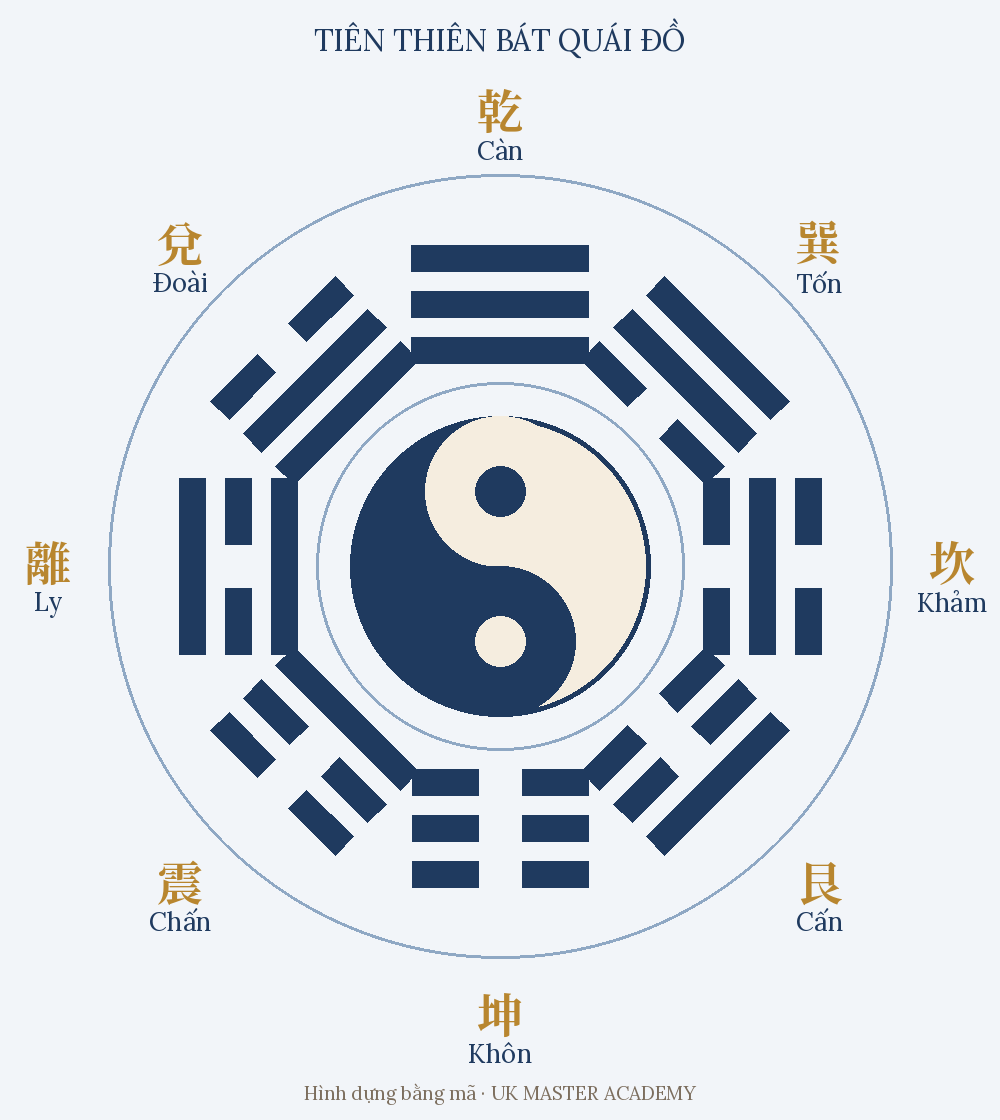
| A bagua hung above the door | The bagua diagram is an implement for protecting the home in Taoist ritual manuals. The bagua mirror was originally a ritual object, not a decoration |
| The Hetu and Luoshu | Two numerical diagrams that Taoism preserved and commented on for a thousand years, the foundation of the nine palaces and every flying star method |
| Nine palaces flying stars | The method of placing nine stars in nine palaces according to the Luoshu, originating in the Taoist divinatory arts and later becoming the backbone of Xuan Kong |
| Three Periods and Nine Cycles | The division of time into three periods and nine cycles following planetary cycles, drawn from Taoist calendrics and astronomy |
| Star offerings to avert misfortune | A Taoist rite honoring the nine stars that govern destiny. Today it is often performed in Buddhist pagodas and so is mistaken for a Buddhist ceremony |
| Date selection | The systems of auspicious and inauspicious spirits, the twelve day officers and the twenty-eight lunar mansions all sit in the calendrical books of the Daozang |
| The Kitchen God and Earth God in the home | Two deities with official duties in the Taoist pantheon, keeping the ledger of the household's good and evil deeds |
| Protecting the home, installing altars, moving in | Originally Taoist ritual programs with petitions, incantations and altar ceremonies, later abridged into folk rites |
This does not mean every divinatory art was born from Taoism. Zi Wei Dou Shu, Ba Zi and the Book of Changes each have their own line of development and their own authors, and many scholars class them as divinatory arts rather than as Taoism in the religious sense. The more accurate statement is this: they share one cosmological language with Taoism, and Taoism is where that language was recorded, systematized and most fully preserved.
Two things must be kept clear, because confusion here leads to misguided behavior. First, consulting feng shui is not the same as following Taoism. A person of any religion, or of none, can have the orientation of their house assessed without changing their beliefs at all, just as studying traditional East Asian medicine does not mean joining a religion. Second, Taoism does not teach that feng shui decides everything. The Taishang Ganying Pian itself, the most widely circulated Taoist morality book, places the accumulation of merit above every technique and states plainly that fortune and misfortune are brought on by oneself. That is also what Master Ưng Khiêm tells his clients: good land keeps a person of virtue, and for a person without virtue even good land cannot hold.
XVNine common misunderstandings
This section gathers the things most often said wrongly about Taoism, including in popular Vietnamese books.
No. Taoist philosophy is the school of thought of Laozi and Zhuangzi. Taoism the religion has deities, scriptures, rituals and organization, and took shape six hundred years later. The two are related but not identical.
No. Laozi left the intellectual foundation and was later worshipped as a god. The founder of the religious organization was Zhang Daoling, in 142 CE.
No. Wu wei means not doing what goes against the natural order and not forcing things. Taoism has an entire tradition of medicine, alchemy, temple building and charitable relief, all very concrete activities.
Not in the Taoist system. The Jade Emperor heads the governing apparatus, while the supreme rank belongs to the Three Pure Ones. The idea that the Jade Emperor is highest belongs to folk belief.
No. Talismans and registers are one part of the practice of some schools. Taoism also has philosophy, medicine, early chemistry, astronomy, calendrics, music, architecture, and a very rigorous tradition of cultivating the heart.
The opposite. Taoist codes of precepts class the use of magic to do harm as a grave offense. What folk usage calls harmful sorcery mostly belongs to local shamanic traditions.
That contrast does not hold up. Both religions have a deep philosophical layer and a ritual layer rich in popular devotion. Comparing the lower layer of one with the higher layer of the other is an unfair comparison.
The root is a Taoist rite honoring the nine stars that govern destiny. Today many Vietnamese pagodas perform it, so people take it for a Buddhist ceremony. Buddhist monastics themselves have spoken out about this more than once.
No. Temples remain active in China, Taiwan, Hong Kong and overseas Chinese communities. Taoist studies remains an independent field of research in universities around the world.
?Quick Questions
What is Taoism, in one sentence
Taoism is the native religion of China. It takes the Tao as its root, teaches living in accordance with the natural order, worships the Three Pure Ones at the head of a large pantheon, has its own scriptures gathered in the Daozang, and has priests, temples and the zhaijiao rituals.
How do Taoism the religion and Taoist philosophy differ
Taoist philosophy is the school of thought of Laozi and Zhuangzi, born in the Spring and Autumn and Warring States periods, with no deities or rituals. Taoism the religion is an organized faith, usually dated to 142 CE when Zhang Daoling founded the Way of the Celestial Masters. The religion takes Taoist philosophy as its foundation and adds a pantheon, scriptures, talismans and rituals.
Who founded Taoism
The founder of the religious organization was Zhang Daoling, in 142 CE at Mount Heming in the land of Shu, under the name the Way of the Five Pecks of Rice, later called the Way of the Celestial Masters. Laozi laid the intellectual foundation and was honored as Taishang Laojun, but he was not the founder of the religion.
How many followers does Taoism have
There is no reliable figure. Taoism has no initiation procedure for lay people, East Asians follow several religions at once, and statistical bodies usually group Taoism under other religions. The Pew Research Center report published on June 9, 2025 places Taoism in the other religions group, at 2.2 percent of the world population by 2020 baseline data, but that group also includes many other faiths.
Does Vietnam have Taoism
It has a very deep influence but no church. In the list of 16 religions recognized by the state, according to figures the Government Committee for Religious Affairs published on August 1, 2025, Taoism does not appear as a separate legal entity. Taoism in Vietnam lives in the worship of the Kitchen God, the Earth God and the God of Wealth, in Đền Quán Thánh, in Đạo Mẫu, in the work of village ritual masters, and in the whole system of feng shui and divinatory arts.
Is consulting feng shui the same as following Taoism
No. Feng shui shares the language of qi, yin-yang and the five phases with Taoism, and many home-protection rites have Taoist roots, but having a house orientation assessed is not an act of conversion. A person of any belief, or of none, can consult feng shui.
Which scripture should be read first when exploring Taoism
Begin with the Tao Te Ching, five thousand characters in eighty-one chapters. After the opening part, read the Zhuangzi to see the free and expansive side, then the Taishang Ganying Pian to see the practical ethics of this religion as lived among ordinary people.
Can Taoist priests marry
It depends on the line. Zhengyi priests practice at home, may marry and eat meat, and the vocation usually passes down through the family. Quanzhen priests leave home, keep precepts, eat vegetarian food and live in monasteries. Both ways continue to this day.