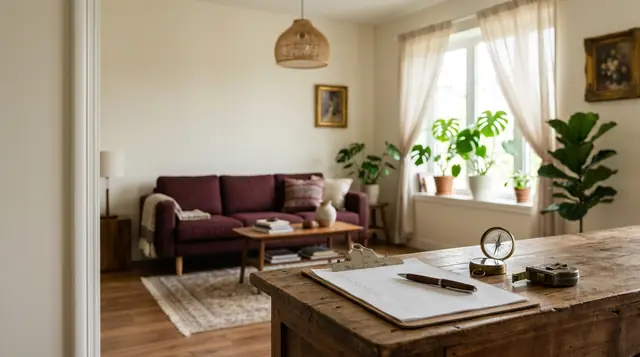
What Is Feng Shui? The Complete Guide, from the Book of Burial to Period 9
Feng shui is the study of how to choose land, build a home and arrange space so that it holds living qi. This guide starts from the original wording of the classics, moves through yin-yang and the Five Elements, the Form School, the Compass School and the cycles of time, and ends with how a beginner can apply it to their own home, with easy animated diagrams along the way.

Quick answer: what is feng shui?
- Feng shui (風水) is a classical East Asian discipline that studies how to choose land, orient and arrange homes and graves so that they hold living qi, helping the people who live there stay healthy and settled.
- The name comes from the Book of Burial (Zang Shu) attributed to Guo Pu of the Jin dynasty: qi scatters when it meets wind and stops when it meets water, so the art of holding qi was called feng shui, literally "wind and water".
- Feng shui rests on three philosophical foundations, yin-yang, the Five Elements and the Ba Gua, and reads three layers: form (Form School), direction (Compass School) and time (cycles of time).
- Its two main branches are yang dwellings (homes of the living) and yin dwellings (graves of the departed).
- The main schools are the Form School, Eight Mansions, Xuan Kong Flying Stars, San He (Three Harmonies) and Xuan Kong Da Gua.
- From 2024 through the end of 2043 we are in Period 9 (Li trigram, Fire element) of the Three Cycles Nine Periods.
- In 2026 (Bing Wu), the 5 Yellow star and Tai Sui sit in the South. In 2027 (Ding Wei), 5 Yellow moves to the North, Tai Sui sits in the Southwest, Sui Po in the Northeast and the Three Killings in the West. The annual stars change at Li Chun (Start of Spring), around February 4.
- The reliable part of feng shui overlaps with microclimate, daylight, ventilation and environmental psychology. Feng shui supports people; it does not replace effort and good character.
Hello, my dear readers. In more than twenty years of reading charts and surveying homes on site, I have noticed one thing: a great many people believe in feng shui, yet nobody has ever explained to them clearly what feng shui actually is. Some think it is superstition, others treat it like a lucky charm. I wrote this article to give feng shui back its true nature: it has original texts, a history, a method and clear limits. I have drawn many animated diagrams so that even a complete beginner can see the logic inside. A note for English readers: some of the in-depth articles linked below are currently available in Vietnamese only.
1. What feng shui means: the words and the original definition
Feng (風) means wind and shui (水) means water. These two words were not invented later for fun. They come straight from the Book of Burial (Zang Shu, 葬書), traditionally attributed to Guo Pu (276-324) of the Eastern Jin dynasty. The original definition reads:
氣乘風則散,界水則止。古人聚之使不散,行之使有止,故謂之風水。"Qi rides the wind and scatters; it is bounded by water and stops. The ancients gathered it so that it would not scatter, and guided it so that it would come to rest. Therefore it is called feng shui."
Book of Burial (Zang Shu), Guo Pu (Jin dynasty)
In plain words: qi carried by the wind disperses, and qi met by water comes to a halt. The ancients looked for ways to gather qi so it would not disperse, and to guide it so it had a place to settle, and they named this art feng shui.
From that original sentence the ancients drew the principle of hiding the wind and gathering the water (藏風聚水). The Book of Burial also says 風水之法,得水為上,藏風次之: in the art of feng shui, obtaining water comes first and sheltering from wind comes second. Water here means real rivers and lakes, but also roads, flows of people, anywhere things circulate.
Put into one sentence, this is how I define it for my students: feng shui is the study of how people choose land, orient and arrange their living space so that it holds sheng qi (living qi) and avoids sha qi (harmful qi), so that the occupants are healthy, settled and prosperous. In old China the art was also called Kan Yu (堪輿, "heaven covers, earth carries") or Di Li (geography), which is why older Vietnamese still call a feng shui master a thầy địa lý, a "geography master".
"A beautiful house is not necessarily a good house. A good house is one where you feel at ease, sleep soundly and do well in your work. Feng shui is simply the search for that lasting ease."
2. Qi: what feng shui is really looking for
If you remember only one word, remember qi (氣). In feng shui, qi is the invisible movement of heaven and earth, showing itself through wind, sunlight, humidity, the breath of the ground and the flow of people. In the end, every rule of feng shui does only three things with qi: receive it, hold it and guide it.
Sheng qi (living qi)
Qi that flows gently, curves and meanders, with light and a soft breeze. A home with sheng qi feels bright and airy without being drafty, and refreshing to live in.
Sha qi (harmful qi)
Qi that rushes straight and hard: a road aimed at the door, a sharp building corner pointing at you, wind tearing through the house. Sha qi makes people uneasy and drains them.
Si qi (stagnant qi)
Qi that is trapped and does not move: damp, moldy corners, dark closed rooms, clutter piled up for years. Si qi makes a home feel heavy and its people sluggish.
You will notice that these three kinds of qi match almost exactly what architects call good ventilation, drafts and stale air. That is why I always say that feng shui, properly understood, is first of all a study of the living environment.
3. Origins and history of feng shui
Feng shui was not invented by one person in one lifetime. It is the sediment of thousands of years of observation, record-keeping and debate. Below are the milestones every serious student should know; I have marked the Vietnamese milestones separately.
- AntiquityChoosing a place to live by observation
Very early on, people learned to settle against a hillside, near water, sheltered from the north wind and facing the sun. The art of choosing land for capitals and tombs gradually became a profession of its own.
- Han dynasty, by traditionQing Wu Jing (青烏經)
An early geomantic text traditionally attributed to Master Qing Wu, discussing the qi within the earth and the shapes of mountains and rivers. Its attribution is traditional and its date is still debated.
- Jin dynasty, 276-324Guo Pu and the Book of Burial
For the first time the term feng shui was clearly defined. The Book of Burial laid the foundation for the theory of dragon (mountain range), lair, sand (surrounding hills) and water in geomancy.
- Tang and Song dynastiesYellow Emperor's Dwelling Classic (黃帝宅經)
A classic on yang dwellings, the homes of the living, stressing the yin-yang balance of a house. The title borrows the name of the Yellow Emperor; the real author is unknown.
- Late Tang dynastyYang Yunsong (楊筠松)
Revered as the founder of the Form School and associated with the Han Long Jing and Yi Long Jing. Legend says he brought geomancy out of the imperial court to help the poor, earning the name Yang Jiu Pin, "Yang who saves the poor".
- Song dynastyThe luopan and the Compass School develop
The magnetic compass came into wide use in feng shui and the rings of the 24 Mountains were gradually refined. The Compass School, which calculates direction and time, grew alongside the Form School.
- Vietnam, 1010Lý Thái Tổ's Edict on Moving the Capital
The edict praises the citadel of Đại La for having "the lay of a coiled dragon and a crouching tiger" (龍蟠虎踞) and for "facing the river with its back to the mountains". This is the language of feng shui, used to choose Thăng Long (today's Hanoi) as the capital.
- Vietnam, Later Lê dynastyMaster Tả Ao
A famed geomancer from Tả Ao village in Hà Tĩnh, honored in folk tradition as the great master of Vietnamese geomancy. The texts handed down under his name, such as Địa Lý Tả Ao, adapted geomancy to the mountains, rivers and climate of Vietnam.
- Early Qing dynastyJiang Dahong and Di Li Bian Zheng
Jiang Dahong (蔣大鴻) reformed the Xuan Kong school and made the Three Cycles Nine Periods the time axis of feng shui, the basis of today's Xuan Kong Flying Stars.
- Vietnam, from 1805The Imperial City of Huế
Built under Emperor Gia Long, the Huế citadel takes Ngự Bình Mountain as its front table hill and the Perfume River as its bright hall, with the islets of Cồn Hến and Dã Viên likened to a dragon and a tiger guarding either side. It is the clearest surviving example of feng shui urban planning in Vietnam.
4. Three foundations: yin-yang, Five Elements, Ba Gua
To understand feng shui you first need three foundation stones. Every school uses these three concepts; they differ only in how they apply them.
Yin-yang: a dynamic balance
Everything has two opposite yet interdependent sides: light and dark, movement and stillness, hot and cold, high and low. These two sides never stand still; they keep transforming. When yang reaches its peak it gives rise to yin, and when yin reaches its peak it gives rise to yang.
A good home is one with yin-yang balance suited to the function of each room: the living room needs yang energy, the bedroom leans toward yin. Imbalance either way causes trouble: too much yang brings irritability and sleeplessness, too much yin brings damp and lethargy.
| Factor | Leaning yang | Leaning yin |
|---|---|---|
| Light | Bright, sunny, white light | Soft, dim, warm yellow light |
| Sound, activity | Lively, shared living, receiving guests | Quiet, rest |
| Areas | Living room, kitchen, main door | Bedroom, ancestral altar room, storeroom |
| Signs of imbalance | Stuffy heat, tension, poor sleep | Damp and mold, heaviness, lack of vitality |
The Five Elements: five phases of movement
The five elements, Wood, Fire, Earth, Metal and Water (ngũ hành, 五行), are not five physical substances but five phases in the movement of qi: Wood grows upward, Fire flares up, Earth nourishes, Metal contracts, Water flows down. They are linked by two cycles: the generating cycle (they feed each other) and the controlling cycle (they restrain each other). Press the buttons below the figure to view each cycle on its own.
| Element | Color | Direction | Season | Shape | In the home |
|---|---|---|---|---|---|
| Wood | Green | East, Southeast | Spring | Tall, columnar | Plants, wooden furniture |
| Fire | Red, orange, purple | South | Summer | Triangular, pointed | Stove, lamps, candles |
| Earth | Yellow, earthy brown | Center, Northeast, Southwest | End of each season | Square, flat | Ceramics, stone, brick |
| Metal | White, gray, metallic | West, Northwest | Autumn | Round, domed | Metal objects, bells |
| Water | Black, dark blue | North | Winter | Wavy | Aquarium, fountain, glass |
Once you understand the Five Elements, you will see why the stove should not sit right next to the sink (Water controls Fire), why the East suits plants, and why a person of one element suits certain colors. I cover the detailed applications in the Five Elements in the home and Yin, Yang and the Five Phases.
The Ba Gua and the Lo Shu: a map of nine palaces
The Ba Gua are the eight trigrams, each made of three lines, standing for the eight directions and eight groups of affairs. Place the eight trigrams in the Later Heaven Ba Gua order of King Wen onto the nine-square grid of the Lo Shu, and you get the map that almost every method of home feng shui uses. The remarkable thing is that every row, column and diagonal of the Lo Shu adds up to 15.
How to lay this map over your floor plan, standing at the center of the house, measuring the directions and dividing the palaces, is explained step by step in the Ba Gua map and how to apply it to a floor plan.
5. Three layers of reading: form, direction, time
This is the part most articles on feng shui skip, yet it is the backbone of the craft. When I survey a home, I always read it in the same three-layer order: form first, direction second, time last. The ancients said form is the body, principle is the function: the landform is the body, the compass calculations describe how that body works, and the time cycles tell you when good or bad fortune will take effect.
Layer 1: the Form School and the Four Guardians model
The Form School (Luan Tou, 巒頭; loan đầu) is the part you read with your eyes: the lie of the land, mountains, water, roads and the buildings around you. The classic pattern of a place where qi gathers is the Four Guardians (四靈): Azure Dragon on the left, White Tiger on the right, Vermilion Bird in front, Black Tortoise behind.
In a city without mountains and rivers, we read the Four Guardians through buildings: the Black Tortoise is a tall, solid building behind you; the Azure Dragon is the building on your left (standing inside looking out), which should be higher than or equal to the one on the right; the White Tiger on the right should not tower over you; the Vermilion Bird is the open yard or pavement in front of the door, while the main road plays the role of water. A road that curves around the house is good; a road aimed straight at the door is sha. I cover choosing land in practice in feng shui for choosing a plot.
Layer 2: the Compass School and the luopan
The Compass School (Li Qi, 理氣; lý khí) is the part you cannot see with your eyes. It must be measured and calculated: which way the house sits and faces, from which direction qi enters, which direction suits which person. Its tool is the luopan (羅經; la kinh), a specialized compass that divides the circle into the 24 Mountains, 15 degrees each: 8 Heavenly Stems (Wu and Ji are left out because they belong to the center), 12 Earthly Branches and the 4 corner trigrams Qian, Kun, Gen and Xun.
A professional luopan can have dozens of rings, including three offset rings of the 24 Mountains called the Correct Needle, the Middle Needle and the Seam Needle, used for setting the facing, assessing the surrounding hills and receiving water. A beginner does not need that yet. Being able to measure the facing of your house accurately down to the mountain is a solid foundation, and you can do it right now with the feng shui compass on your phone.
On top of the Compass School foundation, each school has its own calculations. Eight Mansions checks whether the facing of the house suits or clashes with the East Group or West Group of the occupants. Xuan Kong Flying Stars draws up a star chart from the facing of the house and its construction period to see which star occupies which palace.
Layer 3: time cycles and the Three Cycles Nine Periods
The third layer is time, the one beginners most often forget. According to the Xuan Kong school, time runs in the Three Cycles Nine Periods (San Yuan Jiu Yun, 三元九運): a 180-year cycle divided into three eras of 60 years, each made of three periods of 20 years. The same house may prosper in one period and decline in the next, because the ruling star has changed.
Period 9 (2024-2043) is ruled by the 9 Purple star and corresponds to the Li trigram and the Fire element. Li is fire, light, intelligence and visibility, so practitioners often associate this period with technology, media, energy, culture and beauty. For homes, according to Xuan Kong, the South (the home of the Li trigram on the Lo Shu) is the Proper Spirit direction in Period 9, and the opposite North is the Zero Spirit direction, so the mountains and water in these two directions deserve close attention. Houses built in Period 8 should also have their star charts reviewed now that the period has changed. I have written dedicated guides to the Three Cycles Nine Periods and to Xuan Kong Flying Stars for those who want to go deeper.
| Criterion | Form (Form School) | Direction (Compass School) | Time cycles |
|---|---|---|---|
| What it examines | Mountains, water, roads, surrounding buildings, shape of the house | Sitting and facing, directions, the occupants' personal trigram | The 20-year period, annual stars, monthly stars |
| Tools | Your eyes, walking the site | Luopan, calculation | Stem-branch calendar, star chart |
| Nature | Visible, hard to change | Invisible, must be measured | Rotates over time |
| Question it answers | Can this place hold qi? | In which direction is qi good or bad, and for whom? | When will good or bad take effect? |
| Reading order | First | Second | Last |
One thing I always tell my students: if the form is broken, the compass can hardly save it. If a road stabs straight at the house, a sharp corner points at it and there is nothing behind it for support, then however beautiful the calculated facing, it is like painting flowers on a cracked wall.
6. The schools of feng shui
Feng shui is not a single block but is divided into several schools, each looking at the home from its own angle. Once you know the map of the schools, you will no longer be confused when every master says something different.
| School | Layer | Core idea | For beginners |
|---|---|---|---|
| Form School (Luan Tou) | Form | Reading mountains, water, roads, the Four Guardians and the sha formations around the house | Learn early, you can see it with your eyes |
| Eight Mansions (Ba Zhai) | Direction | Divides people into the East Group and West Group, each with 4 good and 4 bad directions | Easiest, the best place to start |
| Xuan Kong Flying Stars | Direction and time | Nine stars flying according to the facing, construction period, and the year and month | Study once your foundation is solid |
| San He (Three Harmonies) | Direction | Matching dragon, water and facing through the life-stage cycle of the three-harmony frames | Advanced, focused on land and graves |
| Xuan Kong Da Gua | Direction and time | Uses the 64 hexagrams on the luopan to set facings in fine detail | For practitioners |
| Entrance Ba Gua (Western style) | Not based on compass directions | Places the Ba Gua by the front entrance instead of by compass, popular in the United States since the 1980s | Very different from the classical method, easily confusing |
A well-grounded feng shui master does not cling to one school but combines form and compass, Eight Mansions and Xuan Kong, to give well-rounded advice. Please also note: tips such as "the far left corner from the door is always the wealth corner" that you often read online usually come from the Western entrance Ba Gua, not the classical compass method. Read more in Eight Mansions Feng Shui, the complete guide.
7. Yang dwellings and yin dwellings
By subject, feng shui divides into two big branches. Yang dwellings (dương trạch, 陽宅) are the homes of the living, from an apartment, townhouse, office or shop up to a whole village or city (the ancients called the large-scale version yang foundations). Yin dwellings (âm trạch, 陰宅) are the graves of the departed, tied to the belief that ancestral blessings pass down the generations, as in choosing the facing of a grave or choosing a good day for reburial.
For most of us, yang dwellings are the most practical part, because they directly affect our sleep, health, finances and family atmosphere every day. The rest of this article focuses on yang dwellings.
8. Feng shui inside a home
The Three Essentials of a yang dwelling: door, bedroom, kitchen
The old texts say a home has three most important places, called the Three Essentials of a yang dwelling (陽宅三要): the Door (main entrance), the mouth that receives qi; the Master (the householder's bedroom), where people recharge; and the Stove (kitchen), which nourishes the whole family. In Vietnamese homes I always look at the ancestral altar as well, because it is the quietest and most sacred place in the house.
I have a separate guide for each of the Three Essentials: main door feng shui, bedroom feng shui, kitchen feng shui, and how to remedy doors facing each other. The classic rule for the stove remains sit on the bad, face the good: the back of the stove presses down on an unfavorable direction while its mouth faces a favorable direction of the householder.
The command position: solid support behind, a view of the door
Feng shui teaches that a bed, a desk or the head of the household's chair should have support behind it and a view of the entrance, without sitting directly in line with the door. This is simply the Black Tortoise and the Vermilion Bird scaled down into a single room.
Environmental psychology has a very similar idea, the prospect and refuge theory of the geographer Jay Appleton: people feel safest where they are sheltered from behind while enjoying a wide view in front. See more in the command position.
9. Is feng shui real? What science says
This is the question I hear most, and I answer it plainly: part of feng shui is very real, part is still an unverified belief, and part has been embellished by people into superstition. A conscientious student must be able to tell these three parts apart.
- It overlaps with microclimate and passive design. Backing onto a hill to block cold wind, opening toward the warm sun, having water in front to cool the air and avoiding low, damp ground: these are also the principles of modern climate-responsive architecture. In a hot country like Vietnam, a house that turns its back on the harsh afternoon sun is cooler and uses less electricity.
- It overlaps with environmental psychology. A seat with support behind it, a bright and tidy room and unobstructed walkways all help people feel less stressed and sleep better. The prospect and refuge theory mentioned above is one example.
- It is seriously studied by architects and scholars. Researchers Michael Mak and S. Thomas Ng surveyed architects' views on feng shui and published their findings in the journal Building and Environment in 2005. Joseph Needham, in Science and Civilisation in China, noted that the magnetic compass was used in feng shui from very early on. The ancient villages of Xidi and Hongcun in Anhui, famous for village layouts and water systems tied to feng shui ideas, were inscribed as a UNESCO World Heritage Site in 2000.
- The unverified part. The Compass School layers, such as flying stars and personal trigrams, are a body of traditional knowledge that has not been proven by experimental science, and many scientists place them outside the scope of science. I do not dodge that. I use them as a frame of reference distilled by the ancients, and I always put form, function and safety first.
The superstitious part is when people turn feng shui into buying one object to change their life, or placing one statue to end poverty. Feng shui supports people; it does not do the work for them. I have written a fuller article on whether feng shui is real: a scientific and evidence-based view.
Where feng shui ranks in a person's life
Our elders have a saying that ranks the things that shape a life. I have drawn it so you can see that feng shui matters, but it does not stand alone:
- 1First, destiny: the foundation given to you at birth
- 2Second, luck: the fortunes of each stage of life
- 3Third, feng shui: your living environment, the part you can actively improve
- 4Fourth, virtue: doing good deeds, keeping your integrity
- 5Fifth, study: learning and broadening your understanding
We cannot choose our destiny or our luck, but feng shui, virtue and learning are in our own hands. That is why feng shui is worth studying: it is the part we can actively improve.
10. Six common misconceptions about feng shui
Feng shui is fortune-telling and ritual
Feng shui is the study of land, houses and space. It is not fortune-telling, and it is not an exorcism ritual.
Buy an object and wealth follows
If a home is damp, dark, drafty and cluttered, no number of statues will help. Objects are only the final supporting step, and must suit the place and the person.
The facing decides everything
The facing is only one part of the Compass School. The surrounding landform, the interior layout and the time cycles matter just as much.
A house that does not suit you must be sold
Most cases can be handled by changing the side door or rearranging the bed, stove and desk toward the occupants' good directions.
Feng shui is fixed forever
According to Xuan Kong, the annual stars change every Li Chun and the period changes every 20 years. A house that was good last period is not necessarily good in the next.
The more taboos, the better
Feng shui is meant to help you live more comfortably, not to make you afraid. Excessive taboos, damaging the structure or giving up function is what bad feng shui really looks like.
11. Where should a beginner start?
Many people want to learn feng shui but do not know where to take the first step. I recommend going from easy to hard, from what you can see to what you must calculate:
- Declutter and open up the qi. A tidy, airy, bright home is the foundation of every feng shui method. Anyone can do it today; see how in decluttering to open up the qi.
- Look at the landform around your home. Is there a road aimed at you, a sharp corner, or a utility pole blocking the door? Is there support behind the house? This is the Form School layer, read with your eyes.
- Find your personal trigram and measure the facing. Find out whether you belong to the East Group or the West Group, measure the facing of the house with a compass, and compare them to see which directions are good for you.
- Rearrange the Three Essentials. Check whether the main door, bedroom, kitchen and altar are well placed. Getting these three or four points right takes care of most of a home's fortune.
- Learn the time layer. Once you are comfortable, move on to the Xuan Kong annual stars and how to remedy unfavorable formations year by year.
You can calculate your personal trigram and your favorable directions right now with my free tool. That number gives every later piece of feng shui advice a precise anchor.
Start by finding your personal trigram
Enter your birth year and gender, and the tool will tell you whether you belong to the East Group or the West Group, along with your good and bad directions, the basis for arranging your home from then on.
Find your trigram and best directions ›How to recognize a trustworthy feng shui master
- The master visits the site or asks for floor plans, real photos and compass readings, rather than pronouncing judgment from your birth year alone.
- The master can explain the reason for each piece of advice in terms of form, direction and timing, not with a vague "just do it for luck".
- The master fixes the layout first and leaves objects for last, and never pressures you into buying expensive items.
- The master respects the structure, safety and legal status of the building, and never urges you to cut columns or move a staircase against building codes.
- The master is clear about the limits of feng shui and never promises to transform your life.
12. A heartfelt word from the Master
Feng shui is not meant to make you afraid or dependent. I hope you come to feng shui as someone who wants to rearrange their home in harmony with nature, not out of fear of curses or bad luck. Once you understand it properly, you will find feng shui very close to everyday life. It is simply how our ancestors taught us to live in harmony with heaven and earth: lean on something solid, look out toward something open, and keep the qi in your home flowing. Once you have mastered the roots, the in-depth articles on each room and each type of house will come easily to you.
13. Applying it to 2026 (Bing Wu) and 2027 (Ding Wei)
The three foundations of feng shui are form, direction and time. This section is the time layer for two consecutive years, so you can arrange your home once and use it for a long while. The annual stars, or annual flying stars, change at Li Chun (Start of Spring), not at the Lunar New Year or on January 1: the Bing Wu star year begins on , and the Ding Wei star year begins on .
| Direction | 2026 Bing Wu | 2027 Ding Wei | What to do for the new year |
|---|---|---|---|
| Southeast | 9 Purple | 8 White | Good two years running, keep it activated |
| South | 5 Yellow, Tai Sui | 4 Green | From bad to good, a study desk can move here |
| Southwest | 7 Red | 6 White, Tai Sui | The star improves but Tai Sui is here, still no groundbreaking |
| East | 8 White | 7 Red | From good to bad, stop activating, lock doors well |
| Center | 1 White | 9 Purple | Keep the center bright and open |
| West | 3 Jade | 2 Black, Three Killings | Still bad and heavier, no groundbreaking |
| Northeast | 4 Green | 3 Jade, Sui Po | From good to bad, move the study desk elsewhere |
| North | 6 White, Sui Po, Three Killings | 5 Yellow | Keep it quiet both years, 2027 is the heaviest corner |
| Northwest | 2 Black | 1 White | From bad to good, can be activated |
Three things to do before Li Chun 2027
- Move the 5 Yellow remedies (brass bell, brass gourd) from the South corner to the North corner.
- Move the study desk from the Northeast corner (3 Jade and Sui Po in 2027) to the South corner (4 Green, the scholar star).
- Switch the wealth activation: stop activating the East (7 Red), keep the Southeast, add the Northwest (1 White).
2026, the Bing Wu year
Do: Activate the Southeast and East corners. The North holds the good 6 White star but coincides with Sui Po and the Three Killings, so activate it only lightly and never break ground there.
Avoid: The South (5 Yellow together with Tai Sui) and the Northwest (2 Black) should be left undisturbed: no renovation, no new stove or safe in 2026. People born in Horse years are in Tai Sui and those born in Rat years clash with Tai Sui, so they should be more careful.
| Direction | 2026 star | Nature |
|---|---|---|
| Southeast | 9 Purple | Timely and prosperous, wealth, celebrations. Activate |
| East | 8 White | Wealth, promotion. Activate |
| North | 6 White | Helpful people, authority. Sui Po and the Three Killings are here, so activate only lightly with bright metal, and never break ground |
| Northeast | 4 Green | Scholar star, study. Good for a study desk |
| Center | 1 White | Vitality, relationships |
| South | 5 Yellow | Major affliction. No groundbreaking, no repairs, remedy with metal |
| Northwest | 2 Black | Illness. Keep dry, remedy with metal |
| Southwest | 7 Red | Financial loss, theft. Lock up well, use water to subdue it |
| West | 3 Jade | Disputes. Keep it quiet, use red or pink to resolve it |
| Affliction | Mountain | Direction | How to handle it |
|---|---|---|---|
| Tai Sui | Wu (午) | South | Sit with it, never face it: you may have your back to the South, but do not sit facing South |
| Sui Po | Zi (子) | North | No groundbreaking, no building or renovation |
| Three Killings | Hai, Zi, Chou (亥子丑) | North | Face it, never sit with it: you may face North, but do not have your back to the North |
2027, the Ding Wei year
Do: Activate the Southeast (8 White) and Northwest (1 White), put the study desk in the South (4 Green), and keep the center bright and open for 9 Purple. The Southwest holds 6 White but coincides with Tai Sui, so activate it only lightly.
Avoid: The North (5 Yellow), the West (2 Black with the Three Killings) and the Northeast (3 Jade with Sui Po) are the three corners where you should not break ground or renovate in 2027. The East holds 7 Red, so lock doors well. People born in Goat years are in Tai Sui and those born in Ox years clash with Tai Sui, so they should be more careful.
| Direction | 2027 star | Nature |
|---|---|---|
| Southeast | 8 White | Wealth, property. Activate, keep it bright and clean |
| Center | 9 Purple | Timely and prosperous, celebrations. Keep the center bright, open and free of clutter |
| Northwest | 1 White | Relationships, helpful people, career. Activate |
| South | 4 Green | Scholar star, exams, study. Good for a study desk |
| Southwest | 6 White | Authority, helpful people. Tai Sui is here, so activate only lightly and do not break ground |
| North | 5 Yellow | Major affliction. No groundbreaking, no repairs, remedy with metal |
| West | 2 Black | Illness, plus the Three Killings. Keep dry, remedy with metal, no groundbreaking |
| Northeast | 3 Jade | Disputes, lawsuits, plus Sui Po. Keep it quiet, use red to resolve it |
| East | 7 Red | Financial loss, theft. Lock up well, use still water to subdue it |
| Affliction | Mountain | Direction | How to handle it |
|---|---|---|---|
| Tai Sui | Wei (未) | Southwest | Sit with it, never face it: you may have your back to the Southwest, but do not sit facing Southwest |
| Sui Po | Chou (丑) | Northeast | No groundbreaking, no building or renovation |
| Three Killings | Shen, You, Xu (申酉戌) | West | Face it, never sit with it: you may face West, but do not have your back to the West |
Directions are taken from the center of the house: stand in the middle of the home with a compass, mark out the eight directions, then compare with the tables. To see exactly which room falls under which star, build your home in the 3D House tool and turn on the annual star layer. Annual flying stars must be combined with the natal stars of the house according to Xuan Kong to be complete; Master Ung Khiem reads these in person during a site survey.
Frequently Asked Questions
What is feng shui, in short?
Feng shui is a classical East Asian discipline about choosing land, orienting and arranging homes and graves so that they hold living qi and avoid harmful qi. The name comes from the Book of Burial by Guo Pu: qi scatters when it meets wind and stops when it meets water, so the art of holding qi is called feng shui, "wind and water".
Does feng shui really affect your life?
Yes, but in a very practical way. Feng shui works through daylight, ventilation, humidity and the psychology of the occupants, factors that architecture and environmental psychology both recognize. It creates a favorable environment for you to be healthier and do better in your work; it does not replace your own effort.
Is feng shui a superstition?
The core of feng shui is the observation of the living environment, and that is not superstition. Feng shui becomes superstition when it is turned into buying objects to change your life, piling up taboos or judging someone's fate from their birth year alone. The Compass School layers are traditional knowledge that has not been proven by experimental science.
When did feng shui begin, and who gave it its name?
The art of choosing land dates back to antiquity, but the term feng shui was first clearly defined in the Book of Burial (Zang Shu), traditionally attributed to Guo Pu (276-324) of the Eastern Jin dynasty. In Vietnam, the Edict on Moving the Capital of 1010 already used feng shui language to praise the site of Thăng Long.
What is the difference between the Form School and the Compass School?
The Form School deals with the landform you can see: mountains, water, roads and surrounding buildings. The Compass School deals with what must be measured and calculated: sitting and facing, directions, the occupants' personal trigram and the flying stars. The ancients said form is the body and principle is the function, so you read the form first and calculate the compass second.
Which school of feng shui should a beginner learn first?
Start with Eight Mansions, the most accessible school: once you know whether you belong to the East Group or the West Group, you can identify your good and bad directions. At the same time, learn the Form School so you can spot unfavorable formations around the house. Move on to Xuan Kong Flying Stars once your foundation is solid.
What are the three most important areas of a home in feng shui?
They are the main door, the bedroom and the kitchen, which the ancients called the Three Essentials of a yang dwelling: Door, Master and Stove. The main door brings qi into the house, the bedroom governs rest and marriage, and the kitchen governs health and wealth. In Vietnamese homes the ancestral altar should be checked as well.
What is Period 9 in feng shui?
Period 9 is the 20-year span from 2024 through the end of 2043 in the Three Cycles Nine Periods. It is ruled by the 9 Purple star and corresponds to the Li trigram and the Fire element. According to the Xuan Kong school, when the period changes the prosperous and declining stars of every house change too, so many houses built in Period 8 should be reviewed.
Do you need to buy many feng shui objects for good feng shui?
No. Good feng shui is rooted in sound landform, a suitable facing, a sensible layout and a clean, bright space. Objects are only the final supporting step and must suit the person and be placed correctly. Buying many and placing them wrongly can even backfire.
Can you live in a house whose facing does not suit you?
Yes. Most cases are handled by rearranging the bed, stove and desk toward the occupants' good directions, choosing a suitable side door and taking care of the landform around the house. Do not rush to sell the house or tear down the structure just because the facing does not match you.
What should you watch for in feng shui for 2027, the Ding Wei year?
In 2027 the 5 Yellow star sits in the North, 2 Black with the Three Killings in the West, and 3 Jade with Sui Po in the Northeast, so do not break ground or renovate in these three corners. The good corners to activate are the Southeast (8 White), the Northwest (1 White), the South (4 Green, the scholar star) and the center (9 Purple). Tai Sui sits in the Southwest in 2027, and people born in Goat and Ox years should be more careful.
On what date do the new year's feng shui stars change?
The annual stars change at Li Chun (Start of Spring), around February 4 in the Gregorian calendar, not at the Lunar New Year or on January 1. The Bing Wu star year begins on February 4, 2026, and the Ding Wei star year begins on February 4, 2027.
References
- Guo Pu (attributed), Book of Burial (Zang Shu, 葬書), Jin dynasty.
- Yellow Emperor's Dwelling Classic (Huang Di Zhai Jing, 黃帝宅經), anonymous.
- Jiang Dahong, Di Li Bian Zheng (地理辨正), early Qing dynasty.
- Lý Thái Tổ, Edict on Moving the Capital (Chiếu dời đô, 遷都詔), 1010.
- Joseph Needham, Science and Civilisation in China, Vol. 4, Part 1: Physics, Cambridge University Press, 1962.
- Ole Bruun, An Introduction to Feng Shui, Cambridge University Press, 2008.
- Jay Appleton, The Experience of Landscape, John Wiley & Sons, 1975.
- Michael Y. Mak, S. Thomas Ng, "The art and science of Feng Shui: a study on architects' perception", Building and Environment 40 (3), 2005.
- UNESCO World Heritage Centre, Ancient Villages in Southern Anhui: Xidi and Hongcun, inscribed in 2000.