IOverview
Worship of the Mother Goddesses of the Three and Four Palaces in northern Vietnam is the fullest form of Đạo Mẫu. It has a pantheon divided into four realms of heaven, earth, water and mountain forest, with Mother Liễu Hạnh at its centre, and spirit mediumship (hầu đồng) with chầu văn music as its signature rite. On 1 December 2016, UNESCO inscribed the Practices related to the Viet beliefs in the Mother Goddesses of Three Realms on the Representative List of the Intangible Cultural Heritage of Humanity.
It is an indigenous Vietnamese belief with no founder, no original scripture and no central church. Each palace, temple or shrine runs its own worship. What connects them is a shared pantheon, a shared ritual order and a class of specialists, temple keepers, mediums and musicians, who pass their knowledge down over generations.
IIHistory
Folklorists, notably Professor Ngô Đức Thịnh, describe three overlapping layers: goddess worship, the worship of Mother deities, and only then the ranked system of Three and Four Palaces. The last layer took shape around the 16th century, under the Mạc and restored Lê, with the emergence of Mother Liễu Hạnh. These dates are estimates based on sacred biographies, royal decrees and stelae.
- 16th centuryMother Liễu HạnhHer sacred biography tells of three descents to earth, the first in Vụ Bản, Nam Định. Her cult spread across the north.
- 17th centuryPhủ Dầy as a centreChầu văn ritual developed in Nam Định alongside the great temple complexes.
- 1954 to 1990RestrictedAccording to the national heritage dossier, mediumship was restricted and nearly disappeared in many places.
- From 2000RevivalMediumship and chầu văn returned to the temples, alongside new staged performances.
- December 2012Chầu văn listed nationallyThe chầu văn ritual of the Viet was entered in the national inventory of intangible heritage.
- 1 December 2016UNESCO inscriptionThe nomination was approved at the committee's 11th session in Addis Ababa.
IIIPantheon and Beliefs
Believers hold that the Mother gives birth to and protects all things. Each of the four realms has a Mother in charge: the Heaven Palace in red, the Earth Palace in yellow, the Water Palace (Thoải Phủ) in white and the Mountain Forest Palace in green. Below the Three Holy Mothers come the Great Mandarins, the Ladies, the Princes, the Young Ladies and the Young Princes. Worshippers call themselves children of the Mother and pray for peace, health and good fortune in this life.
Mother Liễu Hạnh is the most exalted figure in the north and the only woman among the Four Immortals. Saint Trần, the general Trần Quốc Tuấn, belongs to a separate Trần cult but is often worshipped beside the Four Palaces altar. A popular saying pairs them as Father and Mother, with the Father's anniversary in the eighth lunar month and the Mother's in the third.
The UNESCO title says Three Realms because the original system comprised heaven, water and mountain forest. The Earth Palace was added later. In temple life, Three Palaces and Four Palaces are used interchangeably and are not two different faiths.
IVMediumship and Chầu Văn
A mediumship session is called a vấn hầu. The medium sits on a mat before the main altar, with two assistants beside and the musicians in a corner. Each deity invited is a giá, or incarnation. A red veil covers the medium's head, the musicians sing the invitation, the veil is lifted, and the medium puts on robes of the right colour, offers incense, dances, listens to the sung story of the deity and distributes blessed gifts. Chầu văn music, led by the moon lute and modes such as Bỉ, Phú, Dọc, Xá and Cờn, guides the whole rite.
People often speak of thirty-six incarnations. The national chầu văn dossier records that a session usually has only about 8 to 15, depending on the medium's purpose. The main Đạo Mẫu article cites other research recording sessions of about 25 to more than 40. The number varies by temple, medium lineage and occasion.
VPlaces of Worship and Transmission
There is no church. Each site is looked after by a temple keeper, a heritage management board or a medium. A phủ is a large complex, a đền a mid-sized temple, and an điện usually a shrine founded by a medium. Knowledge passes orally within families and from teacher to student: senior mediums guide new initiates, and veteran musicians teach the younger ones. The UNESCO file stresses exactly this mode of transmission.
| Site | Location | Associated with |
|---|---|---|
| Phủ Dầy | Vụ Bản, formerly Nam Định, now Ninh Bình | Mother Liễu Hạnh, festival in the third lunar month |
| Phủ Tây Hồ | Hanoi | Mother Liễu Hạnh |
| Sòng Sơn Temple | Thanh Hóa | Liễu Hạnh's third descent |
| Bắc Lệ Temple | Lạng Sơn | Mother of the Forests, Mountain Palace |
| Bảo Hà Temple | Lào Cai | The Seventh Prince |
VIToday
Since the 2016 inscription, mediumship has been recognised as a valuable cultural practice, and festivals such as Phủ Dầy draw large crowds. Belief activities in general are governed by the 2016 Law on Belief and Religion. Mother Goddess worship has no representative body and is not counted separately in religious surveys.
Vietnamese scholars and journalists have themselves raised concerns: staging rituals as shows, careless changes to sung texts, very high costs for sessions, and claims that someone has a spiritual calling used to push people into costly initiation. The ritual is real, and so is its exploitation. The UNESCO file places responsibility for safeguarding on the practising communities themselves.
VIISymbol of the Branch
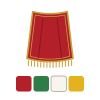
Red face veil and the four colours of the Four Palaces
VIIISub-branches
- Hầu đồng and chầu văn singing
- Mother shrines inside pagodas
- Private household shrines
IXOther Branches of Đạo Mẫu, the Mother Goddess religion
Northern Mother Goddess Worship of the Three and Four PalacesTín ngưỡng thờ Mẫu Tam phủ, Tứ phủThe fullest form, centred on Mother Lieu Hanh, with a four-realm pantheon and spirit possession rituals accompanied by chau van. Worship of the Lady of the Realm of Sam MountainChúa Xứ Thánh Mẫu, Bà Chúa XứOne of the two principal Mother figures of the south, worshipped at Sam Mountain near Chau Doc.Uses the common symbol of the pathWorship of the Holy Mother of Bà Đen Mountain靈山聖母 Linh Sơn Thánh Mẫu, Bà ĐenThe second principal Mother figure of the south, worshipped on Ba Den Mountain in Tay Ninh.Uses the common symbol of the pathThiên Y A Na Mother Worship of Central Vietnam天依阿那 Thiên Y A Na, Po Inu NagarThe central Vietnamese form, blending the Cham Mother of the Land Po Inu Nagar with Viet belief.Uses the common symbol of the path
XSources
The library cross-checks the sources below. Where they disagree, the page gives both.
?Quick Questions
What is the difference between Three Palaces and Four Palaces?
The Three Palaces are heaven, water and mountain forest, the older layer. The Four Palaces add the Earth Palace. In temple life the terms are used interchangeably, and UNESCO uses Three Realms.
How many incarnations are there in a session?
It varies. Thirty-six is a way of saying complete. The chầu văn dossier records 8 to 15 as typical, while other research records about 25 to more than 40, depending on temple, lineage and occasion.
What is the main centre in the north?
Phủ Dầy in Vụ Bản, formerly Nam Định and now part of Ninh Bình province, where Mother Liễu Hạnh is worshipped and a festival is held from the 3rd to the 8th of the third lunar month.
Is mediumship legal in Vietnam?
Yes. The practice was inscribed by UNESCO in 2016, and belief activities are governed by the 2016 Law on Belief and Religion. Exploiting belief for profit is a separate matter.