IColours
Colour used for this page of the library: Red (Palace of Heaven) #B3202A. Every colour code is approximate, since most paths name their colours without publishing codes.
Principal colour the colour of the path
The color of the Palace of Heaven, the celestial realm. It is also the color of the face veil and the most prominent color of the spirit possession ritual ("hầu đồng").
The color of the Palace of Mountains and Forests, the realm of hills and woods.
The color of the Palace of Water, the realm of rivers and seas.
The color of the Palace of Earth, the earthly realm.
Place of worship real sanctuaries
Ritual colours by occasion and season
The master medium leads the new medium through the four palaces: Heaven red, Earth yellow, Water white, Mountains and Forests green. Each palace has its own offering tray with an egg symbolizing the soul of the new medium. The great offering includes incense, flowers, lamps, tea, fruit and food.
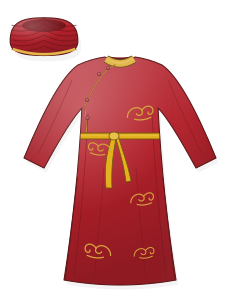
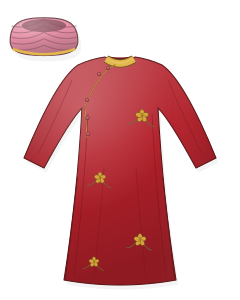
The face veil (the veil of one's own destiny) covers the head of the medium when the deity is invited, and it is usually red. A new medium must buy the first set of red veil and robe and have it consecrated.
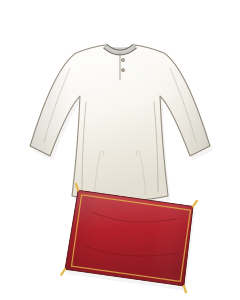
The medium's innermost garment is always white, symbolizing purity.
Mourning and avoided colours
No source found on mourning colors or forbidden colors specific to Mother Goddess worship. The only rule found is that no rings, bracelets or bead strings are worn when embodying the Great Mandarins. This concerns jewelry, not color.
IIRanks
The Vietnamese worship of the Mother Goddesses of the Three and Four Palaces honors the Mother together with a pantheon divided into four palaces: Heaven, Mountains and Forests, Water, and Earth. It has no church or central organization. Each temple, palace shrine and private shrine runs itself around its temple keeper and master medium, and knowledge is passed orally from experienced practitioners to newcomers. UNESCO inscribed the practice in 2016.
- 1Temple keeper (owner of the temple or shrine)守香
- 2Master medium
- 3Medium
- 4Devotee
- 4Ritual assistants: ritual musicians, attendants
- 1Temple keeper (owner of the temple or shrine) 守香 · Temple keeper
The person who keeps the incense and leads all the spiritual affairs of a temple, palace shrine or private shrine. Often also a master medium.
- 2Master medium Master medium
An experienced medium who performs the initiation rite for newcomers, leads the new medium through the four palaces, then teaches the new medium to practice.
- 3Medium Spirit medium
A person who has been initiated and performs spirit possession to invite the manifestations of the deities. A newcomer is called a new medium.
- 4Devotee Devotees
A person who follows a temple or a master medium and takes part in rites and offerings.
- 4Ritual assistants: ritual musicians, attendants Ritual musicians, ritual assistants
Ritual musicians sing "chầu văn" and play music for each manifestation. Attendants help the medium change veils and robes at the right moments. These are roles, not ranks.
Followers: Devotees ("con nhang đệ tử"). There are no formal grades. Roles are distinguished as temple keeper, master medium, medium (a newcomer is a new medium) and devotee.
IIIForms of address
| Rank | Spoken address | In writing | Self reference | Original term |
|---|---|---|---|---|
| Temple keeper, master medium | Addressed as "thầy" (master), "cô" (lady) or "cậu" (young master), depending on gender and role | Written as "đồng thầy" (master medium) or "thủ nhang" (temple keeper) with the person's name and the temple name | no source found | |
| Devotee | Addressed as "con" (child) | Written as "con nhang đệ tử" (devotee) | Refers to self as "con" (child) | |
| Medium | no source found | Written as "thanh đồng" (medium) or "đồng tân" (new medium) | no source found | |
| The ranks of deities | Addressed as "Mẫu" (Mother), "Quan Lớn" (Great Mandarin), "Chầu Bà" (Lady), "Ông Hoàng" (Prince), "Cô" (Maiden), "Cậu" (Young Prince) | Written as "Tam Tòa Thánh Mẫu" (the Three Holy Mothers), "Ngũ Vị Tôn Quan" (the Five Mandarins), "Tứ Phủ Chầu Bà" (the Ladies of the Four Palaces), "Tứ Phủ Ông Hoàng" (the Princes of the Four Palaces), "Tứ Phủ Thánh Cô" (the Maidens of the Four Palaces), "Tứ Phủ Thánh Cậu" (the Young Princes of the Four Palaces) | not applicable |
IVVestments by rank
Flat drawings made from the descriptions in the sources, with no people shown. Colours are approximate.
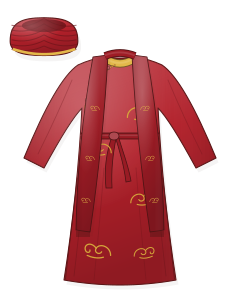
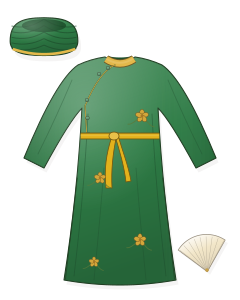
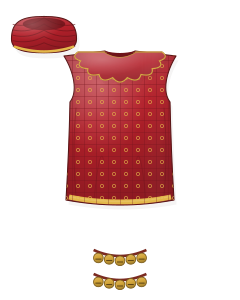
VLine of succession
Mother Goddess worship of the Four Palaces has no founder and no common head. Belief centers on the Holy Mother Liễu Hạnh and the Holy Mothers of the Three and Four Palaces, while transmission takes place temple by temple and shrine by shrine. Master mediums initiate new mediums, and temple keepers pass the care of a temple down within the family. The line below therefore records sacred milestones, historical milestones and representative people and organizations of today, not a chain of succession.
Key milestones of the Mother Goddess religion (Three and Four Palaces)
- By legend she descended to earth several times, most often said to be in the 16th century during the Lê and Mạc periodHoly Mother Liễu Hạnh 柳杏聖母
Central Mother Goddess, venerated as Mother of the Heavenly Palace and one of the Four Immortals.
- No dateThe Holy Mothers of the Three and Four Palaces: Mother of Heaven, Mother of the Mountains and Forests, Mother of Water, Mother of Earth
The four Mother Goddesses ruling heaven, mountains and forests, water and earth.
- Built around the mid 17th century, some sources say during the Cảnh Trị era, 1663 to 1671Tiên Hương Palace, Phủ Dầy (Phủ Giày) 府僊香
Main shrine of Liễu Hạnh at Vụ Bản, Nam Định, regarded as the centre of the religion.
- 1705 to 1748Đoàn Thị Điểm and the story of the Goddess of Vân Cát 段氏點
Woman writer who recorded the legend of Liễu Hạnh in an early and influential literary text.
- 1975The Phủ Dầy relic complex listed as a national monument
The Ministry of Culture listed Phủ Dầy as a national historic and cultural relic.
- Born 1944Ngô Đức Thịnh and his work on Vietnamese Mother Goddess worship 吳德盛
Ethnologist whose research framed Đạo Mẫu as an indigenous religion and supported the UNESCO nomination.
- 1 December 2016, 11th session in Addis Ababa, decision 11.COM 10.b.37UNESCO inscribes the Practices related to the Viet beliefs in the Mother Goddesses of Three Realms
Inscribed on the Representative List of the Intangible Cultural Heritage of Humanity.
- Kept the temple after her husband Mr. Trần Viết Đức died, handed it on in 2017Trần Thị Duyên, temple keeper of Tiên Hương Palace 陳氏緣
Master artisan and keeper of Tiên Hương Palace, an example of family transmission of temple keeping.
- Born 1958, keeper since 2017, Meritorious Artisan in 2019Trần Thị Huệ, current temple keeper of Tiên Hương Palace 陳氏惠
Current keeper of Tiên Hương Palace and community representative in the UNESCO file. A representative figure, not a head of the religion.
- Currently active, chaired by Mr. Nguyễn Văn Thư according to a 2022 articleNam Định Association for the Protection of Mother Goddess Worship Heritage
Representative present-day organisation safeguarding the heritage around Phủ Dầy. There is no overall governing body.
A venerated figure: the library shows no portrait, only the name inside a round seal.
VIOrdination and transmission
There is no ordination. Transmission follows the master and disciple relationship. The master medium performs the initiation rite for the new medium, who then practices under the master. Knowledge is passed orally from experienced practitioners to newcomers and to family members.
- Initiation of a new mediumRequirement: A person considered to have a mediumistic calling, who invites a master mediumRite: A series of rites: the opening announcement, offerings to the Buddha, offerings to the Four Palaces, the feast for the mountain retinue, and offerings to wandering souls. The master medium leads the new medium through the four palaces, and a Great Mandarin descends into the master medium to bathe the soul of the new medium.
- Three years as a soldier, nine years as a mediumRequirement: The new medium practices under the master and performs possession rituals correctlyRite: Regular possession rituals at the master's temple or shrine
- Great altar riteRequirement: After three years as a soldier and nine years as a mediumRite: Moving on to a great altar rite. Details differ by temple and by master medium.
VIIWhere the sources disagree
- The old basis in mau-sac.json cites a four palaces flag. No source found for a common identity flag of Mother Goddess worship. The basis should be changed to the color of the Palace of Heaven and the face veil. The old code #A3132A still works as a dark color.
- The color of the Palace of Mountains and Forests is given as "xanh". Vietnamese sources only say "xanh", some English sources translate it as green and others as blue. The Second Mandarin and the Second Prince belong to the Mountains and Forests, so green is chosen. For the Second Lady, however, the tuphuthanhmau blog gives sky blue or blue, which departs from the Mountains and Forests color rule.
- A journal article on private Mother Goddess shrines (vjol) is summarized as linking green with the Water Palace. All other sources give white for the Palace of Water and green for the Palace of Mountains and Forests. The original vjol article needs to be reread.
- The veil and robe colors of the Ladies come from a community blog and have not been checked against scholarly sources. No source found for the color of the Third Lady. The colors of each Maiden and Young Prince also lack sufficient sources.
- The source for the Great Mandarins and the Princes is the website of a workshop that makes possession ritual costumes, not scholarly research. The colors match the four palaces rule, so they are kept.
- Phuday states that the Three Palaces (Heaven, Earth, Water) is the earlier concept, and the Palace of Mountains and Forests was added later to form the Four Palaces. The page should state that both Three Palaces and Four Palaces are in use.
- Temple keeper and master medium are not administrative ranks. The order in pham_trat follows actual roles only, and in some places one person holds both.
- No source found on mourning colors or forbidden colors.
- Sources disagree on the dates of the Holy Mother Liễu Hạnh's descents. One source tells of three descents (15th century in the Hồng Đức era, 1577, 1650), while many others give the first descent as 1557 under Emperor Lê Thế Tông. These are legendary dates, not historical ones.
- Date of construction of Tiên Hương Palace: one source says mid 17th century, another the Cảnh Trị era, 1663 to 1671. The original inscriptions have not been checked.
- Mother Goddess worship has no head. Mrs. Trần Thị Huệ and the Nam Định heritage association are only representative figures and organizations, listed to give readers a present day reference point.
- No images obtained: the server blocked access to Wikimedia Commons in this session, so all anh entries are null. Images of Mrs. Trần Thị Huệ and Tiên Hương Palace should be sought again if freely licensed ones exist.
- One source says that in 2012 the "chầu văn" singing and spirit possession ritual was recognized as national intangible heritage. The original decision has not been checked, so it is not included as a milestone.
VIIISources
19 sources
- https://vov2.vov.vn/van-hoa-giai-tri/khan-chau-ao-ngu-trong-thuc-hanh-tin-nguong-tho-mau-39869.vov2
- https://petrotimes.vn/dac-sac-phuc-trang-trong-nghi-le-len-dong-675963.html
- https://phuday.com/he-thong-tam-phu-tu-phu-trong-tin-nguong-tho-mau.html
- https://phuday.com/nghi-le-mo-phu-trinh-dong-trong-tin-nguong-tho-mau.html
- https://vietnamnet.vn/nghi-thuc-mo-phu-trinh-dong-trong-tin-nguong-tho-mau-354252.html
- https://vjol.info.vn/index.php/rsr/article/download/86186/73329/
- https://ich.unesco.org/en/RL/practices-related-to-the-viet-beliefs-in-the-mother-goddesses-of-three-realms-01064
- https://haudong.vn/dao-mau-tu-phu/he-thong-tam-phu-tu-phu-trong-tin-nguong-tho-mau-viet-nam
- https://bbcosplay.com/news/trang-phuc-khi-hau-cac-gia-quan-lon-tu-phu-949
- https://bbcosplay.com/news/trang-phuc-hau-dong-cac-gia-tu-phu-thanh-hoang-942
- http://tuphuthanhmau.blogspot.com/p/tu-phu-chau-ba.html
- https://taodan.com.vn/trang-phuc-cua-thanh-co-thanh-cau-trong-nhung-gia-hau.html
- https://en.wikipedia.org/wiki/%C4%90%E1%BA%A1o_M%E1%BA%ABu
- https://dsvh.gov.vn/thuc-hanh-tin-nguong-tho-mau-tam-phu-cua-nguoi-viet-tro-thanh-di-san-van-hoa-phi-vat-the-dai-dien-cua-nhan-loai-1536
- https://lichsuvietnam.org/su-tich-thanh-mau-lieu-hanh/
- https://phunuvietnam.vn/su-tich-phu-day-tho-thanh-mau-lieu-hanh-23496.htm
- https://vov.gov.vn/nghe-nhan-uu-tu-tran-thi-hue-niu-giu-loi-co-trong-nghi-le-hau-dong-dtnew-154287
- https://bvhttdl.gov.vn/nhin-lai-5-nam-thuc-hanh-tin-nguong-tho-mau-tam-phu-cua-nguoi-viet-vui-mung-xen-lan-noi-lo-20220818085739023.htm
- https://vjol.info.vn/index.php/rsr/article/download/85606/72766/
?Quick Questions
What is the principal colour of Đạo Mẫu, the Mother Goddess religion?
Red (Palace of Heaven) (đỏ), #B3202A. Red is the color of the Palace of Heaven, first of the four palaces, the color of the face veil present at every possession ritual, and the red lacquer color of the shrines. Green, white and yellow serve as secondary colors by palace.
How many ranks does Đạo Mẫu, the Mother Goddess religion have?
The library records 5 ranks, from highest to lowest: Temple keeper (owner of the temple or shrine), Master medium, Medium, Devotee, Ritual assistants: ritual musicians, attendants.
Who leads Đạo Mẫu, the Mother Goddess religion today?
In the line of Key milestones of the Mother Goddess religion (Three and Four Palaces), the most recent milestone is Nam Định Association for the Protection of Mother Goddess Worship Heritage (Currently active, chaired by Mr. Nguyễn Văn Thư according to a 2022 article). Representative present-day organisation safeguarding the heritage around Phủ Dầy. There is no overall governing body.