
IOverview
The Nihang are a warrior order within the Sikh Khalsa. They accept the same ten Gurus and the same Guru Granth Sahib as the mainstream, so they are not a separate faith. What sets them apart is their way of life: dark blue dress, tall turbans fitted with steel chakkars and small weapons, and the martial skills and customs of the eighteenth century Khalsa army.
The word Nihang is usually traced to a Persian term for a sea monster, and Mughal writers compared their ferocity to that of crocodiles. They are also called Akali, those who belong to Akal, the Timeless One. The Nihang see themselves as the Khalsa in the complete form Guru Gobind Singh gave it.
IIHistory
Historians have not settled the order's origins. One theory links it to Guru Gobind Singh's son Fateh Singh, who wore blue robes and a blue turban. Another holds that the Guru wore blue as a disguise when leaving Chamkaur in 1704 to 1705. The historian Harjinder Singh Dilgeer relates that at the battle of Anandpur in 1703 the Guru tore a strip of blue cloth to make a pennant on his turban, and warriors followed his example. Firm records of the Nihang before the eighteenth century are scarce.
- 1699Founding of the KhalsaThe shared starting point for every group within the Khalsa.
- 18th centuryThe misl eraThe Nihang are a leading fighting force in the Sikh bands.
- early 19th centuryAkali Phula SinghA Nihang leader who oversaw the Akal Takht under Ranjit Singh's Sikh Empire, killed in battle in 1823.
- 1892 and 1901Sharp decline in numbersBritish counts record 1,376 Nihang in 1892 and 431 in 1901.
- 2001Dispute over shaheedi deghSeveral Nihang leaders reject the SGPC's ban on a cannabis drink used in ritual.
After the fall of the Sikh Empire in 1849 the Nihang's military role faded. Since 1920 the word Akali has also been used by the political party Shiromani Akali Dal, which easily causes confusion with the Nihang in the historical sense.
IIIBelief and Distinctives
At root the Nihang follow common Sikh teaching. Where they differ from the mainstream:
- Three scriptures. They revere the Guru Granth Sahib, the Dasam Granth and the Sarbloh Granth equally and recite from all three in daily prayer, attributing the latter two to Guru Gobind Singh. The authorship of the Dasam Granth is debated by scholars and within the mainstream, and the Sarbloh Granth is even less widely accepted.
- Bana, the dark blue dress and tall dastar bunga turban, with weapons always carried.
- Jhatka, killing an animal with a single stroke for meat, while the Rehat Maryada only forbids kutha meat slaughtered by the rites of another faith.
- Khalsa bole, a distinctive coded way of speaking, used to keep up morale.
The Nihang say they keep the Khalsa exactly as Guru Gobind Singh left it, including a warrior spirit ready to defend the weak, and regard their weapons as part of their faith rather than decoration.
IVPractice, Ritual and Daily Life
Nihang train in gatka and shastar vidya, the traditional Sikh martial arts, as well as horsemanship and the use of weapons. Many live in travelling bands that move between historic gurdwaras. Their largest gathering is Hola Mohalla at Anandpur Sahib in March, just after Holi, when the Dals parade and display riding and fighting skills before tens of thousands of spectators. Some groups drink shaheedi degh, a cannabis preparation, at festivals, a practice the SGPC has banned. Smoking is forbidden throughout Sikhism.
VOrganisation and Distribution
The Nihang have no central command. They are divided into Dals, each led by a jathedar who usually holds office for life. The Budha Dal, based at Raqba, was historically for older men and the Taruna Dal for younger ones. Two smaller groups are the Bidhi Chand Dal, linked to descendants of the warrior Bidhi Chand from the time of Guru Hargobind, and the Ranghreta Dal, prominent among Mazhabi Sikhs. Their centres are Anandpur Sahib and Talwandi Sabo in Punjab. This library has no reliable figure for the number of Nihang today.
Relations between the Nihang and the wider Sikh community have two sides. They are respected for their history of fighting and sacrifice. At the same time, their veneration of the Dasam Granth, the use of shaheedi degh and the open carrying of weapons are points of friction with the SGPC and many mainstream Sikhs. In 1984 the Akal Takht excommunicated the Budha Dal leader Santa Singh. This library records these events without taking sides.
VIIn Vietnam
This library has found no trace of Nihang individuals or groups in Vietnam. Most Vietnamese know the Nihang only from photographs of Hola Mohalla or from films about Punjab.
VIISymbol of the Branch

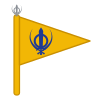
Dark blue Nishan Sahib
Nishan Sahib surmai
VIIISub-branches
- Budha Dal
- Taruna Dal
- Bidhi Chand Dal
- Ranghreta Dal
IXOther Branches of Sikhism
 Mainstream Sikhism (Khalsa Panth)ਖ਼ਾਲਸਾ ਪੰਥ Khālsā PanthThe great majority of Sikhs.Nihangਨਿਹੰਗ NihangA warrior order within the Khalsa, not a separate faith.
 Namdhari (Kuka)ਨਾਮਧਾਰੀ NāmdhārīFounded by Satguru Ram Singh in April 1857 at Sri Bhaini Sahib.
 Sikh Dharma (3HO)Sikh Dharma InternationalFounded in the United States by Harbhajan Singh (Yogi Bhajan), 1971 according to Britannica, 1969 in some sources.Uses the common symbol of the pathNirankariਨਿਰੰਕਾਰੀ NirankārīFounded by Baba Dayal in 1851 in northwest Punjab, stressing remembrance of the Name and the formless God.Uses the common symbol of the pathUdasiਉਦਾਸੀ UdāsīA celibate renunciant order founded by Sri Chand, son of Guru Nanak.Uses the common symbol of the path
 Ravidassiaਰਵਿਦਾਸੀਆ RavidāsīāA community revering Guru Ravidas, formerly counted as a Sikh group.
XSources
The library cross-checks the sources below. Where they disagree, the page gives both.
?Quick Questions
Are the Nihang a separate religion?
No. The Nihang are a warrior order within the Khalsa who accept the same ten Gurus and the Guru Granth Sahib. They differ from the mainstream in dress, martial practice, their reverence for two further scriptures and some customs.
Why do Nihang wear dark blue?
The theories all link the colour to Guru Gobind Singh or his son Fateh Singh. Historians have not established which is right, but the Nihang regard blue as the dress of the early Khalsa.
How many Nihang are there?
There is no reliable current figure. British era counts recorded 1,376 in 1892 and 431 in 1901. Far more people attend Hola Mohalla, since many other Sikhs join the festival.