
IOverview
The Namdhari are a Sikh movement founded in Punjab in the mid nineteenth century. Namdhari means bearers of the Name, stressing the remembrance of the divine Name. They are also known as Kuka, from the Punjabi word for a cry, because some members would cry out in ecstasy during devotional singing.
The Namdhari accept the ten Gurus and revere the Guru Granth Sahib. Their fundamental difference from the mainstream is the belief that the line of living human Gurus continued after 1708. Their present head, whom they call Satguru Uday Singh, succeeded in 2012. Namdharis are easy to recognise by the white turban tied flat across the forehead, the sidhi pagri, and the white woollen rosary.
IIHistory
The movement began with Balak Singh at Hazro in northwest Punjab in the first half of the nineteenth century, calling for simple living and remembrance of the Name. Namdharis regard Balak Singh as the eleventh Guru. His disciple Ram Singh, a former soldier in the Sikh army, raised a white flag at Sri Bhaini Sahib on Vaisakhi 1857 and founded the Namdhari order.
- April 1857FoundingRam Singh raises the white flag and initiates followers at Sri Bhaini Sahib.
- 1860sNon-cooperationNamdharis boycott British schools, courts, post offices and imported cloth.
- January 1872The Malerkotla eventsAfter attacks on cow slaughterhouses, the British execute 66 Namdharis by blowing them from cannon.
- 1872Ram Singh exiled to BurmaThe authorities record his death in 1885. Namdharis believe he is still alive and will return.
- 1959 to 2012Satguru Jagjit SinghA period when the movement became known for classical music, hockey and marriage reform.
- 2012Satguru Uday Singh succeedsThe succession is contested by his elder brother Thakur Dalip Singh.
Indian historiography often counts the Kuka movement among the early anti-colonial movements in Punjab, and the Indian state commemorates the Malerkotla victims. Namdharis themselves regard Ram Singh's non-cooperation as a forerunner of the movement later led by Gandhi. That view belongs to the movement and some historians, not to scholarship as a whole.
IIIBelief and Distinctives
Namdharis relate that Guru Gobind Singh did not die in 1708 but lived on in seclusion as Ajapal Singh, later passing the Guruship to Balak Singh. For them the line of living Gurus is unbroken: Balak Singh, Ram Singh, Hari Singh, Partap Singh, Jagjit Singh and now Uday Singh. They continue to revere the Guru Granth Sahib and the Dasam Granth.
Mainstream Sikhs do not accept this, since under the Rehat Maryada there has been no living human Guru since 1708. This is the doctrinal point that divides the two. Namdharis also keep a strict lacto-vegetarian diet, forbid alcohol and tobacco, and according to some sources tea and coffee as well, and place great weight on protecting cows. Apart from that difference, Namdharis keep the five Ks, recite the daily Nitnem prayers like other Sikhs, and treat remembrance of the Name as the heart of spiritual life, which is the meaning of their name.
IVPractice, Ritual and Daily Life
Namdharis wear handwoven white clothes and a white woollen rosary of 108 knots for remembering the Name. Their characteristic ritual is havan, a sacred fire kept while Sikh scripture is recited. In their Anand Karaj wedding the couple circle the havan fire while hymns are sung, whereas mainstream couples circle the scripture. The movement holds mass weddings, forbids dowry, and from Ram Singh's time has initiated women and opposed child marriage and female infanticide.
Music holds a large place. Satguru Jagjit Singh was a patron of many Indian classical musicians, and the movement's sports academy has trained numerous hockey players for the Indian national team. The movement also runs schools and a hospital in Ludhiana named after Satguru Partap Singh, which serves patients of every faith.
VOrganisation and Distribution
The centre is Sri Bhaini Sahib in Ludhiana district, Punjab, where the Satguru resides. By the movement's own claim cited by Wikipedia, there are 5 to 10 lakh members, that is 500,000 to 1 million, with no independent source and no year given. Outside Punjab there are communities in the UK, Kenya, Thailand, Australia and Canada.
After Satguru Jagjit Singh died in 2012 the movement divided. The larger side follows Satguru Uday Singh at Sri Bhaini Sahib, and the other follows Thakur Dalip Singh. The dispute has at times turned violent, and several incidents have been taken up by Indian investigating agencies. This library records the events without judging between the two sides.
VIIn Vietnam
This library has found no trace of Namdhari individuals or groups in Vietnam. The nearest recorded community is in Thailand, linked to Punjabi traders who settled there from the early twentieth century.
VIISymbol of the Branch

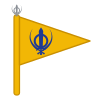
White triangular flag
Chitta Nishan
VIIIOther Branches of Sikhism
 Mainstream Sikhism (Khalsa Panth)ਖ਼ਾਲਸਾ ਪੰਥ Khālsā PanthThe great majority of Sikhs.
 Nihangਨਿਹੰਗ NihangA warrior order within the Khalsa, not a separate faith.Namdhari (Kuka)ਨਾਮਧਾਰੀ NāmdhārīFounded by Satguru Ram Singh in April 1857 at Sri Bhaini Sahib.
 Sikh Dharma (3HO)Sikh Dharma InternationalFounded in the United States by Harbhajan Singh (Yogi Bhajan), 1971 according to Britannica, 1969 in some sources.Uses the common symbol of the pathNirankariਨਿਰੰਕਾਰੀ NirankārīFounded by Baba Dayal in 1851 in northwest Punjab, stressing remembrance of the Name and the formless God.Uses the common symbol of the pathUdasiਉਦਾਸੀ UdāsīA celibate renunciant order founded by Sri Chand, son of Guru Nanak.Uses the common symbol of the path
 Ravidassiaਰਵਿਦਾਸੀਆ RavidāsīāA community revering Guru Ravidas, formerly counted as a Sikh group.
IXSources
The library cross-checks the sources below. Where they disagree, the page gives both.
?Quick Questions
How do Namdharis differ from mainstream Sikhs?
The core difference is that Namdharis believe the line of living human Gurus continued after 1708, while the mainstream holds the Guru Granth Sahib as the eternal Guru. Namdharis also dress in white, keep a strict vegetarian diet and perform havan.
Why are they called Kuka?
Kuka is Punjabi for a cry. During devotional singing some Namdharis would cry out in ecstasy, so outsiders called them Kukas.
What happened at Malerkotla in 1872?
In January 1872, after a band of Namdharis attacked cow slaughterhouses at Malerkotla, the British executed 66 of them by cannon and exiled Ram Singh to Burma. India today commemorates the victims as early opponents of colonial rule.