IOverview
The Ravidassia are a community devoted to Guru Ravidas, a poet saint of the bhakti movement in northern India. Forty of Ravidas's hymns are included in the Guru Granth Sahib, the Sikh scripture, so the community long lived close to Sikhism and was often counted as a Sikh group.
On 29 January 2010 Dera Sachkhand Ballan, the community's largest centre, declared Ravidassia a separate religion, with its own scripture, the Amritbani Guru Ravidass Ji, its own symbol, Har, and the greeting Jai Gurudev. Since then most of the community has not identified as Sikh. This library keeps the Ravidassia in the list of branches because of their shared history with Sikhism, not to class them as Sikh against their own self-description.
IIHistory
Ravidas came from a family of leatherworkers in Varanasi, an occupation the caste society of his time regarded as low. His poetry speaks of devotion to a formless God and of the equality of all people before that God. Ravidassia tradition gives his birth as 1377 and a very long life, while scholars usually place him in the fifteenth to early sixteenth century.
- 15th to 16th centuryGuru RavidasA poet saint of Varanasi whose verses later entered the Sikh scripture.
- 1604Included in the Adi GranthGuru Arjan includes Ravidas's hymns in the scripture that becomes the Guru Granth Sahib.
- 1920sThe Ad Dharm movementMangu Ram leads a movement seeking a separate religious identity for the community in Punjab.
- 1965Birthplace temple in VaranasiDera Sachkhand Ballan begins building the Shri Guru Ravidass Janam Asthan temple.
- 24 May 2009Attack in ViennaSant Ramanand Dass of Dera Sachkhand Ballan is killed in an attack at a temple in Vienna, Austria.
- 29 January 2010Declaration of a separate religionAnnounced in Varanasi together with the Amritbani, the Har symbol and the greeting Jai Gurudev.
IIIBelief and Distinctives
Ravidassia teaching centres on devotion to one Supreme Being, remembrance of the Name and the equality of all people regardless of caste. Guru Ravidas is revered as the supreme teacher. According to Wikipedia, the Amritbani contains 140 shabads, 40 pade and 231 saloks of Ravidas. The Sants of Dera Sachkhand Ballan are living teachers who guide the community.
Before 2010 many of the community's gurdwaras placed the Guru Granth Sahib on the same platform as images of Ravidas and living Sants. Many mainstream Sikhs objected, since under the Rehat Maryada nothing may be placed on a level with the scripture. According to the sources consulted, this tension and the events in Vienna in 2009 form the background to the 2010 declaration. Not the whole community accepted it. Some Ravidassias still keep the five Ks, use the names Singh or Kaur, and regard themselves as Sikh.
IVPractice, Ritual and Daily Life
Community places of worship are usually called Guru Ravidass Bhawan or Sabha. Gatherings include reading and singing Ravidas's verses, sermons and a shared meal in the manner of langar. The main festival is Guru Ravidas Jayanti, his birth anniversary, on the full moon of the month of Magh, usually in February. Indian media report tens of thousands of pilgrims travelling to the temple at Seer Goverdhanpur in Varanasi for the occasion. The Har symbol shows the letter Har within a radiant circle, topped by a flame.
VOrganisation and Distribution
The most influential centre is Dera Sachkhand Ballan near Jalandhar, Punjab, led by a succession of Sants. The community is largest in the Doaba region of Punjab and is also present in the UK, Canada, the US, Italy and Austria. Wikipedia gives a global estimate of 2 to 5 million with no year or method, so this library treats it as unreliable. The 2011 census of England and Wales recorded 11,058 people giving their religion as Ravidassia.
Most Ravidassias come from a community that Punjab's traditional caste order placed at the bottom, now listed among the Scheduled Castes under Indian law. Scholars usually read the growth of a separate religious identity, from Ad Dharm to the 2010 declaration, in the context of the community's search for equal social standing.
VIIn Vietnam
This library has found no trace of a Ravidassia community in Vietnam.
VIISymbol of the Branch
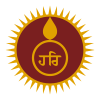
Har Nishaan
ਹਰਿ Har
VIIIOther Branches of Sikhism
 Mainstream Sikhism (Khalsa Panth)ਖ਼ਾਲਸਾ ਪੰਥ Khālsā PanthThe great majority of Sikhs.
 Nihangਨਿਹੰਗ NihangA warrior order within the Khalsa, not a separate faith.
 Namdhari (Kuka)ਨਾਮਧਾਰੀ NāmdhārīFounded by Satguru Ram Singh in April 1857 at Sri Bhaini Sahib.
 Sikh Dharma (3HO)Sikh Dharma InternationalFounded in the United States by Harbhajan Singh (Yogi Bhajan), 1971 according to Britannica, 1969 in some sources.Uses the common symbol of the pathNirankariਨਿਰੰਕਾਰੀ NirankārīFounded by Baba Dayal in 1851 in northwest Punjab, stressing remembrance of the Name and the formless God.Uses the common symbol of the pathUdasiਉਦਾਸੀ UdāsīA celibate renunciant order founded by Sri Chand, son of Guru Nanak.Uses the common symbol of the pathRavidassiaਰਵਿਦਾਸੀਆ RavidāsīāA community revering Guru Ravidas, formerly counted as a Sikh group.
IXSources
The library cross-checks the sources below. Where they disagree, the page gives both.
?Quick Questions
Are Ravidassias Sikhs?
Since 2010 Dera Sachkhand Ballan has declared Ravidassia a separate religion, and most of the community does not identify as Sikh. Some Ravidassias still keep the five Ks and consider themselves Sikh. This library follows each side's own self-description.
Who was Guru Ravidas?
Ravidas was a poet saint of Varanasi, living roughly in the fifteenth to sixteenth century, from a family of leatherworkers. His poetry speaks of devotion and equality, and forty of his hymns are included in the Guru Granth Sahib.
What is the Amritbani?
It is the Ravidassia scripture, announced in 2010, made up of the verses of Guru Ravidas. According to Wikipedia it contains 140 shabads, 40 pade and 231 saloks.