
IOverview
Many people picture the Catholic Church as a single block. In fact it is a communion of twenty four self-governing churches, each described in Latin as sui iuris. Twenty three of them carry Eastern traditions. The remaining one, larger than all the others put together, is the Latin Church.
The Latin Church is governed directly by the Bishop of Rome, with no patriarch or major archbishop in between. Its name comes from Latin, the language of worship and learning in Western Europe for more than a thousand years, and its main rite is the Roman Rite. When Vietnamese people speak of Catholics they almost always mean this church, because all 27 dioceses in Vietnam belong to it.
IIHistory
The Latin Church has no founding date of its own. It is the western half of early Christianity, grown up around the See of Rome. From the 4th century Latin gradually replaced Greek in Roman worship. After the schism of 1054 East and West went separate ways. Once some Eastern communities entered communion with Rome, a name was needed for the Latin part to keep the two apart.
- 306 and 1139Clerical celibacyThe Council of Elvira in 306 already required continence of clergy. The Second Lateran Council in 1139 declared the marriages of priests invalid.
- 1054East West SchismRome and Constantinople exchange excommunications.
- 1570The Tridentine MissalPope Pius V issues a unified Roman Missal, used for almost four centuries.
- 1969 and 1970A new MissalAfter the Second Vatican Council, Pope Paul VI issues a new Missal and opens the way for the vernacular.
- 1983Code of Canon LawThe code now in force for the Latin Church. The Eastern churches have had their own code since 1990.
- 2006 and 2024Patriarch of the WestBenedict XVI dropped the title in 2006. The 2024 Annuario Pontificio restored it to the list of papal titles.
IIITeachings and Distinctives
In matters of faith the Latin Church and the Eastern Catholic Churches hold the same doctrine, recognise the same seven sacraments and accept the primacy of the Bishop of Rome. The differences lie in liturgy, theological tradition, discipline and canon law. The features most often noted are these:
- Priests are bound to celibacy, with exceptions such as married former Anglican clergy received into the Church.
- Confirmation is usually separated from baptism and given later, and children make their First Communion before it.
- The Eucharist uses unleavened bread.
- The Creed includes the phrase and the Son, in Latin Filioque.
A common misunderstanding holds that Catholic means Latin, and that Eastern rite churches are somehow less fully Catholic. The Second Vatican Council, in its 1964 decree Orientalium Ecclesiarum, taught that these churches are equal in dignity to the Latin Church and that none ranks above another because of its rite.
IVPractice, Liturgy and Life
Religious life turns on Sunday Mass and the liturgical year: Advent, Christmas, Lent, Easter and Ordinary Time. Popular devotion is rich, from the Rosary and the Stations of the Cross to Eucharistic adoration and devotion to Mary and the saints. The great Western orders, Benedictines, Franciscans, Dominicans and Jesuits among them, all arose within this church.
| Rite | Where used | Notes |
|---|---|---|
| Roman, ordinary form | Worldwide | Missal of Paul VI, celebrated in local languages |
| Roman, 1962 Missal | Some communities | Widened by Summorum Pontificum in 2007, restricted again by Traditionis Custodes in 2021 |
| Ambrosian | Archdiocese of Milan, Italy | Named after Saint Ambrose, 4th century bishop of Milan |
| Mozarabic | Toledo, Spain | Now celebrated only in a few places |
| Divine Worship | Personal ordinariates | For communities of Anglican heritage, set up under the 2009 constitution Anglicanorum Coetibus |
VOrganisation and Distribution
The basic unit is the diocese, led by a bishop. Dioceses are grouped into provinces, and the bishops of a country form a bishops' conference. Unlike the Eastern churches, whose synods elect their own heads, the Latin Church has no level between its bishops and the Pope, who appoints every Latin bishop.
There is no separate count of Latin Catholics. Taking the Annuario Pontificio's total of about 1.422 billion Catholics in 2024 and subtracting about 18 million Eastern Catholics in 2023 data leaves roughly 1.4 billion. The largest share lives in Latin America, followed by Europe, Africa, North America and the Philippines.
VIIn Vietnam
Every organised Catholic community in Vietnam belongs to the Latin Church and follows the Roman Rite. The first missionaries, Portuguese, Spanish, Italian and French, all came from the Latin tradition. In 1659 the Holy See created the first two apostolic vicariates, for the southern and northern realms. In 1960 Pope John XXIII established the Vietnamese hierarchy with three provinces, Hanoi, Hue and Saigon. The twenty seventh diocese, Ha Tinh, was created in 2018.
According to the Catholic Bishops' Conference of Vietnam, as of 31 December 2025 the country had about 7.57 million Catholics, around 7.4 percent of the population, with 8,307 priests and 28,493 men and women religious. Catholicism is among the sixteen religions recognised or registered by the state. The faithful are concentrated in the Red River Delta, especially the former Nam Dinh and Phat Diem areas now in Ninh Binh province, and in Ho Chi Minh City, Dong Nai and the Central Highlands.
Before the Second Vatican Council, Mass in Vietnam was said in Latin while the people prayed in Vietnamese alongside. Since the council it has been celebrated in Vietnamese. On ancestors, the Holy See's 1939 instruction Plane Compertum Est and a statement by the Vietnamese bishops on 14 June 1965 allowed family altars, incense and death anniversary rites.
VIISymbol of the Branch
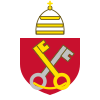
Holy See emblem: two keys and the triple tiara
Stemma Sanctae Sedis
VIIISub-branches
- Roman Rite (ordinary form)
- Ambrosian Rite in Milan
- Mozarabic Rite in Toledo
- Personal ordinariates for former Anglicans
IXOther Branches of Catholicism
Latin ChurchEcclesia LatinaThe largest of the 24 churches that make up the Catholic Church, headed directly by the Bishop of Rome. Syro-Malabar Catholic ChurchSyro-Malabar SabhaThe largest Eastern Catholic Church, rooted in the Saint Thomas Christians of Kerala, India.
 Ukrainian Greek Catholic ChurchУкраїнська греко-католицька церкваThe largest Byzantine-rite Eastern Catholic Church.
 Maronite Churchالكنيسة المارونيةA West Syriac rite church named after the hermit Saint Maron.
 Melkite Greek Catholic Churchكنيسة الروم الملكيين الكاثوليكA Byzantine-rite church worshipping in Arabic and Greek, rooted in the See of Antioch.Uses the common symbol of the pathArmenian Catholic ChurchՀայ Կաթողիկե ԵկեղեցիAn Armenian-rite church in communion with Rome, led by the Armenian Catholic Patriarch of Cilicia seated in Beirut.Uses the common symbol of the pathChaldean Catholic Churchܥܕܬܐ ܟܠܕܝܬܐ ܩܬܘܠܝܩܝܬܐAn East Syriac rite church worshipping in Syriac and Arabic, led by the Chaldean Patriarch of Babylon seated in Baghdad.Uses the common symbol of the path
 Syro-Malankara Catholic ChurchMalankara Suriyani Katholika SabhaA church of the Saint Thomas Christians of Kerala using the West Syriac rite, in communion with Rome since 1930.
XSources
The library cross-checks the sources below. Where they disagree, the page gives both.
?Quick Questions
Is the Latin Church the same as the Roman Catholic Church?
In everyday speech, almost. Strictly speaking, the Catholic Church is made up of the Latin Church and twenty three Eastern churches. The Latin Church is one of twenty four, though by far the largest.
Which rite do Vietnamese Catholics follow?
The Roman Rite of the Latin Church. No source was found for an organised Eastern Catholic community in Vietnam.
Why are Latin priests celibate when some Eastern Catholic priests are married?
Celibacy is a discipline of the Latin Church, not a dogma. The Eastern churches keep the ancient practice of ordaining married men as priests, while bishops everywhere are chosen from the celibate clergy.
Is the Latin Mass still celebrated?
Yes, but rarely. The current Missal exists in a Latin original and may be celebrated in Latin. The 1962 Missal is now allowed only within the limits set by Traditionis Custodes in 2021.