IOverview
This is the largest Byzantine-rite Eastern Catholic Church and the second largest Eastern Catholic Church after the Syro-Malabar. The word Greek in its name refers not to ethnicity but to the Byzantine rite of Greek origin.
Its head holds the title Major Archbishop of Kyiv and Halych. The church has its own synod, which elects its head, and the Pope then confirms the election. A visitor stepping inside would see an iconostasis, unaccompanied chant and the Divine Liturgy of Saint John Chrysostom, in short something almost identical to an Orthodox church. The difference is communion: this church accepts the primacy of the Bishop of Rome.
IIHistory
Its distant root is the baptism of Kyiv in 988 under Grand Prince Volodymyr, in the Byzantine tradition and under the Patriarch of Constantinople. By the late 16th century these lands lay within the Polish Lithuanian Commonwealth. In 1595 and 1596 several bishops of the Kyivan church signed the Union of Brest, leaving Constantinople's jurisdiction to enter communion with Rome while keeping the Byzantine rite. Not all the faithful followed, and the Union left a lasting division with the Orthodox side.
The Soviet era was the hardest chapter. After 1946 the church had no legal existence in Ukraine. Bishops and priests were ordained in secret and the liturgy was celebrated in private homes, while in the diaspora emigrant communities kept eparchies and schools going.
- 1596Union of BrestBishops sign a union with Rome, keeping Eastern liturgy and discipline.
- 1774The name Greek CatholicUnder Maria Theresa of Austria the name is adopted to distinguish the church from Latin and Armenian Catholics.
- 1901 to 1944Metropolitan Andrey SheptytskyThe metropolitan of Lviv leads a move to remove Latin elements from the liturgy from the 1930s.
- 1946LiquidationSoviet authorities convene a synod in Lviv that revokes the Union of Brest and hands church property to the Russian Orthodox Church. The church goes underground.
- 1963Release of Josyf SlipyjMetropolitan Slipyj leaves Soviet imprisonment for Rome and receives the title of Major Archbishop.
- 1989Back in the openIn December 1989 the church is again allowed to function officially.
- 2005 and 2013Return to KyivThe church's centre moves from Lviv to Kyiv in 2005. The Patriarchal Cathedral of the Resurrection in Kyiv is dedicated in 2013.
IIITeachings and Distinctives
The church understands itself as the original Church of Kyiv, faithful to the Byzantine tradition and at the same time in communion with Rome. Its hierarchs and faithful commonly call their head Patriarch and have asked the Holy See to recognise the title. So far the Holy See has not done so.
In doctrine it believes what the whole Catholic Church believes. In discipline and liturgy its differences from the Latin Church include these:
- Married men may be ordained priests. Bishops are chosen from celibate or monastic clergy.
- Infants receive baptism, chrismation and communion together.
- The Eucharist uses leavened bread.
- From 1 September 2023 the church moved its fixed feasts to the new calendar, falling on the same dates as the Gregorian, while Easter is still reckoned the traditional way.
IVPractice, Liturgy and Life
The main service is the Divine Liturgy of Saint John Chrysostom, celebrated in Ukrainian, and abroad sometimes in English, Portuguese or Spanish. The Eastern Great Fast, Easter with its decorated pysanka eggs, and Christmas Eve with its twelve dish supper are familiar customs. Icons hold a central place both in church and at home.
Monastic life includes the Order of Saint Basil the Great and the Studite monks, strengthened under Metropolitan Sheptytsky. The Ukrainian Catholic University in Lviv is its main academic centre.
VOrganisation and Distribution
The current Major Archbishop is Sviatoslav Shevchuk, elected in 2011. According to the Annuario Pontificio 2023 the church has 4,295,581 members. Wikipedia, as accessed in 2026, gives about 3,993 parishes. Most of the faithful live in western Ukraine, around Lviv, Ivano-Frankivsk and Ternopil. Abroad the church has eparchies in Canada, the United States, Brazil, Argentina, Poland, Australia and several European countries, largely formed by waves of emigration in the late 19th century and after the Second World War.
Since 2022 the war in Ukraine has affected many parishes and faithful. This page does not go into the political side of the conflict.
VIIn Vietnam
There is no significant Ukrainian Greek Catholic community in Vietnam, and no source was found for a parish or priest of this church here. Under Eastern canon law, faithful living where their own church has no eparchy come under the local bishop, so any Ukrainian Greek Catholics in Vietnam would usually attend Mass in a Latin parish. For Vietnamese readers the church is the clearest illustration that being Catholic and following the Byzantine rite are not mutually exclusive.
VIISymbol of the Branch
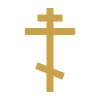
Three bar cross
Трираменний хрест
VIIIOther Branches of Catholicism
 Latin ChurchEcclesia LatinaThe largest of the 24 churches that make up the Catholic Church, headed directly by the Bishop of Rome.
 Syro-Malabar Catholic ChurchSyro-Malabar SabhaThe largest Eastern Catholic Church, rooted in the Saint Thomas Christians of Kerala, India.Ukrainian Greek Catholic ChurchУкраїнська греко-католицька церкваThe largest Byzantine-rite Eastern Catholic Church.
 Maronite Churchالكنيسة المارونيةA West Syriac rite church named after the hermit Saint Maron.
 Melkite Greek Catholic Churchكنيسة الروم الملكيين الكاثوليكA Byzantine-rite church worshipping in Arabic and Greek, rooted in the See of Antioch.Uses the common symbol of the pathArmenian Catholic ChurchՀայ Կաթողիկե ԵկեղեցիAn Armenian-rite church in communion with Rome, led by the Armenian Catholic Patriarch of Cilicia seated in Beirut.Uses the common symbol of the pathChaldean Catholic Churchܥܕܬܐ ܟܠܕܝܬܐ ܩܬܘܠܝܩܝܬܐAn East Syriac rite church worshipping in Syriac and Arabic, led by the Chaldean Patriarch of Babylon seated in Baghdad.Uses the common symbol of the path
 Syro-Malankara Catholic ChurchMalankara Suriyani Katholika SabhaA church of the Saint Thomas Christians of Kerala using the West Syriac rite, in communion with Rome since 1930.
IXSources
The library cross-checks the sources below. Where they disagree, the page gives both.
?Quick Questions
Is the Ukrainian Greek Catholic Church Orthodox?
No. Its liturgy is almost the same as the Orthodox one, but it is in communion with the Bishop of Rome and belongs to the Catholic Church. Ukraine also has separate Orthodox churches.
Can Ukrainian Greek Catholic priests be married?
Yes, if they married before ordination. This is the ancient practice of the Eastern churches. Bishops are chosen from among celibate clergy.
Why is it called Greek if it is Ukrainian?
Greek refers to the Byzantine rite of Greek origin, not to ethnicity. The name Greek Catholic has been in official use since 1774 under Austrian rule.
Can Latin Catholics attend its services?
Yes. The two churches are in communion, so Latin Catholics may attend and receive communion at the Byzantine Divine Liturgy.