IOverview
The Maronite Church is one of the twenty three Eastern Catholic Churches. It is named after Saint Maron, a hermit who lived in the region of Syria and died around 410, and it is the largest Christian community in Lebanon.
It follows the West Syriac rite, worships in Syriac and Arabic, and has its own patriarch, styled Maronite Patriarch of Antioch and All the East. The patriarchate sits at Bkerke, north of Beirut. According to Wikipedia, about two thirds of its members live outside the Middle East, mainly in the Americas and Australia.
IIHistory
After Saint Maron's death his disciples founded a monastery in his name near the Orontes river in Syria. The monastery sided with the Council of Chalcedon of 451 in the theological disputes of the time. Around 685 the community elected Saint John Maron as patriarch, beginning its own patriarchal line. Under pressure from several directions, the community gradually withdrew into Mount Lebanon, building monasteries and villages in its steep valleys.
- around 410Death of Saint MaronA hermit who lived in the open air in Syria, revered by his disciples as their teacher.
- around 685The first patriarchSaint John Maron is elected, opening the patriarchal succession.
- 1182Contact with Rome in the Crusader eraLatin sources record the Maronites affirming communion with Rome.
- 1584Maronite College in RomeGregory XIII founds a college to train Maronite clergy, which produced many Syriac scholars.
- 1736Synod of Mount LebanonThe synod shapes the church's organisation and discipline in the modern period.
- 1943Lebanese National PactAn unwritten agreement provides that the President of Lebanon is a Maronite.
- 2011Patriarch Bechara Boutros al-RaiElected in March 2011 and made a cardinal in 2012.
IIITeachings and Distinctives
The Maronite Church holds that it has never broken communion with Rome, and so, unlike many Eastern churches, has no date of separation and reunion. The community gives this point great weight when it tells its own story.
Some historians argue that between the 7th and 12th centuries the community was influenced by monothelitism, the teaching of a single will in Christ rejected by the Third Council of Constantinople in 681. The Maronite Church rejects this reading. The library records both views.
In doctrine it believes what the whole Catholic Church believes. Over centuries of closeness to Rome, Maronite worship absorbed a number of Latin elements, in church furnishing, vestments and the use of unleavened bread. In Lebanon married men may be ordained priests. In 2014 the Holy See lifted an old restriction on married Eastern priests serving outside their traditional territories.
IVPractice, Liturgy and Life
The Maronite Eucharist is called the Qurbono, and the words of consecration are often said in Syriac, a close relative of Aramaic. Monastic tradition runs deep. The Qadisha Valley in northern Lebanon, dotted with Maronite monasteries and hermit caves, was inscribed on the UNESCO World Heritage List in 1998 together with the Forest of the Cedars of God.
The most venerated saints are Saint Charbel Makhlouf, canonised in 1977, Saint Rafqa in 2001 and Saint Nimatullah al-Hardini in 2004. Saint Charbel's tomb at Annaya is a major pilgrimage site that draws people of other faiths as well.
VOrganisation and Distribution
The patriarch is elected by the synod of bishops, who then ask the Pope for ecclesial communion. According to the Annuario Pontificio 2023 the church has 3,543,796 members. Wikipedia lists some 28 eparchies and patriarchal vicariates across the Middle East, Europe, the Americas, Africa and Oceania. In Lebanon, according to Wikipedia, Maronites make up roughly 22 to 23 percent of the population, an estimate since Lebanon has held no census since 1932. The largest diaspora is in Brazil, followed by the United States, Argentina, Australia, Canada, Mexico and France.
The diaspora took shape in two great waves. The first ran from the late 19th into the early 20th century, when many families left Mount Lebanon to seek a living in the Americas. The second came during and after the Lebanese civil war of 1975 to 1990. In many countries Maronites are now in their third or fourth generation, and the liturgy is celebrated bilingually, Syriac alongside English, Portuguese or Spanish. Passing on liturgical Syriac to the young is a concern that diaspora eparchies often raise.
VIIn Vietnam
There is no significant Maronite community in Vietnam, and no source was found for a Maronite parish or priest here. Under Eastern canon law, faithful living where their own church has no eparchy come under the local bishop, so any Lebanese Catholics in Vietnam would usually attend Mass in a Latin parish.
VIISymbol of the Branch
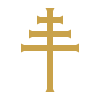
Maronite Cross
الصليب الماروني
VIIIOther Branches of Catholicism
 Latin ChurchEcclesia LatinaThe largest of the 24 churches that make up the Catholic Church, headed directly by the Bishop of Rome.
 Syro-Malabar Catholic ChurchSyro-Malabar SabhaThe largest Eastern Catholic Church, rooted in the Saint Thomas Christians of Kerala, India.
 Ukrainian Greek Catholic ChurchУкраїнська греко-католицька церкваThe largest Byzantine-rite Eastern Catholic Church.Maronite Churchالكنيسة المارونيةA West Syriac rite church named after the hermit Saint Maron.
 Melkite Greek Catholic Churchكنيسة الروم الملكيين الكاثوليكA Byzantine-rite church worshipping in Arabic and Greek, rooted in the See of Antioch.Uses the common symbol of the pathArmenian Catholic ChurchՀայ Կաթողիկե ԵկեղեցիAn Armenian-rite church in communion with Rome, led by the Armenian Catholic Patriarch of Cilicia seated in Beirut.Uses the common symbol of the pathChaldean Catholic Churchܥܕܬܐ ܟܠܕܝܬܐ ܩܬܘܠܝܩܝܬܐAn East Syriac rite church worshipping in Syriac and Arabic, led by the Chaldean Patriarch of Babylon seated in Baghdad.Uses the common symbol of the path
 Syro-Malankara Catholic ChurchMalankara Suriyani Katholika SabhaA church of the Saint Thomas Christians of Kerala using the West Syriac rite, in communion with Rome since 1930.
IXSources
The library cross-checks the sources below. Where they disagree, the page gives both.
?Quick Questions
Are Maronites Arabs?
Most speak Arabic, but many Maronites stress their Syriac and Aramaic roots over an Arab identity. It is a matter of self-identification and varies from person to person.
Is the Maronite Church Catholic?
Yes. It is a self-governing church within the Catholic Church, in full communion with the Pope, with its own patriarch and synod.
Why must the President of Lebanon be a Maronite?
Under the unwritten National Pact of 1943, the top offices are shared among religious communities. The President is a Maronite, the Prime Minister a Sunni Muslim and the Speaker of Parliament a Shia Muslim.
Who is Saint Charbel?
A 19th century Maronite monk and hermit, canonised in 1977. His tomb at Annaya in Lebanon draws many pilgrims, Christians and people of other faiths alike.