IOverview
The Syro-Malabar Church is one of the twenty three Eastern Catholic Churches and the largest of them. The name joins two words: Syro refers to the Syriac liturgical tradition, and Malabar is the old name for the southwestern coast of India, now the state of Kerala.
It is in full communion with the Bishop of Rome yet self-governing, with its own synod of bishops and a Major Archbishop at its head. Its rite is East Syriac, sharing roots with the Assyrian Church of the East and the Chaldean Catholic Church. Its diocesan priests keep celibacy like the Latin Church, which sets it apart from many other Eastern churches.
IIHistory
The community sees itself as descended from those who heard Thomas the Apostle preach when he reached the Malabar coast, traditionally around AD 52. Hence the name Saint Thomas Christians, or Nasrani.
Historians can document an organised presence from about the 6th century, when the community received bishops from the Church of the East in Persia and used the East Syriac liturgy. When the Portuguese arrived in the early 16th century, they brought it under Latin rule.
- 1599Synod of DiamperCuts ties with East Syriac bishops, places the community under Latin authority and latinises its liturgy.
- 1653Coonan Cross OathA large part of the community swears not to obey the Jesuit bishops. It splits in two: those who stay in communion with Rome become the Syro-Malabar Church, the others later adopt the West Syriac tradition.
- 1887 and 1896Release from Latin ruleLeo XIII creates separate vicariates, and in 1896 native bishops are appointed.
- 1923Own hierarchyErnakulam becomes a metropolitan see, with Augustine Kandathil as the first head.
- 1992Major archiepiscopal churchRaised to major archiepiscopal status, with wide self-government under Eastern canon law.
- 2024New Major ArchbishopRaphael Thattil is elected Major Archbishop in January 2024.
IIITeachings and Distinctives
In doctrine the Syro-Malabar Church believes what the whole Catholic Church believes. What sets it apart is its East Syriac heritage and the way Saint Thomas Christians have lived inside Indian society. The Eucharist is called the Holy Qurbana and mostly uses the anaphora of Addai and Mari, one of the oldest still in use. The liturgical language is Malayalam, with some Syriac, and Tamil in places.
Its familiar emblem is the Saint Thomas Cross, which bears no corpus and rests on a lotus. Many families keep customs close to their Hindu neighbours in weddings, dress and food, now recognised as part of the local heritage.
In 1999 the synod adopted a uniform mode of celebration: the priest faces the people for the Liturgy of the Word and faces the altar for the Eucharistic prayer. When this was widely applied from 2021, many parishes in the Archeparchy of Ernakulam-Angamaly objected and wished to keep facing the people throughout. Pope Francis intervened with letters and a personal delegate. The library records the events without taking a side.
IVPractice, Liturgy and Life
Parish life in Kerala is vigorous, with patronal feasts, processions and large associations. The church has many indigenous religious congregations. The Carmelites of Mary Immaculate, known as CMI, are considered the first native congregation for men in India and are linked to Saint Kuriakose Elias Chavara. The church also runs an extensive network of schools, hospitals and colleges.
Its saints include Saint Alphonsa, the first Indian woman to be canonised, in 2008, Saint Kuriakose Elias Chavara and Saint Euphrasia, canonised in 2014, and Saint Mariam Thresia in 2019.
VOrganisation and Distribution
The church is headed by the Major Archbishop of Ernakulam-Angamaly, whose seat is at Mount Saint Thomas in Kakkanad, near Kochi. The synod of bishops elects the Major Archbishop and the Pope confirms the choice. Wikipedia, as accessed in 2026, lists 35 eparchies, 31 in India and 4 abroad, in the United States, Canada, Britain and Australia. Many faithful also live in the Gulf states, where large numbers of people from Kerala work, though the church has no eparchy of its own there.
| Measure | Figure | Source and year |
|---|---|---|
| Members worldwide | 4,537,342 | Annuario Pontificio 2023 |
| Members in Kerala | About 2.35 million | Census of India 2011, via Wikipedia |
| Eparchies | 35 | Wikipedia, accessed 2026 |
VIIn Vietnam
There is no significant Syro-Malabar community in Vietnam, and no source was found for an organised congregation. Under Eastern canon law, faithful living where their own church has no eparchy come under the local bishop. Catholics from Kerala living in Vietnam, if any, would normally attend Mass in Latin parishes. For Vietnamese readers the church is of interest as an example of Catholicism long rooted in an Asian culture without having arrived through Western missionaries.
VIISymbol of the Branch
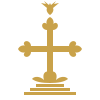
Saint Thomas Cross
Mar Thoma Sliva
VIIIOther Branches of Catholicism
 Latin ChurchEcclesia LatinaThe largest of the 24 churches that make up the Catholic Church, headed directly by the Bishop of Rome.Syro-Malabar Catholic ChurchSyro-Malabar SabhaThe largest Eastern Catholic Church, rooted in the Saint Thomas Christians of Kerala, India.
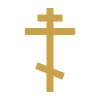 Ukrainian Greek Catholic ChurchУкраїнська греко-католицька церкваThe largest Byzantine-rite Eastern Catholic Church.
 Maronite Churchالكنيسة المارونيةA West Syriac rite church named after the hermit Saint Maron.
 Melkite Greek Catholic Churchكنيسة الروم الملكيين الكاثوليكA Byzantine-rite church worshipping in Arabic and Greek, rooted in the See of Antioch.Uses the common symbol of the pathArmenian Catholic ChurchՀայ Կաթողիկե ԵկեղեցիAn Armenian-rite church in communion with Rome, led by the Armenian Catholic Patriarch of Cilicia seated in Beirut.Uses the common symbol of the pathChaldean Catholic Churchܥܕܬܐ ܟܠܕܝܬܐ ܩܬܘܠܝܩܝܬܐAn East Syriac rite church worshipping in Syriac and Arabic, led by the Chaldean Patriarch of Babylon seated in Baghdad.Uses the common symbol of the path
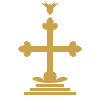 Syro-Malankara Catholic ChurchMalankara Suriyani Katholika SabhaA church of the Saint Thomas Christians of Kerala using the West Syriac rite, in communion with Rome since 1930.
IXSources
The library cross-checks the sources below. Where they disagree, the page gives both.
?Quick Questions
Is the Syro-Malabar Church Catholic?
Yes. It is a self-governing church within the Catholic Church, in full communion with the Pope. Latin Catholics may attend and receive communion at a Syro-Malabar Qurbana.
How does it differ from the Syro-Malankara Church?
Both come from the Saint Thomas Christians of Kerala and both are in communion with Rome. The Syro-Malabar Church uses the East Syriac rite, while the Syro-Malankara Church uses the West Syriac rite and joined Rome in 1930.
Can Syro-Malabar priests marry?
No. Although it is an Eastern church, it keeps celibacy for priests, a practice formed over its long period under Latin authority.
Did Saint Thomas really reach India?
That is the community's tradition, and no contemporary document confirms it. Historians can trace an organised presence only from about the 6th century.