IOverview
Shaivism is the tradition within Hinduism that holds Shiva to be the supreme reality. Its central object of worship is the linga, a non-figurative emblem usually set on a yoni base. The tradition is associated with asceticism, meditation and the greatest temples of South India.
For Vietnamese readers it is the closest of the four great traditions, because it was Shaivism that travelled by sea to Champa, became the state religion there, and left behind the sanctuary of My Son and the Cham towers. The Cham Ahier community today continues that line in a localised form, described on a page of its own.
IIHistory
The Vedas know Rudra, a fearsome figure who is also a healer. The epithet Shiva, meaning auspicious, gradually became the main name. The Shvetashvatara Upanishad already speaks of Rudra Shiva as the supreme Lord. From around the start of the Common Era systematic Shaiva schools appeared, with their own scriptures called Agamas, initiation rites and lines of teachers.
- around 2nd centuryPashupataAn ascetic order associated with Lakulisha, one of the earliest recorded Shaiva schools.
- around 380 to 413The first linga at My SonThe Cham king Bhadravarman I installs a linga of Shiva under the name Bhadresvara.
- 6th to 9th centuriesThe NayanarsSixty three Tamil poet saints sing of Shiva, and their hymns are gathered in the Tirumurai.
- 9th to 11th centuriesKashmir ShaivismFrom Vasugupta to Abhinavagupta, a subtle non-dual philosophy takes shape.
- 1010Brihadeeswarar templeThe Chola king Rajaraja I completes the great temple at Thanjavur, now part of the Great Living Chola Temples World Heritage site.
- 12th centuryBasava and the LingayatsA movement in Karnataka stresses personal devotion to Shiva and rejects caste distinctions.
- 13th centuryMeykandarComposes the Shivajnanabodham, the foundational text of Tamil Shaiva Siddhanta.
IIITeachings and Distinctives
Shaivas hold that Shiva creates, sustains, dissolves and renews, conceals and bestows grace. The bound soul is liberated by Shiva's grace, received through a teacher, initiation and practice.
The schools differ over whether the soul and Shiva are one or two. Tamil Shaiva Siddhanta teaches three realities, Pati the Lord, pashu the soul and pasha the bond, and largely holds a dualist view. Kashmir Shaivism is non-dual: everything is Shiva's consciousness, and liberation is recognising this. The Lingayats reject the authority of the Veda and the caste system, and each believer wears a small personal linga.
A common misunderstanding is that Shiva is merely a god of destruction. The Trimurti formula assigns him that role, but it is a later summary. Within Shaivism itself Shiva performs all five cosmic acts, and dissolution is understood as clearing the way for a new cycle.
IVPractice, Liturgy and Life
Worship of the linga involves pouring water, milk and honey over it and offering bilva leaves and flowers. The five syllable mantra Om Namah Shivaya is recited very widely. Devotees mark the forehead with the tripundra, three horizontal lines of sacred ash called vibhuti, and wear rudraksha beads.
The greatest festival is Maha Shivaratri, a night of vigil and prayer in the month of Phalguna, around February or March. The twelve Jyotirlinga temples, the city of Varanasi on the Ganges and Mount Kailash in Tibet are major pilgrimage goals. The ascetic tradition is strong, with many orders of wandering, homeless sadhus.
VOrganisation and Distribution
| School | Main features | Stronghold |
|---|---|---|
| Shaiva Siddhanta | Agama based, temple ritual, Nayanar hymns | Tamil Nadu, Sri Lanka |
| Kashmir Shaivism | Non-dual philosophy, now mainly a scholarly tradition | Kashmir, academic circles |
| Pashupata | Ascetic, now barely surviving as a distinct order | Historically Gujarat and Rajasthan |
| Veerashaiva and Lingayat | Personal linga, rejection of caste | Karnataka |
| Nath | Hatha yoga, linked with Gorakhnath | North India, Nepal |
According to the World Religion Database, as cited by Wikipedia, there were about 385.4 million Shaivas in 2020. Jones and Ryan in 2007 ranked Shaivism as the largest tradition. In 2018 the Karnataka state government recommended that the central government recognise Lingayatism as a separate minority religion. Some in the community support this, while others wish to remain within Hinduism. This page records both positions.
VIIn Vietnam
UNESCO's file on the My Son Sanctuary, inscribed in 1999, states that although Mahayana Buddhism entered Cham culture, Shaivism remained the state religion. The site has eight groups with 71 monuments dating from the 4th to the 13th century. King Bhadravarman I installed a linga under the name Bhadresvara, joining his own name with the god's, a practice that shows how royal and divine authority were bound together.
Shaivism in Vietnam today takes two forms. The first is the religion of the Cham Ahier in Khanh Hoa and Lam Dong provinces, formerly Ninh Thuan and Binh Thuan, a deeply localised Shaivism with its own page in this library. The second is the Tamil tradition in Ho Chi Minh City. The Sri Thenday Yutthapani temple at 66 Ton That Thiep, recorded by Thanh Nien newspaper as built in 1880 by Nattukkottai Chettiar merchants, is dedicated to Murugan, a son of Shiva in Tamil mythology, in the South Indian Shaiva manner. No source has been found for any other officially active Shaiva organisation.
VIISymbol of the Branch

Tripundra
त्रिपुण्ड्र Tripuṇḍra
VIIISub-branches
- Shaiva Siddhanta
- Kashmir Shaivism
- Pashupata
- Veerashaiva and Lingayat
- Nath
IXOther Branches of Hinduism
 Vaishnavismवैष्णव VaiṣṇavaThe tradition centred on Vishnu and his avatars, above all Rama and Krishna.Shaivismशैव ŚaivaThe tradition centred on Shiva, whose main object of worship is the linga.
 Shaktismशाक्त ŚāktaThe tradition that takes the Goddess, as Devi, Durga or Kali, as the root principle of power (shakti).
 Smartismस्मार्त SmārtaA tradition with no single deity at the centre.
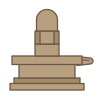 Cham Ahier (Cham Brahmanism)AhiérThe localised Shaiva tradition of Champa kept by the Cham Ahier.
 Neo-Hindu and Reform MovementsNeo-Hinduism, Reform HinduismMovements from the 19th century onward that reinterpret the tradition for modern times, such as Brahmo Samaj, Arya Samaj and the Ramakrishna Mission.
XSources
The library cross-checks the sources below. Where they disagree, the page gives both.
?Quick Questions
What is a linga?
The linga is a non-figurative emblem of Shiva, usually set on a yoni base, and the central object of worship in Shaiva temples. Many devotees understand it as a sign of the formless, and interpretations vary by school.
Is Cham Ahier a form of Shaivism?
Cham Ahier continues the Shaivism of Champa, but in a deeply localised form: deified Cham kings are worshipped, the Cham calendar is used and the main festival is Kate. The library presents it as a branch of its own.
What is Maha Shivaratri?
The greatest night of the year for Shaivas, falling in the month of Phalguna, around February or March. Devotees fast, keep vigil, chant and make offerings to the linga through the night.