
IOverview
Shaktism is the tradition within Hinduism that regards the Goddess, known broadly as Devi or Mahadevi, as the supreme reality. The word shakti means power. For Shaktas that power does not depend on any male god, it is itself the source of all things.
The Goddess is invoked under a great many names: Durga, Kali, Lalita Tripurasundari, Parvati and countless village and regional goddesses. Shaktas understand these names as aspects of one Mother. The tradition is closely bound up with Tantra, the ritual and meditative traditions based on the Tantric scriptures, but it is also widely present in popular worship.
IIHistory
Goddess worship in the subcontinent is very old, but systematic Shaktism took shape around the Devi Mahatmya, part of the Markandeya Purana, usually dated to around the 5th to 6th centuries. The text tells of the Goddess overcoming the forces of chaos and declares her the supreme being. From there, Tantras and Puranas devoted to the Goddess developed into two major branches.
- around 5th to 6th centuriesDevi MahatmyaThe foundational text of Shaktism, still recited during Navaratri.
- 7th to 12th centuriesThe TantrasTantric ritual systems take shape, forming the basis of the Srikula and Kalikula branches.
- 8th to 13th centuriesPo Nagar towersThe Cham build a complex for Po Nagar, Mother of the Land, identified with Bhagavati.
- 18th centuryRamprasad SenThe Bengali poet writes songs to Kali in Bengali that are still widely sung.
- 19th centuryRamakrishna at DakshineswarRamakrishna serves as priest at the Dakshineswar Kali temple near Kolkata and later deeply influences the reform movements.
- 2021Durga Puja in KolkataUNESCO inscribes Durga Puja in Kolkata on the Representative List of the Intangible Cultural Heritage of Humanity.
IIITeachings and Distinctives
Shaktas hold that the world is the manifestation of Shakti. The Goddess is both the Mother who blesses and the power that destroys what binds people. Liberation means realising one's identity with that power, or receiving the Mother's grace.
| Branch | Focus | Stronghold |
|---|---|---|
| Srikula, also called Shri Vidya | Worship of Lalita Tripurasundari, use of the Shri Yantra and the Panchadashi mantra, recitation of the Lalita Sahasranama | South India, Kerala, Tamil Nadu, Karnataka |
| Kalikula | Worship of Kali and related goddesses, with much Tantric ritual | Bengal, Assam, Odisha, Nepal |
A misunderstanding sometimes heard in Vietnam is that Vietnamese Mother Goddess worship is a form of Shaktism. Both traditions place a goddess at the centre, but they have different origins, texts and rituals. At the Po Nagar towers three layers coexist, the Cham goddess, the Hindu Bhagavati and the Vietnamese Thien Y A Na, but that does not make Dao Mau a form of Shaktism.
IVPractice, Liturgy and Life
The greatest festival is Navaratri, nine nights of Goddess worship in autumn, known in Bengal as Durga Puja, when pandal pavilions go up across whole cities. The Shakti Pithas, places tradition links with the Goddess, are major pilgrimage sites, and the Kamakhya temple in Guwahati, Assam, is among the most famous. In practice Shaktas recite the Devi Mahatmya and use yantras, diagrams for meditation, and mantras. Many families wear a red kumkum dot on the forehead.
VOrganisation and Distribution
Like the other traditions, Shaktism has no central authority. Transmission runs through teachers, temples and families. Shri Vidya lineages have long ties with certain Smarta monasteries in South India. According to the World Religion Database, as cited by Wikipedia, there were about 305.6 million Shaktas in 2020. The figure is hard to pin down, since many people worship the Goddess alongside Shiva or Vishnu without placing themselves in any one tradition.
VIIn Vietnam
Shaktism has left two marks in Vietnam, centuries apart.
The first is the Po Nagar temple complex in Nha Trang, now in Khanh Hoa province, built between the 8th and 13th centuries. It honours Po Nagar, also written Yang Po Inu Nagar, Mother of the Land for the Cham, identified with the Hindu Bhagavati. Later the Vietnamese worshipped here under the name Thien Y A Na. The Thap Ba festival was added to the national list of intangible cultural heritage in 2012, and the site was classed as a special national monument on 17 January 2025. The Cham Ahier still worship Po Inu Nagar, including at a shrine in Huu Duc village in former Ninh Thuan.
The second is the Mariamman temple at 45 Truong Dinh, Ho Chi Minh City, known locally as chua Ba An, built by the Tamil community in the colonial period. Mariamman is a Tamil goddess associated with rain, harvests and protecting villages from epidemics. Sources differ on its date: some give around 1885, others simply say it is over a century old. Most of the daily worshippers are Vietnamese, who light incense and pray in their own way.
VIISymbol of the Branch
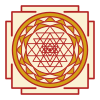
Shri Yantra
श्रीयन्त्र Śrī Yantra
VIIISub-branches
- Srikula (Shri Vidya)
- Kalikula
IXOther Branches of Hinduism
 Vaishnavismवैष्णव VaiṣṇavaThe tradition centred on Vishnu and his avatars, above all Rama and Krishna.
 Shaivismशैव ŚaivaThe tradition centred on Shiva, whose main object of worship is the linga.Shaktismशाक्त ŚāktaThe tradition that takes the Goddess, as Devi, Durga or Kali, as the root principle of power (shakti).
 Smartismस्मार्त SmārtaA tradition with no single deity at the centre.
 Cham Ahier (Cham Brahmanism)AhiérThe localised Shaiva tradition of Champa kept by the Cham Ahier.
 Neo-Hindu and Reform MovementsNeo-Hinduism, Reform HinduismMovements from the 19th century onward that reinterpret the tradition for modern times, such as Brahmo Samaj, Arya Samaj and the Ramakrishna Mission.
XSources
The library cross-checks the sources below. Where they disagree, the page gives both.
?Quick Questions
What does Shakti mean?
Shakti is Sanskrit for power. In Shaktism, Shakti is the Goddess herself, the source of all things. In other traditions shakti is usually understood as the power paired with a male god.
How do Navaratri and Durga Puja differ?
Navaratri is nine nights of Goddess worship celebrated across India with regional customs. Durga Puja is the Bengali way of marking the season, centred on Durga, and the Kolkata celebration was inscribed by UNESCO in 2021.
Which tradition does the Mariamman temple in Saigon belong to?
The Mariamman temple honours the Tamil goddess Mariamman and belongs to South Indian folk worship within the Shakta frame. Vietnamese call it a chua, a pagoda, out of habit, though it is a Hindu temple.