
IColours
Colour used for this page of the library: Saffron (bhagwa, kesari) #F28C28. Every colour code is approximate, since most paths name their colours without publishing codes.
Principal colour the colour of the path
The colour of dusk (sandhya) and fire (Agni). It stands for sacrifice, light and the quest for liberation. Saints and renunciates wear it. Radhakrishnan read bhagwa as renunciation and freedom from desire. The hex is an estimate between saffron shades, since sources give different codes (saffron #F4C430, India saffron of the flag #FF671F).
Sannyasi renunciates wear yellow, saffron, orange, ochre and earth tones. Gerua and kāṣāya are the traditional names. The hex is an estimate.
Place of worship real sanctuaries
Ritual colours by occasion and season
The Po Adhia, Paseh, Ka-ing, Kadhar and Muk Pajau bathe and dress the statues, offer fruit and betel, chant and dance. Basaih clergy wear white. Katê has been a national intangible cultural heritage of Vietnam since 2017.
Hinduism has no common liturgical colour calendar. No reliable source was found that assigns a colour to each festival, so no colour is set.
Mourning and avoided colours
In the antyesti cremation rite, the bodies of men and widows are wrapped in white cloth.
The body of a married woman whose husband is living is wrapped in red cloth. It is not a mourning colour for the living.
IIRanks
Hinduism has no central church. Authority is spread across monastic orders, the matha monasteries (four principal mathas founded by Adi Shankara, each led by a Shankaracharya with its own line of succession), temples and Brahmin families. In Vietnam, the Cham Balamon (Ahier) of Ninh Thuận and Bình Thuận have a hereditary Basaih priesthood headed by the Po Adhia, with worship at the towers of Po Klong Garai, Po Rome, Po Nagar and Po Dam.
- 1Shankaracharya (teacher in the Shankara tradition)शङ्कराचार्य (Śaṅkarācārya)
- 2Sannyasi, Swami (renunciate)संन्यासी (saṃnyāsī)
- 3Pujari (temple priest)पुजारी (pujārī)
- 4Brahmin (priestly class)ब्राह्मण (brāhmaṇa)
- 1Po Adhia, chief priest (Cham Balamon)Po Adhia (Basaih Po Adhia)
- 2Po Tapuh, deputy chief priest (Cham Balamon)Basaih Po Tapah
- 3Basaih Tahwak, feeding priestBasaih Tahwak
- 4Basaih LiahBasaih Liah
- 5Basaih Ndung Akaok, newly initiated PasehBasaih Ndung Akaok
- 6Ka-ing, Kadhar, Muk Pajau (Cham folk ritualists, outside the Basaih ranks)Ka-ing, Kadhar, Muk Pajau
- 1Shankaracharya (teacher in the Shankara tradition) शङ्कराचार्य (Śaṅkarācārya) · Shankaracharya
Heads one of the four principal mathas founded by Adi Shankara: Sringeri (south), Dwarka (west), Puri (east), Jyotirmath (north). Kanchi Kamakoti also claims foundation by Shankara. Each matha keeps its own succession, and none has authority over all Hindus. The Jyotirmath seat is disputed.
- 2Sannyasi, Swami (renunciate) संन्यासी (saṃnyāsī) · Sannyasi, renunciate
One who has renounced worldly life, lives simply without possessions and pursues the spiritual life. It is a stage of life, not an administrative office.
- 3Pujari (temple priest) पुजारी (pujārī) · Temple priest
Performs puja and aarti in temples. Most are Brahmins, appointed by the temple custodian (shebait).
- 4Brahmin (priestly class) ब्राह्मण (brāhmaṇa) · Brahmin
The traditional varna in charge of sacrifice and Vedic learning, and the main source of pujaris. It is a hereditary status, not a conferred rank.
- 1Po Adhia, chief priest (Cham Balamon) Po Adhia (Basaih Po Adhia) · Chief priest of Cham Ahier
The highest office, with supreme authority among the Basaih. Keeps the scriptures and the ritual calendar.
- 2Po Tapuh, deputy chief priest (Cham Balamon) Basaih Po Tapah · Deputy chief priest
A rank that has attained detachment from the world, below the Po Adhia.
- 3Basaih Tahwak, feeding priest Basaih Tahwak · Basaih Tahwak
Holds the exclusive right to perform the feeding rite at funerals.
- 4Basaih Liah Basaih Liah · Basaih Liah
Rank after the ordination rite. Must learn the Cham script and doctrine.
- 5Basaih Ndung Akaok, newly initiated Paseh Basaih Ndung Akaok · Novice Basaih
A cleric newly entered into the priestly ranks.
- 6Ka-ing, Kadhar, Muk Pajau (Cham folk ritualists, outside the Basaih ranks) Ka-ing, Kadhar, Muk Pajau · Folk ritual specialists
The Kadhar chants with the rabap fiddle. The Muk Pajau is a woman who presents offerings and dances. The Ka-ing, with the Maduen, conducts the Raja (Rija) rite. All three take part in the Katê festival at the towers. They are not part of the Basaih hierarchy.
Followers: Hindus. In Vietnam: the Cham Balamon, or Cham Ahier (Balamon Cham).. In India there are no formal grades of believers, but there is the hereditary varna system. Among the Cham, lay believers are distinct from the hereditary Basaih priesthood.
IIIForms of address
| Rank | Spoken address | In writing | Self reference | Original term |
|---|---|---|---|---|
| Shankaracharya | No source found for a Vietnamese form of address | Shankaracharya + monastic name, e.g. Sri Bharati Tirtha (Sringeri) | no source found | Jagadguru Śaṅkarācārya |
| Sannyasi | Swami | Swami + monastic name, e.g. Swami Nischalananda Saraswati (Puri) | no source found | Svāmī |
| Cham Balamon clergy | Addressed as "Ông Cả sư" (chief priest, for the Po Adhia) and "thầy Paseh" (priest Paseh) | Written as "Cả sư Pô Adhia" + name (Chief Priest Po Adhia) and "tu sĩ Paseh" + name (Priest Paseh) | no source found | Po (honorific), Basaih |
IVVestments by rank
Flat drawings made from the descriptions in the sources, with no people shown. Colours are approximate.


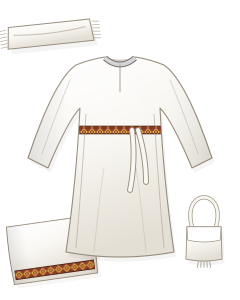
VLine of succession
Hinduism has no founder and no common church. Transmission runs through many parallel guru lineages (parampara), and each matha keeps its own succession: Advaita through the Shankaracharyas, Sri Vaishnava through Ramanuja, Dvaita through Madhva. In Vietnam, the Balamon religion of the Cham passes through a hereditary Basaih priesthood, now represented by Councils of Dignitaries.
The Vedas, Adi Shankara and the Advaita mathas, current heads
- No founder सनातन धर्म
Hinduism has no founder or central church. The Vedas are held to be śruti, heard by the seers rather than authored.
- c. 1500 to 1200 BCERigveda ऋग्वेद
Oldest of the Vedas, the earliest Hindu scripture.
- c. 1500 to 500 BCEThe four Vedas and the Brahmanas वेद
The four Vedas with the ritual Brahmanas, transmitted orally in Brahmin lineages.
- c. 800 to 200 BCEThe Upanishads उपनिषद्
Philosophical close of the Vedas (Vedanta), basis of later Vedanta schools.
- traditionalVyasa (Veda Vyasa) वेदव्यास
Sage credited with dividing the Veda and composing the Mahabharata, head of many guru lineages.
- c. 6th to 7th centuriesGaudapada गौडपाद
Author of the Mandukya Karika, teacher of Shankara's teacher.
- c. 7th to 8th centuriesGovinda Bhagavatpada गोविन्द भगवत्पाद
Direct teacher of Adi Shankara.
- c. 8th century (Sringeri gives death in 820)Adi Shankara (Shankaracharya) आदि शङ्कराचार्य
Systematised Advaita Vedanta, traditionally founded four mathas in the four directions, revered as an incarnation of Shiva.
- #East · in office from 1992Govardhan Matha, Puri: Swami Nischalananda Saraswati निश्चलानन्द सरस्वती
145th Shankaracharya of the Govardhan Matha, Puri, per the matha's count.
- #West · in office from 2022Dwarka Sharada Peetham: Swami Sadanand Saraswati सदानन्द सरस्वती
Succeeded Swaroopanand Saraswati who died in 2022.
- #North · took office 2022, disputedJyotirmath: Swami Avimukteshwaranand Saraswati (disputed) अविमुक्तेश्वरानन्द सरस्वती
Named successor in 2022, but the Jyotirmath seat has long been disputed, with rival claimants such as Vasudevanand Saraswati.
- #Kanchi · in office from 2018Kanchi Kamakoti Peetham: Sri Vijayendra Saraswati विजयेन्द्र सरस्वती
70th pontiff per Kanchi's count. Kanchi claims Shankara as founder, not accepted by the other four as an original matha.
Advaita: the Shankaracharyas of Sringeri Sharada Peetham
- #1 · died 820 according to SringeriAdi Shankara आदि शङ्कराचार्य
Founded the Sringeri Sharada Peetham in the south, first of the four mathas.
- #2 · 820 to 834Sureshvaracharya सुरेश्वराचार्य
Disciple of Shankara, first pontiff after him.
- #10 · 1229 to 1333Sri Vidya Tirtha विद्यातीर्थ
Pontiff commemorated by the Vidyashankara temple at Sringeri.
- #12 · 1380 to 1386Sri Vidyaranya विद्यारण्य
Great scholar associated with the founding of the Vijayanagara Empire.
- #33 · 1879 to 1912Sri Sacchidananda Shivabhinava Nrisimha Bharati सच्चिदानन्द शिवाभिनव नृसिंह भारती
Revived Shankara's birthplace at Kalady.
- #34 · 1912 to 1954Sri Chandrasekhara Bharati III चन्द्रशेखर भारती
Revered as a jivanmukta.
- #35 · 1954 to 1989Sri Abhinava Vidyatirtha अभिनव विद्यातीर्थ
Expanded the matha's work across India.
- #36 · born 1951, in office from 1989Sri Bharati Tirtha भारती तीर्थ
Current 36th Jagadguru Shankaracharya of Sringeri.
- #37 · designated successor since 2015Sri Vidhushekhara Bharati विधुशेखर भारती
Chosen and initiated by Bharati Tirtha in 2015 as successor.
Full list of 37 holders
- 1Sri Shankara Bhagavatpadadied 820
- 2Sri Sureshwaracharya820 to 834
- 3Sri Nityabodaghana834 to 848
- 4Sri Jnanaghana848 to 910
- 5Sri Jnanottama910 to 954
- 6Sri Jnanagiri954 to 1038
- 7Sri Simhagiri1038 to 1098
- 8Sri Ishwara Tirtha1098 to 1146
- 9Sri Nrisimha Tirtha1146 to 1229
- 10Sri Vidya Tirtha1229 to 1333
- 11Sri Bharati Tirtha1333 to 1380
- 12Sri Vidyaranya1380 to 1386
- 13Sri Chandrasekhara Bharati I1386 to 1389
- 14Sri Nrisimha Bharati I1389 to 1408
- 15Sri Puroshottama Bharati I1408 to 1448
- 16Sri Shankara Bharati1448 to 1455
- 17Sri Chandrasekhara Bharati II1455 to 1464
- 18Sri Nrisimha Bharati II1464 to 1479
- 19Sri Puroshottama Bharati II1479 to 1517
- 20Sri Ramachandra Bharati1517 to 1560
- 21Sri Nrisimha Bharati III1560 to 1573
- 22Sri Nrisimha Bharati IV1573 to 1576
- 23Sri Nrisimha Bharati V1576 to 1600
- 24Sri Abhinava Nrisimha Bharati1600 to 1623
- 25Sri Sacchidananda Bharati I1623 to 1663
- 26Sri Nrisimha Bharati VI1663 to 1706
- 27Sri Sacchidananda Bharati II1706 to 1741
- 28Sri Abhinava Sacchidananda Bharati I1741 to 1767
- 29Sri Nrisimha Bharati VII1767 to 1770
- 30Sri Sacchidananda Bharati III1770 to 1814
- 31Sri Abhinava Sacchidananda Bharati II1814 to 1817
- 32Sri Nrisimha Bharati VIII1817 to 1879
- 33Sri Sacchidananda Shivabhinava Nrisimha Bharati1879 to 1912
- 34Sri Chandrasekhara Bharati III1912 to 1954
- 35Sri Abhinava Vidyatirtha1954 to 1989
- 36Sri Bharati Tirthafrom 1989
- 37Sri Vidhushekhara Bharatidesignated successor since 2015
Vaishnava: the Sri Vaishnava line of Ramanuja
- c. 824 to 924Nathamuni नाथमुनि
Collected the Alvars' hymns into the Divya Prabandham, first acharya of the line.
- c. 916 to 1041 by traditionYamunacharya (Alavandar) यामुनाचार्य
Grandson of Nathamuni, the master before Ramanuja.
- 1017 to 1137 by traditionRamanuja रामानुज
Systematised Vishishtadvaita, head of Sri Vaishnavism, enshrined in temples as an incarnation of Adishesha.
- 1268 to 1369Vedanta Desika वेदान्त देशिक
Principal master of the Vadakalai branch.
- 1370 to 1443Manavala Mamunigal मणवाळ मामुनिगळ्
Principal master of the Tenkalai branch.
- incumbentAhobila Matha, 46th Jiyar (present representative) श्री रङ्गनाथ यतीन्द्र महादेशिकन्
Sri Vaishnavism has no single head. The 46th Jiyar of the Ahobila Matha (Vadakalai) is one leading pontiff, Tenkalai has its own jiyars.
Vaishnava: the Dvaita line of Madhva
- 1238 to 1317 (some sources give 1199 to 1278)Madhvacharya मध्वाचार्य
Founder of Dvaita, installed the Krishna image at Udupi with its eight mathas, revered as an incarnation of Vayu.
- c. 1345 to 1388Jayatirtha जयतीर्थ
Foremost commentator of the school, called Tikacharya.
- 1460 to 1539Vyasatirtha व्यासतीर्थ
Master of the Vijayanagara era, high point of Dvaita.
- 1595 to 1671Raghavendra Tirtha राघवेन्द्र तीर्थ
Worshipped at his brindavana in Mantralayam.
- in office from 1996Uttaradi Matha: Sri Satyatma Tirtha सत्यात्म तीर्थ
Pontiff of the Uttaradi Matha, a principal Madhva matha.
- holds the Paryaya from January 2026 to January 2028Udupi, Paryaya Shiroor Matha: Sri Vedavardhana Tirtha वेदवर्धन तीर्थ
The eight Udupi mathas rotate the worship of Krishna every two years (Paryaya). Shiroor Matha holds it from January 2026.
Vietnam: Cham Brahmanism and Hinduism
- late 4th centuryBhadravarman I and Mỹ Sơn Bhadravarman
Champa king who founded the Bhadreshvara Shiva shrine at My Son, landmark of Hinduism in present Vietnam.
- tower built in the late 13th centuryPo Klong Garai Po Klaong Garai
Deified Cham king worshipped at the Po Klong Garai towers, site of the Kate festival.
- hereditaryCham Balamon religion (Ahier) and the Basaih priesthood Ahier, Basaih
Hereditary Basaih priests rise from novice to Po Adhia. No overall succession list.
- late 19th centuryMariamman Temple, Saigon
Temple of the Tamil community, a second Hindu strand in Vietnam separate from the Cham tradition.
- recognised 2012Councils of Cham Balamon Dignitaries of Ninh Thuận and Bình Thuận
The two state recognised bodies of Cham Brahmanism.
- Chairman, re-elected for the 2022 to 2027 termChief Priest Hán Đô
Chair of the Ninh Thuan council, re elected at its third congress in September 2022.
A venerated figure: the library shows no portrait, only the name inside a round seal.
VIOrdination and transmission
In India, a renunciate receives sannyasa from a teacher within a lineage, and each matha keeps its own Shankaracharya succession, sometimes settled by the courts. Among the Cham Balamon, the Basaih priesthood is hereditary, and priests rise through ordination rites from Ndung Akaok to Po Adhia.
- Cham: entry as Basaih Ndung AkaokRequirement: A man of a Basaih lineage, from a harmonious family, without disabilityRite: No source found describing the initiation rite in detail
- Cham: ordination, becoming Basaih LiahRequirement: Study of the Cham script and doctrineRite: Ordination rite, details: no source found
- Cham: rising to Tahwak, Po Tapuh, Po AdhiaRequirement: Long years of practice and study. The Po Tapuh has attained detachment from the worldRite: no source found
- India: receiving sannyasa dikshaRequirement: Renunciation of worldly lifeRite: No source found with a detailed description
VIIWhere the sources disagree
- The old code #A8480F in mau-sac.json is the fired-brick shade of the Cham towers, not saffron. The note of 16/09 already acknowledged this. Proposal: change the main colour to bhagwa and keep the brick shade for mau_noi_tho.
- Sources give different saffron codes (#F4C430 for saffron, #FF671F for India saffron of the flag). The code #F28C28 is an estimate in between. The flag of India is a national symbol, not a religious one.
- The Bhagwa Dhwaj (saffron flag) is linked to Shivaji and has been used since the 1920s by Hindutva organisations such as the RSS. Using this flag as a religious symbol on the page should be avoided.
- Whether the Balamon religion of the Cham is Hinduism remains a scholarly question. One author (champa.one) sees Ahier as a phase of Awal Islam with worship of local deities and does not call it Hindu. It is best described as a Cham belief system influenced by Brahmanism.
- Names and order of the Cham ranks differ between sources: Po Tapuh or Po Tapah. One source lists, from the top down, Ndung Akaok, Liah, Pauh, Tapah below the Po Adhia. Another lists Liah and then Tahwak. Paseh, Basaih and Baséh are the same office.
- One source says Baséh literally means one who wears yellow, while other sources describe the Basaih as wearing white. Unresolved.
- Role of the Ka-ing: the vjol source groups the Ka-ing with the Maduen for the Raja (Rija) rite, while the Dân tộc và Phát triển newspaper says the Ka-ing take part in the Katê festival at the towers. Both may be true.
- mau-that.json takes the colours of the home puja room from an Asian Paints (vastu) blog. This is not a source from the religious community, so it is a decorative reference, not a standard.
- Dates of Adi Shankara: Sringeri gives his death as 820, scholars usually place him around 700 to 750, and some other mathas place him before the Common Era.
- Wikipedia gives the 33rd Jagadguru of Sringeri as in office 1872 to 1912, while the Sringeri list gives 1879 to 1912. The full list follows sringeri.net.
- The Jyotirmath Shankaracharya seat is disputed in court, with several claimants. Kanchi claims foundation by Shankara, which the other four mathas do not accept.
- All Shankaracharyas, Vaishnava acharyas and Paryaya holders are marked sacred because devotees keep their images in shrine rooms and perform foot worship (pada puja). This is a cautious choice under the rule of choosing true when in doubt, so this line has no photos.
- The years in office of the 46th Jiyar of the Ahobila Matha could not be verified.
- Whether the Balamon religion of the Cham is Hinduism is still debated. It is best described as a Cham belief system influenced by Brahmanism.
- The year of recognition of the two Councils (2012) follows a VietNamNet article and has not been checked against the original document. No list of earlier chairmen was found. After the 2025 provincial merger, Ninh Thuận became part of Khánh Hòa and Bình Thuận part of Lâm Đồng. It is unclear whether the Councils have new names or whether Chief Priest Hán Đô's term has changed.
VIIISources
63 sources
- https://en.wikipedia.org/wiki/Saffron_(color)
- https://en.wikipedia.org/wiki/Flag_of_India
- https://en.wikipedia.org/wiki/Bhagwa_Dhwaj
- https://en.wikipedia.org/wiki/Sannyasa
- https://en.wikipedia.org/wiki/Shankaracharya
- https://en.wikipedia.org/wiki/Pujari
- https://en.wikipedia.org/wiki/Antyesti
- https://en.wikipedia.org/wiki/Hinduism_in_Vietnam
- https://en.wikipedia.org/wiki/Mariamman_Temple,_Ho_Chi_Minh_City
- https://en.wikipedia.org/wiki/Po_Klong_Garai_Temple
- https://dantocphattrien.vietnamnet.vn/den-thap-po-klong-garai-bieu-tuong-vung-ben-cua-van-hoa-cham-66832.html
- https://dantocmiennui.baotintuc.vn/doc-dao-trang-phuc-chuc-sac-dan-toc-cham-post2891.html
- https://vjol.info.vn/index.php/tapchiviendantochoc/article/download/106545/89587/
- https://vjol.info.vn/rsr/article/download/44491/35901/
- https://petruspaulusthong.wordpress.com/2017/02/10/sinh-hoat-cua-nguoi-cham-ninh-thuan-trong-boi-canh-cac-di-tich/
- https://champa.one/article/869
- https://redsvn.net/tong-quan-ve-tin-nguong-ton-giao-cua-nguoi-cham2/
- https://1008.guru/
- https://en.wikipedia.org/wiki/Abhinava_Vidyatirtha
- https://en.wikipedia.org/wiki/Adi_Shankara
- https://en.wikipedia.org/wiki/Ahobila_Matha
- https://en.wikipedia.org/wiki/Bhadravarman_I
- https://en.wikipedia.org/wiki/Bharati_Tirtha
- https://en.wikipedia.org/wiki/Chandrashekhara_Bharati_III
- https://en.wikipedia.org/wiki/Dvaita_Vedanta
- https://en.wikipedia.org/wiki/Dwarka_Sharada_Peetham
- https://en.wikipedia.org/wiki/Gaudapada
- https://en.wikipedia.org/wiki/Govardhan_Math
- https://en.wikipedia.org/wiki/Govinda_Bhagavatpada
- https://en.wikipedia.org/wiki/Jayatirtha
- https://en.wikipedia.org/wiki/Jyotir_Math
- https://en.wikipedia.org/wiki/Kanchi_Kamakoti_Peetham
- https://en.wikipedia.org/wiki/M%E1%BB%B9_S%C6%A1n
- https://en.wikipedia.org/wiki/Madhvacharya
- https://en.wikipedia.org/wiki/Manavala_Mamunigal
- https://en.wikipedia.org/wiki/Nathamuni
- https://en.wikipedia.org/wiki/Nischalananda_Saraswati
- https://en.wikipedia.org/wiki/Paryaya
- https://en.wikipedia.org/wiki/Po_Klong_Garai
- https://en.wikipedia.org/wiki/Raghavendra_Tirtha
- https://en.wikipedia.org/wiki/Ramanuja
- https://en.wikipedia.org/wiki/Rigveda
- https://en.wikipedia.org/wiki/Satyatma_Tirtha
- https://en.wikipedia.org/wiki/Sri_Vaishnavism
- https://en.wikipedia.org/wiki/Sringeri_Sharada_Peetham
- https://en.wikipedia.org/wiki/Sureshvara
- https://en.wikipedia.org/wiki/Swaroopanand_Saraswati
- https://en.wikipedia.org/wiki/Upanishads
- https://en.wikipedia.org/wiki/Uttaradi_Math
- https://en.wikipedia.org/wiki/Vasudevanand_Saraswati
- https://en.wikipedia.org/wiki/Vedanta_Desika
- https://en.wikipedia.org/wiki/Vedas
- https://en.wikipedia.org/wiki/Vidyaranya
- https://en.wikipedia.org/wiki/Vijayendra_Saraswati
- https://en.wikipedia.org/wiki/Vyasa
- https://en.wikipedia.org/wiki/Vyasatirtha
- https://en.wikipedia.org/wiki/Yamunacharya
- https://nhandan.vn/dai-hoi-dai-bieu-hoi-dong-chuc-sac-cham-theo-dao-ba-la-mon-tinh-ninh-thuan-lan-thu-3-post714092.html
- https://vietnamnet.vn/16-ton-giao-duoc-cong-nhan-tai-viet-nam-co-mot-so-duoc-it-nguoi-biet-den-2422958.html
- https://www.hinduismtoday.com/magazine/october-november-december-2015/2015-10-monasticism-sringeri-s-pontiff-anoints-successor/
- https://www.sringeri.net/jagadgurus
- https://www.sringeri.net/jagadgurus/sri-bharati-tirtha-mahaswamiji
- https://www.theweek.in/wire-updates/national/2026/01/16/udupi-gears-up-for-paryaya-mahotsava-as-shiroor-matha-takes-over-sri-krishna-temple.html
?Quick Questions
What is the principal colour of Hinduism?
Saffron (bhagwa, kesari) (भगवा (bhagwā), केसरी (kesarī), kesariya), #F28C28. Bhagwa or kesari is a colour named within Indian culture itself. Sources explain it as the colour of fire, sacrifice and renunciation, and it is the colour of renunciate robes. The old code #A8480F is the brick colour of the Cham towers. It is an architectural colour, not the identifying colour of the religion, so it moves to mau_noi_tho. Text placed on this background needs a darker shade for enough contrast.
How many ranks does Hinduism have?
The library records 10 ranks, from highest to lowest: Shankaracharya (teacher in the Shankara tradition), Sannyasi, Swami (renunciate), Pujari (temple priest), Brahmin (priestly class), Po Adhia, chief priest (Cham Balamon), Po Tapuh, deputy chief priest (Cham Balamon), Basaih Tahwak, feeding priest, Basaih Liah, Basaih Ndung Akaok, newly initiated Paseh, Ka-ing, Kadhar, Muk Pajau (Cham folk ritualists, outside the Basaih ranks).
Who leads Hinduism today?
In the line of The Vedas, Adi Shankara and the Advaita mathas, current heads, the most recent milestone is Kanchi Kamakoti Peetham: Sri Vijayendra Saraswati (in office from 2018). 70th pontiff per Kanchi's count. Kanchi claims Shankara as founder, not accepted by the other four as an original matha.