
IOverview
Longmen, the Dragon Gate line, is the largest of the seven lines of Quanzhen Daoism and, according to Wikipedia, the largest Daoist branch still in existence. It honours Qiu Chuji, one of Wang Chongyang's seven principal disciples, as its patriarch. Its centre is the White Cloud Monastery in Beijing.
Longmen Daoists are monastics under the Quanzhen rule: celibate, vegetarian, bound by precepts and living in monasteries. The most visible feature is how they are named. Each generation takes one character, in order, from a hundred-character lineage poem that opens with the lines 道德通玄靜 真常守太清, read Dao De Tong Xuan Jing, Zhen Chang Shou Tai Qing.
IIHistory
The name comes from Mount Longmen near Baoji in Shaanxi, where Qiu Chuji practised from 1180. By tradition the line passed down through several generations, mostly from a single master to a single disciple, until the seventh patriarch, Wang Changyue.
Wang Changyue became abbot of the White Cloud Monastery and in 1656 held the first public three-platform ordination. He wrote precept texts and the Longmen Xinfa, the Heart Method of the Dragon Gate. After him Longmen dominated Quanzhen throughout the Qing. In the south, the eleventh-generation master Min Yide, who lived from 1758 to 1836, compiled the Jin'gai Xindeng, a genealogy of the Longmen line on Mount Jin'gai in Zhejiang.
- 1180Qiu Chuji on Mount LongmenThe place that gives the line its name.
- 1513The Shou generation attestedDaoists of the Shou character are recorded at the Xiuzhen Palace in Shandong, according to Zhang Guangbao.
- 1656Ordination at White CloudWang Changyue holds a public ordination, opening the revival.
- 1758 to 1836Min YideCompiles the Jin'gai Xindeng, fixing the southern Longmen genealogy.
- 1800 to 192731 ordinationsAbout 5,465 Daoists ordained at White Cloud, according to Yue Wang's 2017 thesis.
Scholars still debate the line's origins. Zhang Guangbao, writing on daoisms.com.cn, suggests the first twenty characters of the lineage poem took shape in the early Ming, probably after the Xuande reign, and stresses that this is a conjecture. Yue Wang's 2017 thesis at the University of Saskatchewan argues that the unbroken genealogy from Qiu Chuji may be a legitimising narrative built in late imperial times, and that the northern genealogy was itself elaborated by southern groups.
IIITeachings and Distinctive Features
Doctrinally, Longmen shares the Quanzhen foundations: the unity of the three teachings, inner alchemy and the dual cultivation of nature and life. What Longmen stresses is the precepts. In Wang Changyue's system, a Daoist passes through three grades.
- Initial Perfection Precepts. The basic precepts for newcomers.
- Middle Ultimate Precepts. A broader and stricter intermediate grade.
- Great Precepts of the Celestial Immortals. The highest grade, aimed at the mind of one who has realised the Way.
By late imperial times the three were usually conferred one after another in a single ceremony.
Longmen Daoists see the precepts as the base of all practice. Without them inner alchemy is mere technique. Keeping the precepts calms the mind, a calm mind lets the breath flow, and only then can refinement begin.
Longmen is often taken for a separate school split off from Quanzhen. In fact it is a line within Quanzhen, with the same precepts and the same monastic life. The word school here means a line of transmission, not a different church.
IVPractice and Daily Life
Longmen Daoists follow the monastic routine: morning and evening liturgy, work, study and meditation. On taking a master, a disciple receives a religious name whose first character comes from the lineage poem. Wang Changyue carried the character Chang, placing him in the seventh generation. This lets Daoists in distant temples recognise each other's place in the line.
Ordination takes place in public monasteries entitled to hold it, of which the White Cloud Monastery is the most important. In Hong Kong, Longmen temples such as Ching Chung Koon and Fung Ying Seen Koon combine religious life with charity and community ritual.
VOrganisation and Distribution
Longmen has no administration separate from Quanzhen. On the mainland its temples belong to the Chinese Taoist Association, headquartered at the White Cloud Monastery. There are many sub-lines named after mountains or founders, such as the Jin'gai line in Zhejiang. Outside China, since the second half of the twentieth century a number of centres in Europe and North America have claimed Longmen transmission, mostly teaching inner alchemy and qigong to Western students.
Zhang Guangbao's research shows that Longmen lines in various regions often have their own local roots and did not necessarily descend from Wang Changyue. The library has found no reliable count of Longmen clergy.
VIIn Vietnam
No significant Longmen community has been documented in Vietnam. English Wikipedia describes Khanh Van Nam Vien in District 11, Ho Chi Minh City, as run by Cantonese Quanzhen Daoists, but the library has found no source confirming that it belongs to the Longmen line.
VIISymbol of the Branch
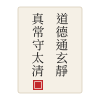
Hundred character lineage poem
百字派詩, mở đầu 道德通玄靜 真常守太清
VIIIOther Branches of Taoism
 Zhengyi Dao正一道Descends from Zhang Daoling's Way of the Celestial Masters of 142 CE.
 Quanzhen Daoism全真道Founded by Wang Chongyang in 1167 in Shandong.Uses the common symbol of the pathLongmen Daoism龍門派The largest Quanzhen line, honouring Qiu Chuji as patriarch, centred on the White Cloud Monastery.Shangqing Daoism上清派 茅山Formed around scriptures recorded by Yang Xi in 364 to 370, with Lady Wei Huacun as first matriarch.Uses the common symbol of the path
 Lingbao Daoism靈寶派Began around 400 CE with scriptures compiled by Ge Chaofu in 397 to 402.
 Wudang Daoism武當派Tied to Mount Wudang in Hubei and the cult of Zhenwu, the Dark Warrior.Jingming Daoism淨明道, full name 淨明忠孝道Honours Xu Xun of the Jin as first patriarch and took shape in the Southern Song.Uses the common symbol of the pathTaoism in VietnamTemples, ritual masters and cults shaped by TaoismNot a school but the form Taoism takes in Vietnam.Uses the common symbol of the path
IXSources
The library cross-checks the sources below. Where they disagree, the page gives both.
?Quick Questions
What is Longmen Daoism
It is the largest of the seven lines of Quanzhen Daoism, honouring Qiu Chuji as patriarch and centred on the White Cloud Monastery in Beijing. Its Daoists are celibate monastics bound by precepts.
What is the Longmen lineage poem
A hundred-character poem used to assign religious names by generation. It opens with 道德通玄靜 真常守太清. The first generation takes Dao, the second De, and so on.
Who was Wang Changyue
The seventh-generation Longmen master and abbot of the White Cloud Monastery. In 1656 he held a public ordination and wrote precept texts, and he is regarded as the reviver of Longmen.
Did Qiu Chuji really found Longmen
Tradition says so. Some scholars argue that the line took clear shape in the Ming and that the genealogy linking it to Qiu Chuji was reconstructed later. The question remains open.