
IColours
Colour used for this page of the library: Zangqing (deep blue) #2E4E7E. Every colour code is approximate, since most paths name their colours without publishing codes.
Principal colour the colour of the path
The dark blue of the everyday Taoist robe. Qing belongs to the Wood phase and the East, and symbolizes vital energy. This fits the Taoist emphasis on life. The deluo, the ceremonial robe of Quanzhen, is blue.
Taoist priests are also called huangguan 黃冠, "yellow caps". Yellow is linked to the Yellow Emperor in the Huang Lao teaching and to longevity. Many sources rank the yellow ritual robe highest. The hex code follows xinghuang 杏黃 (apricot yellow) and is approximate.
From the story of the purple qi coming from the East when Laozi passed through the Hangu Pass. The abode of immortals is called the Purple Palace and scriptures are called purple texts. The hex code follows jiangzi 絳紫 (crimson purple) and is approximate.
Place of worship real sanctuaries
The official visitbeijing page records grey tubular tiles (灰筒瓦) on the Jade Emperor Hall and the Qiu Patriarch Hall. Autohome states that all halls are roofed with grey tiles (灰瓦盖顶). Hex follows 灰色 in the boxingp table and is an estimate of the actual tile colour.
Only the Lü Patriarch Hall (呂祖殿) is roofed with green glazed tiles, which the source describes as unique within the temple. Hex follows 綠沈 in the boxingp table and is an estimate.
The main gate has an arched stone doorway of carved Han white marble. 漢白玉 is the name of a stone, not a colour term. Hex follows 象牙白 and is an estimate.
Only one English-language travel page mentions red walls and green tiles. No official source has been found. Hex follows 朱紅 in the boxingp table and is an estimate. The actual walls may be darker.
Daoist banners in bright yellow (明黃) hang on the moon terrace in front of the hall. 明黃 is not listed in the boxingp table, so hex is left empty.
No source records the colour of the columns.
Sources mention only a gilt bronze tripod (鎏金銅鼎) in front of the hall and Daoist motifs throughout the interior (lingzhi fungus, cranes, the eight trigrams, the Eight Immortals). They do not record the colour of the altar.
Travel blogs describe the Second Gate as having red walls and green tiles (紅牆綠瓦) and the Jade Emperor Hall as having vermilion walls and green tiles (朱垣碧瓦). Hex follows 朱紅 in the boxingp table and is an estimate.
Sources record green tiles (綠瓦, 碧瓦) at the Second Gate and the Jade Emperor Hall but do not state whether they are glazed. Hex follows 綠沈 and is an estimate.
Sources describe the whole mansion as carved and finished in fine vermilion lacquer (雕花鏤刻,朱紅細漆). Another blog gives 米紅細漆, possibly a copying error. Hex follows 朱紅 and is an estimate.
The couplets on the columns of the Mansion Gate and the Second Gate have gold characters on a black ground. The ground colour follows 漆黑 and the characters follow 金 #EACD76. These are wooden couplet boards, not textiles, and are placed under this heading provisionally.
The vertical signboard reading 嗣漢天師府 above the central door is described as dazzling gold (金光奪目). Hex follows 金 in the boxingp table and is an estimate.
Sources mention only a large incense burner and candlesticks in front of the Jade Emperor Hall, without colours.
The statue of Xuanwu, the Dark Warrior (Huyền Thiên Trấn Vũ), was cast in black bronze in 1677. It is 3.96 metres tall and weighs about 4 tonnes. Hex follows 烏黑 in the boxingp table and is an estimate. The original term 烏銅 is inferred from meaning and not attested in any source.
Sources state that the wooden columns and horizontal boards are finished in vermilion lacquer with gilding (sơn son thếp vàng). Hex follows 朱紅 in the Chinese table and is an estimate. Vietnamese vermilion lacquer is usually darker. The gilded parts follow 金 #EACD76.
The State Records and Archives Department page records red tiled roofs. Hex follows 赭色 and is an estimate for fired clay tiles.
Sources state that pairs of red couplets surround the four gate pillars. It is unclear whether they are cloth or lacquered wood. Hex is an estimate following 朱紅.
A travel account records a stone triple gateway and a courtyard paved in grey stone. Hex follows 墨灰 and is an estimate.
No written source records the colour of the exterior walls. One travel account says only that the interior walls are covered in mahogany wood with gold inscriptions.
No source records the colour of the altar.
Ritual colours by occasion and season
The red ritual robe is used for blessing rites. It is worn by senior ritual masters.
The blue ritual robe is commonly used for worship and for the festivals of deities and immortals.
The precept robe is yellow. Quanzhen priests wear it when receiving the precepts.
The black ritual robe is reserved for Dipper rites according to the popular seven color scheme.
The white ritual robe is reserved for underworld rites. Sources describe it as rare and unusual.
Mourning and avoided colours
White is the color of underworld rites, used for the deliverance of the dead. It is not an ordinary ritual color. No source found on colors specifically avoided in Taoism. Family funerals follow the general white mourning custom of Chinese and Vietnamese people.
Popular sources say the green robe belongs to unaffiliated immortals and is rarely used by ordained priests because of its low rank. It is not a forbidden color, only a rarely used one.
IIRanks
Taoism has no single worldwide central church. The two major surviving schools are Quanzhen and Zhengyi. Quanzhen is monastic. Its clergy live in public monasteries, its center is the White Cloud Temple (Baiyun Guan) in Beijing, and it transmits the Threefold Great Precepts. Zhengyi clergy mostly practice as householders. The school is rooted in Mount Longhu and the line of the Celestial Masters, and entry is by conferral of a register (shoulu). In mainland China, precept transmission and register conferral are organized and certified by the Chinese Taoist Association. In Vietnam, Taoism has no church. Only a few temples remain, such as Quán Thánh and Bích Câu, and some elements have merged into folk belief.
- 1Abbot (Quanzhen)方丈
- 2Prior, popularly called Dangjia (Quanzhen)監院
- 3Officers (Quanzhen): High Ritual Master, Liturgical Director, Memorial Reader, Guest Master, Inspector, Scripture Master and others執事 高功 知客
- 4Ordained priest (Quanzhen)受戒道士
- 5Newly capped priest (Quanzhen)冠巾道士
- 1Celestial Master (Zhengyi)天師
- 2Promotion to the highest grade: Shangqing Three Caverns scripture register (Zhengyi)上清三洞經籙
- 3Further promotion: Shangqing Great Cavern scripture register (Zhengyi)上清大洞經籙
- 4Additional conferral: Shangqing Three Caverns Five Thunders scripture register (Zhengyi)上清三洞五雷經籙
- 5Promotion: Taishang Zhengyi Covenant with the Powers scripture register (Zhengyi)太上正一盟威經籙
- 6Initial conferral: Taishang Three and Five Duke Merit scripture register (Zhengyi)太上三五都功經籙
- 7Acolyte who has been initiated (Zhengyi)道童
- 1Abbot (Quanzhen) 方丈 · Abbot
Head of a public monastery, also called the resident head. Must have received the Threefold Great Precepts, keep the precepts strictly and enjoy high virtue and respect.
- 2Prior, popularly called Dangjia (Quanzhen) 監院 · Prior, temple manager
Manages all the daily affairs of the monastery and is elected by the community. Below the prior are the Three Supervisors, the Five Heads and the Eighteen Chiefs.
- 3Officers (Quanzhen): High Ritual Master, Liturgical Director, Memorial Reader, Guest Master, Inspector, Scripture Master and others 執事 高功 知客 · Temple officers
The twenty four great officers comprise the Three Supervisors (general manager, lecturer, kitchen master), the Five Heads (meditation, refectory, hall, scripture, alms), the Eighteen Chiefs, together with the High Ritual Master, the Liturgical Director and the Memorial Reader. The High Ritual Master presides over offering and fasting rites.
- 4Ordained priest (Quanzhen) 受戒道士 · Ordained Quanzhen priest
Has received the Threefold Great Precepts, namely the Initial Perfection, Middle Ultimate and Celestial Immortal precepts, and holds a precept certificate sealed by the Chinese Taoist Association.
- 5Newly capped priest (Quanzhen) 冠巾道士 · Novice priest
Capping (guanjin) is the rite of entering monastic life. After it the person is a priest and receives a Taoist name. One must be capped for at least two years before applying for the precepts.
- 1Celestial Master (Zhengyi) 天師 · Celestial Master
Spiritual leader of Zhengyi, descended from the line of Zhang Daoling, with the ancestral seat at Mount Longhu since the Tang dynasty.
- 2Promotion to the highest grade: Shangqing Three Caverns scripture register (Zhengyi) 上清三洞經籙 · Highest register
The highest register grade under the current regulations on register conferral.
- 3Further promotion: Shangqing Great Cavern scripture register (Zhengyi) 上清大洞經籙 · Great Cavern register
May be requested after twelve full years at the previous grade.
- 4Additional conferral: Shangqing Three Caverns Five Thunders scripture register (Zhengyi) 上清三洞五雷經籙 · Five Thunders register
May be requested after eight full years at the previous grade and mastery of the Shangqing scriptures.
- 5Promotion: Taishang Zhengyi Covenant with the Powers scripture register (Zhengyi) 太上正一盟威經籙 · Covenant register
May be requested after three full years at the initial grade, keeping the precepts, with upright conduct.
- 6Initial conferral: Taishang Three and Five Duke Merit scripture register (Zhengyi) 太上三五都功經籙 · Initial register
The grade of entry. Only after receiving a register is one a full priest whose ritual documents are valid.
- 7Acolyte who has been initiated (Zhengyi) 道童 · Acolyte
Initiated but not yet holding a register, and without a Taoist name. One must be initiated for at least two years before applying for a register.
Followers: Believers are called xinshi (faithful), shanxin (good believers) or daoyou (fellow followers of the Way). Monastics are called Taoist priests. Women are called kundao or nüguan (female names not verified against sources in this round).. Zhengyi has register grades for lay people according to their level of knowledge. Lay believers in Vietnam usually have no formal rank.
IIIForms of address
| Rank | Spoken address | In writing | Self reference | Original term |
|---|---|---|---|---|
| Taoist priests in general | Addressed as "Đạo trưởng" (Daozhang, Master of the Way), optionally with the surname (for example Li Daozhang), or as "Tiên trưởng" (Xianzhang, Elder Immortal). The greeting is given with joined hands and the phrase Daozhang cibei (Master, be compassionate). | Written as "Đạo trưởng" (Daozhang) followed by the Taoist name or surname | Refers to self as "Bần đạo" (Pindao, this humble Taoist). A priest should not call himself Daozhang, as that is seen as arrogant. | 道長 仙長 貧道 道長慈悲 |
| Abbot (Quanzhen) | Addressed as "Phương trượng" (Fangzhang, Abbot) | Written as "Phương trượng" (Abbot) followed by the Taoist name | Refers to self as "Bần đạo" (Pindao, this humble Taoist) | 方丈 |
| Prior (Quanzhen) | Addressed as "Đương gia" (Dangjia, head of the house) | Written as "Giám viện" (Jianyuan, Prior) followed by the Taoist name | Refers to self as "Bần đạo" (Pindao, this humble Taoist) | 監院 當家 |
| Celestial Master (Zhengyi) | Addressed as "Thiên Sư" (Tianshi, Celestial Master) | Written as "Thiên Sư" (Celestial Master) with the generation number | no source found | 天師 |
| Performers of Taoist rites in Vietnam | No source found for a standard form of address. In folk usage they are often called "thầy" (master), "thầy pháp" (ritual master) or "thầy cúng" (ritual officiant), but these are general popular terms, not ranks. | Written as "Đạo sĩ" (Taoist priest) | no source found | 道士 |
IVVestments by rank
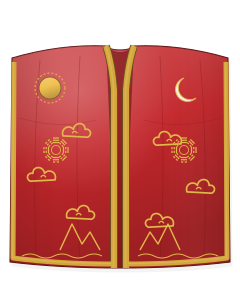
Flat drawings made from the descriptions in the sources, with no people shown. Colours are approximate.




VLine of succession
Taoism has no single head for all schools. Zhengyi passes by blood within the Zhang family of Mount Longhu, from father to son or within the clan, and the holder is called the Celestial Master. Quanzhen passes from master to disciple and through ordination platforms, and each public monastery has its own abbot. In China today the Chinese Taoist Association is the common body for both schools.
Zhengyi: the Zhang Celestial Masters of Mount Longhu
- 6th century BCE by traditionLaozi (Taishang Laojun, the Supreme Lord Lao) 老子 (太上老君)
Revered as the founder of the Dao. Zhengyi tradition holds that the deified Laozi revealed the teaching to Zhang Daoling in 142.
- #1 · 34 to 156Zhang Daoling (Founding Celestial Master) 張道陵
Founded the Way of the Celestial Masters in Sichuan, first Celestial Master.
- #2 · 2nd centuryZhang Heng 張衡
Son of Zhang Daoling, second Celestial Master.
- #3 · ? to 216Zhang Lu 張魯
Third Celestial Master, ran a theocratic state in Hanzhong for about thirty years before submitting to Cao Cao in 215.
- #4 · Three Kingdoms periodZhang Sheng 張盛
Fourth Celestial Master, by tradition the one who moved the line to Mount Longhu in Jiangxi.
- #30 · 1092 to 1127Zhang Jixian 張繼先
Thirtieth Celestial Master, favoured by Emperor Huizong of Song, known for thunder rites.
- #36 · 1244 to 1291Zhang Zongyan 張宗演
Thirty sixth Celestial Master, put in charge of Daoism south of the Yangtze by Khubilai Khan in 1276.
- #42 · 1335 to 1377Zhang Zhengchang 張正常
Forty second Celestial Master. The Hongwu Emperor replaced the title Celestial Master with Perfected, though Daoists kept the old name.
- #43 · 1361 to 1410Zhang Yuchu 張宇初
Forty third Celestial Master, charged with editing the Ming Daoist Canon.
- #50 · ? to 1611Zhang Guoxiang 張國祥
Fiftieth Celestial Master, compiled the Wanli supplement to the Daoist Canon in 1607.
- #62 · 1862 to 1924Zhang Yuanxu 張元旭
Sixty second Celestial Master, active in organising Daoists in the Republican era.
- #63 · 1904 to 1969Zhang Enpu 張恩溥
Sixty third Celestial Master, moved to Taiwan in 1949. The last Celestial Master whose succession is not disputed.
- #64 · 1930 to 2008, succeeded 1971Zhang Yuanxian 張源先
Nephew of Zhang Enpu, recognised in Taiwan as sixty fourth Celestial Master in 1971. His death in 2008 opened a succession dispute.
- #65 · heads the Celestial Master Mansion at Mount Longhu, still active in 2024Zhang Jintao (mainland side) 張金濤
Zhang descendant heading the Celestial Master Mansion at Mount Longhu, former vice president of the China Taoist Association. Often called the 65th Celestial Master on the mainland, though no state title is conferred.
- #65 · since 2008Zhang Yijiang and other claimants in Taiwan 張意將
In Taiwan several Zhang relatives claim to be the 65th Celestial Master, among them Zhang Yijiang and Zhang Jiexiang. None is recognised by all parties.
Full list of 65 holders
- 1Zhang Daoling34 to 156
- 2Zhang Heng
- 3Zhang Lu
- 4Zhang Sheng
- 5Zhang Zhaocheng
- 6Zhang Jiao
- 7Zhang Hui
- 8Zhang Jiong
- 9Zhang Fu
- 10Zhang Zixiang
- 11Zhang Tong
- 12Zhang Heng
- 13Zhang Guang
- 14Zhang Cizheng
- 15Zhang Gao
- 16Zhang Yingshao
- 17Zhang Shun
- 18Zhang Shiyuan
- 19Zhang Xiu
- 20Zhang Chen
- 21Zhang Bingyi
- 22Zhang Shan
- 23Zhang Jiwen
- 24Zhang Zhengsui
- 25Zhang Qianyao
- 26Zhang Sizong
- 27Zhang Xiangzhong
- 28Zhang Dunfu
- 29Zhang Jingduan
- 30Zhang Jixian1092 to 1127
- 31Zhang Shixiu
- 32Zhang Shouzhen
- 33Zhang Jingyuan
- 34Zhang Qingxian
- 35Zhang Keda
- 36Zhang Zongyan1244 to 1291
- 37Zhang Yudi
- 38Zhang Yucai
- 39Zhang Sicheng
- 40Zhang Side
- 41Zhang Zhengyan
- 42Zhang Zhengchang1335 to 1377
- 43Zhang Yuchu1361 to 1410
- 44Zhang Yuqing
- 45Zhang Maocheng
- 46Zhang Yuanji
- 47Zhang Xuanqing
- 48Zhang Yanxu
- 49Zhang Yongxu
- 50Zhang Guoxiang
- 51Zhang Xianyong
- 52Zhang Yingjing
- 53Zhang Hongren
- 54Zhang Jizong
- 55Zhang Xilin
- 56Zhang Yulong
- 57Zhang Cunyi
- 58Zhang Qilong
- 59Zhang Yu
- 60Zhang Peiyuan
- 61Zhang Renzheng
- 62Zhang Yuanxu1862 to 1924
- 63Zhang Enpu1904 to 1969
- 64Zhang Yuanxian1930 to 2008, succeeded 1971
- 65Disputed: Zhang Jintao (Mount Longhu, mainland), Zhang Yijiang and several others in Taiwansince 2008
Quanzhen: the founder, the Seven Perfected and the Longmen line at the White Cloud Temple
- 1113 to 1170Wang Chongyang 王重陽 (王嚞)
Founded Quanzhen Daoism in Shandong in 1167, venerated as its patriarch.
- 1123 to 1184Ma Yu (Danyangzi) 馬鈺
First disciple, second head of Quanzhen, founder of the Yuxian branch. One of the Seven Perfected.
- 1123 to 1185Tan Chuduan 譚處端
Third head, founder of the Nanwu branch. One of the Seven Perfected.
- 1147 to 1203Liu Chuxuan 劉處玄
Fourth head, founder of the Suishan branch. One of the Seven Perfected.
- 1148 to 1227Qiu Chuji (Perfected Changchun) 丘處機
Fifth head, founder of the Longmen branch. Met Chinggis Khan in 1222, then lived and died at the Changchun Palace, today the White Cloud Temple.
- 1142 to 1217, 1140 to 1212, 1119 to 1183Wang Chuyi, Hao Datong, Sun Bu'er 王處一 郝大通 孫不二
The other three of the Seven Perfected, founders of the Yushan, Huashan and Qingjing branches. Sun Bu'er, a woman, was Ma Yu's wife.
- #7 · ? to 1680Wang Changyue 王常月
Seventh generation Longmen master and abbot of the White Cloud Temple, held public ordinations from 1656 and revived Quanzhen under the Qing.
- abbot since 11 September 2021Meng Zhiling 孟至嶺
Current abbot of the White Cloud Temple in Beijing, installed 11 September 2021, vice president of the China Taoist Association.
Presidents of the China Taoist Association
- #1 · 1st term, 1957 to 1958Yue Chongdai 岳崇岱
First president when the association was founded in 1957.
- #2 · 1880 to 1969, 2nd term from 1961Chen Yingning 陳攖寧
Scholar of inner alchemy, second president. The association was inactive through the Cultural Revolution.
- #3 · 3rd and 4th terms, 1980 to 1992Li Yuhang 黎遇航
President for two terms after the association was restored.
- #5 · 5th term, 1992 to 1998Fu Yuantian 傅圓天
Fifth term president.
- #6 · 6th term, 1998 to 2005Min Zhiting 閔智亭
Sixth term president, a Quanzhen priest.
- #7 · 7th and 8th terms, 2005 to 2015Ren Farong 任法融
President for two terms, a Quanzhen priest of Louguantai.
- #9 · in office since 2015, reelected December 2025Li Guangfu 李光富
Current president, from Wudang Mountain, re-elected for the eleventh term in December 2025.
Full list of 7 holders
- 1Yue Chongdai1957 to 1958
- 2Chen Yingning1961 to 1980
- 3 and 4Li Yuhang1980 to 1992
- 5Fu Yuantian1992 to 1998
- 6Min Zhiting1998 to 2005
- 7 and 8Ren Farong2005 to 2015
- 9 to 11Li Guangfusince 2015
Daoism in Vietnam: milestones and temples
- 1011Thái Thanh Palace in Thăng Long 太清宮
Emperor Lý Thái Tổ built the Thai Thanh Daoist palace next to Vạn Tuế pagoda.
- 1016Lý Thái Tổ ordains monks and Taoist priests 李太祖
Ordained over a thousand monks and Daoist priests in the capital.
- 1027Taoist priest Trần Tuệ Long 陳慧龍
Daoist of the Nam Đế temple, among the earliest named Vietnamese Daoists.
- 1031Taoist priest Trịnh Trí Không 鄭智空
Petitioned for Daoist priests to receive official registers.
- 1195Three Teachings examination 三教科
The Lý court held an examination on Confucianism, Daoism and Buddhism.
- came to Vietnam in 1302Xu Zongdao (Hứa Tông Đạo) 許宗道
Chinese Daoist who came to Đại Việt under the Trần and spread ritual practice.
- built under the Lý, bronze statue cast in 1677Quán Thánh Temple (Trấn Vũ Quán), Hanoi 鎮武觀 真武觀
Daoist temple to the Dark Warrior guarding northern Thăng Long, with a 1677 bronze statue.
- listed as a monument in 1962Today: Quán Thánh Temple is a national monument
Vietnam has no state recognised Daoist organisation and no public priestly lineage. Quán Thánh is a national monument since 1962. No source names its current keeper.
A venerated figure: the library shows no portrait, only the name inside a round seal.
VIOrdination and transmission
Quanzhen transmits through precepts. A person leaves home, receives the capping rite, then receives the Threefold Great Precepts at an ordination platform presided over by the Chinese Taoist Association and is given a precept certificate. Zhengyi transmits through registers. A person is initiated, then receives registers in five grades, with a set number of years between grades. Both schools require a transmitting master, taking refuge in the Three Treasures of Taoism (the Dao, the Scriptures, the Master) and passing through the corresponding rite.
- Quanzhen 1: Capping (entering the Way)Requirement: Leaving home, with a transmitting masterRite: The capping rite. The hair is tied up and capped and a Taoist name is given. From this point the person is a priest.
- Quanzhen 2: Receiving the Threefold Great PreceptsRequirement: At least two years since capping, with a certificate of religious personnel. Those capped for thirty full years and aged seventy five or over may apply for expedient precepts.Rite: The ordination platform lasts at least twenty eight days and covers the Initial Perfection, Middle Ultimate and Celestial Immortal precepts. Officers include the Precept Master, the Head Seat, the Witness, the Precept Supervisor, the Sponsor, the Ritual Instructor and others. Ordinands receive a precept certificate bearing the ordination seal.
- Quanzhen 3: Becoming abbotRequirement: Has received the Threefold Great Precepts, high virtue, strict observance of the preceptsRite: no source found describing the installation rite of an abbot
- Zhengyi 1: InitiationRequirement: Passing the master's examination on liturgy and scripturesRite: The initiation rite. Before receiving a register the person is only an acolyte without a Taoist name.
- Zhengyi 2: Initial conferral of the Duke Merit registerRequirement: At least two years since initiation, proper Taoist attireRite: The register platform is presided over by the Chinese Taoist Association and organized by the conferring temple. It has three great masters (Supervisor of Ordination, Transmitting Master, Sponsor) and six great masters guarding the platform.
- Zhengyi 3: Promotion, additional conferral, further promotion, highest promotionRequirement: Three years after the initial grade to the Covenant register, eight years after that to the Five Thunders register, twelve years after that to the Great Cavern register. Without merit at the end of the term there is no promotion. Outstanding merit allows skipping a grade.Rite: Must be reviewed by the Association and the great masters of the register platform.
VIIWhere the sources disagree
- The seven color scheme of ritual robes (yellow, purple, red, blue, green, black, white) appears only on popular websites and Chinese online media. No document from the Chinese Taoist Association prescribing colors by rank has been found. It should be treated as custom, not rule.
- Wikipedia says the red robe belongs to middle rank priests and the crimson robe to the highest rank. Chinese sources instead rank yellow first, purple second and red third. The two rankings do not match.
- Wikipedia calls the deluo indigo. The sqs373 source calls it blue. Zangqing 藏青 and indigo 靛藍 are two different color names, and the Teacher needs to choose one.
- The Quanzhen and Zhengyi hierarchies run on two different axes. Quanzhen ranks by monastic office and precepts, Zhengyi by register grade. The grade numbers in this file are given separately for each school and should not be added together.
- No source found in this round to establish a current Celestial Master recognized by all parties. The Celestial Master should be given as a title, without a personal name.
- The temple colors in mau-that.json take Wong Tai Sin Temple in Hong Kong as the model. It is managed by Sik Sik Yuen and honors Confucianism, Buddhism and Taoism together, so it does not fully represent a Quanzhen or Zhengyi temple. No source found describing the colors of the White Cloud Temple or Mount Longhu.
- Quán Thánh Temple in Hanoi was Buddhicized during the Later Lê restoration and gained Buddha statues. The roof tile color of Quán Thánh is described only in text. The hex code is the nearest color name and has not been measured.
- The old color in mau-sac.json (zangqing #2e4e7e) matches the new findings. The old note saying the precept robe is yellow also matches sqs373.
- The sixty fifth Celestial Master has been disputed since 2008. On the mainland, Zhang Jintao heads the Celestial Master Mansion at Mount Longhu and is called the sixty fifth Celestial Master by the press, but the Chinese state does not confer the title. In Taiwan there are at least Zhang Yijiang, Zhang Jiexiang, Zhang Daozhen (claiming the sixty fourth generation) and Zhang Meiliang (claiming to be a child of the sixty third Celestial Master). The page lists both sides and does not choose.
- Zhang Jintao is not on the list of vice presidents of the eleventh council (December 2025) of the Chinese Taoist Association. It has not been verified whether he still heads the Celestial Master Mansion as of September 2026. The latest source is from March 2024.
- The list of sixty four Celestial Masters follows the common table (the Han Celestial Master family records, Chinese Wikipedia). Birth and death years for many generations before the Song are uncertain and left blank. Some sources give Zhang Enpu's birth year as 1904, others as 1913.
- Vietnamese sources disagree on the year Trấn Vũ Quán was renamed under the Nguyễn (1823, 1840, 1842).
- Images: the Wikimedia Commons file pages could not be opened (the domain was blocked and only the cache could be read), so licenses could not be checked. All anh fields are null. Manual checking is needed before using images of Li Guangfu, Meng Zhiling, Zhang Enpu and Zhang Yuanxian.
VIIISources
35 sources
- https://www.sohu.com/a/341912655_717027
- https://dao-world.org/2023/01/22/taoist-clothes-and-ritual-garments/
- https://en.wikipedia.org/wiki/Daojiao_fushi
- https://www.sqs373.com/article/392.html
- https://boxingp.github.io/traditional-chinese-colors/
- https://en.wikipedia.org/wiki/Wong_Tai_Sin_Temple_(Hong_Kong)
- https://www.archives.org.vn/gioi-thieu-tai-lieu-nghiep-vu/tran-vu-quan-noi-tho-tu-cua-dao-giao.htm
- https://www.sohu.com/a/758017219_121082710
- https://www.cooperhewitt.org/2017/12/02/robe-of-descent/
- https://www.sohu.com/a/412291519_120067974
- https://www.daoisms.com.cn/2011/05/11/20507/
- https://www.wdsdjxh.com/detail.php?id=177
- https://m.lushifu.net/daojia/202011/3568.html
- https://en.wikipedia.org/wiki/Zhengyi_Dao
- https://www.sara.gov.cn/static/content/xxgk/zjttzd/2015-10-15/1306305903519072256.html
- https://m.lushifu.net/daojia/201910/2508_2.html
- https://www.163.com/dy/article/GMTLA02F0525GQ4A.html
- https://vietnamnet.vn/dao-giao-tai-viet-nam-tung-co-21-dao-quan-vi-sao-nay-mo-bong-2551663.html
- https://baike.baidu.com/item/%E5%BC%A0%E9%87%91%E6%B6%9B/8455554
- https://daoism.family/pedigree-of-celestial-master/
- https://finance.sina.com.cn/jjxw/2026-01-01/doc-inheumpq8504232.shtml
- https://lius.cc/n/person/zhang_tian_shi
- https://nguoihanoi.vn/den-quan-thanh-net-dep-tu-tran-trong-long-thu-do-67642.html
- https://vjol.info.vn/index.php/rsr/article/download/85894/73065/
- https://www.chinanews.com/gn/2021/09-11/9563403.shtml
- https://www.jiemian.com/article/13835506.html
- https://www.jx.chinanews.com.cn/news/2024/0307/93067.html
- https://www.mirrormedia.mg/story/20200121soc014
- https://www.thepaper.cn/newsDetail_forward_14461127
- https://www.wdsdjxh.com/detail.php?id=153
- https://zh.daoinfo.org/index.php?title=%E4%B8%AD%E5%9C%8B%E9%81%93%E6%95%99%E5%8D%94%E6%9C%83&variant=zh-hans
- https://zh.wikipedia.org/zh-hans/%E4%B8%98%E5%A4%84%E6%9C%BA
- https://zh.wikipedia.org/zh-hans/%E5%85%A8%E7%9C%9F%E9%81%93
- https://zh.wikipedia.org/zh-hans/%E5%BC%A0%E5%A4%A9%E5%B8%88
- https://zh.wikipedia.org/zh-hans/%E7%99%BD%E4%BA%91%E8%A7%82
?Quick Questions
What is the principal colour of Taoism?
Zangqing (deep blue) (藏青), #2E4E7E. Zangqing is a color name found in the traditional Chinese palette. Blue and qing are the everyday robe colors of all Taoist priests and the color of the Quanzhen deluo ceremonial robe. They carry the meaning of the vital energy of the East, as Taoism itself explains. Yellow is ranked highest but overlaps with Buddhism, so it does not work as an identity color. Keeping the old color is reasonable.
How many ranks does Taoism have?
The library records 12 ranks, from highest to lowest: Abbot (Quanzhen), Prior, popularly called Dangjia (Quanzhen), Officers (Quanzhen): High Ritual Master, Liturgical Director, Memorial Reader, Guest Master, Inspector, Scripture Master and others, Ordained priest (Quanzhen), Newly capped priest (Quanzhen), Celestial Master (Zhengyi), Promotion to the highest grade: Shangqing Three Caverns scripture register (Zhengyi), Further promotion: Shangqing Great Cavern scripture register (Zhengyi), Additional conferral: Shangqing Three Caverns Five Thunders scripture register (Zhengyi), Promotion: Taishang Zhengyi Covenant with the Powers scripture register (Zhengyi), Initial conferral: Taishang Three and Five Duke Merit scripture register (Zhengyi), Acolyte who has been initiated (Zhengyi).
Who leads Taoism today?
In the line of Zhengyi: the Zhang Celestial Masters of Mount Longhu, the most recent milestone is Zhang Yijiang and other claimants in Taiwan (since 2008). In Taiwan several Zhang relatives claim to be the 65th Celestial Master, among them Zhang Yijiang and Zhang Jiexiang. None is recognised by all parties.