
IOverview
Jingming Dao, in full the Way of Purity, Brightness, Loyalty and Filial Piety, is a Daoist line from Jiangxi. It honours Xu Xun, a figure of the Jin dynasty, as patriarch, and centres on the Yulong Wanshou Palace in the Western Hills near Nanchang. Its name holds the three keys of its teaching: purity and brightness, loyalty, and filial piety.
What sets Jingming apart is that it places Confucian ethics at the centre of Daoist practice. Loyalty to the state and devotion to parents are, in its view, the root of the Way. It flourished under the Yuan and Ming, spread across Jiangnan, and faded from the late Ming and early Qing.
IIHistory
By tradition Xu Xun was born in 239 and ascended as an immortal in 374. He served as magistrate of Jingyang, known for his integrity, and popular legend credits him with slaying a flood dragon and taming the waters of Jiangxi. Emperor Huizong of Song gave him the title of Perfected Lord and raised his temple in the Western Hills to the rank of palace, the Yulong Wanshou Palace.
In 1131, under the Southern Song, the Daoist He Zhengong said Xu Xun had descended to transmit to him the rites of Purity, Brightness, Loyalty and Filial Piety, and he formed a community of about five hundred. Under the Yuan, Liu Yu, who lived from 1257 to 1308, adopted Jingming as the school's name and reorganised its teaching, and disciples such as Huang Yuanji compiled the Jingming Zhongxiao Quanshu, the Complete Writings of the school.
- 239 to 374Xu XunTraditional dates of birth and ascension.
- 1131He Zhengong's communityThe school takes shape under the Southern Song.
- 1297Liu Yu fixes the teachingAccording to Yongzhentang, Liu Yu received revelations this year and systematised the doctrine.
- 1323 to 1327The Complete WritingsThe school's collection receives prefaces from several literati in these years.
- Late Ming to early QingDeclineThe line of transmission becomes hard to trace from here.
IIITeachings and Distinctive Features
The school explains purity and brightness as not being stained by things, not being touched by things, keeping the mind upright and the intention sincere, free of every speck of dust. Loyalty and filial piety are the everyday standard. The school calls them the root of the great Way.
- Loyalty and filial piety as the root. Fulfilling one's duty to the state and to parents is the first part of practice.
- A pure and bright heart. Keeping the inner mind clear.
- The three teachings as one. Confucianism, Buddhism and Daoism return to a single source.
Jingming holds that one need not leave ordinary life to practise. Cultivation happens within one's role as a child, an official or a subject, as long as the heart stays pure and bright.
IVPractice and Daily Life
Jingming does not require monastic life, and lay practice is fully accepted. According to Yongzhentang, the school pared back elaborate talismanic and jiao rituals and replaced them with daily self-examination through a journal and ledgers of merit and demerit. The practice of filial piety carries great weight. The Wanshou Palace in the Western Hills is the main pilgrimage site for those in Jiangxi who venerate Xu Xun.
VOrganisation and Present State
Jingming never had a large administration. Its centre is the Wanshou Palace in the Western Hills, once honoured by successive courts. Under the Ming and Qing it was at times abandoned. According to Yongzhentang, in 1652 the Daoist Xu Shoucheng went to the Western Hills to practise Jingming and passed it on to disciples, but after the late Ming and early Qing the line is hard to trace. The library has found no source for any community today that identifies as Jingming and meets in an organised way.
Jingming is sometimes taken for a branch of Confucianism because it prizes loyalty and filial piety. It remains Daoist, venerating Xu Xun as a Perfected Lord and keeping its own scriptures in the Daoist canon. Its closeness to Confucianism lies only in its ethical standards.
VIIn Vietnam
No Jingming community is recorded in Vietnam. The library has also found no source showing that Xu Xun is venerated in Chinese Daoist temples in Vietnam.
VIISymbol of the Branch

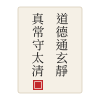
No symbol of its own is recorded with a source for this branch, so the library uses the common symbol of the path.
VIIIOther Branches of Taoism
 Zhengyi Dao正一道Descends from Zhang Daoling's Way of the Celestial Masters of 142 CE.Quanzhen Daoism全真道Founded by Wang Chongyang in 1167 in Shandong.Uses the common symbol of the path
 Longmen Daoism龍門派The largest Quanzhen line, honouring Qiu Chuji as patriarch, centred on the White Cloud Monastery.Shangqing Daoism上清派 茅山Formed around scriptures recorded by Yang Xi in 364 to 370, with Lady Wei Huacun as first matriarch.Uses the common symbol of the path
 Lingbao Daoism靈寶派Began around 400 CE with scriptures compiled by Ge Chaofu in 397 to 402.
 Wudang Daoism武當派Tied to Mount Wudang in Hubei and the cult of Zhenwu, the Dark Warrior.Jingming Daoism淨明道, full name 淨明忠孝道Honours Xu Xun of the Jin as first patriarch and took shape in the Southern Song.Uses the common symbol of the pathTaoism in VietnamTemples, ritual masters and cults shaped by TaoismNot a school but the form Taoism takes in Vietnam.Uses the common symbol of the path
IXSources
The library cross-checks the sources below. Where they disagree, the page gives both.
?Quick Questions
What is Jingming Daoism
A Daoist line from Jiangxi that honours Xu Xun of the Jin as patriarch and took shape under the Southern Song. It makes loyalty and filial piety the root of practice and a pure, bright mind its goal.
Who was Xu Xun
A Jin dynasty figure who by tradition lived from 239 to 374 and served as magistrate of Jingyang. Legend says he slew a flood dragon, and Emperor Huizong of Song named him a Perfected Lord.
How does Jingming differ from other Daoist schools
Jingming puts the ethics of loyalty and filial piety at the centre, does not require monastic life and simplifies talismanic ritual. Other schools usually centre on inner alchemy or liturgy.