
IOverview
Quanzhen, or Complete Perfection, is the monastic current of Daoism. The name means keeping one's original true nature whole. It was founded by Wang Chongyang in northern China in the twelfth century, and together with Zhengyi it is one of the two main currents of Daoism today.
Unlike Zhengyi priests, who live as householders, Quanzhen Daoists leave home, remain celibate, eat a vegetarian diet, keep precepts and live together in monasteries. Their core practice is inner alchemy, the refining of essence, breath and spirit within the body, together with meditation and the cultivation of the mind. The historic centre is the White Cloud Monastery in Beijing, now the seat of the Chinese Taoist Association.
IIHistory
Wang Chongyang, born Wang Zhe, lived from 1113 to 1170. Tradition says that in 1159 he met immortals and then spent years as a recluse in the Zhongnan mountains. In 1167 he went to Shandong and gathered seven principal disciples, later known as the Seven Perfected: Ma Yu, Sun Bu'er, Qiu Chuji, Tan Chuduan, Liu Chuxuan, Wang Chuyi and Hao Datong. Each opened a line of transmission, giving Quanzhen its seven branches.
The turning point came with Qiu Chuji. In 1220 he left Shandong at the invitation of Genghis Khan and met him in 1222 near the Hindu Kush. After that meeting the Mongol court favoured Quanzhen, and it spread quickly across the north. In 1227 the Tianchang temple in Yanjing was renamed the Palace of Eternal Spring, the forerunner of the White Cloud Monastery.
- 1167Wang Chongyang in ShandongGathers seven disciples. The library's main article uses this as the founding year.
- 1222Qiu Chuji meets Genghis KhanThe Mongol court favours Quanzhen, which spreads across the north.
- 1227Palace of Eternal SpringThe Yanjing temple that later became the White Cloud Monastery.
- 1656Wang Changyue's public ordinationThe first public three-platform ordination at the White Cloud Monastery, opening the Longmen revival.
- 1957Chinese Taoist AssociationFounded this year, with its seat at the White Cloud Monastery.
According to Yue Wang's 2017 thesis at the University of Saskatchewan, between 1800 and 1927 the White Cloud Monastery held 31 ordination ceremonies and ordained about 5,465 Daoists. Under the Qing, the Longmen line became dominant within Quanzhen.
IIITeachings and Distinctive Features
Quanzhen puts the cultivation of heart and nature at the centre. Wang Chongyang taught that the three teachings, Confucianism, Buddhism and Daoism, complement one another. Britannica describes the school as a synthesis of Confucianism, Daoism and Chan Buddhism.
- Inner rather than outer alchemy. No elixirs brewed from minerals in a furnace. The practitioner works within the body, using essence, breath and spirit as ingredients.
- Dual cultivation of nature and life. Nature is the mind, life is the body. Both must be cultivated.
- Monastic precepts. Celibacy, a vegetarian diet, no alcohol and a life ordered by monastery rules.
For Quanzhen, becoming an immortal means above all returning to one's true nature, the clear mind one has always had. Precepts, work and meditation all serve to wear away the greed, anger and wandering thoughts that cover it.
IVPractice, Ritual and Daily Life
A day in a Quanzhen monastery includes morning and evening liturgy, work, study and meditation. Daoists wear their hair in a topknot, dress in robes and take religious names following their lineage poem. Those who wish to join go through a probation period before ordination.
Quanzhen distinguishes two kinds of temple. A public monastery of the ten directions belongs to all, is open to Daoists from anywhere and may hold ordinations. A hereditary temple passes from master to disciple within one line. The ordination is called the three-platform great precepts, with three grades: Initial Perfection, Middle Ultimate and Celestial Immortal. Quanzhen temples also perform rites for lay people, but this is not their main focus.
VOrganisation and Distribution
The seven lines of the Seven Perfected are Longmen, Suishan, Nanwu, Yuxian, Huashan, Yushan and Qingjing. Longmen, traced to Qiu Chuji, is by far the largest and today accounts for most Quanzhen clergy. Many smaller sub-lines are named after mountains or temples.
On the mainland, Quanzhen belongs to the Chinese Taoist Association. Major monasteries include the White Cloud Monastery in Beijing, the Chongyang Palace in Shaanxi and the Qingyang Palace in Chengdu. In Hong Kong, Quanzhen temples such as Ching Chung Koon combine religious life with charity. The 2018 white paper counts over 40,000 clergy and about 9,000 temples for Daoism in China as a whole, without a breakdown by school.
VIIn Vietnam
There is no separately registered Quanzhen body in Vietnam. The clearest trace is Khanh Van Nam Vien at 269/2 Nguyen Thi Nho Street, District 11, Ho Chi Minh City. English Wikipedia states that it is run by Cantonese Quanzhen Daoists.
According to Duong Hoang Hai Binh, writing in the journal Religious Studies Review in 2018, masters from the Qingyun Cave at Chashan in Nanhai, Guangdong, came to Vietnam in the 1930s, founded a hall on Tran Hung Dao Street and moved to the present site in 1942. The article calls it the only place of formal Daoist practice among the ethnic Chinese, notes that all its priests are ethnic Chinese, and says it is administered by the Chinese Buddhist community within the Vietnam Buddhist Sangha. Its biggest annual festival honours the immortal Lü Dongbin.
VIISymbol of the Branch

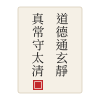
No symbol of its own is recorded with a source for this branch, so the library uses the common symbol of the path.
VIIISub-branches
- Longmen
- Suishan
- Nanwu
- Yuxian
- Huashan
- Yushan
- Qingjing
IXOther Branches of Taoism
 Zhengyi Dao正一道Descends from Zhang Daoling's Way of the Celestial Masters of 142 CE.Quanzhen Daoism全真道Founded by Wang Chongyang in 1167 in Shandong.Uses the common symbol of the path
 Longmen Daoism龍門派The largest Quanzhen line, honouring Qiu Chuji as patriarch, centred on the White Cloud Monastery.Shangqing Daoism上清派 茅山Formed around scriptures recorded by Yang Xi in 364 to 370, with Lady Wei Huacun as first matriarch.Uses the common symbol of the path
 Lingbao Daoism靈寶派Began around 400 CE with scriptures compiled by Ge Chaofu in 397 to 402.
 Wudang Daoism武當派Tied to Mount Wudang in Hubei and the cult of Zhenwu, the Dark Warrior.Jingming Daoism淨明道, full name 淨明忠孝道Honours Xu Xun of the Jin as first patriarch and took shape in the Southern Song.Uses the common symbol of the pathTaoism in VietnamTemples, ritual masters and cults shaped by TaoismNot a school but the form Taoism takes in Vietnam.Uses the common symbol of the path
XSources
The library cross-checks the sources below. Where they disagree, the page gives both.
- Wikipedia, Quanzhen School
- Britannica, Quanzhen
- Wikipedia, Qiu Chuji
- Wikipedia, White Cloud Temple
- Yue Wang, On Quanzhen Daoism and the Longmen Lineage, luận văn, University of Saskatchewan, 2017
- Wikipedia, Taoism in Vietnam
- Dương Hoàng Hải Bình, Đạo giáo trong cộng đồng người Hoa, Tạp chí Nghiên cứu Tôn giáo số 1 năm 2018
- Chính phủ Trung Quốc, sách trắng về tự do tín ngưỡng, 2018
- Wikipedia, Chinese Taoist Association
?Quick Questions
Who founded Quanzhen Daoism
Wang Chongyang, born Wang Zhe, who lived from 1113 to 1170. In 1167 he gathered seven principal disciples in Shandong, and they opened the seven lines of Quanzhen.
How does Quanzhen differ from Zhengyi
Quanzhen Daoists are celibate vegetarian monastics who focus on inner alchemy and the mind. Zhengyi priests are mostly householders who marry and focus on talismans and communal rites.
What is the White Cloud Monastery
The largest Quanzhen monastery in Beijing, descended from the Palace of Eternal Spring associated with Qiu Chuji. It is the centre of the Longmen line and the seat of the Chinese Taoist Association.
Is there a Quanzhen temple in Vietnam
English Wikipedia states that Khanh Van Nam Vien in District 11, Ho Chi Minh City, is run by Cantonese Quanzhen Daoists. It dates from the 1930s and has no separate registration as a religion.