
IOverview
Zhengyi Dao is one of the two main currents of Daoism today, alongside Quanzhen. Its full scriptural name, Zhengyi Mengwei, refers to a covenant of orthodox unity with the powers. The school traces itself to the Way of the Celestial Masters founded by Zhang Daoling in 142, and by tradition it is headed by a Celestial Master of the Zhang family.
The most visible feature of Zhengyi is that most of its priests are householders. They marry, eat meat, live with their families, and the profession often passes down within a family. Entry into the priesthood requires receiving a register, a document listing the deities the holder is entitled to summon.
IIHistory
According to tradition, in 142 the deified Laozi granted Zhang Daoling the Zhengyi Mengwei covenant. The early movement was nicknamed the Way of the Five Pecks of Rice after the contribution asked of new members. Zhang's grandson Zhang Lu ran a religious state in the Hanzhong valley until he submitted to Cao Cao in 215. His followers were resettled across China and took the teaching with them.
Under the Tang, Emperor Xuanzong honoured Zhang Daoling, and a temple on Mount Longhu in Jiangxi was recognised as the home of his legitimate descendants. Longhu became the ancestral seat. In 1239 the Southern Song emperor Lizong put the 35th Celestial Master, Zhang Keda, in charge of the registers of three mountains, Longhu, Mao and Gezao. In 1304 the Yuan court gathered every talismanic school except Quanzhen under the Zhengyi name, led by the 38th Celestial Master, Zhang Yucai.
- 142Zhang Daoling founds the Celestial MastersIn Shu, present-day Sichuan. The usual starting point of organised Daoism.
- 215Zhang Lu submits to Cao CaoThe Hanzhong state ends and resettled followers spread the faith.
- 1239Registers of three mountains unitedEmperor Lizong gives the 35th Celestial Master authority over Longhu, Mao and Gezao.
- 1304The Zhengyi name fixedThe Yuan unite the talismanic schools under the 38th Celestial Master.
- 1949The 63rd Celestial Master moves to TaiwanZhang Enpu leaves the mainland. Zhengyi ritual in Taiwan continues without a break.
- 1982Ordination resumes on the mainlandZhengyi priests may again be ordained after years of interruption.
From the Ming onward the court repeatedly reduced the Celestial Masters' titles, and by the Daoguang reign of the Qing their official relationship with the court had lapsed, though their prestige among Daoist priests stayed high. After the 64th Celestial Master, Zhang Yuanxian, died in 2008, several members of the Zhang family on the mainland and in Taiwan each claimed to be the 65th, and no single claimant is accepted by all sides.
IIITeachings and Distinctive Features
Zhengyi shares the common ground of Daoist teaching: the Dao as the root of all things, the Three Pure Ones at the head of the pantheon, a life in tune with nature and a calm heart. What sets it apart is how the priest works. Zhengyi treats the priest as an official of heaven. Once ordained with a register, his name is entered in the heavenly rolls and he may submit memorials, invite deities and command spirit generals.
- Registers. Ordination documents in many grades. A higher grade allows more deities to be summoned and larger rites to be led.
- Talismans. Written in a special script to guard, expel and protect. Under the Tang, selling protective talismans was the chief activity of Zhengyi priests.
- Thunder rites. Exorcistic methods invoking thunder, taken up by the Celestial Masters near the end of the Northern Song.
Zhengyi does not treat Laozi as a god of its own making but as the ancestor of its teaching. The covenant of 142 is understood as a pact between humans and the powers of heaven and earth: those who keep their word and their precepts receive protection.
IVRitual and the Priest's Life
The two main rites are zhai and jiao. The zhai comes first and centres on repentance and a written report to heaven of the merit gained. The jiao is the offering itself, usually over three days, with processions through the streets, music and a great communal offering. In Taiwan and Hong Kong large jiao festivals are still held on cycles of several years.
Beyond the big festivals lies the everyday work of a village priest: blessing a house, averting a bad year, rites for the dead, talismans for a sick adult or a small child. The craft passes from master to disciple and from father to son. A student must learn the texts, the music and the ritual steps before receiving a register. The Celestial Master's Residence on Mount Longhu remains the most important place of ordination.
VOrganisation and Distribution
Zhengyi has no centralised church in the Western sense. Its network is made of temples, private altars and priestly families. On the mainland, Zhengyi priests belong to the Chinese Taoist Association together with Quanzhen clergy. Taiwan has several separate bodies, and the dispute over the 65th Celestial Master means more than one organisation claims to speak for the Zhang line.
Zhengyi is strongest in southern China, Taiwan, Hong Kong and the Chinese communities of Southeast Asia. The library's main article on Daoism cites Taiwan's Ministry of the Interior figure for 2015 of 9,485 registered Daoist temples, but that number is not broken down by school.
VIIn Vietnam
No Zhengyi organisation is registered in Vietnam, and Daoism is not among the sixteen religions recognised by the state. Traces of talismanic practice are everywhere, though: petitions in Chinese characters, house-protecting charms, star rites to ward off a bad year, and the village ritual master. Vietnamese ritual masters usually learn orally, draw on many sources and do not describe themselves as ordained priests of the Celestial Master lineage.
Among ethnic Chinese, especially in Chợ Lớn, there are community temples and ritual specialists who follow southern Chinese liturgy. The library has not found a source confirming that any specific temple in Vietnam belongs to the Zhengyi order.
VIISymbol of the Branch

Yangping Zhidu Gong Seal
陽平治都功印
VIIISub-branches
- Way of the Celestial Masters
- Lingbao
- Shangqing
- Jingming
IXOther Branches of Taoism
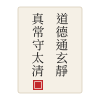
Zhengyi Dao正一道Descends from Zhang Daoling's Way of the Celestial Masters of 142 CE. Quanzhen Daoism全真道Founded by Wang Chongyang in 1167 in Shandong.Uses the common symbol of the path
 Longmen Daoism龍門派The largest Quanzhen line, honouring Qiu Chuji as patriarch, centred on the White Cloud Monastery.Shangqing Daoism上清派 茅山Formed around scriptures recorded by Yang Xi in 364 to 370, with Lady Wei Huacun as first matriarch.Uses the common symbol of the path
 Lingbao Daoism靈寶派Began around 400 CE with scriptures compiled by Ge Chaofu in 397 to 402.
 Wudang Daoism武當派Tied to Mount Wudang in Hubei and the cult of Zhenwu, the Dark Warrior.Jingming Daoism淨明道, full name 淨明忠孝道Honours Xu Xun of the Jin as first patriarch and took shape in the Southern Song.Uses the common symbol of the pathTaoism in VietnamTemples, ritual masters and cults shaped by TaoismNot a school but the form Taoism takes in Vietnam.Uses the common symbol of the path
XSources
The library cross-checks the sources below. Where they disagree, the page gives both.
?Quick Questions
Is Zhengyi the same as the Way of the Celestial Masters
Zhengyi sees itself as the continuation of the Celestial Masters movement founded by Zhang Daoling in 142. The name comes from the Zhengyi Mengwei covenant. From 1304 it became the shared name for all talismanic schools under the Celestial Master of Mount Longhu.
Can Zhengyi priests marry
Yes. Most Zhengyi priests are householders who marry, eat meat and live with their families. This is the sharpest contrast with Quanzhen, whose clergy are celibate monastics.
What is a register
A register is an ordination document listing the deities its holder may summon. In Zhengyi, receiving one is the formal entry into the priesthood. Registers come in grades, and higher grades allow larger rites.
Who is the Celestial Master today
The 64th Celestial Master, Zhang Yuanxian, died in 2008. Since then several members of the Zhang family on the mainland and in Taiwan have claimed to be the 65th, and none is recognised by all sides.