IOverview
The Oriental Orthodox Churches are a family of six autocephalous churches in communion with one another but not with the Eastern Orthodox communion to which the Russian, Greek and Serbian churches belong. What they share is that they accept only the first three ecumenical councils and not the Council of Chalcedon of 451.
The name Oriental Orthodox was adopted by the churches themselves at the Addis Ababa conference of 1965, to distinguish them from the Eastern Orthodox. There is no single head. Each church has its own patriarch or catholicos, such as Pope Tawadros II of the Coptic church, in office since 2012.
IIThe Six Churches
| Church | Seat | Key points |
|---|---|---|
| Coptic Orthodox | Cairo and Alexandria | The church of Egypt's Christians, honouring Saint Mark as founder. Birthplace of Christian monasticism. |
| Ethiopian Tewahedo | Addis Ababa | The largest church of the family. Granted autocephaly by the Coptic church in 1959. |
| Eritrean Tewahedo | Asmara | Separated from the Ethiopian church after Eritrea's independence in 1993. |
| Syriac Orthodox | Damascus | Its head holds the title Patriarch of Antioch, and it keeps a liturgy in Syriac, a form of Aramaic. |
| Armenian Apostolic | Etchmiadzin and Antelias | By tradition Armenia made Christianity its state religion in 301, the first country to do so. |
| Malankara Orthodox Syrian | Kottayam, Kerala | The church of part of the Saint Thomas Christians of southern India. |
IIIHistory
In 451 the Council of Chalcedon defined Christ as one person in two natures. Many bishops in Egypt, Syria and Armenia felt the formula departed from the teaching of Saint Cyril of Alexandria, who spoke of one nature of God the Word incarnate. They rejected the council. Over the centuries the division hardened, partly for theological reasons and partly through the politics and languages dividing the Byzantine Empire from the peoples on its frontiers.
- 301Armenia becomes ChristianBy tradition King Tiridates III is converted by Saint Gregory the Illuminator.
- 451Council of ChalcedonThese churches do not accept the council.
- 1959Ethiopian autocephalyThe Coptic church grants autocephaly and a patriarch to the Ethiopian church.
- 1965Addis Ababa conferenceThe churches meet together and adopt the name Oriental Orthodox.
- 1973Joint declaration of Rome and the CoptsPope Paul VI and Pope Shenouda III sign a common statement of faith in Christ.
- 1989 to 1990Joint statements with the Eastern OrthodoxA joint commission meeting at Chambésy, Switzerland, concludes that both sides hold the same faith in Christ expressed in two ways.
IVDoctrine and Distinctives
These churches call their teaching on Christ miaphysite: one united nature of the incarnate Word, fully divine and fully human, without mixture, change or division. They reject the label monophysite that others have applied to them, because it implies that Christ's humanity was absorbed, which they deny.
Beyond Christology, each church keeps its own rite. The Copts use Coptic and Arabic, the Ethiopians and Eritreans classical Ge'ez, the Syriac church Syriac, and the Armenians Classical Armenian. The Ethiopian church has the broadest biblical canon in Christianity, including the books of Enoch and Jubilees, and keeps customs such as circumcision, abstaining from pork and honouring the Sabbath.
A common misunderstanding is that Copts or Armenians are a branch of Russian or Greek Orthodoxy. They are a separate family, standing apart since the fifth century, well before the East West break of 1054.
VWorship and Daily Life
Fasting has a central place. Copts and Ethiopians keep more than two hundred fast days a year at various levels, fasting meaning abstinence from all animal products. Ethiopia's Timkat, celebrating the baptism of Christ, was inscribed by UNESCO as intangible heritage in 2019. Armenians celebrate Christmas and Theophany together on 6 January. Christian monasticism began in the Egyptian desert with Saint Anthony and Saint Pachomius, and ancient Coptic monasteries are still active today.
VIStructure and Distribution
Wikipedia cites an estimate of about 71.86 million members in 2020, while the churches' own reports add up to about 87 million. According to Pew Research in 2017, the Ethiopian Tewahedo Church alone has about 36 million people, nearly half the family. Large diaspora communities live in North America, Europe, Australia and the Gulf states.
In Kerala, the Malankara Orthodox Syrian Church and the Jacobite Syrian Christian Church, which remains loyal to the Syriac Orthodox patriarch, have disputed control of parish churches for more than a century. In 2017 the Supreme Court of India ruled in favour of the Malankara Orthodox side on the administration of churches under the constitution of 1934, a ruling the Jacobite side does not accept. This library records the events without taking sides.
VIIIn Vietnam
This library has found no source for an organised Oriental Orthodox parish or community in Vietnam. In Southeast Asia the clearest trace is the Armenian Church of Saint Gregory the Illuminator in Singapore, built in 1835, along with Kerala communities of the Malankara churches in countries with many Indian workers. No comparable record has been found for Vietnam.
VIIISymbol of the Branch
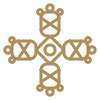
Ethiopian, Coptic and Armenian crosses
IXSub-branches
- Ethiopian Orthodox Tewahedo Church
- Coptic Orthodox Church
- Armenian Apostolic Church
- Eritrean Orthodox Tewahedo Church
- Syriac Orthodox Church
- Malankara Orthodox Syrian Church
XOther Branches of Orthodox Christianity
 Russian Orthodox ChurchРусская православная церковьThe largest autocephalous church, de facto independent from 1448 and a patriarchate from 1589, seated in Moscow.
 Romanian Orthodox ChurchBiserica Ortodoxă RomânăThe only Orthodox church worshipping in a Romance language.
 Church of GreeceΕκκλησία της ΕλλάδοςThe autocephalous church of Greece, seated in Athens.
 Serbian Orthodox ChurchСрпска православна цркваAutocephalous since 1219 under Saint Sava, seated in Belgrade.
 Ecumenical Patriarchate of ConstantinopleΟικουμενικό Πατριαρχείο ΚωνσταντινουπόλεωςOne of the five ancient sees, first in honour among Orthodox churches as first among equals, seated in Istanbul.
 Greek Orthodox Patriarchate of Antiochبطريركية أنطاكية وسائر المشرق للروم الأرثوذكسThe ancient see where disciples were first called Christians, based in Damascus since 1342.Uses the common symbol of the pathBulgarian Orthodox ChurchБългарска православна църкваA patriarchate since the 10th century, re-established as autocephalous in the 19th and 20th centuries, seated in Sofia.Uses the common symbol of the path
 Georgian Orthodox Churchსაქართველოს მართლმადიდებელი ეკლესიაOne of the oldest churches, its faith brought to the kingdom of Iberia by Saint Nino in the 4th century, with Georgian tradition dating autocephaly to the 5th century.
 Greek Orthodox Patriarchate of AlexandriaΠατριαρχείο Αλεξανδρείας και πάσης ΑφρικήςAn ancient see traditionally founded by Saint Mark, overseeing Orthodox communities across Africa.Oriental Orthodox ChurchesOriental OrthodoxyA second family also called Orthodox but outside the communion above.
XISources
The library cross-checks the sources below. Where they disagree, the page gives both.
?Quick Questions
How do the Oriental Orthodox differ from the Eastern Orthodox?
The two families parted after the Council of Chalcedon in 451. The Eastern Orthodox, including the Russian, Greek and Serbian churches, accept seven ecumenical councils. The Oriental Orthodox, including the Coptic, Ethiopian, Armenian and Syriac churches, accept only the first three and are not in communion with the other family.
Is miaphysitism the same as monophysitism?
These churches say no. They teach that Christ has one united nature, fully divine and fully human without mixture, and reject the idea that his humanity was absorbed, which is how monophysite is usually understood.
How many Oriental Orthodox Christians are there?
Wikipedia cites an estimate of about 71.86 million in 2020, while the churches report about 87 million. The Ethiopian Tewahedo Church alone has about 36 million members according to Pew Research in 2017.