IOverview
The Serbian Orthodox Church is the autocephalous church of the Serbian people, seated in Belgrade. Its head bears the title Archbishop of Peć, Metropolitan of Belgrade and Karlovci, and Serbian Patriarch. Patriarch Porfirije has held the office since February 2021.
The church keeps the old Julian calendar, so it celebrates Christmas on 7 January in the civil calendar. Its services are in Church Slavonic and, increasingly, modern Serbian. Its territory spans several states of the former Yugoslavia, together with dioceses for Serbs in Western Europe, North America and Australia.
IIHistory
The Serbs became Christian from the ninth century onward. The turning point came in 1219, when Sava, a Nemanjić prince who had become a monk on Mount Athos, was consecrated first archbishop of an autocephalous church by the Patriarch of Constantinople, then in exile at Nicaea. Sava organised dioceses, founded monasteries and drew up church law. Serbs venerate him as a saint and as the founder of their church.
- 1219Saint Sava receives autocephalyThe autocephalous Archbishopric of Serbia is born, first seated at the monastery of Žiča.
- 1346Patriarchate of PećUnder Tsar Stefan Dušan the archbishopric is raised to a patriarchate.
- 1557Peć restoredAfter a period of abolition the see is re-established under Ottoman rule.
- 1766Peć abolishedSerbian dioceses in the Ottoman Empire return to the authority of Constantinople.
- 1920Unification and a restored patriarchateThe Serbian churches of the new kingdom unite as a single patriarchate.
- 2021Patriarch PorfirijeElected after the death of Patriarch Irinej late in 2020.
The twentieth century was a hard one. During the Second World War, in the Independent State of Croatia, many Serbian bishops and priests were killed and many churches destroyed. Patriarch Gavrilo was held by the Germans, for a time in Dachau. Under communist Yugoslavia the church's activity was restricted. In 1967 the church in Macedonia declared autocephaly, which Belgrade did not recognise. In May 2022 the Serbian church restored communion with it and later granted it autocephaly. Not every Orthodox church has yet recognised that step.
IIITradition and Distinctives
Its doctrine is the common faith of the Orthodox communion. What sets it apart is lived tradition.
- The Slava. Each family has a patron saint handed down from father to son, and celebrates the saint's day with a special bread, boiled wheat, a candle and wine. UNESCO added the Slava to its list of intangible cultural heritage in 2014.
- Saint Sava is both a church saint and a symbol of learning. His feast on 27 January is a school holiday.
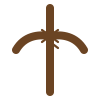
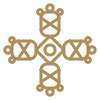
- The Serbian cross, with four firesteels or ocila in its corners, often seen on the church's flag.
The church understands itself through what Serbs call the way of Saint Sava: Orthodox faith woven together with the language, culture and historical memory of the nation.
IVWorship and Daily Life
The Divine Liturgy is celebrated every Sunday. On Christmas Eve Serbs burn oak branches called badnjak outside churches and in their yards. On Christmas morning every household breaks a česnica loaf with a coin hidden inside. Monastic life centres on medieval foundations such as Studenica, Žiča and Hilandar on Mount Athos, founded by Saint Sava and his father at the end of the twelfth century.
Many Serbs who rarely attend church still keep the Slava, the Christmas customs and Easter eggs dyed red, which is one reason the church remains central to Serbian culture even among the less observant.
VStructure and Distribution
Supreme authority lies with the bishops' council, which meets every year, while a permanent Holy Synod handles day-to-day affairs. In Serbia's 2022 census, 5,387,426 people identified as Orthodox, or 81.1 percent of the population. This library has found no reliable source for the church's total membership, since most faithful outside Serbia are not counted separately.
Several of the church's most important monasteries lie in Kosovo, including the Patriarchate of Peć, Visoki Dečani and Gračanica. UNESCO lists them together as the Medieval Monuments in Kosovo and placed them on its List of World Heritage in Danger in 2006. In Montenegro, a 2019 law on religious freedom prompted a wave of protest processions by the church's faithful, and the law was amended in 2020. This library records these events without commenting on the political disputes around them.
VIIn Vietnam
This library has found no source for an organised Serbian Orthodox parish or community in Vietnam. Serbs living in Vietnam can attend services at the parishes of the Russian church, since the two churches share communion and both keep the old Julian calendar. The Serbian church has a diocese for Serbs in Australia and New Zealand, but this library has found no Serbian diocese with responsibility for Southeast Asia.
VIISymbol of the Branch
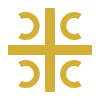
Serbian cross with four ocila
Српски крст
VIIIOther Branches of Orthodox Christianity
 Russian Orthodox ChurchРусская православная церковьThe largest autocephalous church, de facto independent from 1448 and a patriarchate from 1589, seated in Moscow.
 Romanian Orthodox ChurchBiserica Ortodoxă RomânăThe only Orthodox church worshipping in a Romance language.
 Church of GreeceΕκκλησία της ΕλλάδοςThe autocephalous church of Greece, seated in Athens.Serbian Orthodox ChurchСрпска православна цркваAutocephalous since 1219 under Saint Sava, seated in Belgrade.
 Ecumenical Patriarchate of ConstantinopleΟικουμενικό Πατριαρχείο ΚωνσταντινουπόλεωςOne of the five ancient sees, first in honour among Orthodox churches as first among equals, seated in Istanbul.
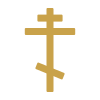 Greek Orthodox Patriarchate of Antiochبطريركية أنطاكية وسائر المشرق للروم الأرثوذكسThe ancient see where disciples were first called Christians, based in Damascus since 1342.Uses the common symbol of the pathBulgarian Orthodox ChurchБългарска православна църкваA patriarchate since the 10th century, re-established as autocephalous in the 19th and 20th centuries, seated in Sofia.Uses the common symbol of the path
 Georgian Orthodox Churchსაქართველოს მართლმადიდებელი ეკლესიაOne of the oldest churches, its faith brought to the kingdom of Iberia by Saint Nino in the 4th century, with Georgian tradition dating autocephaly to the 5th century.
 Greek Orthodox Patriarchate of AlexandriaΠατριαρχείο Αλεξανδρείας και πάσης ΑφρικήςAn ancient see traditionally founded by Saint Mark, overseeing Orthodox communities across Africa.
 Oriental Orthodox ChurchesOriental OrthodoxyA second family also called Orthodox but outside the communion above.
IXSources
The library cross-checks the sources below. Where they disagree, the page gives both.
?Quick Questions
What is a Slava?
The Slava is a family's feast of its patron saint, passed from father to son. The family prepares a special bread and boiled wheat, lights a candle and welcomes guests. UNESCO recognised the Slava as intangible cultural heritage in 2014.
How many Serbs are Orthodox?
In the 2022 census, 5,387,426 people in Serbia identified as Orthodox, 81.1 percent of the population. No reliable figure exists for the church's total membership in other countries.
Who was Saint Sava?
Sava was a Nemanjić prince who became a monk on Mount Athos and in 1219 the first archbishop of the autocephalous Serbian church. Serbs regard him as the founder of both their church and their tradition of learning.