IOverview
The Greek Orthodox Patriarchate of Alexandria and All Africa is one of the five ancient sees of Christianity and second in the Orthodox diptychs, after Constantinople. Its head bears the title Pope and Patriarch of Alexandria and All Africa. Theodore II has held the office since 2004.
The title Pope is an ancient one for the bishop of Alexandria, older than its specific link to the bishop of Rome. The patriarchate should not be confused with the Coptic Orthodox Church, which is also seated in Alexandria and also honours Saint Mark as its founder, but belongs to the Oriental Orthodox family. In Egypt, the Orthodox faithful of this patriarchate are a small minority compared with the Copts.
IIHistory
Alexandria was a great theological centre of early Christianity, home to Clement, Origen, Saint Athanasius and Saint Cyril. After the Council of Chalcedon in 451 most Egyptian Christians rejected the council and later formed the Coptic church. Those who accepted it, supported by the Byzantine emperors, became today's Orthodox Patriarchate of Alexandria. Through centuries of Arab and Ottoman rule the patriarchate mainly served Greek and Arab Orthodox communities in Egypt.
- 1st centurySaint Mark in AlexandriaBy tradition the evangelist Mark founds the church of Alexandria.
- 451Division after ChalcedonTwo patriarchates emerge, one Orthodox and one Coptic.
- 1930s to 1946Ugandan converts joinThe movement of Reuben Spartas Mukasa turns to Orthodoxy and finally enters the Patriarchate of Alexandria.
- 11 September 2004Patriarch Petros VII killedHis helicopter crashes into the Aegean. Theodore II is elected the following month.
- 8 November 2019Recognition of the Orthodox Church of UkrainePatriarch Theodore II commemorates the Ukrainian primate in the liturgy.
- December 2021Moscow creates an Exarchate of AfricaThe Moscow Holy Synod receives 102 clergy from Alexandria and sets up its own structure in Africa.
East Africans came to Orthodoxy by an unusual route. Reuben Spartas Mukasa and his Ugandan companions first made contact with the African Orthodox Church, an independent body founded in the United States in 1921. When they learned that it was not in communion with the Orthodox churches, they turned to the Patriarchate of Alexandria through the Greek community in East Africa. In Kenya the movement grew in the 1950s and 1960s, and the Nairobi seminary bears the name of Archbishop Makarios III of Cyprus, who supported its founding.
IIITradition and Distinctives
Its doctrine is the common faith of the Orthodox communion, accepting the seven ecumenical councils. What marks Alexandria out:
- An ancient see turned missionary church. Over the twentieth century its centre of gravity shifted from the Greek community in Egypt to African congregations south of the Sahara.
- Worship in many languages. Beside Greek and Arabic, services are held in Swahili, Luganda, French, English and many local languages.
The patriarchate presents itself as the apostolic church of the whole African continent, which is why its title includes the words all Africa.
A common misunderstanding is that Orthodox in Egypt means Coptic. There are two churches. The Coptic Orthodox Church is far larger and belongs to the Oriental Orthodox family. The Orthodox Patriarchate of Alexandria belongs to the Eastern Orthodox communion and has few faithful in Egypt.
IVWorship and Daily Life
Worship follows the Byzantine rite and the Revised Julian calendar for fixed feasts. In East Africa parish life is closely tied to the schools, clinics and orphanages the church has founded. According to Wikipedia, in Kenya alone the patriarchate has four cathedrals, 185 churches, three orphanages and 20 schools, without a date for the figures, as well as a seminary in Nairobi that trains clergy for many African countries.
VStructure and Distribution
The patriarch governs together with the Holy Synod. According to Wikipedia the patriarchate has some 23 metropolitan sees across Africa. This library has no reliable figure for total membership. Country figures cited by Wikipedia include 48,421 in Uganda in the 2014 census and 42,251 in South Africa in the 2001 census. Figures for Kenya are usually given as much higher but without a census source.
After Alexandria recognised the Orthodox Church of Ukraine on 8 November 2019, the Moscow Patriarchate stopped commemorating Patriarch Theodore II from late December 2019. In December 2021 Moscow received 102 African clergy from Alexandria and created a Patriarchal Exarchate of Africa. Alexandria regards this as an intrusion into its territory, and in 2022 it stopped commemorating Patriarch Kirill. Moscow says it was responding to requests from the clergy themselves. This library records the events without taking sides.
VIIn Vietnam
The territory of the Patriarchate of Alexandria covers Africa only. This library has found no source for any parish or community of the patriarchate in Vietnam.
VIISymbol of the Branch
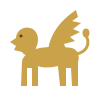
Lion of Saint Mark
Λέων του Αγίου Μάρκου
VIIIOther Branches of Orthodox Christianity
 Russian Orthodox ChurchРусская православная церковьThe largest autocephalous church, de facto independent from 1448 and a patriarchate from 1589, seated in Moscow.
 Romanian Orthodox ChurchBiserica Ortodoxă RomânăThe only Orthodox church worshipping in a Romance language.
 Church of GreeceΕκκλησία της ΕλλάδοςThe autocephalous church of Greece, seated in Athens.
 Serbian Orthodox ChurchСрпска православна цркваAutocephalous since 1219 under Saint Sava, seated in Belgrade.
 Ecumenical Patriarchate of ConstantinopleΟικουμενικό Πατριαρχείο ΚωνσταντινουπόλεωςOne of the five ancient sees, first in honour among Orthodox churches as first among equals, seated in Istanbul.
 Greek Orthodox Patriarchate of Antiochبطريركية أنطاكية وسائر المشرق للروم الأرثوذكسThe ancient see where disciples were first called Christians, based in Damascus since 1342.Uses the common symbol of the pathBulgarian Orthodox ChurchБългарска православна църкваA patriarchate since the 10th century, re-established as autocephalous in the 19th and 20th centuries, seated in Sofia.Uses the common symbol of the path
 Georgian Orthodox Churchსაქართველოს მართლმადიდებელი ეკლესიაOne of the oldest churches, its faith brought to the kingdom of Iberia by Saint Nino in the 4th century, with Georgian tradition dating autocephaly to the 5th century.Greek Orthodox Patriarchate of AlexandriaΠατριαρχείο Αλεξανδρείας και πάσης ΑφρικήςAn ancient see traditionally founded by Saint Mark, overseeing Orthodox communities across Africa.
 Oriental Orthodox ChurchesOriental OrthodoxyA second family also called Orthodox but outside the communion above.
IXSources
The library cross-checks the sources below. Where they disagree, the page gives both.
?Quick Questions
How is the Orthodox Patriarchate of Alexandria different from the Coptic church?
Both honour Saint Mark as founder and both are seated in Alexandria. But they separated after 451: the Orthodox patriarchate accepts the Council of Chalcedon and belongs to the Eastern Orthodox communion, while the Coptic church does not and belongs to the Oriental Orthodox family.
Why is the Patriarch of Alexandria called Pope?
The title Pope, meaning father, was used for the bishop of Alexandria from the third century, before it became tied specifically to the bishop of Rome. Both the Orthodox patriarch and the Coptic pope in Alexandria still use it.
Are there many Orthodox Christians in Africa?
There is no reliable figure for the whole patriarchate. Wikipedia gives 500,000 to 1,500,000 without a year, concentrated in Kenya, Uganda, Tanzania and Cameroon.