IOverview
The Ecumenical Patriarchate of Constantinople is one of the five ancient sees of Christianity, based in the Phanar district of Istanbul. Its head bears the title Archbishop of Constantinople, New Rome, and Ecumenical Patriarch. Bartholomew I has held the office since 1991.
The Orthodox churches recognise the Ecumenical Patriarch as first in honour, first among equals. He can convene pan-Orthodox gatherings but has no jurisdiction over the other autocephalous churches. What that primacy includes, and where it stops, is exactly where the churches have come to disagree in recent years. Beyond that, the patriarchate directly oversees many communities in countries that lie outside the territory of any autocephalous church, which is why its reach extends far beyond Turkey.
IIHistory
When Emperor Constantine moved his capital to Byzantium in 330, the bishop of the new city grew in importance. The Council of Constantinople in 381 ranked the see second after Rome. Canon 28 of the Council of Chalcedon in 451 gave it authority over the provinces of Pontus, Asia and Thrace. From the sixth century its bishop carried the title Ecumenical Patriarch. After communion with Rome broke in 1054, Constantinople held first place in honour among the Eastern churches.
- 381Second after RomeThe second ecumenical council gives New Rome the rank of honour next after Rome.
- 1054Mutual excommunications with RomeThe conventional date for the East West schism.
- 1453Fall of ConstantinopleUnder Ottoman rule the patriarch is both religious head and civil representative of the empire's Orthodox community.
- 1965Excommunications of 1054 liftedA joint declaration by Patriarch Athenagoras and Pope Paul VI.
- 1971Halki seminary closedA Turkish law banning private higher education forces the patriarchate's seminary to close.
- 1991Patriarch Bartholomew IElected in October 1991.
- 2016Holy and Great Council in CreteConvened by the patriarchate after decades of preparation. The churches of Russia, Antioch, Bulgaria and Georgia stay away.
- 28 November 20251,700 years since NicaeaPatriarch Bartholomew and Pope Leo XIV pray together at Iznik, ancient Nicaea.
IIIRole and Distinctives
The patriarchate sees its role as a service of unity: convening and chairing pan-Orthodox meetings and, in its own understanding, hearing appeals from other churches and granting autocephaly to new ones.
Some churches, above all the Russian church, read that primacy more narrowly as a rank of honour, and hold that granting autocephaly requires the consent of the whole communion. The disagreement is old but has sharpened since 2018. The patriarchate is also known for its own emphases.
- Ecumenical dialogue with Catholics, Anglicans and other churches.
- Care for creation. Patriarch Bartholomew has been called the Green Patriarch for describing environmental destruction as sin.
- The Revised Julian calendar for fixed feasts.
IVWorship and Daily Life
The patriarchal church is the Cathedral of Saint George at the Phanar. Its Greek Byzantine liturgy is widely regarded as the model for other churches. On 30 November, the feast of Saint Andrew, whom the see honours as its founder, Rome usually sends a delegation, and Constantinople returns the visit for the feast of Saints Peter and Paul on 29 June in Rome.
Mount Athos, the peninsula of twenty ruling monasteries in northern Greece, falls under the patriarchate. It is the largest monastic centre of the Orthodox world, where monks from Russia, Serbia, Bulgaria, Romania and Georgia live side by side with Greeks.
VStructure and Distribution
The patriarchate is governed by a Holy Synod of twelve bishops. Turkish law requires the patriarch to be a Turkish citizen, while the Greek Orthodox community of Istanbul is now very small. Most of the patriarchate's faithful live elsewhere: in Crete and the Dodecanese, in the Greek archdioceses of America, Australia and Western Europe, in the autonomous churches of Finland and Estonia, and in many Ukrainian dioceses abroad. This library has no reliable figure for total membership.
On 11 October 2018 the patriarchate's Holy Synod decided to move toward granting autocephaly to the church in Ukraine, and on 6 January 2019 the tomos was handed to the Orthodox Church of Ukraine. Moscow had broken communion with Constantinople on 15 October 2018 and does not recognise the new church. So far the churches of Greece, Alexandria and Cyprus have recognised it, and the others have not. The Halki seminary has been closed since 1971. In May 2026 Patriarch Bartholomew announced that it would reopen that September.
VIIn Vietnam
Under the patriarchate's division of territory, Vietnam falls within the Metropolis of Hong Kong and Southeast Asia. The metropolis is active in Hong Kong, Singapore, Indonesia, the Philippines and elsewhere, but this library has found no source for any organised parish or regular service of the patriarchate in Vietnam. The Orthodox parishes active in Vietnam all belong to the Russian church, and since 2018 the two sees have not been in communion.
VIISymbol of the Branch
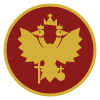
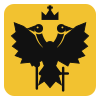
Crowned double headed eagle
Δικέφαλος αετός
VIIISub-branches
- Finnish Orthodox Church (autonomous)
- Estonian Apostolic Orthodox Church (autonomous)
- Greek Orthodox Archdiocese of America
- Metropolis of Hong Kong and Southeast Asia
IXOther Branches of Orthodox Christianity
 Russian Orthodox ChurchРусская православная церковьThe largest autocephalous church, de facto independent from 1448 and a patriarchate from 1589, seated in Moscow.
 Romanian Orthodox ChurchBiserica Ortodoxă RomânăThe only Orthodox church worshipping in a Romance language.
 Church of GreeceΕκκλησία της ΕλλάδοςThe autocephalous church of Greece, seated in Athens.
 Serbian Orthodox ChurchСрпска православна цркваAutocephalous since 1219 under Saint Sava, seated in Belgrade.Ecumenical Patriarchate of ConstantinopleΟικουμενικό Πατριαρχείο ΚωνσταντινουπόλεωςOne of the five ancient sees, first in honour among Orthodox churches as first among equals, seated in Istanbul.
 Greek Orthodox Patriarchate of Antiochبطريركية أنطاكية وسائر المشرق للروم الأرثوذكسThe ancient see where disciples were first called Christians, based in Damascus since 1342.Uses the common symbol of the pathBulgarian Orthodox ChurchБългарска православна църкваA patriarchate since the 10th century, re-established as autocephalous in the 19th and 20th centuries, seated in Sofia.Uses the common symbol of the path
 Georgian Orthodox Churchსაქართველოს მართლმადიდებელი ეკლესიაOne of the oldest churches, its faith brought to the kingdom of Iberia by Saint Nino in the 4th century, with Georgian tradition dating autocephaly to the 5th century.
 Greek Orthodox Patriarchate of AlexandriaΠατριαρχείο Αλεξανδρείας και πάσης ΑφρικήςAn ancient see traditionally founded by Saint Mark, overseeing Orthodox communities across Africa.
 Oriental Orthodox ChurchesOriental OrthodoxyA second family also called Orthodox but outside the communion above.
XSources
The library cross-checks the sources below. Where they disagree, the page gives both.
?Quick Questions
Is the Patriarch of Constantinople the pope of the Orthodox?
No. He is first in honour, first among equals, but has no jurisdiction over the other autocephalous churches. In Orthodox teaching the highest authority belongs to councils of bishops.
Why is the see in Istanbul when it has so few faithful there?
The see dates from when Istanbul was Constantinople, the Byzantine capital. The city's Greek Orthodox community shrank sharply in the twentieth century, and the patriarchate's faithful now live mainly in Crete, the Dodecanese and the diaspora.
What do Constantinople and Moscow disagree about?
Ukraine, and the scope of Constantinople's authority. In 2019 Constantinople granted autocephaly to the Orthodox Church of Ukraine, which Moscow does not recognise, having already broken communion in 2018.