IOverview
The Georgian Orthodox Church, formally the Georgian Apostolic Autocephalous Orthodox Church, is the church of Georgia in the Caucasus. Its head holds the title Catholicos-Patriarch of All Georgia. Catholicos is an ancient title used in several Eastern churches for the head of a church beyond the old imperial sees. On 11 May 2026 Metropolitan Shio was elected Patriarch Shio III, following the death of Patriarch Ilia II on 18 March that year.
The church keeps the old Julian calendar, so Christmas falls on 7 January in the civil calendar. The liturgy is in Old Georgian, written in the Georgian people's own alphabet. Its best-known emblem is the grapevine cross, with arms that droop slightly at the ends, tied to the story of Saint Nino.
IIHistory
According to tradition, Nino was a woman from Cappadocia who came to the kingdom of Iberia, eastern Georgia, early in the fourth century. Her preaching and healings led Queen Nana and then King Mirian III to the faith. Sources date the king's conversion to around 334 and the official baptism to 337. Legend tells that she made a cross from two vine branches bound with her own hair. The Georgian church was first under Antioch and became autocephalous in the late fifth century, with sources giving dates from 467 to 488.
- around 334 to 337King Mirian III convertsChristianity becomes the religion of the kingdom of Iberia.
- late 5th centuryAutocephalyThe church leaves the jurisdiction of Antioch, its head taking the title Catholicos.
- 1811Autocephaly abolished by RussiaAfter Georgia's annexation by the Russian Empire the church becomes an exarchate of the Russian church.
- 25 March 1917Autocephaly restoredAfter the February Revolution in Russia the Georgian bishops declare the church independent again.
- 1943Recognised by MoscowThe Russian church recognises Georgian autocephaly.
- 1990Recognised by ConstantinopleConstantinople recognises its autocephaly and patriarchal title.
- 1977 to 2026Patriarch Ilia IINearly fifty years at the head of the church, through Soviet rule, independence and upheaval.
IIITradition and Distinctives
Its doctrine is the common faith of the Orthodox communion. What marks it out:
- Polyphonic chant. Singing in several voices is a Georgian musical tradition recognised by UNESCO as intangible heritage, and church chant is part of it.
- Mtskheta, the old capital, with the Svetitskhoveli Cathedral where, according to tradition, the robe of Christ is buried. The monuments of Mtskheta were inscribed by UNESCO in 1994.
- Language and script. Many of the oldest surviving Georgian texts are religious, so the church is bound up with the history of Georgian writing.
The church calls Georgia the lot of the Mother of God, after a tradition that when the apostles drew lots for their missions, Mary received Georgia. This is how the church speaks of itself, not a finding of historians.
IVWorship and Daily Life
The Divine Liturgy follows the Byzantine rite, sung in Georgian in the country's distinctive polyphony. On 14 October in the civil calendar, Svetitskhovloba is a great festival in Mtskheta, and Saint Nino is honoured on 27 January. From 2008 Patriarch Ilia II personally baptised the third and later children of families in mass ceremonies, an initiative linked to concern over the low birth rate, and Georgian media report that tens of thousands of children were baptised this way.
Georgian churches are often small stone buildings set on hilltops, such as the Jvari Monastery above Mtskheta, built around the year 600 where tradition says Nino raised her cross. Families visit them for baptisms, weddings and memorials, and many Georgians cross themselves when passing a church.
VStructure and Distribution
The patriarch governs together with the Holy Synod. According to Wikipedia the church has about 50 dioceses, including dioceses for Georgians in Western Europe, North America and Australia. In the 2014 census, 83.4 percent of Georgia's population identified as Orthodox. A Constitutional Agreement of 2002 between the state and the church recognises the church's special historical role, while the constitution maintains the separation of church and state. Many opinion polls rank the church among the most trusted institutions in the country.
The Russian church regards Abkhazia and South Ossetia as belonging to the Georgian church's territory, although both regions have been outside the Georgian government's control since 2008. In 2016 the Georgian church did not attend the Holy and Great Council in Crete, and it has not so far recognised the Orthodox Church of Ukraine. The 2026 patriarchal election took place amid public debate in Georgia over relations with Moscow, according to press coverage compiled by Wikipedia.
VIIn Vietnam
This library has found no source for an organised Georgian Orthodox parish or community in Vietnam. Georgians living in Vietnam can attend services at the parishes of the Russian church, since the two churches share communion and both keep the old Julian calendar.
VIISymbol of the Branch
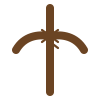
Saint Nino's grapevine cross
ჯვარი ვაზისა
VIIIOther Branches of Orthodox Christianity
 Russian Orthodox ChurchРусская православная церковьThe largest autocephalous church, de facto independent from 1448 and a patriarchate from 1589, seated in Moscow.
 Romanian Orthodox ChurchBiserica Ortodoxă RomânăThe only Orthodox church worshipping in a Romance language.
 Church of GreeceΕκκλησία της ΕλλάδοςThe autocephalous church of Greece, seated in Athens.
 Serbian Orthodox ChurchСрпска православна цркваAutocephalous since 1219 under Saint Sava, seated in Belgrade.
 Ecumenical Patriarchate of ConstantinopleΟικουμενικό Πατριαρχείο ΚωνσταντινουπόλεωςOne of the five ancient sees, first in honour among Orthodox churches as first among equals, seated in Istanbul.
 Greek Orthodox Patriarchate of Antiochبطريركية أنطاكية وسائر المشرق للروم الأرثوذكسThe ancient see where disciples were first called Christians, based in Damascus since 1342.Uses the common symbol of the pathBulgarian Orthodox ChurchБългарска православна църкваA patriarchate since the 10th century, re-established as autocephalous in the 19th and 20th centuries, seated in Sofia.Uses the common symbol of the pathGeorgian Orthodox Churchსაქართველოს მართლმადიდებელი ეკლესიაOne of the oldest churches, its faith brought to the kingdom of Iberia by Saint Nino in the 4th century, with Georgian tradition dating autocephaly to the 5th century.
 Greek Orthodox Patriarchate of AlexandriaΠατριαρχείο Αλεξανδρείας και πάσης ΑφρικήςAn ancient see traditionally founded by Saint Mark, overseeing Orthodox communities across Africa.
 Oriental Orthodox ChurchesOriental OrthodoxyA second family also called Orthodox but outside the communion above.
IXSources
The library cross-checks the sources below. Where they disagree, the page gives both.
?Quick Questions
Who was Saint Nino?
According to Georgian tradition, Nino was a woman from Cappadocia who came to the kingdom of Iberia early in the fourth century, preached, and brought King Mirian III to Christianity. Georgians honour her as equal to the apostles and enlightener of Georgia.
Who is the current Patriarch of Georgia?
Since 11 May 2026 it has been Patriarch Shio III. He succeeded Patriarch Ilia II, who led the church from 1977 and died on 18 March 2026.
How many Georgians are Orthodox?
In the 2014 census, 83.4 percent of Georgia's population identified as Orthodox, about 3.1 million people.