IOverview
The Church of Greece is the autocephalous Orthodox church of the Greek state, seated in Athens. Its head is the Archbishop of Athens and All Greece, since 2008 Archbishop Ieronymos II.
It should not be confused with the phrase Greek Orthodox, which is often used loosely for the whole Orthodox world. The Church of Greece is only one of several Greek-speaking churches, alongside the patriarchates of Constantinople, Alexandria and Jerusalem and the Church of Cyprus. Its liturgy is in Koine Greek, the language of the New Testament, and it follows the Revised Julian calendar for fixed feasts.
IIHistory
Under Ottoman rule the dioceses of Greece belonged to the Patriarchate of Constantinople. When Greece won independence in the war that began in 1821, the new government did not want the church of the kingdom governed from a see inside the Ottoman Empire. On 25 July 1833 King Otto ratified a declaration of the church's independence and set up a permanent Holy Synod. Constantinople regarded this as unilateral, and communion between the two was strained until the tomos of 1850.
- 25 July 1833Autocephaly declaredKing Otto ratifies the declaration of the church's independence.
- 29 June 1850Tomos of recognitionConstantinople formally recognises the Church of Greece as autocephalous.
- 1924Calendar changeThe church adopts the Revised Julian calendar for fixed feasts. Some faithful refuse, later forming Old Calendarist groups.
- 1928The New Lands arrangementDioceses in northern Greece and the northeast Aegean stay nominally under Constantinople but are administered by the Church of Greece.
- 2008Archbishop Ieronymos IIElected head of the church.
IIITradition and Distinctives
Its doctrine is the common faith of the Orthodox communion. What marks the Church of Greece out lies in three areas.
- Language. Scripture, the Greek Fathers and the service books are read in their original tongue, although Koine is far from everyday modern Greek.
- Calendar. The Revised Julian calendar puts Christmas on 25 December, while Easter is still reckoned by the Julian calendar.
- Legal standing. The Greek constitution opens in the name of the Holy Trinity, and its Article 3 names Orthodoxy the prevailing religion of the country.
The church presents itself as guardian of the heritage of the Greek Fathers and of Byzantium, and regards Orthodox faith as a pillar that preserved Greek identity through almost four centuries of Ottoman rule.
A common misunderstanding is that every Orthodox Christian is Greek Orthodox. The word Greek in the old name refers to the original liturgical language. The Church of Greece is one autocephalous church among others, with no authority over them.
IVWorship and Daily Life
The Divine Liturgy is celebrated every Sunday and feast day. Greeks celebrate name days, the feast of the saint whose name they bear, often more than birthdays. Holy Week and Pascha are the high point of the year: on the evening of Good Friday the Epitaphios is carried through the streets, and on Easter night whole towns stand with candles waiting for the proclamation Christos anesti.
The Dormition of the Mother of God on 15 August is a major pilgrimage day, most famously on the island of Tinos. The Meteora monasteries, perched on rock pillars in central Greece, belong to the Church of Greece and were inscribed by UNESCO in 1988. Mount Athos, though on Greek soil, falls under the Patriarchate of Constantinople.
VStructure and Distribution
The church is governed by a Holy Synod of bishops chaired by the Archbishop of Athens. According to Wikipedia it has 81 dioceses: 45 directly under the Church of Greece in the south and 36 in the New Lands of the north. Clergy are paid from the state budget at rates matching teachers' salaries. Crete has a semi-autonomous church under Constantinople, and the Dodecanese islands come directly under Constantinople.
In October 2019 the Holy Synod of the Church of Greece decided to recognise the Orthodox Church of Ukraine, which had received autocephaly from Constantinople, and on 21 October Archbishop Ieronymos sent a letter of recognition. On 3 November 2019 Patriarch Kirill of Moscow stopped commemorating Archbishop Ieronymos in the liturgy. The Church of Greece was the first autocephalous church after Constantinople to take this step, and Moscow regards the decision as uncanonical. This library records the events without taking sides.
VIIn Vietnam
This library has found no source for a parish of the Church of Greece in Vietnam. Under the Orthodox division of territory, Greek-speaking communities in Asia fall under the Patriarchate of Constantinople rather than the Church of Greece, and Vietnam lies nominally within that patriarchate's Metropolis of Hong Kong and Southeast Asia. No organised activity has been recorded. Greek Orthodox believers living in Vietnam can attend services at the parishes of the Russian church. The same holds for Greek sailors, engineers and business people who pass through Vietnamese ports and cities for shorter stays.
VIISymbol of the Branch
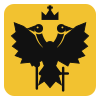
Double headed eagle flag
Σημαία της Εκκλησίας
VIIIOther Branches of Orthodox Christianity
 Russian Orthodox ChurchРусская православная церковьThe largest autocephalous church, de facto independent from 1448 and a patriarchate from 1589, seated in Moscow.
 Romanian Orthodox ChurchBiserica Ortodoxă RomânăThe only Orthodox church worshipping in a Romance language.Church of GreeceΕκκλησία της ΕλλάδοςThe autocephalous church of Greece, seated in Athens.
 Serbian Orthodox ChurchСрпска православна цркваAutocephalous since 1219 under Saint Sava, seated in Belgrade.
 Ecumenical Patriarchate of ConstantinopleΟικουμενικό Πατριαρχείο ΚωνσταντινουπόλεωςOne of the five ancient sees, first in honour among Orthodox churches as first among equals, seated in Istanbul.
 Greek Orthodox Patriarchate of Antiochبطريركية أنطاكية وسائر المشرق للروم الأرثوذكسThe ancient see where disciples were first called Christians, based in Damascus since 1342.Uses the common symbol of the pathBulgarian Orthodox ChurchБългарска православна църкваA patriarchate since the 10th century, re-established as autocephalous in the 19th and 20th centuries, seated in Sofia.Uses the common symbol of the path
 Georgian Orthodox Churchსაქართველოს მართლმადიდებელი ეკლესიაOne of the oldest churches, its faith brought to the kingdom of Iberia by Saint Nino in the 4th century, with Georgian tradition dating autocephaly to the 5th century.
 Greek Orthodox Patriarchate of AlexandriaΠατριαρχείο Αλεξανδρείας και πάσης ΑφρικήςAn ancient see traditionally founded by Saint Mark, overseeing Orthodox communities across Africa.
 Oriental Orthodox ChurchesOriental OrthodoxyA second family also called Orthodox but outside the communion above.
IXSources
The library cross-checks the sources below. Where they disagree, the page gives both.
- Wikipedia, Church of Greece
- Pew Research Center, Orthodox Christianity in the 21st Century (2017)
- Wikipedia, Eastern Orthodoxy by country
- UNESCO, Meteora
- Wikipedia, Greek Old Calendarists
- Wikipedia, 2018 Moscow Constantinople schism
- RFE/RL, In A First, Greek Church Recognizes Orthodox Church Of Ukraine (2019)
?Quick Questions
Is Greek Orthodox the same as the Church of Greece?
Not quite. Greek Orthodox is an old name for the Orthodox world as a whole, or for the Greek-speaking churches. The Church of Greece is the specific autocephalous church of the Greek state, seated in Athens.
How many Greeks are Orthodox?
About 90 percent of Greeks identify as Orthodox, according to Pew Research in 2017. Greece does not ask about religion in its census, so there is no official census figure.
Does Mount Athos belong to the Church of Greece?
No. Mount Athos is on Greek territory but falls under the Ecumenical Patriarchate of Constantinople in church matters, with its own self-governing status.
When do Greeks celebrate Christmas?
On 25 December in the civil calendar, the same day as the West, because the Church of Greece has used the Revised Julian calendar since 1924. Easter is still calculated by the Julian calendar.