IOverview
The Russian Orthodox Church is one of the fourteen autocephalous churches usually listed in the Orthodox communion, and by far the largest. It is seated in Moscow, and its head holds the title Patriarch of Moscow and All Rus. Patriarch Kirill has held the office since 1 February 2009.
The church follows the old Julian calendar, which is why it celebrates Christmas on 7 January in the civil calendar. Its services are in Church Slavonic, an old liturgical language related to Russian but not the same. Beyond Russia it cares for the faithful in Belarus, Central Asia, the Baltic states and a wide diaspora.
IIHistory
The church traces its origin to the baptism of Kievan Rus in 988 under Grand Prince Vladimir. For centuries the Church of Rus was a metropolitan province of Constantinople, led by the Metropolitan of Kiev. After the Mongol invasions the metropolitan see moved north, first to Vladimir and then to Moscow.
In 1448 the Russian bishops elected Metropolitan Jonah without waiting for Constantinople's approval, which marks de facto autocephaly. In 1589, with the consent of Patriarch Jeremias II of Constantinople, Moscow gained its own patriarch.
- 1721Holy Synod replaces the patriarchPeter I abolishes the patriarchate and places the church under a state-supervised synod.
- 1917 to 1918Patriarchate restoredA local council elects Saint Tikhon patriarch in the first months of Soviet rule.
- 17 May 2007Reunion with the Church Outside of RussiaROCOR and Moscow sign the Act of Canonical Communion.
The Soviet period was the hardest in the church's history. After 1917 most churches and monasteries were closed or seized, and a great many bishops, priests and lay people were killed or sent to camps. In 2000 a bishops' council canonised a large group the church calls the New Martyrs and Confessors of Russia. In 1927 Metropolitan Sergius issued a declaration of loyalty to the Soviet state, a text that historians and Orthodox writers still judge in very different ways.
IIITradition and Distinctives
In doctrine the church shares the faith of the other Orthodox churches: the seven ecumenical councils, the Creed without the Filioque, the sacraments and the veneration of icons. What sets it apart is its lived tradition.
- The old Julian calendar. Christmas falls on 7 January and Theophany on 19 January in the civil calendar.
- Church Slavonic in worship, though many diaspora parishes also use local languages.
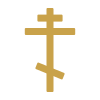
- The eight-pointed cross, with three bars and a slanted footrest, raised above onion domes.
The church sees itself as the direct heir of Kievan Rus and speaks of a Russian world, a shared cultural and spiritual space of the peoples baptised from Kiev. The church presents the idea as a civilisational community. Many Orthodox theologians elsewhere have criticised it, particularly since 2022.
IVWorship and Daily Life
The centre of church life is the Divine Liturgy of Saint John Chrysostom. Worshippers usually stand throughout, and most churches have few seats. Choirs sing without instruments, and Russian choral writing is regarded as one of the high points of sacred music. Women commonly cover their heads in church. Four fasting seasons are kept each year, the strictest being Great Lent before Easter.
Pascha is the feast of feasts. The night vigil ends with the greeting Христос воскресе, Christ is risen, and the reply Воистину воскресе, truly He is risen. Monastic life centres on great houses such as the Trinity Lavra of Saint Sergius at Sergiev Posad and the Pskov Caves Monastery.
VStructure and Distribution
The patriarch governs together with the Holy Synod, while supreme authority belongs to the bishops' council and the local council. Figures published by the church in 2019, as compiled by Wikipedia, list 314 dioceses, 382 bishops, 38,649 parishes and 972 monasteries. The church includes self-governing churches in Belarus, Latvia, Moldova and Estonia, and autonomous churches in Japan and China. The Russian Orthodox Church Outside of Russia, formed after the 1917 revolution, reunited with Moscow in 2007 and keeps broad self-government.
On Ukraine, press sources record the following events. On 15 October 2018 the Moscow Holy Synod broke eucharistic communion with Constantinople after Constantinople moved toward granting autocephaly to a church in Ukraine. On 6 January 2019 Constantinople handed a tomos of autocephaly to the Orthodox Church of Ukraine, which Moscow does not recognise. On 27 May 2022 a council of the Ukrainian Orthodox Church, previously under Moscow, declared its full independence, and many of its parishes stopped commemorating the Moscow patriarch. On 24 August 2024 Ukraine's president signed a law banning religious organisations linked to the Russian church. Human Rights Watch raised concerns about the law's effect on religious freedom. Each side makes its own canonical case, and this library records the events without taking a position.
VIIn Vietnam
Every organised Orthodox parish in Vietnam belongs to the Russian church, through the Diocese of the Philippines and Vietnam in the Patriarchal Exarchate of Southeast Asia, created on 28 December 2018.
| Place | Parish | Milestones |
|---|---|---|
| Vung Tau, now part of Ho Chi Minh City | Kazan Icon of the Mother of God | Opened 17 July 2002, house church consecrated 27 February 2024 |
| Hanoi | Saint Xenia of Petersburg | Formally taken under the diocese in 2019 |
| Ho Chi Minh City | Protection of the Mother of God | Formally taken under the diocese in 2019 |
| Nha Trang, Khanh Hoa province | Saint Nicholas | Founded 2024 |
Orthodox Christianity is not among the 16 religions recognised by the Vietnamese state. This library has found no public document granting legal status to any Orthodox parish, and no Vietnamese authority has published a count of believers.
VIISymbol of the Branch
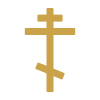
Three bar cross
Восьмиконечный крест
VIIISub-branches
- Russian Orthodox Church Outside of Russia (self-governing, reunited in 2007)
- Japanese Orthodox Church (autonomous)
- Chinese Orthodox Church (autonomous)
IXOther Branches of Orthodox Christianity
Russian Orthodox ChurchРусская православная церковьThe largest autocephalous church, de facto independent from 1448 and a patriarchate from 1589, seated in Moscow. Romanian Orthodox ChurchBiserica Ortodoxă RomânăThe only Orthodox church worshipping in a Romance language.
 Church of GreeceΕκκλησία της ΕλλάδοςThe autocephalous church of Greece, seated in Athens.
 Serbian Orthodox ChurchСрпска православна цркваAutocephalous since 1219 under Saint Sava, seated in Belgrade.
 Ecumenical Patriarchate of ConstantinopleΟικουμενικό Πατριαρχείο ΚωνσταντινουπόλεωςOne of the five ancient sees, first in honour among Orthodox churches as first among equals, seated in Istanbul.
 Greek Orthodox Patriarchate of Antiochبطريركية أنطاكية وسائر المشرق للروم الأرثوذكسThe ancient see where disciples were first called Christians, based in Damascus since 1342.Uses the common symbol of the pathBulgarian Orthodox ChurchБългарска православна църкваA patriarchate since the 10th century, re-established as autocephalous in the 19th and 20th centuries, seated in Sofia.Uses the common symbol of the path
 Georgian Orthodox Churchსაქართველოს მართლმადიდებელი ეკლესიაOne of the oldest churches, its faith brought to the kingdom of Iberia by Saint Nino in the 4th century, with Georgian tradition dating autocephaly to the 5th century.
 Greek Orthodox Patriarchate of AlexandriaΠατριαρχείο Αλεξανδρείας και πάσης ΑφρικήςAn ancient see traditionally founded by Saint Mark, overseeing Orthodox communities across Africa.
 Oriental Orthodox ChurchesOriental OrthodoxyA second family also called Orthodox but outside the communion above.
XSources
The library cross-checks the sources below. Where they disagree, the page gives both.
- Wikipedia, Russian Orthodox Church
- Wikipedia, Eastern Orthodoxy in Vietnam
- Wikipedia, Russian Orthodox Church Outside of Russia
- Tòa Thượng phụ Moskva, patriarchia.ru
- Pew Research Center, Orthodox Christianity in the 21st Century (2017)
- RFE/RL, Zelenskiy Signs Law Banning Russian Orthodox Church In Ukraine (2024)
- Human Rights Watch, Ukraine: New Law Raises Religious Freedom Concerns (2024)
- CNEWA, The Orthodox Church of Russia
?Quick Questions
Why do Russians celebrate Christmas on 7 January?
The Russian church still keeps 25 December, but by the old Julian calendar. Between 1900 and 2100 the Julian calendar runs 13 days behind the civil calendar, so the feast falls on 7 January.
How many members does the Russian Orthodox Church have?
According to Pew Research in 2017, over 100 million people in Russia identify as Orthodox. That counts self-identification, not regular churchgoing, and the church also serves believers in many other countries.
Is there a Russian Orthodox church in Vietnam?
Yes. According to the diocese there are four parishes, in Vung Tau, Hanoi, Ho Chi Minh City and Nha Trang. The Vung Tau parish opened in 2002 and consecrated a house church in 2024.
What is the dispute between Moscow and Constantinople?
It concerns the church in Ukraine. In 2018 Moscow broke communion with Constantinople, and in 2019 Constantinople granted autocephaly to the Orthodox Church of Ukraine, which Moscow does not recognise.