IOverview
The Romanian Orthodox Church is the second largest Orthodox church after the Russian church by number of adherents. It is seated in Bucharest and has been led by Patriarch Daniel since his election on 12 September 2007.
Its most visible distinctive is language. It is the only autocephalous Orthodox church that worships in a Romance language. It follows the Revised Julian calendar for fixed feasts, so Christmas falls on 25 December as in the West, while Easter is still reckoned by the Julian calendar, as in most Orthodox churches.
IIHistory
Christianity reached the lands of Dacia in Roman times, and Romanian tradition holds that the Apostle Andrew preached in Dobruja. Through the Middle Ages the metropolitan sees of Wallachia and Moldavia were under Constantinople, and worship was in Church Slavonic. Romanian entered the liturgy gradually between the sixteenth and eighteenth centuries.
After Wallachia and Moldavia united in 1859, Prince Alexandru Ioan Cuza passed a law in 1865 declaring the church fully independent of Constantinople. Recognition from Constantinople came twenty years later.
- 1865Independence declaredLegislation under Cuza declares the church of the united principalities independent of Constantinople.
- 25 April 1885Autocephaly recognisedThe Ecumenical Patriarchate issues a tomos recognising an autocephalous metropolis.
- 4 February 1925Patriarchate establishedMiron Cristea becomes the first patriarch, and later serves as prime minister in 1938 and 1939.
- 1948Greek Catholic Church suppressedThe communist government outlaws the Romanian Greek Catholic Church and transfers around 2,500 of its churches to the Orthodox Church.
- 12 September 2007Patriarch Daniel electedThe sixth patriarch of Romania.
- 2018People's Salvation Cathedral consecratedA vast new cathedral in central Bucharest, consecrated for the centenary of Romanian unification.
Under communism the church was both controlled and used. According to figures compiled by Wikipedia, between 300 and 500 Orthodox priests were held in camps by January 1953. Between 1958 and 1962 more than half of the remaining monasteries were closed and over 2,000 monks were forced back into lay life. The 1948 transfer of Greek Catholic property remains a point of dispute between the two churches today.
IIITradition and Distinctives
In doctrine the church shares the faith of the Orthodox communion: the seven ecumenical councils, the Creed without the Filioque, the seven mysteries and the veneration of icons. What marks it out:
- Romanian in every service, so the church is Byzantine in rite yet close to the Latin world in speech.
- The Revised Julian calendar for fixed feasts, adopted in the 1920s.
- The painted monasteries of Bukovina, fifteenth and sixteenth century churches with frescoed outer walls, listed as UNESCO World Heritage in 1993.
- Pilgrimage on a large scale, such as the feast of Saint Parascheva in Iaşi each October.
The church presents itself as the only Orthodox church of a Latin-speaking people, and treats Orthodox faith as part of Romanian identity from the very beginning.
IVWorship and Daily Life
The Divine Liturgy of the Byzantine rite is celebrated every Sunday. Romanians keep several fasting seasons through the year. Memorial services for the dead, with offerings of bread and coliva, a dish of boiled wheat, are a familiar part of parish life. Monastic life is strong: Wikipedia reports close to 400 monasteries in Romania with about 3,500 monks and 5,000 nuns, without giving the year of the figures.
The church runs its own television and radio network, Trinitas, and religious education is taught in state schools as a subject families may choose.
VStructure and Distribution
Supreme authority rests with the Holy Synod of all bishops. According to Wikipedia the church has ten metropolises, twenty archdioceses and twenty-three dioceses, including dioceses abroad in Europe, the Americas, Asia and Oceania. In the 2021 census, 14,025,064 people in Romania identified as Orthodox, or 73.42 percent of the population. Migration since the 2000s has led the dioceses in Italy, Spain and Germany to open many new parishes, which often worship in churches lent by the local Catholic diocese. For these communities the parish is also a place to keep the Romanian language and customs alive for children born abroad.
Moldova has two Orthodox bodies. The Metropolis of Chişinău and All Moldova, under Moscow, has more parishes. The Metropolis of Bessarabia, under Bucharest and revived in 1992, is the smaller of the two. In 2001 the European Court of Human Rights ruled that Moldova's refusal to register the Metropolis of Bessarabia breached religious freedom. Disputes over parishes and property between the two continue.
VIIn Vietnam
This library has found no source for an organised Romanian Orthodox parish or community in Vietnam. The Romanian church has dioceses serving Romanians in Asia, but no activity in Vietnam has been publicly recorded. Romanians living in Vietnam can take part in services at the parishes of the Russian church, since all these churches share one communion.
VIISymbol of the Branch
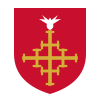
Emblem of the Romanian Patriarchate
Stema Patriarhiei Române
VIIISub-branches
- Metropolis of Bessarabia (Moldova)
IXOther Branches of Orthodox Christianity
 Russian Orthodox ChurchРусская православная церковьThe largest autocephalous church, de facto independent from 1448 and a patriarchate from 1589, seated in Moscow.Romanian Orthodox ChurchBiserica Ortodoxă RomânăThe only Orthodox church worshipping in a Romance language.
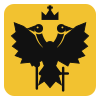 Church of GreeceΕκκλησία της ΕλλάδοςThe autocephalous church of Greece, seated in Athens.
 Serbian Orthodox ChurchСрпска православна цркваAutocephalous since 1219 under Saint Sava, seated in Belgrade.
 Ecumenical Patriarchate of ConstantinopleΟικουμενικό Πατριαρχείο ΚωνσταντινουπόλεωςOne of the five ancient sees, first in honour among Orthodox churches as first among equals, seated in Istanbul.
 Greek Orthodox Patriarchate of Antiochبطريركية أنطاكية وسائر المشرق للروم الأرثوذكسThe ancient see where disciples were first called Christians, based in Damascus since 1342.Uses the common symbol of the pathBulgarian Orthodox ChurchБългарска православна църкваA patriarchate since the 10th century, re-established as autocephalous in the 19th and 20th centuries, seated in Sofia.Uses the common symbol of the path
 Georgian Orthodox Churchსაქართველოს მართლმადიდებელი ეკლესიაOne of the oldest churches, its faith brought to the kingdom of Iberia by Saint Nino in the 4th century, with Georgian tradition dating autocephaly to the 5th century.
 Greek Orthodox Patriarchate of AlexandriaΠατριαρχείο Αλεξανδρείας και πάσης ΑφρικήςAn ancient see traditionally founded by Saint Mark, overseeing Orthodox communities across Africa.
 Oriental Orthodox ChurchesOriental OrthodoxyA second family also called Orthodox but outside the communion above.
XSources
The library cross-checks the sources below. Where they disagree, the page gives both.
?Quick Questions
How does the Romanian Orthodox Church differ from the Russian church?
Doctrine is the same. The differences are the liturgical language, Romanian rather than Church Slavonic, and the calendar: Romanians celebrate Christmas on 25 December, Russians on 7 January.
How many Romanians are Orthodox?
In the 2021 census, 14,025,064 people identified as Orthodox, 73.42 percent of Romania's population. The 2011 figure was 86.5 percent, but many more people left the religion question blank in the later census, so the two numbers are not directly comparable.
When did the Romanian church become a patriarchate?
On 4 February 1925, with Miron Cristea as its first patriarch. Constantinople had recognised it as autocephalous in 1885.