
Ancestor veneration does not worship a deity with a visible form. This page answers a different question: on the altar, what stands in for the grandparents and forebears who have passed away, and what is set out around it. The oldest answer is a name written on wood, called a thần chủ or bài vị (ancestral tablet). The memorial portrait came later. The library uses photos of real altars and altar objects: colour photographs taken in Hanoi and Hà Đông in 1914 and 1915, museum objects, clan halls and old houses. The library does not use photos of families' memorial portraits. The only drawing on the page is a diagram.
IWhat stands for the ancestors on the altar
The Vietnamese ancestral altar has no statue of a deity. What occupies the most honoured place is the name of the departed, written on a wooden tablet called a thần chủ or bài vị and set inside a shrine cabinet or on a small throne. The photographic portrait, usually called a di ảnh (memorial portrait), came later. Phan Kế Bính, in a book printed in 1915, describes the tablets and altar objects in great detail without mentioning photographs.
Source: Phan Kế Bính, Việt Nam phong tục (Vietnamese Customs, 1915), part I, chapter IV Phụng sự tổ tôn (Serving the ancestors), Wikisource edition. Wikipedia (Vietnamese), Nhà thờ họ (Clan hall). Wikipedia (Vietnamese), Tín ngưỡng thờ cúng tổ tiên (Ancestor veneration).
.jpg)

Thần chủ
also called bài vị or linh vịHow to recognize: An upright wooden tablet bearing the name and titles in the middle, usually kept in a box or inside a shrine cabinetAccording to Phan Kế Bính, the thần chủ is made of jujube wood, chosen because jujube wood is said to last a thousand years. The tablet is about one thước (a traditional Vietnamese foot) long. The middle bears the person's name and titles. The two sides bear the dates of birth and death. The tablet sits in a square box that covers it completely, kept inside the shrine cabinet, and is opened only for offerings and rites. Wealthy families keep tablets for four generations: cao, tằng, tổ, khảo, that is, great-great-grandfather, great-grandfather, grandfather and father.
Ngũ đại mai thần chủ
How to recognize: Tablets are kept for four generations only. When a fifth generation comes, the tablet of the most distant generation is buriedPhan Kế Bính records that once there are five generations, the tablet of the great-great-grandfather is "mai", that is, buried, and the tablets of the great-grandfather, grandfather and father each move up one place, while the newly deceased takes the father's place. This custom is called ngũ đại mai thần chủ, burying the tablet at the fifth generation. Only the hall of the clan's founding ancestor keeps one tablet forever, never replaced, called bách thế bất diêu chi chủ, the tablet not removed for a hundred generations.
Source: Phan Kế Bính, Việt Nam phong tục (Vietnamese Customs, 1915), part I, chapter IV Phụng sự tổ tôn (Serving the ancestors), Wikisource edition.The ancestral throne and the ỷ seat
a throne with dragon-carved arms is also called long ngaiHow to recognize: A small chair in red lacquer and gilt set at the innermost level, left empty or holding the tabletPhan Kế Bính writes that among ordinary families some used tablets and some used only an ỷ, a small altar seat, for worship. Vietnamese Wikipedia, in its article on the clan hall, describes an altar platform holding a spirit seat (linh tọa) or a throne (ngai), whose arms are carved with dragons, hence the name long ngai, dragon throne. The throne holds the ancestral tablets, or a scroll case or a red-lacquered and gilded box containing the genealogy, covered with red silk. The throne in the photo is a museum object, and the library does not know whom it once served.
The Cửu Huyền Thất Tổ tablet
九玄七祖How to recognize: A tablet or a reverse glass painting inscribed with four characters, honouring all generations of ancestors togetherVietnamese Wikipedia records that on the ancestral altars of many Vietnamese families there is a central tablet inscribed with the four words Cửu Huyền Thất Tổ, in Chinese characters or in the Vietnamese alphabet, and that when praying, the person leading the rite addresses Cửu Huyền Thất Tổ in order to reach all the ancestors. The same source notes that the phrases Cửu Huyền and Thất Tổ both appear in classical Chinese texts, while the full phrase is not used in Chinese culture today. In southern Vietnam these four words often appear on a reverse glass painting hung behind the altar.
Source: Wikipedia (Vietnamese), Cửu Huyền Thất Tổ. Tuổi Trẻ newspaper, Tranh kính dân gian dựng bàn thờ gia tiên (Folk glass paintings and the family altar, 21/07/2023).Portraits: from painted icons to memorial photographs
Before the camera, some families and temples had hand-painted portraits. The National Museum of Vietnamese History states that its portrait of Nguyễn Trãi is a reproduction of the devotional painting kept at the Nguyễn Trãi temple in the village of Nhị Khê. The Vietnam National Museum of Fine Arts displays a portrait of an elderly woman from Thái Bình, its label dated 1804.
Source: National Museum of Vietnamese History, Tranh thờ, một nét di sản văn hóa trong mỹ thuật cổ của người Việt (Devotional paintings in old Vietnamese art, 27/08/2015).

Today memorial portraits are very common on altars. Vietnamese Wikipedia writes that the great majority of families have an ancestral altar at home, at the very least a memorial portrait hung with care, and that the altar holds a tablet or a picture of the departed. An article in Tuổi Trẻ newspaper describing the altars of Saigon families also lists a tablet or a photograph. Huế still has the craft of truyền thần, black and white portraits drawn by hand from a photograph to be placed on the altar, and an article from 2011 reports that the craft is dying out.
Source: Wikipedia (Vietnamese), Tín ngưỡng thờ cúng tổ tiên (Ancestor veneration). Tuổi Trẻ newspaper, Bàn thờ tổ tiên ngày tết của người Sài Gòn ra sao (The Tết ancestral altar of Saigon families, 26/01/2017). Worldcrunch (translated from Süddeutsche Zeitung), In Vietnam, souls captured on paper (06/10/2011). Wikipedia (Vietnamese), Truyền thần (Hand-drawn memorial portraits).The library has not found any study that states when photographs first appeared on Vietnamese altars. What can be said with confidence is this: photography reached Vietnam in the 19th century, and studios opened in Hanoi and Saigon. English Wikipedia, in its article Photography in Vietnam, writes that the need for family portraits for use in ancestor worship was one reason photography spread. Phan Kế Bính's book of 1915 does not yet include photographs among the altar objects. This page therefore says only that the memorial portrait is a custom of the 20th century onward and gives no specific year.
Source: Wikipedia, Photography in Vietnam. Phan Kế Bính, Việt Nam phong tục (Vietnamese Customs, 1915), part I, chapter IV Phụng sự tổ tôn (Serving the ancestors), Wikisource edition.The library does not use photos of families' memorial portraits. The two portraits above show a historical figure and a museum object.
IIObjects on the altar
Phan Kế Bính lists the altar objects that every household has: a set of lamps and candles, an incense burner, a flower vase, offering trays (mâm quỳ, mâm bồng), wine stands, a betel box and a water stand. Some use bronze or pewter, others red-lacquered and gilded wood. He adds that however poor a family is, it has at least a couple of red-lacquered candlesticks and an incense bowl, and that altar objects are something nobody dares to pawn or sell.
Source: Phan Kế Bính, Việt Nam phong tục (Vietnamese Customs, 1915), part I, chapter IV Phụng sự tổ tôn (Serving the ancestors), Wikisource edition.Tam sự and ngũ sự
How to recognize: Tam sự: a censer or incense burner in the middle with a candlestick on each side. Ngũ sự: two more pieces addedVietnamese Wikipedia defines the tam sự, the three-piece altar set, as one censer or incense burner and two candlesticks, usually of bronze. The ngũ sự, the five-piece set, is the tam sự plus two more pieces, which the source lists as flower vases, an aloeswood burner, oil lamp dishes or a pair of cranes, depending on the family. The censer is for burning aloeswood, the lamps give light. The same source notes that at Tết (the Lunar New Year) many families take the bronze set to be polished to welcome the ancestors home. Léon Busy's photo of 1915 shows a pair of bronze cranes standing on either side of the incense burner.

.JPG)

The incense bowl
How to recognize: A round bowl of porcelain or bronze, filled with ash or sand to hold incense sticksThe incense bowl (bát hương) is where the incense sticks are placed at each offering. Phan Kế Bính calls it the bình hương and counts it among the things even the poorest family has. The number of incense bowls on an altar differs from family to family and from region to region. An article on Vietcetera, drawing on a book by Toan Ánh, gives three or five. The library has not read the book itself, so it gives no number as a rule.

Horizontal board and parallel couplets
Phan Kế Bính calls them hoành biển and đối liễnHow to recognize: A horizontal board hung high, bearing three or four large characters. Two couplet panels hang vertically on either sideAccording to Phan Kế Bính, wealthy families hang a horizontal board carved with three or four large characters, with a pair of couplets on either side of the altar, inlaid with mother of pearl or lacquered and gilded. Families without them paste up a board and couplets made of paper. The words praise the merit and virtue of the ancestors. The board in the photo taken in Hanoi in 1914 or 1915 bears four Chinese characters, which the library reads from the photo as Thuận đức giả xương (順德者昌), "those who follow virtue prosper".
The tray of five fruits
How to recognize: A tray of about five kinds of fruit, set on the altar at TếtThe mâm ngũ quả is a tray holding about five different kinds of fruit, set on the ancestral altar at Tết Nguyên Đán, the Lunar New Year. The names of the fruits, their colours and their arrangement express what the family hopes for in the new year. Each region chooses its fruits differently, as the table in the section on north, centre and south below shows. On ordinary days the offerings can be very simple. Phan Kế Bính writes that there must always be a betel tray, a bowl of clear water and a flask of rice wine for the offering to be complete.

Two stalks of sugarcane at Tết
How to recognize: Two stalks of sugarcane stood beside the altar at TếtPhan Kế Bính records that at Tết some families stand two stalks of sugarcane beside the altar as walking sticks for ông vải, that is, the ancestors.
Source: Phan Kế Bính, Việt Nam phong tục (Vietnamese Customs, 1915), part I, chapter XII Tứ thời tiết lạp (Festivals of the four seasons), Wikisource edition.
_de_la_province,_%C3%A0_l'%C3%A9poque_de_la_f%C3%AAte_du_T%C3%AAt_-_A5564.jpg)
IIIHow a family altar is arranged
The ancestral altar stands in the highest, cleanest and most dignified place in the house: the central bay in a single-storey house, the top floor in a house of several storeys. There is no single pattern for the whole country. The diagram below brings together the points that Phan Kế Bính's book and the photographs taken in Hanoi and Hà Đông in 1914 and 1915 have in common.
Source: Wikipedia (Vietnamese), Tín ngưỡng thờ cúng tổ tiên (Ancestor veneration). Phan Kế Bính, Việt Nam phong tục (Vietnamese Customs, 1915), part I, chapter IV Phụng sự tổ tôn (Serving the ancestors), Wikisource edition. Albert-Kahn Museum, Archives of the Planet: original caption of photo A5239 by Léon Busy, transcribed on Wikimedia Commons.The diagram is only a visual aid. In the past an ordinary family sometimes had just an ỷ seat, a few candlesticks and an incense bowl.


Wealthy families of the past had a gia từ, a private family shrine. The central altar honoured the four generations of cao, tằng, tổ and khảo. The two side altars honoured the Earth God (Thổ công), the Kitchen God (Táo quân) and the patron of the family's trade (Nghệ sư), and some families also honoured Bà Cô and Ông Mãnh, relatives who died young and unmarried. Ordinary families without a separate shrine worshipped in the house where they lived. Phan Kế Bính writes that however poor a family is, it has an altar.
Source: Phan Kế Bính, Việt Nam phong tục (Vietnamese Customs, 1915), part I, chapter IV Phụng sự tổ tôn (Serving the ancestors), Wikisource edition.An article on Vietcetera says that the ancestral portraits are placed according to the rule nam tả nữ hữu, men on the left and women on the right. An article in Tuổi Trẻ newspaper records the Saigon rule of đông bình tây quả, "vase to the east, fruit to the west": the flower vase on the left and the fruit tray on the right, as seen from inside the house looking out towards the door. Since few sources say clearly which way they are counting, this page gives left and right only where the source says so.
Source: Vietcetera, 4 bàn thờ phổ biến trong nhà người Việt (Four common altars in Vietnamese homes, drawing on a book by Toan Ánh). Tuổi Trẻ newspaper, Bí ẩn bàn thờ tổ tiên ngày tết của người Sài Gòn (The secrets of the Tết ancestral altar in Saigon).IVFrom the home altar to the clan hall
According to Phan Kế Bính, the descendants of one lineage build a shared hall for the founding ancestor, called the từ đường (ancestral hall) of that clan. This hall honours only the founding ancestor, and when rites are held the ancestors of each branch are honoured alongside him. Each branch also has its own hall, called the bản chi từ đường, the branch ancestral hall. A clan without a hall builds an open-air altar platform and sets up a stone stele with the names of its ancestors, and goes there to hold the rites.
Source: Phan Kế Bính, Việt Nam phong tục (Vietnamese Customs, 1915), part I, chapter IV Phụng sự tổ tôn (Serving the ancestors), Wikisource edition.What is inside a clan hall
How to recognize: An altar platform in the central bay, with a throne or shrine cabinet holding the founder's tablet, sometimes also the genealogyVietnamese Wikipedia describes the central bay of a clan hall as usually extended towards the back wall, in a form called chuôi vồ, to hold an altar platform. On the platform stands a spirit seat or a throne. The throne holds the ancestral tablets, or a red-lacquered and gilded box containing the genealogy. The founder's tablet is kept forever, never buried like the tablets in a family home. The hall of the senior line, which keeps the original genealogy, is called the nhà thờ đại tôn, the hall of the main lineage.


The genealogy
also called tộc phả, thế phả, phả kýHow to recognize: A book recording the generations, names, titles and dates of birth and death of the ancestorsPhan Kế Bính writes that every ancestral hall has a book recording the order of generations, the names, titles and dates of birth and death of the ancestors and of family members. Great families also record the deeds and careers of their ancestors and where they are buried, like a history book of the house. The genealogy is kept in the ancestral hall, and some clans print it and give a copy to each branch. In the past genealogies were written mainly in Chinese characters and in chữ Nôm, the old Vietnamese script. The Nguyễn tộc gia phả in the photo belongs to a clan in the village of Trung Tự, Hanoi, copied in 1932, with a preface written in 1843.

_02.png)
Ritual fields and the founder's anniversary
How to recognize: Fields held in common by the clan, whose harvest pays for the ritesA clan that has an ancestral hall also has ruộng kỵ, ritual fields: land handed down by the ancestors, bought together by the clan, or donated by a clan member. The harvest pays for the rites. Every year, on the death anniversary of the founding ancestor, the whole clan gathers at the hall to make offerings to him. At the Thanh Minh festival the clan goes together to tend the founder's grave. During the three days of Tết, descendants bring betel and areca to the hall to pay their respects to the ancestor.
.jpg)
VNorth, centre and south: each region its own way
This section records only the differences the library found in its sources. Within the same region, every clan and every household still has customs of its own.
The north
Phan Kế Bính's book, printed in 1915, describes tablets in the shrine cabinet, sets of lamps and candles, incense burners, footed trays, horizontal boards and couplets. Léon Busy's colour photographs taken in Hanoi and Hà Đông in 1914 and 1915 show exactly these objects on northern altars of that time, with narcissus flowers, pots of chrysanthemums and embroidered altar cloths at Tết. Clan halls are common in the plains and midlands of northern Vietnam and in central Vietnam.
Huế and central Vietnam
Huế has a layer of ancestor veneration belonging to the royal family: the temples inside the Imperial City honour the Nguyễn emperors and lords, as the section below shows. In the old town of Hội An, a survey report published in 2018 in the bulletin Thông tin nghiên cứu Bảo tồn Di sản (Heritage Conservation Research Bulletin) records that 312 of the 604 houses and clan halls in Zone I venerate grandparents and ancestors, that is, 51.6 percent. The report uses the term nhà thờ tộc for a clan hall.

_(4381975068).jpg)
The south
Tuổi Trẻ newspaper describes the ancestral altar of Saigon families: a tablet or a photograph, an incense burner, candlesticks, a flower vase and a fruit tray. Many families also have a horizontal board, couplets and a carved wooden canopy (bao lam). Well-off families add a pair of parasols and a pair of ceremonial canopies and a pair of cranes standing on the backs of tortoises. Many long-established Saigon families hang a large landscape painting on the wall behind the altar. Old houses also had a ritual bed placed behind the altar, which many families later gave up because their houses had become cramped, and it is now seen only in a few places. The arrangement follows the rule đông bình tây quả: a single flower vase on the left and the fruit tray on the right, as seen from inside the house looking out towards the door. Behind the altar there is often a tranh kiếng, a painting done in reverse on the back of a sheet of glass, inscribed Cửu Huyền Thất Tổ.
.jpg)

The tray of five fruits in the three regions
VIRoyal ancestral temples and the temple of the National Ancestor
Thế Miếu in Huế
Thế Miếu, in full Thế Tổ Miếu, stands in the southwest corner of the Imperial City of Huế and is where the Nguyễn emperors are honoured. Thế Miếu is part of the Complex of Huế Monuments, inscribed by UNESCO in 1993. Emperor Minh Mạng had the temple built to honour Emperor Gia Long, and it later became the place of worship for the emperors who followed. Inside, the altar of Gia Long and his two empresses stands in the central bay, and the altars of later emperors are arranged outward on both sides. Before 1958 there were seven altars. Three emperors who resisted French rule, Hàm Nghi, Thành Thái and Duy Tân, were brought in later, and the temple now honours ten emperors. In the southeast corner of the Imperial City, matching Thế Miếu, stands Thái Miếu, which honours the Nguyễn lords from Nguyễn Hoàng to Nguyễn Phúc Thuần.
Source: UNESCO, Complex of Huế Monuments. Wikipedia (Vietnamese), Thế Tổ miếu (Imperial City of Huế). Văn Hóa newspaper, Sẽ không đón khách tham quan nội thất Thế Tổ Miếu (Visitors no longer admitted inside Thế Tổ Miếu, 05/09/2025). vietnamtourism.vn, Dynastic Temple (The Mieu). Wikipedia (Vietnamese), Thái Tổ miếu (Imperial City of Huế).


The year Thế Miếu was built: Vietnamese Wikipedia gives 1821 to 1822, English Wikipedia gives 1822 to 1823, and a tourism website gives 1821. When the three emperors Hàm Nghi, Thành Thái and Duy Tân were brought in: Vietnamese Wikipedia gives October 1958, the tourism website gives 25 January 1959. The library has not been able to read the documents of the Huế Monuments Conservation Centre and so records both.
Source: Wikipedia (Vietnamese), Thế Tổ miếu (Imperial City of Huế). Wikipedia, Thế Miếu. vietnamtourism.vn, Dynastic Temple (The Mieu).Đền Hùng: the shared ancestors of the whole nation
The Vietnamese call the Hùng Kings the Quốc Tổ, the National Ancestors. The Hùng Temple complex on Nghĩa Lĩnh mountain, Phú Thọ, includes the Lower, Middle and Upper Temples, the Well Temple and the Tomb of the Hùng King. The Hùng Kings' Commemoration Day falls on the tenth day of the third lunar month. In 2012 UNESCO inscribed the Worship of Hùng Kings in Phú Thọ on the Representative List of the Intangible Cultural Heritage of Humanity. The nomination describes offerings of bánh chưng and bánh giầy rice cakes, palanquin processions, Xoan singing and bronze drum beating. Pháp Luật Việt Nam newspaper, in its description of the Lower Temple, records that the three main altars in the inner sanctuary each hold a tablet set in a dragon throne. As on the home altar, the place of the ancestors here is the tablet and the throne, not a portrait.
Source: UNESCO, Worship of Hùng kings in Phú Thọ (inscribed 2012). Wikipedia (Vietnamese), Đền Hùng. Pháp Luật Việt Nam newspaper, Bảo tồn và phát huy giá trị di tích Đền Hùng (Preserving the Hùng Temple site, 27/02/2018).


VIIAncestral altars in neighbouring countries
The wooden tablet bearing the name of the departed comes from Chinese culture and is found throughout East Asia. Each country sets it in a different frame. This section is only a comparison to make recognition easier, and does not rank one custom above another.
Source: Wikipedia, Spirit tablet. Britannica, Ancestor worship.China and the Chinese diaspora
After the funeral, the family sets up a tablet for the deceased on the household altar beside those of earlier generations. Lineages have ancestral halls in which the tablets are arranged by generation. In the Ming and Qing periods there were also ancestor portraits painted for worship: the subject sits on a chair, shown full length, the face painted with great care to capture a likeness. The Smithsonian Institution calls these portraits made for the veneration of ancestors. The painting at the Metropolitan Museum of Art shows twenty-one ancestors around a tablet, and that tablet bears the name of a lady of the Wu (Ngô) family.


Korea
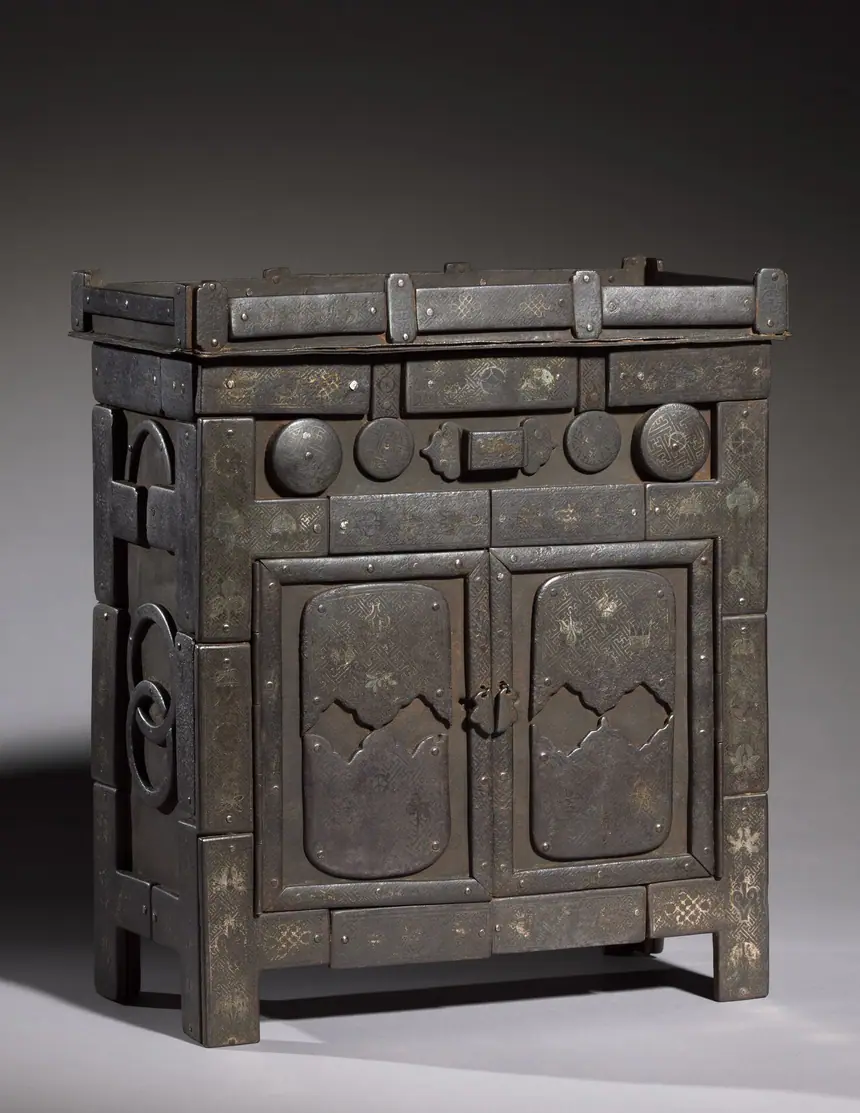
The rite of offering to the ancestors is called jesa. The tablet, in Korean shinwi (신위, 神位), is placed in the middle of the offering table with a paper screen behind. Two candles stand at the two ends of the table and an incense holder in the middle. The Cleveland Museum of Art holds a small shrine of iron inlaid with silver and copper, which the museum calls a spirit house, placed on a tall chair as a seat for the ancestral spirits who come to the rite. Jongmyo in Seoul is the shrine for the tablets of the Joseon kings and queens, inscribed by UNESCO in 1995. Wikipedia records that it holds the tablets of 19 kings and 30 queens in 19 chambers.


Japan
The tablet is called an ihai and is kept in the butsudan, the household Buddhist altar. The butsudan is a cabinet or small shrine with an image of the Buddha in the middle and the ancestral tablets on either side. The family offers rice, flowers and incense, lights candles and recites scriptures. The custom spread in the Tokugawa period (1603 to 1867). Wikipedia records that most Buddhist schools place ihai inside or near the butsudan, with the exception of Jōdo Shinshū.


Ryukyu (Okinawa)
In Okinawa the ancestral tablets are called totome and are kept on the household altar. The main occasions are Shimi in spring, when the family gathers at the ancestral grave, and Obon, a festival honouring the dead. The person who uploaded the photo below explains that the top row holds tiles bearing the names of the dead, each upper and lower pair being one generation, with the husband on the upper row and the wife on the lower, the generations running from right to left. This is the uploader's own account, and the library has not checked it against a research source.

VIIIWhat the library is not sure of
Do you keep the incense for your clan, make altar objects or study these traditions, and have you found something inaccurate, or do you have a photo of your own to contribute? Please send it with its source to thayungkhiem@gmail.com. The library will correct the page and credit the contributor.
IXPhotos and licences
Every photo on this page comes from Wikimedia Commons, under Public domain, CC0, CC BY or CC BY-SA licences. Authors and licences are given exactly as on the original file pages, read on 07/10/2026. The photos have only been reduced in size, with no change to their content. Click the name of a photo to go to its original file page. If you are an author and see an incorrect credit, please let the library know so it can be corrected.
XSources
The pages above were read in October 2026. If a page has changed its address, please let the library know so it can be updated.
?Quick Questions
Must an ancestral altar have a memorial portrait
No source the library has read says it must. The old custom was to worship with a thần chủ, a wooden tablet bearing the name, or with just an ỷ seat. The book Việt Nam phong tục of 1915 describes altar objects in great detail without mentioning photographs. The memorial portrait is a custom of the 20th century onward.
What is the difference between thần chủ and bài vị
In the sources the library has read, the two names are used interchangeably for the wooden tablet bearing the name of the departed. Phan Kế Bính uses the word thần chủ and describes it: jujube wood, about one thước long, the name and titles in the middle, the dates of birth and death on the sides, covered by a box and kept in a shrine cabinet.
Why are tablets kept for only four generations
Under the custom of ngũ đại mai thần chủ recorded by Phan Kế Bính, a household keeps the tablets of four generations: cao, tằng, tổ and khảo. When a fifth generation comes, the tablet of the most distant generation is buried and the later ones move up. Only the founding ancestor's tablet in the clan hall is kept forever.
What do the tam sự and ngũ sự include
The tam sự is a censer or incense burner in the middle and a candlestick on each side. The ngũ sự is the tam sự plus two more pieces, which depending on the family are flower vases, an aloeswood burner, oil lamp dishes or a pair of cranes.
How does the tray of five fruits differ between north and south
In the north it usually has bananas, a pomelo and other fruits of many colours, with few taboos. In the south people favour custard apple, coconut, papaya, mango and fig, read together as "cầu sung vừa đủ xài", and avoid banana, orange and pear because their names suggest bad luck.
Why does this page show no family memorial portraits
A memorial portrait shows a relative of a particular family. The library uses only portraits of historical figures and museum objects, and otherwise photos of altars, altar objects and clan halls.