HALL OF MYRIAD PATHSVẠN ĐẠO ĐƯỜNGTiếng ViệtVIMaster Ưng Khiêm's site
HALL OF MYRIAD PATHS

Sacred images in Buddhism

· Statues and paintings across Buddhist countries

Photos of real objects, under open licences, with the photographer named. Every point carries its source. Where the library is not sure, it says so.

Photos
105
photos of real objects, nothing redrawn
Countries and regions
17
from India to Japan, more being added
Sources
150
museums, UNESCO, Buddhist newspapers and journals

This page brings together the sacred images of Buddhism across many countries: which figures are venerated, the signs that identify them, and how they are arranged on the altar. The library uses photos of real statues and paintings now kept in temples or museums, and does not redraw portraits of holy figures. The only drawing on the page is a diagram. Under each photo are the photographer's name and the licence. The material on Vietnamese temples follows the sources of Vietnamese Buddhism and Vietnamese scholars. This page is still being expanded, and countries not yet covered will be added over time.

IThe early period before images of the Buddha

In the earliest Buddhist art, the Buddha does not appear in human form. His place is marked by a sign: a pair of footprints, an empty seat, or the empty space under a parasol. The Bodhi tree, the Dharma wheel and the stupa belong to the same group of signs, and they are common on the reliefs of Sanchi, Bharhut and Amaravati.

Source: Metropolitan Museum of Art, Buddhism and Buddhist Art. British Museum, Amaravati gallery. Smarthistory, The stupa.
Bharhut relief: lay people venerate the empty seat under the Bodhi tree, with no image of the Buddha. Indian Museum, Kolkata.
Bharhut relief: lay people venerate the empty seat under the Bodhi tree, with no image of the Buddha. Indian Museum, Kolkata.Photo: Ken Kawasaki, CC BY-SA 3.0, Wikimedia Commons
Bharhut relief: veneration of the Dharma wheel. Sandstone, about the 2nd century BCE. Indian Museum, Kolkata.
Bharhut relief: veneration of the Dharma wheel. Sandstone, about the 2nd century BCE. Indian Museum, Kolkata.Photo: Biswarup Ganguly, CC BY 3.0, Wikimedia Commons
Bharhut relief: celestial beings flying around a stupa. Indian Museum, Kolkata.
Bharhut relief: celestial beings flying around a stupa. Indian Museum, Kolkata.Photo: Anandajoti, CC BY-SA 4.0, Wikimedia Commons
Footprints of the Buddha (buddhapada) from the great stupa of Amaravati. British Museum, London.
Footprints of the Buddha (buddhapada) from the great stupa of Amaravati. British Museum, London.Photo: Jl FilpoC, CC BY-SA 4.0, Wikimedia Commons

The Buddha's footprints (buddhapada) remained objects of veneration even after statues existed. Britannica notes that the footprints and other traces of the Buddha continued to be worshipped alongside relics, stupas and images.

Source: Britannica, Buddhism: Popular religious practices.
Scholars do not agree

The older view held that early Buddhists deliberately avoided depicting the Buddha and used symbols instead. In 1990 Susan L. Huntington challenged this. In her view, many reliefs are not scenes from the Buddha's life with the Buddha replaced by a symbol, but scenes of lay people making pilgrimage and worshipping at the holy sites themselves. In 1991 Vidya Dehejia replied that these symbols carry several layers of meaning at once. A tree can point to the Buddha, to a holy site and to a point of the teaching at the same time. The question is still open. The library records both sides and does not choose between them.

Source: Susan L. Huntington, Early Buddhist Art and the Theory of Aniconism, Art Journal 49, no. 4, 1990. Vidya Dehejia, Aniconism and the Multivalence of Emblems, Ars Orientalis 21, 1991 (bibliographic record).
Veneration of the empty seat, Mathura stone, Kushan period, about 100 to 300. Victoria and Albert Museum, London. Scenes of symbolic worship were still carved after statues of the Buddha existed.
Veneration of the empty seat, Mathura stone, Kushan period, about 100 to 300. Victoria and Albert Museum, London. Scenes of symbolic worship were still carved after statues of the Buddha existed.Photo: Ethan Doyle White, CC BY-SA 4.0, Wikimedia Commons

IIThe first statues of the Buddha

Images of the Buddha in human form appear in the Kushan period, around the 1st century CE. Two centres each created their own type of statue and then influenced each other: Gandhara in the northwest (now in Pakistan and Afghanistan) and Mathura in north central India. The sources consulted do not state which came first.

Source: Metropolitan Museum of Art, Kushan Empire. Britannica, Gandhara art. Britannica, Mathura art.

Gandhara

How to recognize: A youthful face, wavy hair, a thick robe with many folds covering both shoulders

The clearest Greek and Roman influence. Britannica compares the face to the god Apollo, and the Metropolitan Museum compares the robe to the Roman toga. The material is grey-green schist, and from the 3rd century stucco was widely used. The statues were originally painted and gilded.

Standing Buddha, schist, Gandhara region near Peshawar, 2nd to 3rd centuries. Tokyo National Museum.
Standing Buddha, schist, Gandhara region near Peshawar, 2nd to 3rd centuries. Tokyo National Museum.Photo: Daderot, CC0, Wikimedia Commons
Source: Britannica, Gandhara art. Metropolitan Museum of Art, Gandhara. Metropolitan Museum of Art, Buddhism and Buddhist Art.

Mathura

How to recognize: Broad shoulders, a full chest, a thin robe leaving the right shoulder bare, the right hand raised in the abhaya mudra

Carved in the spotted red sandstone of the region, continuing the local tradition of yaksha statues. The famous seated figure from Katra has the form of a Buddha, but the inscription carved on the statue itself calls it a Bodhisattva.

Seated figure from Katra, red Mathura sandstone, Kushan period, the right hand raised in the abhaya mudra. The inscription on the statue calls it a Bodhisattva. Government Museum, Mathura.
Seated figure from Katra, red Mathura sandstone, Kushan period, the right hand raised in the abhaya mudra. The inscription on the statue calls it a Bodhisattva. Government Museum, Mathura.Photo: Biswarup Ganguly, CC BY 3.0, Wikimedia Commons
Source: Britannica, Mathura art. Metropolitan Museum of Art, Buddhism and Buddhist Art.

Gupta

How to recognize: Small snail-shell curls, downcast eyes, a thin robe that seems to cling to the body

The Gupta period (4th to 6th centuries) brought the features of Gandhara and Mathura together into a type that the Metropolitan Museum calls an ideal. This type later became the model for Nepal, Sri Lanka, Thailand, Indonesia and China. The most famous piece is the statue of the Buddha preaching his first sermon at Sarnath, 5th century: the hands form the dharmachakra mudra, and on the base are a wheel and a pair of deer.

The Buddha preaching his first sermon, sandstone, Sarnath, 5th century, Gupta period. Both hands form the dharmachakra mudra. Sarnath Museum.
The Buddha preaching his first sermon, sandstone, Sarnath, 5th century, Gupta period. Both hands form the dharmachakra mudra. Sarnath Museum.Photo: พระมหาเทวประภาส วชิรญาณเมธี (Tevaprapas Makklay), CC BY-SA 3.0, Wikimedia Commons
Source: Metropolitan Museum of Art, Buddhism and Buddhist Art. Britannica, Mathura art. Wikipedia, Buddha Preaching his First Sermon (Sarnath). University of Washington, Silk Road Seattle, a Gupta period Buddha.

IIIHow to recognize a statue of the Buddha

Marks on the body

Tradition holds that the Buddha bore the thirty-two marks of a great man, recorded in the Lakkhana Sutta (Digha Nikaya 30) and the Brahmayu Sutta (Majjhima Nikaya 91). Statues do not show all thirty-two. The three most often seen are the ushnisha (the protuberance on the top of the head), the urna (the spot between the eyebrows, which the texts describe as a tuft of white hair) and the long earlobes, a reminder of the heavy earrings the prince took off when he left home. Scholars also discuss when the list of thirty-two marks took shape.

Source: Asia Society Museum, The Image of the Buddha. Frank L. Chance, Which Buddha Is This Anyway, Education About Asia 17, no. 1, 2012.

A Buddha wears the robe of a monk and no jewellery. A Bodhisattva wears rich garments and jewellery. This is an easy sign for telling the two groups of statues apart.

Source: University of Washington, Silk Road Seattle, a Gupta period Buddha.
Head of a Gupta Buddha, Sarnath, 5th century: the ushnisha on the top of the head, snail-shell curls, long earlobes. National Museum, New Delhi.
Head of a Gupta Buddha, Sarnath, 5th century: the ushnisha on the top of the head, snail-shell curls, long earlobes. National Museum, New Delhi.Photo: Gary Todd, CC0, Wikimedia Commons

Four postures

Statues of the Buddha have four basic postures: seated, standing, walking and reclining. Seated statues usually sit cross-legged in the full lotus position, and some sit with both legs pendant as on a chair. The Buddha lying on his right side is the scene of his approaching final Nirvana. The walking Buddha is a creation of the Sukhothai art of Thailand from the 14th century. Britannica notes that India had no canonical type of walking Buddha.

Source: Wikipedia, Iconography of Gautama Buddha in Laos and Thailand. Wikipedia, Reclining Buddha. Britannica, Sukhothai style.
Meditation mudra: both hands rest in the lap. Statue carved into the rock face of Gal Vihara, Polonnaruwa, Sri Lanka, 12th century.
Meditation mudra: both hands rest in the lap. Statue carved into the rock face of Gal Vihara, Polonnaruwa, Sri Lanka, 12th century.Photo: Philip Nalangan, CC BY 4.0, Wikimedia Commons
Standing Buddha: the Sultanganj bronze, India. Birmingham Museum and Art Gallery, England.
Standing Buddha: the Sultanganj bronze, India. Birmingham Museum and Art Gallery, England.Photo: Birmingham Museums, CC0, Wikimedia Commons
Walking Buddha: Sukhothai bronze, 14th century. Bangkok National Museum.
Walking Buddha: Sukhothai bronze, 14th century. Bangkok National Museum.Photo: Photo Dharma from Sadao, Thailand, CC BY 2.0, Wikimedia Commons
The Buddha lying in final Nirvana, carved into the wall of cave 26, Ajanta, India.
The Buddha lying in final Nirvana, carved into the wall of cave 26, Ajanta, India.Photo: Photo Dharma from Sadao, Thailand, CC BY 2.0, Wikimedia Commons

Mudras, the hand gestures of statues

MudraFormMeaning according to the sources
Earth-touching (bhumisparsha)Seated, the right hand hangs over the knee with the fingertips touching the groundThe moment of enlightenment, unshakeable steadiness
Meditation (dhyana)Seated, both hands palm up in the lap, the right hand on the leftMeditation
Turning the wheel of the Dharma (dharmachakra)Both hands at the chest, thumb and index finger of each hand touchingTeaching, the first sermon at Sarnath
Fearlessness (abhaya)The right hand raised, palm facing outwardFearlessness, protection
Gift-giving (varada)The hand lowered, palm facing outwardGiving, compassion
Discussion (vitarka)The hand raised, thumb touching index fingerExplaining and discussing the teaching
Joined palms (anjali)Both palms pressed together in front of the chestReverence. Usually the gesture of worshippers and of Bodhisattvas
Source: Smarthistory, article on mudras. BuddhaNet, Mudras. Britannica, mudra. Frank L. Chance, Which Buddha Is This Anyway, Education About Asia 17, no. 1, 2012.

Some sources describe the varada mudra with the left hand and some with the right. Both are found on statues, so the library does not give either hand as the rule.

Earth-touching mudra: the right hand touches the ground. Bronze from Nalanda, Pala period, about the 9th to 10th centuries. Indian Museum, Kolkata.
Earth-touching mudra: the right hand touches the ground. Bronze from Nalanda, Pala period, about the 9th to 10th centuries. Indian Museum, Kolkata.Photo: Biswarup Ganguly, CC BY 3.0, Wikimedia Commons
The Buddha preaching his first sermon, sandstone, Sarnath, 5th century, Gupta period. Both hands form the dharmachakra mudra. Sarnath Museum.
The Buddha preaching his first sermon, sandstone, Sarnath, 5th century, Gupta period. Both hands form the dharmachakra mudra. Sarnath Museum.Photo: พระมหาเทวประภาส วชิรญาณเมธี (Tevaprapas Makklay), CC BY-SA 3.0, Wikimedia Commons
Seated figure from Katra, red Mathura sandstone, Kushan period, the right hand raised in the abhaya mudra. The inscription on the statue calls it a Bodhisattva. Government Museum, Mathura.
Seated figure from Katra, red Mathura sandstone, Kushan period, the right hand raised in the abhaya mudra. The inscription on the statue calls it a Bodhisattva. Government Museum, Mathura.Photo: Biswarup Ganguly, CC BY 3.0, Wikimedia Commons
Varada mudra: the hand lowered, palm facing outward. Basalt, Nalanda, 8th to 9th centuries. Nalanda Archaeological Museum.
Varada mudra: the hand lowered, palm facing outward. Basalt, Nalanda, 8th to 9th centuries. Nalanda Archaeological Museum.Photo: Sumitsurai, CC BY-SA 4.0, Wikimedia Commons
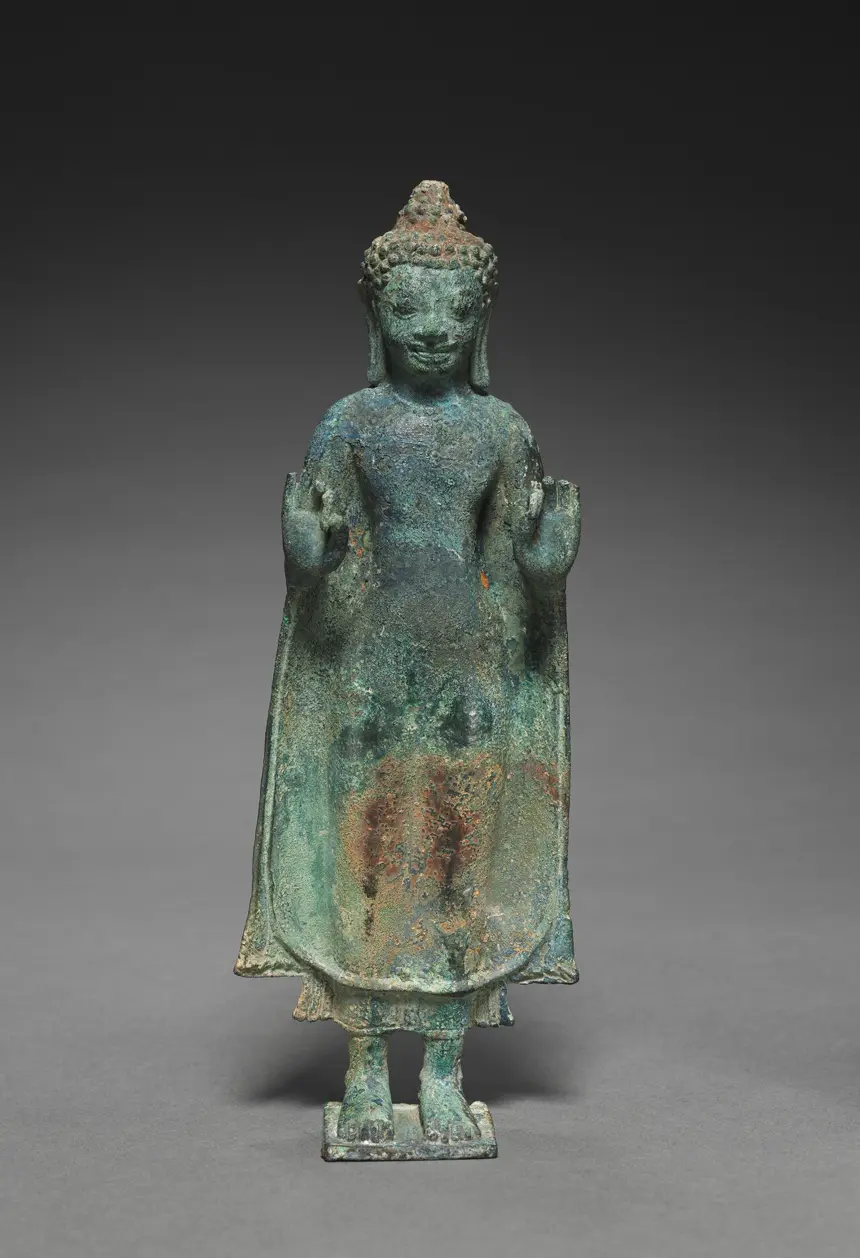
Vitarka mudra: the thumb touches the index finger. Dvaravati statue, Thailand, 7th century. Cleveland Museum of Art.
Vitarka mudra: the thumb touches the index finger. Dvaravati statue, Thailand, 7th century. Cleveland Museum of Art.Photo: Cleveland Museum of Art, CC0, Wikimedia Commons
Anjali (joined palms): a Bodhisattva with palms pressed together. Small painting on a panel from Khara Khoto, 13th century. State Hermitage Museum, Saint Petersburg.
Anjali (joined palms): a Bodhisattva with palms pressed together. Small painting on a panel from Khara Khoto, 13th century. State Hermitage Museum, Saint Petersburg.Photo: Unknown, State Hermitage Museum, Public domain, Wikimedia Commons

A Thai custom: one posture of the Buddha for each day of the week

In Thailand and Laos there is a custom of matching a posture of the Buddha to people born on each day of the week. It is a living folk custom, not something taught in the scriptures. The list below follows the Buddhistdoor dictionary, while the article in the magazine Silpa Wattanatham discusses only the Monday posture. The Wikipedia article on Buddha iconography in Laos and Thailand does not give this list. None of the sources comes from academic research.

Source: Buddhistdoor, Buddha images for the seven days of the week. Silpa Wattanatham magazine (Thailand), on the Monday Buddha image. Wikipedia, Iconography of Gautama Buddha in Laos and Thailand.
DayThai namePosture
SundayPang Thawai Net (ปางถวายเนตร)Standing, hands crossed in front of the belly, eyes gazing at the Bodhi tree
MondayPang Ham Yat (ปางห้ามญาติ)Standing, the right hand raised: the Buddha stops two clans quarrelling over the water of the Rohini river
TuesdayPang Sai Yat (ปางไสยาสน์)Reclining on the right side
Wednesday, daytimePang Um Bat (ปางอุ้มบาตร)Standing, both hands holding the alms bowl
Wednesday, nightPang Pa Lelai (ปางป่าเลไลยก์)The Buddha in the forest, attended by an elephant and a monkey
ThursdayPang Samathi (ปางสมาธิ)Seated in meditation, hands in the lap
FridayPang Ram Phueng (ปางรำพึง)Standing, hands crossed in front of the chest
SaturdayPang Nak Prok (ปางนาคปรก)Seated in meditation under the hood of the serpent king Mucalinda

IVThe Buddhas on the altar

Theravada Buddhism venerates mainly Shakyamuni Buddha. Mahayana and Vajrayana Buddhism also venerate many other Buddhas. Below are the ones most often seen and the signs that identify each.

Shakyamuni

Śākyamuni · 釋迦牟尼 · ShakaHow to recognize: The robe of a monk, usually in the earth-touching, meditation or dharmachakra mudra

The historical Buddha, venerated by every tradition. Besides the statues of the enlightenment and of teaching, there are three types of statue for particular stages of his life. The birth statue shows an infant standing, one hand pointing to the sky and the other to the earth. In Japan, on the Buddha's birthday, people pour sweet tea over this statue. In the temples of northern Vietnam, the newborn stands among nine dragons, an image called Tòa Cửu Long (the Nine Dragon Seat). The Tuyết Sơn (Snowy Mountain) statue shows Shakyamuni emaciated to the bone during his six years of austerities before the enlightenment, and chùa Keo, chùa Tây Phương and chùa Bút Tháp all have one. For the same stage of life, Gandharan art has the famous ascetic figure in the Lahore Museum, more accurately called the ascetic Prince Siddhartha, since he was not yet a Buddha.

The Buddha at birth (tanjōbutsu), gilt bronze, Japan, Asuka period, 7th century. Freer Gallery of Art, Washington.
The Buddha at birth (tanjōbutsu), gilt bronze, Japan, Asuka period, 7th century. Freer Gallery of Art, Washington.Photo: Daderot, CC0, Wikimedia Commons
The newborn Shakyamuni standing in a ring of dragons, in the manner of the Nine Dragon Seat, Vietnam, 19th century. Museum of Vietnamese History, Ho Chi Minh City.
The newborn Shakyamuni standing in a ring of dragons, in the manner of the Nine Dragon Seat, Vietnam, 19th century. Museum of Vietnamese History, Ho Chi Minh City.Photo: Daderot, CC0, Wikimedia Commons
Tuyết Sơn (the ascetic Shakyamuni), lacquered wood, after the statue of chùa Tây Phương (the museum label gives the year 1794). Photo of the object on display in the Vietnam National Museum of Fine Arts. The library does not know whether this is the original statue or a remake.
Tuyết Sơn (the ascetic Shakyamuni), lacquered wood, after the statue of chùa Tây Phương (the museum label gives the year 1794). Photo of the object on display in the Vietnam National Museum of Fine Arts. The library does not know whether this is the original statue or a remake.Photo: Daderot, CC0, Wikimedia Commons
The ascetic Prince Siddhartha (often called the Fasting Buddha), found at Sikri, Gandharan art. Lahore Museum, Pakistan.
The ascetic Prince Siddhartha (often called the Fasting Buddha), found at Sikri, Gandharan art. Lahore Museum, Pakistan.Photo: Patrik Germann, CC BY-SA 4.0, Wikimedia Commons
Source: Metropolitan Museum of Art, Buddhism and Buddhist Art. JAANUS, tanjoubutsu. Dr. Lê Tâm Đắc (Institute for Religious Studies), Bàn về đối tượng thờ trong các ngôi chùa Việt ở miền Bắc (On the objects of worship in Vietnamese temples of the north). Thế giới và Việt Nam newspaper, Báu vật gần 400 tuổi ở chùa Keo (A treasure nearly 400 years old at chùa Keo). Majid Sheikh, Dawn newspaper, 15/03/2020, on the ascetic statue in the Lahore Museum.

Amitabha

Amitābha · 阿彌陀佛 · Amida · འོད་དཔག་མེད་How to recognize: Usually forms a triad with Avalokiteshvara and Mahasthamaprapta

The Buddha who presides over the Western Pure Land of Sukhavati, at the centre of Pure Land practice in East Asia. In Vajrayana he is one of the five Buddhas, red in colour, with his hands in the meditation mudra. The triad of Amitabha, Avalokiteshvara and Mahasthamaprapta is called the Three Sages of the West, or the Amitabha Triad. In Vietnam, the stone Amitabha of chùa Phật Tích (Bắc Ninh), set up in 1057 under the Lý dynasty, is a national treasure. In Japan there is the Great Buddha of Kamakura, whose casting began in 1252, about 11.3 metres tall, and the statue by Jōchō at Byōdō-in, made in 1053.

REPLICA of the Amitabha of chùa Phật Tích (the original is stone, 1057, Lý dynasty), on display in the Vietnam National Museum of Fine Arts. The library has not yet found an openly licensed photo of the original statue in the temple.
REPLICA of the Amitabha of chùa Phật Tích (the original is stone, 1057, Lý dynasty), on display in the Vietnam National Museum of Fine Arts. The library has not yet found an openly licensed photo of the original statue in the temple.Photo: Daderot, CC0, Wikimedia Commons
Amitabha with two Bodhisattvas, limestone relief from Baoqing temple, Xi'an, 703, Tang dynasty. Tokyo National Museum.
Amitabha with two Bodhisattvas, limestone relief from Baoqing temple, Xi'an, 703, Tang dynasty. Tokyo National Museum.Photo: Daderot, CC0, Wikimedia Commons
The Great Buddha of Kamakura (Amida), bronze, casting begun in 1252, Kōtoku-in temple, Japan. Photo taken about 1900, collection of the Metropolitan Museum of Art.
The Great Buddha of Kamakura (Amida), bronze, casting begun in 1252, Kōtoku-in temple, Japan. Photo taken about 1900, collection of the Metropolitan Museum of Art.Photo: Adolph de Meyer, CC0, Wikimedia Commons
Amida by Jōchō, 1053, assembled gilded wood, Phoenix Hall of Byōdō-in, Japan. Photo published in 1952.
Amida by Jōchō, 1053, assembled gilded wood, Phoenix Hall of Byōdō-in, Japan. Photo published in 1952.Photo: Ken Domon, Public domain, Wikimedia Commons
Source: Britannica, Amitabha. JAANUS, Amida sanzon. Tiền Phong newspaper, Giải mã bảo vật quốc gia (Decoding national treasures). Znews, Nguồn gốc tên gọi Phật Tích (The origin of the name Phật Tích). Thanh Tra newspaper, Công nhận bảo vật quốc gia 30 hiện vật (30 objects recognized as national treasures). Kōtoku-in temple, introduction to the Great Buddha of Kamakura. Byōdō-in temple, the Amida statue by Jōchō.

Bhaishajyaguru, the Medicine Buddha

Bhaiṣajyaguru · Yakushi NyoraiHow to recognize: Holds a medicine bowl. Tibetan images show him with a blue body, also holding a branch of myrobalan fruit

The Buddha of healing, who presides over the Pure Land of the East, attended by twelve yaksha generals. He is widely venerated in Tibet, China and Japan.

The Medicine Buddha (Yakushi Nyorai), wood-core dry lacquer with gold leaf, Japan, Nara period, 8th century. Tokyo National Museum.
The Medicine Buddha (Yakushi Nyorai), wood-core dry lacquer with gold leaf, Japan, Nara period, 8th century. Tokyo National Museum.Photo: Daderot, CC0, Wikimedia Commons
The Medicine Buddha, gilt bronze, Tibet, 15th century. Berkeley Art Museum and Pacific Film Archive.
The Medicine Buddha, gilt bronze, Tibet, 15th century. Berkeley Art Museum and Pacific Film Archive.Photo: Daderot, CC0, Wikimedia Commons
Source: Britannica, Bhaishajya-guru.

Vairocana, Dainichi

Vairocana · Dainichi NyoraiHow to recognize: A white body, hands in the dharmachakra mudra, his symbol the wheel

Many Mahayana traditions in East Asia, Tibet, Nepal and Java regard him as the supreme Buddha. Sometimes he is counted as one of the five Buddhas (Vairocana, Akshobhya, Ratnasambhava, Amitabha, Amoghasiddhi), and sometimes as the source of all five. The five are carved almost alike and are told apart by body colour, symbol, mudra and direction. The Great Buddha of the Fengxian niche at Longmen (672 to 675) and the Great Buddha of Tōdai-ji in Nara (eyes consecrated in 752) are both Vairocana. In Japan, under the name Dainichi, he is the most venerated figure of the Shingon school.

Vairocana and attendant figures, Fengxian temple niche, Longmen Grottoes, Luoyang, 672 to 675, Tang dynasty.
Vairocana and attendant figures, Fengxian temple niche, Longmen Grottoes, Luoyang, 672 to 675, Tang dynasty.Photo: Gary Todd, CC0, Wikimedia Commons
Dainichi Nyorai by Unkei, Enjō-ji temple, Nara, Japan. Photo printed in 1933.
Dainichi Nyorai by Unkei, Enjō-ji temple, Nara, Japan. Photo printed in 1933.Photo: Nara National Museum 奈良帝室博物館 (Showa 8 - 1933), Public domain, Wikimedia Commons
The Great Buddha of Tōdai-ji (Vairocana), Nara, Japan, eyes consecrated in 752. Most of the present statue was recast later.
The Great Buddha of Tōdai-ji (Vairocana), Nara, Japan, eyes consecrated in 752. Most of the present statue was recast later.Photo: Gilles Desjardins, CC BY-SA 4.0, Wikimedia Commons
Source: Britannica, Vairochana. Britannica, Dhyani-Buddha. UNESCO, Longmen Grottoes. Smarthistory, Longmen caves. Tōdai-ji temple, the Great Buddha Hall. Smarthistory, Tōdai-ji.

Maitreya

Maitreya · Metteyya · 彌勒 · Miroku · བྱམས་པ་How to recognize: Either a Bodhisattva wearing a crown or a Buddha seated with both legs pendant. In China and Vietnam, a laughing monk with a large belly

The future Buddha, now a Bodhisattva in the Tushita heaven. Britannica notes that Maitreya is the only Bodhisattva generally venerated in the Theravada tradition. In Korea and Japan in the 6th to 7th centuries there is a type of pensive Bodhisattva in half-lotus, one foot resting on the knee and a finger touching the cheek, usually taken to be Maitreya. The Leshan Giant Buddha in Sichuan, 71 metres tall and carved from 713 to 803, is Maitreya. The figure of the big-bellied monk is Budai, a Chinese monk of the 10th century named Qici (契此), who often carried a cloth sack. The Chinese believed him to be an incarnation of Maitreya, so statues of Budai are venerated as Maitreya. This laughing Buddha is not Shakyamuni.

Standing Bodhisattva Maitreya, grey schist, Gandhara, about the 3rd century. Matsuoka Museum of Art, Tokyo.
Standing Bodhisattva Maitreya, grey schist, Gandhara, about the 3rd century. Matsuoka Museum of Art, Tokyo.Photo: Daderot, CC0, Wikimedia Commons
Pensive Bodhisattva, gilt bronze, Korea, Three Kingdoms period, mid 7th century. Metropolitan Museum of Art. This type is usually taken to be Maitreya, but the museum label does not say so.
Pensive Bodhisattva, gilt bronze, Korea, Three Kingdoms period, mid 7th century. Metropolitan Museum of Art. This type is usually taken to be Maitreya, but the museum label does not say so.Photo: The Metropolitan Museum of Art, CC0, Wikimedia Commons
The Leshan Giant Buddha (Maitreya seated with both legs pendant), Sichuan, China, carved from 713 to 803, 71 metres tall.
The Leshan Giant Buddha (Maitreya seated with both legs pendant), Sichuan, China, carved from 713 to 803, 71 metres tall.Photo: Calistemon, CC BY-SA 4.0, Wikimedia Commons
Budai, glazed stoneware, Henan, China, 1486, Ming dynasty. British Museum, London.
Budai, glazed stoneware, Henan, China, 1486, Ming dynasty. British Museum, London.Photo: Osama Shukir Muhammed Amin FRCP(Glasg), CC BY-SA 4.0, Wikimedia Commons
Source: Britannica, Maitreya. Metropolitan Museum of Art, Pensive bodhisattva. Metropolitan Museum of Art, Pensive Treasure. Britannica, Leshan Giant Buddha. UNESCO, Mount Emei and Leshan Giant Buddha. JAANUS, Hotei. British Museum, Budai figure of 1486. Bowers Museum, A Budai by Any Other Name.

Buddhas of the Three Times

三世佛How to recognize: Three identical seated Buddhas of the same size, in a row on the highest tier

In the temples of northern Vietnam, the three Tam Thế statues sit on lotus thrones on the top tier of the Buddha hall and stand for the Buddhas of the past, present and future. Dr. Lê Tâm Đắc writes that, when divided by time, the three are Dipankara (past), Shakyamuni (present) and Maitreya (future). The Himalayan tradition also names the Buddhas of the three ages with these three names. The Tam Thế set of chùa Côn Sơn (17th century) and the set at chùa Bút Tháp are national treasures. Vietnamese sources do not explain these three statues in the same way. See the section on what the library is not sure of.

The large Buddha statues in the upper hall of chùa Bút Tháp, Bắc Ninh, 17th century. The original file page does not name each statue.
The large Buddha statues in the upper hall of chùa Bút Tháp, Bắc Ninh, 17th century. The original file page does not name each statue.Photo: Benjamin Smith, CC BY-SA 4.0, Wikimedia Commons
Source: Dr. Lê Tâm Đắc (Institute for Religious Studies), Bàn về đối tượng thờ trong các ngôi chùa Việt ở miền Bắc (On the objects of worship in Vietnamese temples of the north). Phật tử Việt Nam, Cách bố trí tượng thờ trong chùa miền Bắc (How statues are arranged in northern temples), 01/11/2007. Rubin Museum of Art, Buddhas of the Three Times. Văn Hóa newspaper, Độc đáo bộ tượng Tam Thế Phật chùa Côn Sơn (The unique Three Times Buddhas of chùa Côn Sơn). Thanh Tra newspaper, Nơi lưu giữ 4 bảo vật quốc gia (The place that keeps 4 national treasures).

VThe Bodhisattvas

Avalokiteshvara

Avalokiteśvara · 觀音 Guanyin · Kannon · སྤྱན་རས་གཟིགས་ ChenrezigHow to recognize: A small Amitabha on the crown. In East Asia usually holds a water vase and a willow branch

The Bodhisattva of compassion, venerated under many names in every Mahayana country. In India he is Padmapani, a princely figure holding a lotus. In China, before the Song dynasty statues were male, and by about the 12th century most were female, in forms such as the White-robed Guanyin, the Water-Moon Guanyin and the Child-giving Guanyin. The Most Venerable Thích Thanh Từ taught that a Bodhisattva is neither male nor female, and that the mother's form expresses compassion. In Tibet he is Chenrezig, white with four arms: two hands joined at the chest, the other two holding a crystal rosary and a lotus. Japan has many forms of Kannon, including an eleven-headed form. The Thousand-eyed, Thousand-armed Avalokiteshvara of chùa Bút Tháp (Bắc Ninh), in wood, 3.7 metres tall, with eleven heads and carved in 1656, is a national treasure.

The Bodhisattva Padmapani, wall painting in cave 1, Ajanta, India, late 5th century.
The Bodhisattva Padmapani, wall painting in cave 1, Ajanta, India, late 5th century.Photo: Unknown, Public domain, Wikimedia Commons
Guanyin seated at ease, wood, China, Song dynasty, 12th century. Ethnological Museum, Berlin.
Guanyin seated at ease, wood, China, Song dynasty, 12th century. Ethnological Museum, Berlin.Photo: User:FA2010, Public domain, Wikimedia Commons
The White-robed Guanyin, Dehua porcelain, China, late 18th century, Qing dynasty. Linden-Museum, Stuttgart.
The White-robed Guanyin, Dehua porcelain, China, late 18th century, Qing dynasty. Linden-Museum, Stuttgart.Photo: Daderot, CC0, Wikimedia Commons
The Thousand-eyed, Thousand-armed Avalokiteshvara, lacquered and gilded wood, 1656, at chùa Bút Tháp, Bắc Ninh. A national treasure.
The Thousand-eyed, Thousand-armed Avalokiteshvara, lacquered and gilded wood, 1656, at chùa Bút Tháp, Bắc Ninh. A national treasure.Photo: Khangoii, CC BY-SA 4.0, Wikimedia Commons
Four-armed Avalokiteshvara (Chenrezig), thangka, Lhasa, late 19th century. Alice S. Kandell Collection, Smithsonian.
Four-armed Avalokiteshvara (Chenrezig), thangka, Lhasa, late 19th century. Alice S. Kandell Collection, Smithsonian.Photo: Unknown, Smithsonian Institution, Public domain, Wikimedia Commons
Eleven-headed Kannon (Jūichimen Kannon), wood, Japan, Heian period, 9th century. Tokyo National Museum.
Eleven-headed Kannon (Jūichimen Kannon), wood, Japan, Heian period, 9th century. Tokyo National Museum.Photo: Daderot, CC0, Wikimedia Commons
Source: Smarthistory, Bodhisattva Avalokiteshvara (Guanyin). University of Michigan Museum of Art, Guanyin with a willow branch and vase. JAANUS, Amida sanzon. Himalayan Art Resources, Avalokiteshvara Chaturbhuja. JAANUS, Juuichimen Kannon. VTC News, Bồ tát Quán Thế Âm là nam hay nữ (Is Avalokiteshvara male or female), quoting the Most Venerable Thích Thanh Từ. Thanh Tra newspaper, Nơi lưu giữ 4 bảo vật quốc gia (The place that keeps 4 national treasures). VietNamNet, A visit to But Thap Pagoda.

Manjushri

Mañjuśrī · 文殊 Wenshu · Monju · འཇམ་དཔལ་How to recognize: The right hand raises the sword of wisdom, the left holds a sutra. Seated on a lion

The Bodhisattva of wisdom. Mount Wutai in Shanxi, China, is his sacred mountain. In Vietnamese temples, Manjushri riding a blue lion usually stands on one side of Shakyamuni, with Samantabhadra on the other.

Manjushri seated on a lion, marble, Hebei, China, Liao dynasty, about the 11th century. San Diego Museum of Art.
Manjushri seated on a lion, marble, Hebei, China, Liao dynasty, about the 11th century. San Diego Museum of Art.Photo: Daderot, CC0, Wikimedia Commons
Source: Britannica, Manjushri. Dr. Lê Tâm Đắc (Institute for Religious Studies), Bàn về đối tượng thờ trong các ngôi chùa Việt ở miền Bắc (On the objects of worship in Vietnamese temples of the north).

Samantabhadra

Samantabhadra · 普賢 · FugenHow to recognize: Seated on a white elephant

The Bodhisattva of vows and practice, whose sacred mountain is Mount Emei in Sichuan. Britannica describes his elephant as having three heads, or one head with six tusks. The triad of Shakyamuni, Manjushri and Samantabhadra is found in China, Japan and Vietnam. In Vietnamese temples this triad is usually called Hoa Nghiêm Tam Thánh, the Three Holy Ones of the Avatamsaka.

Samantabhadra (Fugen) on a white elephant, painting on silk, Japan, Heian period, 12th century. Tokyo National Museum.
Samantabhadra (Fugen) on a white elephant, painting on silk, Japan, Heian period, 12th century. Tokyo National Museum.Photo: Unknown, Public domain, Wikimedia Commons
Shakyamuni with Samantabhadra and Manjushri, Japanese painting, Kamakura period. Cleveland Museum of Art.
Shakyamuni with Samantabhadra and Manjushri, Japanese painting, Kamakura period. Cleveland Museum of Art.Photo: Unknown, CC0, Wikimedia Commons
Source: Britannica, Samantabhadra. Dr. Lê Tâm Đắc (Institute for Religious Studies), Bàn về đối tượng thờ trong các ngôi chùa Việt ở miền Bắc (On the objects of worship in Vietnamese temples of the north).

Kshitigarbha

Kṣitigarbha · 地藏 · Jizō · ས་ཡི་སྙིང་པོ་How to recognize: A monk with a shaven head, holding a staff with rings and a jewel

The Bodhisattva who vowed to save beings in the hells. In China he is regarded as the ruler of the hell realms and is prayed to for the dying. In Japan, Jizō protects the dead, especially young children.

Kshitigarbha (Jizō) by Kaikei, lacquered and gilded cypress wood, Japan, about 1202. Metropolitan Museum of Art.
Kshitigarbha (Jizō) by Kaikei, lacquered and gilded cypress wood, Japan, about 1202. Metropolitan Museum of Art.Photo: Kaikei, CC0, Wikimedia Commons
Kshitigarbha, painting on silk, Goryeo, late 14th century. Metropolitan Museum of Art.
Kshitigarbha, painting on silk, Goryeo, late 14th century. Metropolitan Museum of Art.Photo: Unknown, Public domain, Wikimedia Commons
Source: Britannica, Kshitigarbha. Metropolitan Museum of Art, Jizō by Kaikei.

Mahasthamaprapta

Mahāsthāmaprāpta · 大勢至 · SeishiHow to recognize: A water vase on the crown, where Avalokiteshvara has the small Amitabha

Most venerated in the Pure Land schools, standing with Avalokiteshvara on either side of Amitabha. He represents wisdom, and Avalokiteshvara represents compassion.

The Bodhisattva Mahasthamaprapta, China, Jin dynasty, 13th century. Metropolitan Museum of Art.
The Bodhisattva Mahasthamaprapta, China, Jin dynasty, 13th century. Metropolitan Museum of Art.Photo: The Metropolitan Museum of Art, CC0, Wikimedia Commons
Source: Britannica, Mahasthamaprapta. JAANUS, Amida sanzon.

Tara

Tārā · སྒྲོལ་མ་ DrolmaHow to recognize: Green Tara sits with the right leg pendant, holding a closed blue lotus. White Tara sits in full lotus, with extra eyes on the forehead, palms and soles

A female Bodhisattva widely venerated in Tibet, Nepal and Mongolia. Legend tells that she was born from a tear of Avalokiteshvara. Tibetan paintings often show twenty-one Taras around Green Tara.

White Tara and Green Tara, painting on cloth, western Tibet (Guge), about 1450 to 1500. Metropolitan Museum of Art.
White Tara and Green Tara, painting on cloth, western Tibet (Guge), about 1450 to 1500. Metropolitan Museum of Art.Photo: Unknown, Public domain, Wikimedia Commons
Green Tara, bronze, Tibet, 12th century. Fitchburg Art Museum.
Green Tara, bronze, Tibet, 12th century. Fitchburg Art Museum.Photo: Daderot, CC0, Wikimedia Commons
Source: Britannica, Tara. Metropolitan Museum of Art, White Tara and Green Tara.

VIGuardians, Arhats and patriarchs

The protectors

The Four Heavenly Kings

Shitennō (Japan)How to recognize: Four armoured generals, each guarding one direction

Dhritarashtra guards the East, Virudhaka the South, Virupaksha the West and Vaishravana the North. In East Asia the king of the East usually holds a pipa lute, the king of the South a sword, and the king of the West a snake or a dragon. Sources differ on what the king of the North holds: a parasol or a pagoda. In Chinese temples the four stand in the Hall of the Heavenly Kings just inside the gate.

Jikokuten (Dhritarashtra), one of the Four Heavenly Kings in the Ordination Hall of Tōdai-ji, Nara. Photo printed in 1915.
Jikokuten (Dhritarashtra), one of the Four Heavenly Kings in the Ordination Hall of Tōdai-ji, Nara. Photo printed in 1915.Photo: Imperial Japanese Commission to the Panama-Pacific International Exposition, Public domain, Wikimedia Commons
Source: Britannica, lokapala. Wikipedia, Four Heavenly Kings. Wikipedia, Hall of Four Heavenly Kings. Đào Thái Sơn, Bốn hệ tượng Hộ pháp trong các ngôi chùa Việt (Four groups of guardian statues in Vietnamese temples), Giác Ngộ newspaper, 07/07/2017.

The guardians Khuyến Thiện and Trừng Ác

How to recognize: Two very large armoured statues in the front hall of northern temples, seated on the backs of beasts

Popularly called Ông Thiện (Sir Good) and Ông Ác (Sir Fierce). Ông Thiện has a white, gentle face and holds a jewel. Ông Ác has a red, fierce face and holds a weapon. The Vietnamese saying "as big as a Hộ pháp" refers to these two statues.

White-faced guardian seated on the back of a beast at chùa Bút Tháp, Bắc Ninh. The gentle-faced figure is popularly called Ông Thiện.
White-faced guardian seated on the back of a beast at chùa Bút Tháp, Bắc Ninh. The gentle-faced figure is popularly called Ông Thiện.Photo: Benjamin Smith, CC BY-SA 4.0, Wikimedia Commons
Red-faced guardian at chùa Bút Tháp, Bắc Ninh. The fierce-faced figure is popularly called Ông Ác.
Red-faced guardian at chùa Bút Tháp, Bắc Ninh. The fierce-faced figure is popularly called Ông Ác.Photo: Benjamin Smith, CC BY-SA 4.0, Wikimedia Commons
Source: Dr. Lê Tâm Đắc (Institute for Religious Studies), Bàn về đối tượng thờ trong các ngôi chùa Việt ở miền Bắc (On the objects of worship in Vietnamese temples of the north). Phật tử Việt Nam, Cách bố trí tượng thờ trong chùa miền Bắc (How statues are arranged in northern temples), 01/11/2007. Đào Thái Sơn, Bốn hệ tượng Hộ pháp trong các ngôi chùa Việt (Four groups of guardian statues in Vietnamese temples), Giác Ngộ newspaper, 07/07/2017. Vô Ưu, Hai vị Hộ pháp khuyến thiện trừng ác trong các ngôi chùa Việt (The two guardians in Vietnamese temples), phatgiao.org.vn, 25/07/2020.

Skanda and Tiêu Diện

Skanda · 韋馱 WeituoHow to recognize: Skanda is a young armoured general holding a vajra. Tiêu Diện has a fierce face

In Chinese temples, Skanda stands behind the Budai figure of Maitreya in the Hall of the Heavenly Kings, facing the main hall. In Vietnam, Skanda and Tiêu Diện Đại Sĩ form one of the four groups of guardian statues. Tiêu Diện is understood as a manifestation of Avalokiteshvara, taking a fierce form to subdue evil.

The guardian Skanda (Vi Đà) at chùa Giác Lâm, Ho Chi Minh City.
The guardian Skanda (Vi Đà) at chùa Giác Lâm, Ho Chi Minh City.Photo: Phương Huy, CC BY-SA 4.0, Wikimedia Commons
Tiêu Diện Đại Sĩ at chùa Vĩnh Tràng, Mỹ Tho.
Tiêu Diện Đại Sĩ at chùa Vĩnh Tràng, Mỹ Tho.Photo: Bùi Thụy Đào Nguyên, CC BY-SA 3.0, Wikimedia Commons
Source: Wikipedia, Skanda (Buddhism). Wikipedia, Hall of Four Heavenly Kings. Đào Thái Sơn, Bốn hệ tượng Hộ pháp trong các ngôi chùa Việt (Four groups of guardian statues in Vietnamese temples), Giác Ngộ newspaper, 07/07/2017.

The Niō of Japan

仁王How to recognize: Two bare-chested strongmen standing on either side of a temple gate, one with an open mouth, one with a closed mouth

The open-mouthed one is Agyō and the closed-mouthed one is Ungyō, matching the two sounds "a" and "hūm".

The closed-mouthed Niō (Ungyō) at the Great South Gate of Tōdai-ji, Nara, Japan.
The closed-mouthed Niō (Ungyō) at the Great South Gate of Tōdai-ji, Nara, Japan.Photo: Bamse, CC BY-SA 3.0, Wikimedia Commons
Source: Wikipedia, Nio (Buddhism).

The wrathful protectors of Tibet

DharmapālaHow to recognize: A dark body, a fierce face, surrounded by flames

The fierce form expresses readiness to protect practitioners, and they take a wrathful form only for the benefit of beings. Mahākāla is the best known.

Mahākāla, a wrathful protector, thangka from central Tibet, about 1500. Metropolitan Museum of Art.
Mahākāla, a wrathful protector, thangka from central Tibet, about 1500. Metropolitan Museum of Art.Photo: Unknown, Public domain, Wikimedia Commons
Source: Wikipedia, Dharmapala.

Disciples, Arhats and patriarchs

Mahakashyapa and Ananda

Mahākāśyapa · ĀnandaHow to recognize: Two monks standing on either side of Shakyamuni: Mahakashyapa with an old face, Ananda with a young face

An arrangement of Mahayana temples. In northern Vietnam this group is called Niêm Hoa (Holding the Flower): Shakyamuni holds a lotus, flanked by Mahakashyapa and Ananda. The group tells the story of the Buddha holding up a flower on Vulture Peak, when only Mahakashyapa smiled, and so Mahakashyapa is regarded as the first patriarch of Zen in India.
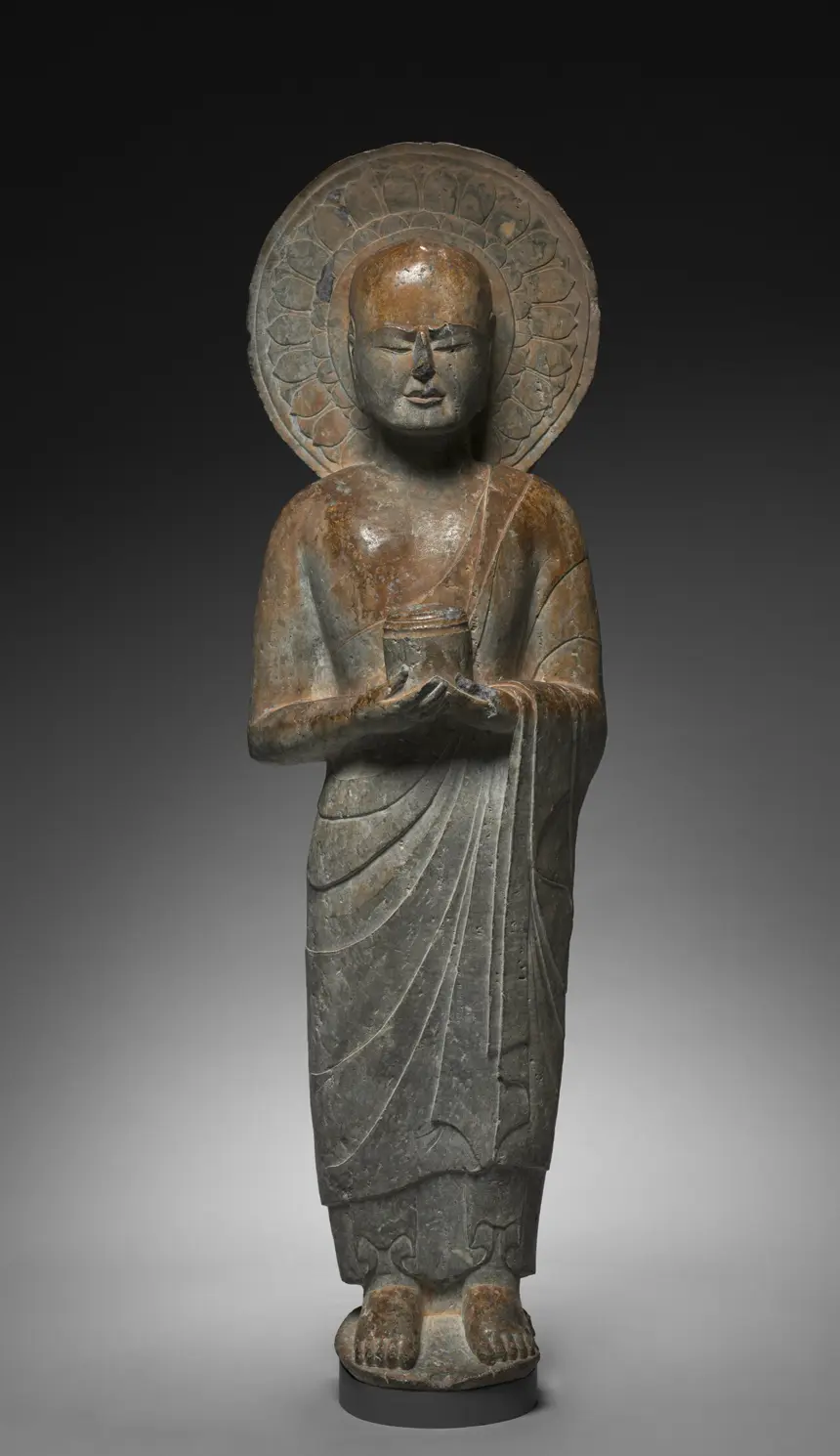
The Venerable Mahakashyapa, stone, Xiangtangshan caves, Hebei, China, about 550, Northern Qi dynasty. Cleveland Museum of Art.
The Venerable Mahakashyapa, stone, Xiangtangshan caves, Hebei, China, about 550, Northern Qi dynasty. Cleveland Museum of Art.Photo: Cleveland Museum of Art, CC0, Wikimedia Commons
Source: Wikipedia, Mahavira Hall. Dr. Lê Tâm Đắc (Institute for Religious Studies), Bàn về đối tượng thờ trong các ngôi chùa Việt ở miền Bắc (On the objects of worship in Vietnamese temples of the north).

Sariputta and Moggallana

Sāriputta · MoggallānaHow to recognize: Two monks with joined palms on either side of the Buddha

An arrangement of Theravada temples. The two are the chief disciples. According to the Elder Nyanaponika, Sariputta stands on the Buddha's right and Moggallana on his left, and many temples in Sri Lanka have statues of the two on either side of the Buddha.

The Buddha with the two chief disciples Sariputta and Moggallana, in the Theravada arrangement. Modern statues, Mahabodhi Vihara, Hyderabad, India.
The Buddha with the two chief disciples Sariputta and Moggallana, in the Theravada arrangement. Modern statues, Mahabodhi Vihara, Hyderabad, India.Photo: Anandajoti, CC BY-SA 4.0, Wikimedia Commons
Source: Nyanaponika Thera, The Life of Sariputta, Buddhist Publication Society.

Arhats

Arhat · 羅漢How to recognize: Monks each in a different pose, seated on rocks or tree stumps

The scriptures speak of sixteen. In China, from the late Tang dynasty two were added to make the Eighteen Arhats, while Japan kept sixteen. In Vietnamese temples, the Arhat statues, sixteen or eighteen of them, are usually venerated in the two corridors on either side of the temple.

A row of Arhat statues in the right-hand corridor of chùa Mía, Đường Lâm, Hanoi.
A row of Arhat statues in the right-hand corridor of chùa Mía, Đường Lâm, Hanoi.Photo: Ngokhong, CC BY-SA 3.0, Wikimedia Commons
Arhat, glazed ceramic, China, Liao dynasty, about 1000. Metropolitan Museum of Art.
Arhat, glazed ceramic, China, Liao dynasty, about 1000. Metropolitan Museum of Art.Photo: The Metropolitan Museum of Art, CC0, Wikimedia Commons
Source: Wikipedia, Eighteen Arhats. Dr. Lê Tâm Đắc (Institute for Religious Studies), Bàn về đối tượng thờ trong các ngôi chùa Việt ở miền Bắc (On the objects of worship in Vietnamese temples of the north). Phật tử Việt Nam, Cách bố trí tượng thờ trong chùa miền Bắc (How statues are arranged in northern temples), 01/11/2007.

The statues of chùa Tây Phương: Arhats or patriarchs

How to recognize: More than ten statues in lacquered and gilded jackfruit wood, late 18th century

The press, the website of the Department of Cultural Heritage and a poem by Huy Cận call them Arhats. Another reading holds that they are the Indian patriarchs of Zen. A name board placed in front of one statue in the temple, photographed in 2023, reads "Tổ Phật Đà Mật Đa" (the Patriarch Buddhamitra). The library gives both names. The Tây Sơn era set of Buddhist statues of chùa Tây Phương has been a national treasure since 2015.

One statue from the set of chùa Tây Phương, Hanoi, late 18th century. The name board in front of it reads "Tổ Phật Đà Mật Đa".
One statue from the set of chùa Tây Phương, Hanoi, late 18th century. The name board in front of it reads "Tổ Phật Đà Mật Đa".Photo: Benjamin Smith, CC BY-SA 4.0, Wikimedia Commons
The statue commonly called the "Laughing Arhat" at chùa Tây Phương, Hanoi, late 18th century.
The statue commonly called the "Laughing Arhat" at chùa Tây Phương, Hanoi, late 18th century.Photo: Liftold at Vietnamese Wikipedia, CC BY-SA 3.0, Wikimedia Commons
Source: Department of Cultural Heritage (Vietnam), Di tích kiến trúc nghệ thuật chùa Tây Phương (The architectural and artistic monument of chùa Tây Phương). Vietnamese Wikipedia, Chùa Tây Phương. Tuổi Trẻ News, Vietnam names another 12 items national treasures. Văn Hóa newspaper, Chùa Tây Phương là điểm du lịch di tích quốc gia đặc biệt (Chùa Tây Phương as a tourist site and special national monument).

Bodhidharma

Bodhidharma · DarumaHow to recognize: A thick beard, large eyes, the look of a foreigner, sometimes carrying one sandal

The first patriarch of Zen in China. In northern Vietnam he is called Đức Tổ Tây (the Western Patriarch) and appears on the altar of almost every patriarchs' hall.

Bodhidharma (Daruma), ink painting by the Zen master Hakuin Ekaku, Japan, 18th century. Metropolitan Museum of Art.
Bodhidharma (Daruma), ink painting by the Zen master Hakuin Ekaku, Japan, 18th century. Metropolitan Museum of Art.Photo: Hakuin Ekaku, Public domain, Wikimedia Commons
Source: Wikipedia, Bodhidharma. Dr. Lê Tâm Đắc (Institute for Religious Studies), Bàn về đối tượng thờ trong các ngôi chùa Việt ở miền Bắc (On the objects of worship in Vietnamese temples of the north). Phật tử Việt Nam, Cách bố trí tượng thờ trong chùa miền Bắc (How statues are arranged in northern temples), 01/11/2007.

Padmasambhava and Tsongkhapa

Padmasambhava · TsongkhapaHow to recognize: Padmasambhava holds a vajra and a skull cup. Tsongkhapa wears a yellow hat

Two great teachers of Tibetan Buddhism. Padmasambhava is the 8th-century teacher associated with the founding of Samye monastery, the central figure of the Nyingma school. Tsongkhapa (about 1357 to 1419) founded the Gelug school.

Padmasambhava holding a vajra and a skull cup, thangka, 18th century. Art Institute of Chicago.
Padmasambhava holding a vajra and a skull cup, thangka, 18th century. Art Institute of Chicago.Photo: Unknown, Public domain, Wikimedia Commons
Tsongkhapa wearing the yellow hat, thangka. American Museum of Natural History, New York.
Tsongkhapa wearing the yellow hat, thangka. American Museum of Natural History, New York.Photo: Daderot, CC0, Wikimedia Commons
Source: Wikipedia, Padmasambhava. Wikipedia, Je Tsongkhapa.

VIIHow the altar is arranged

Temples of northern Vietnam

The Buddha hall of a northern temple has several tiers of platforms. The highest tier is at the very back, close to the roof, and the following tiers step down toward the front, ending with the incense table. Every source stresses that the order is not fixed and that each temple arranges its statues in its own way. The diagram below shows the points on which the sources agree.

Source: Vietnamese Wikipedia, Chùa Việt Nam, section on the arrangement of statues. Phật tử Việt Nam, Cách bố trí tượng thờ trong chùa miền Bắc (How statues are arranged in northern temples), 01/11/2007. Dr. Lê Tâm Đắc (Institute for Religious Studies), Bàn về đối tượng thờ trong các ngôi chùa Việt ở miền Bắc (On the objects of worship in Vietnamese temples of the north). Nguyễn Quang Khải, Một số đặc điểm chùa Việt (Some features of Vietnamese temples), Religious Studies Review (Nghiên cứu Tôn giáo), no. 3, 2012.
Top tierBuddhas of the Three TimesThree identical statues of the same size, seated in a row
Next tierAmitabha TriadAmitabha in the middle, Avalokiteshvara and Mahasthamaprapta on either side. The Amitabha is usually the largest statue in the hall
Middle tierShakyamuni teachingThe Three Holy Ones of the Avatamsaka (Shakyamuni, Manjushri, Samantabhadra) or Niêm Hoa (Shakyamuni, Mahakashyapa, Ananda). Many temples also have a Tuyết Sơn statue
Lower tierTòa Cửu Long (Nine Dragon Seat)The newborn Shakyamuni among nine dragons, at the front, near the incense table

The library drew this diagram as a summary. It is not the plan of any particular temple. Four sources place the Amitabha Triad on the second tier. Dr. Lê Tâm Đắc places the Shakyamuni teaching group on "the third or second tier". For the statues standing beside the Nine Dragon Seat, some sources give Indra and Brahma, others the Jade Emperor with Nam Tào and Bắc Đẩu (the Taoist stars of the South and North).

The multi-tiered altar of a temple in Hanoi, autochrome by Léon Busy, 1916. The Nine Dragon Seat stands in the middle, at the front. Albert Kahn Archives.
The multi-tiered altar of a temple in Hanoi, autochrome by Léon Busy, 1916. The Nine Dragon Seat stands in the middle, at the front. Albert Kahn Archives.Photo: Busy Léon, CC0, Wikimedia Commons
Close view of the Nine Dragon Seat on the altar of a temple in Hanoi, autochrome by Léon Busy, April 1916.
Close view of the Nine Dragon Seat on the altar of a temple in Hanoi, autochrome by Léon Busy, April 1916.Photo: Busy Léon, CC0, Wikimedia Commons
An altar in chùa Thầy (Thiên Phúc temple), Sài Sơn, autochrome by Léon Busy, 14 May 1916.
An altar in chùa Thầy (Thiên Phúc temple), Sài Sơn, autochrome by Léon Busy, 14 May 1916.Photo: Busy Léon, CC0, Wikimedia Commons

Besides the Buddha hall, a northern temple has the two guardians in the front hall, the altar of Đức Ông (whom many sources identify as the elder Anathapindika, who donated the Jeta Grove), the altar of the Holy Monk, eight Vajra guardians on the two sides in large temples, the Ten Kings of Hell in some temples, and the patriarchs' hall at the back, where Bodhidharma and former abbots are venerated. Most northern temples have a shrine to the Mother Goddesses. Lê Tâm Đắc reads this arrangement as a blend of Zen, Pure Land and Esoteric Buddhism with indigenous beliefs.

Source: Dr. Lê Tâm Đắc (Institute for Religious Studies), Bàn về đối tượng thờ trong các ngôi chùa Việt ở miền Bắc (On the objects of worship in Vietnamese temples of the north). Phật tử Việt Nam, Cách bố trí tượng thờ trong chùa miền Bắc (How statues are arranged in northern temples), 01/11/2007. Thiện Minh, Đức Ông được thờ trong chùa là ai (Who is the Đức Ông venerated in temples), phatgiao.org.vn, 13/03/2021. Nguyễn Quang Khải, Một số đặc điểm chùa Việt (Some features of Vietnamese temples), Religious Studies Review (Nghiên cứu Tôn giáo), no. 3, 2012.
The patriarchs' hall of chùa Cổ Pháp, Đình Bảng, Bắc Ninh.
The patriarchs' hall of chùa Cổ Pháp, Đình Bảng, Bắc Ninh.Photo: Phuonghoanghamthu, CC BY-SA 4.0, Wikimedia Commons

Central and southern Vietnam, the Khất Sĩ sangha and Khmer Theravada

Temples in central and southern Vietnam are arranged more simply: the main image is usually a single Shakyamuni or the triad of the Three Sages of the West. Temples in Huế usually follow the pattern of Buddha in front and patriarchs behind. The tịnh xá (monasteries) of the Khất Sĩ (mendicant) sangha have an octagonal main hall, with the Buddha statue placed inside a thirteen-storey wooden tower in the centre. Khmer Theravada temples in southern Vietnam venerate only Shakyamuni Buddha, their main hall faces east, and the Buddha's life is told in paintings on the walls and ceiling. On a Khmer altar there are often many Shakyamuni statues, large and small, in different postures.

Source: Faculty of Tourism, Thai Nguyen University of Sciences, Sơ đồ tượng chùa Bắc, Trung, Nam (Statue layouts of northern, central and southern temples). Ven. Dr. Thích Trung Định, Đặc điểm kiến trúc chùa Huế (Architectural features of Huế temples), Buddhist Studies Review (Nghiên cứu Phật học), 2023. Khất Sĩ sangha, Nét đặc thù của Khất sĩ qua mô hình kiến trúc tịnh xá (The distinctive features of the Khất Sĩ seen in monastery architecture). Kim Ngân, Chùa Khmer Nam Bộ (Khmer temples of southern Vietnam), scov.gov.vn, 18/10/2013. Lý Lết, Chùa Nam tông Khmer (Khmer Theravada temples), Buddhist Culture Magazine (Văn hóa Phật giáo), 14/04/2023. Dr. Lê Tâm Đắc (Institute for Religious Studies), Bàn về đối tượng thờ trong các ngôi chùa Việt ở miền Bắc (On the objects of worship in Vietnamese temples of the north).
The main hall of chùa Âng, a Khmer Theravada temple in Trà Vinh: only Shakyamuni Buddha is venerated, in many statues large and small.
The main hall of chùa Âng, a Khmer Theravada temple in Trà Vinh: only Shakyamuni Buddha is venerated, in many statues large and small.Photo: Bùi Thụy Đào Nguyên, CC BY-SA 3.0, Wikimedia Commons
The main hall of a Khất Sĩ monastery (tịnh xá Ngọc Tín): one Buddha statue inside a wooden tower in the middle of the hall.
The main hall of a Khất Sĩ monastery (tịnh xá Ngọc Tín): one Buddha statue inside a wooden tower in the middle of the hall.Photo: Phương Huy, CC BY-SA 4.0, Wikimedia Commons

Other traditions

Theravada temples (Thailand, Sri Lanka, Myanmar)

How to recognize: One main statue of Shakyamuni Buddha, possibly flanked by the two chief disciples

In a Thai temple the ubosot, where ordinations take place, is the most sacred building, and the wihan is where the assembly gathers. Both house Buddha statues.

Inside the ordination hall (ubosot) of Wat Ratchabophit, Bangkok: one main Buddha statue on a high throne.
Inside the ordination hall (ubosot) of Wat Ratchabophit, Bangkok: one main Buddha statue on a high throne.Photo: Photo Dharma from Sadao, Thailand, CC BY 2.0, Wikimedia Commons
Source: Wikipedia, Wat. Nyanaponika Thera, The Life of Sariputta, Buddhist Publication Society.

Chinese temples

How to recognize: From the gate inward: the Hall of the Heavenly Kings, then the Mahavira Hall

In the Hall of the Heavenly Kings, the Budai Maitreya sits facing the gate with Skanda standing behind him. In the Mahavira Hall, the most common arrangement is Shakyamuni with Mahakashyapa and Ananda, or three Buddhas: Shakyamuni in the middle with Amitabha and the Medicine Buddha on either side. The two side walls usually carry the Eighteen Arhats.

The Mahavira Hall of Haichuang temple, Guangzhou: Shakyamuni in the middle, the Medicine Buddha and Amitabha on either side. Modern statues.
The Mahavira Hall of Haichuang temple, Guangzhou: Shakyamuni in the middle, the Medicine Buddha and Amitabha on either side. Modern statues.Photo: Huangdan2060, CC0, Wikimedia Commons
Source: Wikipedia, Hall of Four Heavenly Kings. Wikipedia, Mahavira Hall.

Japanese temples

How to recognize: The principal image (honzon) differs from school to school

Jōdo Shinshū venerates only Amida, as a statue, a painting or a calligraphy of his name. Shingon places Dainichi Nyorai at the centre of its teaching and hangs two mandalas facing each other. Zen venerates Shakyamuni. The Nichiren schools venerate the Gohonzon, a mandala written in characters, which Nichiren first inscribed in the years 1271 to 1274. Some Nichiren communities do not approve of reproducing the Gohonzon, so the library does not publish a photo of it.

The Amida Hall of Nishi Hongan-ji, Kyoto, head temple of Jōdo Shinshū.
The Amida Hall of Nishi Hongan-ji, Kyoto, head temple of Jōdo Shinshū.Photo: Zairon, CC BY-SA 4.0, Wikimedia Commons
Statues arranged as a mandala in the Lecture Hall of Tō-ji, Kyoto, a temple of the Shingon school.
Statues arranged as a mandala in the Lecture Hall of Tō-ji, Kyoto, a temple of the Shingon school.Photo: Zairon, CC BY-SA 4.0, Wikimedia Commons
Source: Wikipedia, Honzon. Buddhist Churches of America, Naijin (a guide to the inner sanctuary of Jōdo Shinshū). Wikipedia, Shingon Buddhism. JAANUS, Ryoukai mandara. Sōtōshū, Butsudan. Wikipedia, Gohonzon.

Tibetan shrines

How to recognize: Statue, scripture and stupa on the same altar, with seven water bowls in front

The altar represents the body, speech and mind of the Buddha: the statue is the body, the scripture the speech, the stupa the mind. The seven water bowls are set in a straight line, close together but not touching. The butter lamp stands for wisdom dispelling ignorance. The main image may be a thangka instead of a statue.

A Tibetan-style shrine reconstructed in a museum (not a shrine in use), objects from the 13th to 20th centuries. Arthur M. Sackler Gallery, Washington.
A Tibetan-style shrine reconstructed in a museum (not a shrine in use), objects from the 13th to 20th centuries. Arthur M. Sackler Gallery, Washington.Photo: Daderot, CC0, Wikimedia Commons
A row of water offering bowls on the altar of Thiksey monastery, Ladakh, India.
A row of water offering bowls on the altar of Thiksey monastery, Ladakh, India.Photo: Vyacheslav Argenberg, CC BY 4.0, Wikimedia Commons
Source: Interview with the Venerable Tenzin Yignyen, Tibetan Altars, Snow Lion. Museum of International Folk Art, The Tibetan Buddhist Altar.

The home Buddha altar of Vietnamese Buddhists

The Venerable Thích Phước Thái wrote on the Buddhist information portal that the patriarchs advised that one Buddha statue or one Bodhisattva statue at home is enough, because with one statue the mind settles more easily. Pure Land practitioners who wish to have the full set venerate Amitabha with Avalokiteshvara and Mahasthamaprapta. The advisory team of Giác Ngộ newspaper sets no number, and notes that the saying "too many statues upset the balance" comes from feng shui, not from the Buddha's teaching. On venerating the Buddha together with the ancestors, Giác Ngộ gives two patterns: tiền Phật hậu linh (Buddha in front, ancestors behind) and thượng Phật hạ linh (Buddha above, ancestors below), with the ancestors' altar one step lower than the Buddha altar.

Source: Thích Phước Thái, Thờ nhiều tượng Phật và Bồ tát có sai trái gì không (Is it wrong to have many Buddha and Bodhisattva statues), phatgiao.org.vn, 28/02/2020. Minh Chính, Phật tử nên thờ tượng Phật nào trong nhà (Which Buddha statue should a Buddhist have at home), phatgiao.org.vn, 13/07/2020. Advisory team of Giác Ngộ newspaper, Thờ nhiều tượng Phật (Having many Buddha statues), 27/03/2012. Advisory team of Giác Ngộ newspaper, Thờ Phật và thờ gia tiên (Venerating the Buddha and the ancestors).

VIIIBuddha statues country by country

The same Buddha is carved in each land with its own faces and materials. Each country below has a few lines on its style and one to four photos of representative objects. Many countries are still missing, and the library will add them over time.

India

The land where the image of the Buddha was born. After Mathura and the Gupta period, the Ajanta caves (with new caves cut in the 5th to 6th centuries) preserve paintings and sculpture that UNESCO calls masterpieces of Buddhist art. In the sanctum of the Mahabodhi Temple at Bodh Gaya is a gilded Buddha statue in the earth-touching mudra.

Seated figure from Katra, red Mathura sandstone, Kushan period, the right hand raised in the abhaya mudra. The inscription on the statue calls it a Bodhisattva. Government Museum, Mathura.
Seated figure from Katra, red Mathura sandstone, Kushan period, the right hand raised in the abhaya mudra. The inscription on the statue calls it a Bodhisattva. Government Museum, Mathura.Photo: Biswarup Ganguly, CC BY 3.0, Wikimedia Commons
The Buddha preaching his first sermon, sandstone, Sarnath, 5th century, Gupta period. Both hands form the dharmachakra mudra. Sarnath Museum.
The Buddha preaching his first sermon, sandstone, Sarnath, 5th century, Gupta period. Both hands form the dharmachakra mudra. Sarnath Museum.Photo: พระมหาเทวประภาส วชิรญาณเมธี (Tevaprapas Makklay), CC BY-SA 3.0, Wikimedia Commons
The Buddha lying in final Nirvana, carved into the wall of cave 26, Ajanta, India.
The Buddha lying in final Nirvana, carved into the wall of cave 26, Ajanta, India.Photo: Photo Dharma from Sadao, Thailand, CC BY 2.0, Wikimedia Commons
Source: Metropolitan Museum of Art, Buddhism and Buddhist Art. UNESCO, Ajanta Caves. UNESCO, Mahabodhi Temple Complex at Bodh Gaya.

Pakistan and Afghanistan

The old land of Gandhara. At Bamiyan (Afghanistan) there once stood two Buddha statues carved into the cliff, 55 metres and 38 metres tall, covered with plaster and painted, from about the 6th to 7th centuries. Neither has survived since March 2001.

Standing Buddha, schist, Gandhara region near Peshawar, 2nd to 3rd centuries. Tokyo National Museum.
Standing Buddha, schist, Gandhara region near Peshawar, 2nd to 3rd centuries. Tokyo National Museum.Photo: Daderot, CC0, Wikimedia Commons
The ascetic Prince Siddhartha (often called the Fasting Buddha), found at Sikri, Gandharan art. Lahore Museum, Pakistan.
The ascetic Prince Siddhartha (often called the Fasting Buddha), found at Sikri, Gandharan art. Lahore Museum, Pakistan.Photo: Patrik Germann, CC BY-SA 4.0, Wikimedia Commons
The smaller Buddha (38 metres) at Bamiyan, Afghanistan, seen from its foot, photo taken on 10 August 1977. The statue was destroyed in 2001.
The smaller Buddha (38 metres) at Bamiyan, Afghanistan, seen from its foot, photo taken on 10 August 1977. The statue was destroyed in 2001.Photo: Phecda109, Public domain, Wikimedia Commons
Source: Britannica, Gandhara art. UNESCO, Bamiyan Valley. Smarthistory, Bamiyan Buddhas.

Sri Lanka

Sri Lankan Buddha statues are calm, almost without ornament, and favour the meditation posture. The Samadhi statue at Anuradhapura is about 2.2 metres tall, and its date is given as about the 4th to 6th centuries. Avukana is a standing statue carved into the rock, nearly 12 metres tall, dated by some sources to the 5th century and by others to the 8th. Gal Vihara at Polonnaruwa has four statues carved on one rock face, made under King Parakramabahu I in the 12th century.

The Samadhi statue (the Buddha in meditation), stone, Anuradhapura, Sri Lanka, about the 4th century.
The Samadhi statue (the Buddha in meditation), stone, Anuradhapura, Sri Lanka, about the 4th century.Photo: Naveen sandeepa sdnsk, CC BY-SA 4.0, Wikimedia Commons
The standing Avukana Buddha carved into the rock, Sri Lanka.
The standing Avukana Buddha carved into the rock, Sri Lanka.Photo: Carlos Delgado, CC BY-SA 4.0, Wikimedia Commons
Standing and reclining statues at Gal Vihara, Polonnaruwa, Sri Lanka, 12th century.
Standing and reclining statues at Gal Vihara, Polonnaruwa, Sri Lanka, 12th century.Photo: Balou46, CC BY-SA 3.0, Wikimedia Commons
Source: UNESCO, Sacred City of Anuradhapura. UNESCO, Ancient City of Polonnaruwa. Wikipedia, Samadhi Statue. Wikipedia, Avukana Buddha statue. Wikipedia, Gal Vihara.

Myanmar

Bagan (11th to 13th centuries) is the classical period, and UNESCO records 3,595 monuments. The earth-touching mudra is the most common gesture. From about the 17th century there is the Mandalay style, often carved in marble, which still fills most Burmese altars today. The Mahamuni statue in Mandalay was brought from Arakan in 1784.

The Mahamuni statue in Mandalay, Myanmar, its body thickly covered with gold leaf applied by pilgrims.
The Mahamuni statue in Mandalay, Myanmar, its body thickly covered with gold leaf applied by pilgrims.Photo: Philip Nalangan, CC BY 4.0, Wikimedia Commons
One of the four standing Buddha statues of the Ananda temple, Bagan, Myanmar.
One of the four standing Buddha statues of the Ananda temple, Bagan, Myanmar.Photo: Vyacheslav Argenberg, CC BY 4.0, Wikimedia Commons
Source: UNESCO, Bagan. Britannica, Southeast Asian arts: Burma. Wikipedia, Mahamuni Buddha Temple. Sahapedia, Infinite Wisdom: Buddhas of the Ananda Temple.

Thailand

The Mon of Dvaravati (6th to 11th centuries) made the first large series of Buddha statues. Sukhothai (13th to 14th centuries) created the familiar Thai Buddha: an oval face, long smooth limbs, a robe with almost no folds, and a flame above the ushnisha, a feature learned from Sri Lanka. The Emerald Buddha in Bangkok is carved from green jade, was first recorded in the 15th century at Chiang Rai, and has its costume changed each year for the three seasons.

Buddha in meditation, stone, Dvaravati art, 8th century. Bangkok National Museum.
Buddha in meditation, stone, Dvaravati art, 8th century. Bangkok National Museum.Photo: Photo Dharma from Sadao, Thailand, CC BY 2.0, Wikimedia Commons
Walking Buddha: Sukhothai bronze, 14th century. Bangkok National Museum.
Walking Buddha: Sukhothai bronze, 14th century. Bangkok National Museum.Photo: Photo Dharma from Sadao, Thailand, CC BY 2.0, Wikimedia Commons
Phra Phuttha Chinnarat, Wat Phra Si Rattana Mahathat, Phitsanulok, Thailand.
Phra Phuttha Chinnarat, Wat Phra Si Rattana Mahathat, Phitsanulok, Thailand.Photo: Supanut Arunoprayote, CC BY 4.0, Wikimedia Commons
The Emerald Buddha (Phra Kaeo Morakot) in Bangkok in the three costumes of the three seasons. A montage of three photos.
The Emerald Buddha (Phra Kaeo Morakot) in Bangkok in the three costumes of the three seasons. A montage of three photos.Photo: Sodacan, a montage of photos by Supanut Arunoprayote, Gremelm and กสิณธร ราชโอรส, CC BY-SA 4.0, Wikimedia Commons
Source: Britannica, Southeast Asian arts: Thailand and Laos. UNESCO, Historic Town of Sukhothai. Britannica, Sukhothai style. Wikipedia, Phra Phuttha Chinnarat. Britannica, Emerald Buddha.

Laos

Lao statues belong to the same family as Sukhothai but have their own features: an egg-shaped head, eyebrows curved like a bow, a hooked nose and very long earlobes. The "calling for rain" posture, with both arms hanging straight along the body, is typical of Laos and northern Thailand. The city of Luang Prabang takes its name from the Phra Bang statue.

Standing Buddha in the "calling for rain" posture, both arms hanging straight along the body, bronze, 18th century. Haw Phra Kaew, Vientiane, Laos.
Standing Buddha in the "calling for rain" posture, both arms hanging straight along the body, bronze, 18th century. Haw Phra Kaew, Vientiane, Laos.Photo: Mx. Granger, CC0, Wikimedia Commons
Source: Northern Illinois University, Treasures of Luang Prabang: Buddha images. Ferenc Hopp Museum of Asiatic Arts (Budapest), Buddha in calling for rain mudra. UNESCO, Town of Luang Prabang. Wikipedia, Phra Bang.

Cambodia

The distinctive Khmer image of the Buddha shows him meditating on the coils of the serpent king Mucalinda, with seven serpent heads spread behind him. The Metropolitan Museum notes that the subject existed earlier, but that the Khmer made it popular, especially under King Jayavarman VII (reigned 1181 to 1218).

The Buddha seated on the coils of the serpent king Mucalinda, sandstone, Bayon style, Cambodia, 12th century. Honolulu Museum of Art.
The Buddha seated on the coils of the serpent king Mucalinda, sandstone, Bayon style, Cambodia, 12th century. Honolulu Museum of Art.Photo: Hiart, CC0, Wikimedia Commons
Source: UNESCO, Angkor. Metropolitan Museum of Art, Buddha Sheltered by a Naga.

Indonesia

Borobudur in Java (8th to 9th centuries) has 72 openwork stupas on its circular terraces, each containing a seated Buddha. The nearby Mendut temple has a Buddha seated with legs pendant, about 3 metres tall, between two Bodhisattvas. The maritime kingdom of Srivijaya left many bronze statues of the Buddha and of Avalokiteshvara.

A Buddha statue on a circular terrace of Borobudur, Java, Indonesia, 8th to 9th centuries.
A Buddha statue on a circular terrace of Borobudur, Java, Indonesia, 8th to 9th centuries.Photo: Photo Dharma from Penang, Malaysia, CC BY 2.0, Wikimedia Commons
Inside the Mendut temple, Java: a seated Buddha between two Bodhisattvas, early 9th century.
Inside the Mendut temple, Java: a seated Buddha between two Bodhisattvas, early 9th century.Photo: Chainwit., CC BY 4.0, Wikimedia Commons
The Bodhisattva Avalokiteshvara, bronze, Srivijaya art, found at Chaiya. Bangkok National Museum.
The Bodhisattva Avalokiteshvara, bronze, Srivijaya art, found at Chaiya. Bangkok National Museum.Photo: Gunawan Kartapranata, CC BY-SA 3.0, Wikimedia Commons
Source: UNESCO, Borobudur Temple Compounds. Britannica, Borobudur. Britannica, Southeast Asian arts: Indonesia.

Vietnam

Vietnam has three streams of Buddha statues. In the Mekong Delta, the Óc Eo culture left standing Buddhas carved from a single tree trunk. In the centre, Champa cast bronze statues around the Buddhist monastery of Đồng Dương (9th to 10th centuries). In the north, Đại Việt has the stone Amitabha of the Lý dynasty and the lacquered and gilded jackfruit wood statues of the 17th to 18th centuries at Bút Tháp and Tây Phương.

Wooden Buddha statue from the Tháp Mười area, Đồng Tháp, Óc Eo culture. Museum of Vietnamese History, Ho Chi Minh City.
Wooden Buddha statue from the Tháp Mười area, Đồng Tháp, Óc Eo culture. Museum of Vietnamese History, Ho Chi Minh City.Photo: Jacklee, CC BY-SA 3.0, Wikimedia Commons
The Đồng Dương Buddha, bronze, Champa, 8th to 9th centuries. Museum of Vietnamese History, Ho Chi Minh City. A national treasure.
The Đồng Dương Buddha, bronze, Champa, 8th to 9th centuries. Museum of Vietnamese History, Ho Chi Minh City. A national treasure.Photo: Damian Vo, CC BY-SA 4.0, Wikimedia Commons
REPLICA of the Amitabha of chùa Phật Tích (the original is stone, 1057, Lý dynasty), on display in the Vietnam National Museum of Fine Arts. The library has not yet found an openly licensed photo of the original statue in the temple.
REPLICA of the Amitabha of chùa Phật Tích (the original is stone, 1057, Lý dynasty), on display in the Vietnam National Museum of Fine Arts. The library has not yet found an openly licensed photo of the original statue in the temple.Photo: Daderot, CC0, Wikimedia Commons
The Thousand-eyed, Thousand-armed Avalokiteshvara, lacquered and gilded wood, 1656, at chùa Bút Tháp, Bắc Ninh. A national treasure.
The Thousand-eyed, Thousand-armed Avalokiteshvara, lacquered and gilded wood, 1656, at chùa Bút Tháp, Bắc Ninh. A national treasure.Photo: Khangoii, CC BY-SA 4.0, Wikimedia Commons
The statue commonly called the "Laughing Arhat" at chùa Tây Phương, Hanoi, late 18th century.
The statue commonly called the "Laughing Arhat" at chùa Tây Phương, Hanoi, late 18th century.Photo: Liftold at Vietnamese Wikipedia, CC BY-SA 3.0, Wikimedia Commons
Source: Pháp Luật Việt Nam newspaper, Tượng gỗ Phật Thích Ca Mâu Ni 1.500 tuổi (A 1,500-year-old wooden Shakyamuni statue). VnExpress, Những bảo vật quốc gia (National treasures). Thanh Tra newspaper, Bảo vật quốc gia 1.200 tuổi ở Sài Gòn (A 1,200-year-old national treasure in Saigon). Tiền Phong newspaper, Giải mã bảo vật quốc gia (Decoding national treasures). Thanh Tra newspaper, Nơi lưu giữ 4 bảo vật quốc gia (The place that keeps 4 national treasures). Văn Hóa newspaper, Chùa Tây Phương là điểm du lịch di tích quốc gia đặc biệt (Chùa Tây Phương as a tourist site and special national monument).

China

Chinese Buddha statues can be followed through the cave temple complexes. Yungang (from about 460, Northern Wei) has five early caves founded by the monk Tanyao, with statues up to about 17 metres tall. Longmen has the Great Vairocana Buddha of the Fengxian niche. Dunhuang (Mogao) has more than two thousand painted clay statues. The Leshan Giant Buddha is 71 metres tall.

The Great Buddha of cave 20, Yungang, Datong, China, Northern Wei dynasty, about the 460s.
The Great Buddha of cave 20, Yungang, Datong, China, Northern Wei dynasty, about the 460s.Photo: Patrick20242023, CC BY-SA 4.0, Wikimedia Commons
Vairocana and attendant figures, Fengxian temple niche, Longmen Grottoes, Luoyang, 672 to 675, Tang dynasty.
Vairocana and attendant figures, Fengxian temple niche, Longmen Grottoes, Luoyang, 672 to 675, Tang dynasty.Photo: Gary Todd, CC0, Wikimedia Commons
The Leshan Giant Buddha (Maitreya seated with both legs pendant), Sichuan, China, carved from 713 to 803, 71 metres tall.
The Leshan Giant Buddha (Maitreya seated with both legs pendant), Sichuan, China, carved from 713 to 803, 71 metres tall.Photo: Calistemon, CC BY-SA 4.0, Wikimedia Commons
Source: UNESCO, Yungang Grottoes. Britannica, Yungang caves. UNESCO, Longmen Grottoes. UNESCO, Mogao Caves. UNESCO, Mount Emei and Leshan Giant Buddha.

South Korea

Two representative works: the gilt bronze pensive Bodhisattvas (6th to 7th centuries), and Seokguram near Gyeongju, 8th century, where a white granite Buddha about 3.5 metres tall sits in the earth-touching mudra, facing the sea.

The Buddha statue in Seokguram, Gyeongju, South Korea, 751 to 774, seen through the entrance.
The Buddha statue in Seokguram, Gyeongju, South Korea, 751 to 774, seen through the entrance.Photo: myllissa from Seoul, S. Korea, CC BY 2.0, Wikimedia Commons
Pensive Bodhisattva, gilt bronze, National Treasure 78. National Museum of Korea.
Pensive Bodhisattva, gilt bronze, National Treasure 78. National Museum of Korea.Photo: Suohros, CC0, Wikimedia Commons
Source: UNESCO, Seokguram Grotto and Bulguksa Temple. Britannica, Sokkuram. Metropolitan Museum of Art, Pensive Treasure.

Japan

The Shakyamuni triad in the Golden Hall of Hōryū-ji (623), by Tori Busshi, is a bronze in the Northern Wei manner. The Nara court cast the Great Buddha of Tōdai-ji. In the Heian period, Jōchō created the classic Japanese Buddha type with the Amida of Byōdō-in (1053), assembled from many hollow wooden blocks. The Great Buddha of Kamakura has sat in the open air since its hall was damaged twice by storms in the 14th century and then swept away by a tsunami in 1498.

The Shakyamuni triad in the Golden Hall of Hōryū-ji, Japan, 623. Photo printed in 1915.
The Shakyamuni triad in the Golden Hall of Hōryū-ji, Japan, 623. Photo printed in 1915.Photo: Japanese Temples and their Treasures, The Shimbi Shoin 1915, Public domain, Wikimedia Commons
The Great Buddha of Tōdai-ji (Vairocana), Nara, Japan, eyes consecrated in 752. Most of the present statue was recast later.
The Great Buddha of Tōdai-ji (Vairocana), Nara, Japan, eyes consecrated in 752. Most of the present statue was recast later.Photo: Gilles Desjardins, CC BY-SA 4.0, Wikimedia Commons
Amida by Jōchō, 1053, assembled gilded wood, Phoenix Hall of Byōdō-in, Japan. Photo published in 1952.
Amida by Jōchō, 1053, assembled gilded wood, Phoenix Hall of Byōdō-in, Japan. Photo published in 1952.Photo: Ken Domon, Public domain, Wikimedia Commons
The Great Buddha of Kamakura (Amida), bronze, casting begun in 1252, Kōtoku-in temple, Japan. Photo taken about 1900, collection of the Metropolitan Museum of Art.
The Great Buddha of Kamakura (Amida), bronze, casting begun in 1252, Kōtoku-in temple, Japan. Photo taken about 1900, collection of the Metropolitan Museum of Art.Photo: Adolph de Meyer, CC0, Wikimedia Commons
Source: UNESCO, Buddhist Monuments in the Horyu-ji Area. Britannica, Tori style. Smarthistory, Tōdai-ji. Tōdai-ji temple, the Great Buddha Hall. Byōdō-in temple, the Amida statue by Jōchō. Kōtoku-in temple, introduction to the Great Buddha of Kamakura. Wikipedia, Kōtoku-in.

Tibet

The most sacred statue is the Jowo Shakyamuni in the Jokhang temple in Lhasa: the Buddha wears not a monk's robe but a crown and royal jewellery. Tradition holds that a Chinese princess brought the statue to Lhasa in 641. Scholars still discuss the statue's actual date. Tibetan sacred images also include thangkas, scroll paintings on cloth painted according to fixed canonical proportions.

The crowned Jowo Shakyamuni in the Jokhang temple, Lhasa. Photo taken in August 1999.
The crowned Jowo Shakyamuni in the Jokhang temple, Lhasa. Photo taken in August 1999.Photo: LBM1948, CC BY-SA 4.0, Wikimedia Commons
Shakyamuni Buddha, Tibetan thangka, 18th century. Rubin Museum of Art.
Shakyamuni Buddha, Tibetan thangka, 18th century. Rubin Museum of Art.Photo: Unknown, Public domain, Wikimedia Commons
Source: Rubin Museum of Art, Jowo Shakyamuni of the Jokhang. UNESCO, Historic Ensemble of the Potala Palace, Lhasa. Metropolitan Museum of Art, Tibetan Buddhist Art. Britannica, thang-ka.

Nepal, Bhutan and Mongolia

Newar craftsmen of the Kathmandu valley made heavily gilded copper statues with broad faces and long eyes, and worked for both Tibet and China. In Mongolia, Zanabazar (1635 to 1723), the first Jebtsundamba, was also a sculptor whom one source calls the Mongolian Michelangelo. The library so far has only one photo of a Bhutanese thangka and no written source on Bhutanese sacred images.

Seated Buddha in the earth-touching mudra (Shakyamuni or Akshobhya), gilt copper alloy, Nepal, 13th century. Norton Simon Museum.
Seated Buddha in the earth-touching mudra (Shakyamuni or Akshobhya), gilt copper alloy, Nepal, 13th century. Norton Simon Museum.Photo: Daderot, CC0, Wikimedia Commons
Standing Bodhisattva Maitreya, attributed to Zanabazar, gilt bronze, Mongolia, 1650 to 1700. Harvard Art Museums.
Standing Bodhisattva Maitreya, attributed to Zanabazar, gilt bronze, Mongolia, 1650 to 1700. Harvard Art Museums.Photo: Daderot, CC0, Wikimedia Commons
White Tara by Zanabazar, 17th century. Zanabazar Museum of Fine Arts, Ulaanbaatar.
White Tara by Zanabazar, 17th century. Zanabazar Museum of Fine Arts, Ulaanbaatar.Photo: Lady Anu, CC BY-SA 3.0, Wikimedia Commons
Appliqué thangka from Bhutan, Shakyamuni Buddha in the centre, 19th century. Rubin Museum of Art.
Appliqué thangka from Bhutan, Shakyamuni Buddha in the centre, 19th century. Rubin Museum of Art.Photo: Unknown, Public domain, Wikimedia Commons
Source: Metropolitan Museum of Art, Nepalese Sculpture. Rubin Museum of Art, Maitreya by Zanabazar. University of Washington, Silk Road Seattle, Zanabazar.

The Silk Road

The oasis kingdoms of the Tarim Basin carried the image of the Buddha from Gandhara to China. Kizil near Kucha has 236 caves cut from about the 3rd to the 8th centuries. Khotan made statues mainly in clay.

The Buddha preaching, wall painting from cave 206, Kizil, Xinjiang, 4th to 5th centuries. Ethnological Museum, Berlin.
The Buddha preaching, wall painting from cave 206, Kizil, Xinjiang, 4th to 5th centuries. Ethnological Museum, Berlin.Photo: Daderot, CC0, Wikimedia Commons
Head of a Buddha, gilt bronze, Khotan, 3rd to 4th centuries. Tokyo National Museum.
Head of a Buddha, gilt bronze, Khotan, 3rd to 4th centuries. Tokyo National Museum.Photo: Daderot, CC0, Wikimedia Commons
Source: Wikipedia, Kizil Caves. Encyclopaedia Iranica, Khotan: Khotanese art.

IXWhat the library is not sure of

·The library has read most sources online. Three printed books on Vietnamese temple statues, by Bùi Văn Tiến, Trần Lâm Biền and Chu Quang Trứ, have not yet been checked. The section on northern temples relies on an article by Dr. Lê Tâm Đắc, an article by Nguyễn Quang Khải in the journal Religious Studies Review (Nghiên cứu Tôn giáo), an article on the Phật tử Việt Nam website, and Vietnamese Wikipedia.
·Which Buddhas are the Buddhas of the Three Times: some sources give Dipankara, Shakyamuni and Maitreya. Some give Amitabha, Shakyamuni and Maitreya, and another source says this reading is incorrect. Some give a spatial set: the Medicine Buddha, Shakyamuni and Amitabha. Lê Tâm Đắc also notes that this group is often confused with the Three Bodies (Tam Thân).
·Left and right: Vietnamese sources give the positions of Avalokiteshvara and Mahasthamaprapta, of Manjushri and Samantabhadra, and of Mahakashyapa and Ananda with the words "left" and "right" without saying whether this is seen from the worshipper or from the statue. Two sources give opposite positions for Avalokiteshvara and Mahasthamaprapta. For this reason the page does not say which figure stands on which side.
·The Three Holy Ones of the Avatamsaka: in Vietnamese temples, this name is used for the group of Shakyamuni, Manjushri and Samantabhadra. The library has not yet found a doctrinal source that states clearly whether the central figure is Shakyamuni or Vairocana.
·The position of the Tuyết Sơn statue and the Maitreya statue among the tiers of northern temples: each source gives a different placement, so the diagram does not assign these two statues to a tier of their own.
·The Avalokiteshvara of chùa Bút Tháp: one museum label gives the year 1656, another 1657. For the number of small hands, one source gives 954 and another more than 900. The sculptor's name has so far only been found as a man surnamed Trương. This page gives only the figures on which two or more sources agree.
·The Amitabha of chùa Phật Tích: the newspapers give heights that differ by a few centimetres (1.85 to 1.87 metres). The photo on this page is a replica in a museum, not the original statue.
·Some photos taken in the Vietnam National Museum of Fine Arts (the Tuyết Sơn of chùa Tây Phương): the library does not know whether the object on display is the original statue or a remake, and the photo caption says so.
·The pensive Bodhisattvas of Korea and Japan are usually taken to be Maitreya, but the label of the Metropolitan Museum does not say so.
·The Thai custom of one Buddha posture for each day: the list relies on one main source, Buddhistdoor, and no Thai research source has yet been read. For the Wednesday night posture, some sources describe it as seated and some as standing.
·The dates of many objects follow museum labels as copied by the photographers, and the library has not yet checked them against the museums' own records: the Gandharan statue in Tokyo, the Buddha footprints in the British Museum, the Sultanganj statue, the reclining statue of Ajanta cave 26.
·The meaning of the lotus throne and the halo: there is not yet a sufficiently reliable source, so this page does not discuss it.
·Original scripts: Chinese characters and Tibetan script are given only for names found in the sources. The Devanagari spellings of Sanskrit names have not yet been checked, so the page uses Latin transliteration.
·Many details about Sri Lanka, Myanmar, Laos, Kizil and the guardian deities rely on English Wikipedia. When sources from museums or heritage bodies are available, the library will replace them.
·This page so far covers the sacred images of seventeen countries and regions. Still missing are photos of temple interiors in Sri Lanka and Myanmar, the main hall of a Huế temple, the home Buddha altar of Vietnamese families, and Mandalay marble statues.

Are you a Buddhist, a monk or nun, or a researcher, and have you found something inaccurate, or do you have a photo of your own to contribute? Please send it with its source to thayungkhiem@gmail.com. The library will correct the page and credit the contributor.

XPhotos and licences

Every photo on this page comes from Wikimedia Commons, under Public domain, CC0, CC BY or CC BY-SA licences. Authors and licences are given exactly as on the original file pages, read on 07/10/2026. The photos have only been reduced in size, with no change to their content. Click the name of a photo to go to its original file page. If you are an author and see an incorrect credit, please let the library know so it can be corrected.

1Adoration of the Diamond Throne and the Bodhi Tree Bharhut relief.jpg · Ken Kawasaki · CC BY-SA 3.0
2Worship of Chakra - Sandstone - ca 2nd Century BCE - Sunga Period - Bharhut - ACCN 305 - Indian Museum - Kolkata 2016-03-06 1563.JPG · Biswarup Ganguly · CC BY 3.0
3021 Prasenajit Pillar, Devas Flying Over a Stupa.jpg · Anandajoti · CC BY-SA 4.0
4Las huellas de Buda, British Museum.jpg · Jl FilpoC · CC BY-SA 4.0
5The Adoration of the Empty Throne.JPG · Ethan Doyle White · CC BY-SA 4.0
6Standing Buddha, near Peshawar, Pakistan, Kushan dynasty, 100s-200s AD, schist - Tokyo National Museum - Tokyo, Japan - DSC08671.jpg · Daderot · CC0
7Inscribed Seated Buddha Image in Abhaya Mudra - Kushan Period - Katra Keshav Dev - ACCN A-1 - Government Museum - Mathura 2013-02-24 5972.JPG · Biswarup Ganguly · CC BY 3.0
8Buddha in Sarnath Museum (Dhammajak Mutra).jpg · พระมหาเทวประภาส วชิรญาณเมธี (Tevaprapas Makklay) · CC BY-SA 3.0
9Buddha Head, Gupta, 5th Century AD, Sarnath, Uttar Pradesh.jpg · Gary Todd · CC0
10Buddha in Bhumisparsha Mudra - Bronze - ca 9th-10th Century CE - Pala Period - Nalanda - ACCN 9426-A24290 - Indian Museum - Kolkata 2016-03-06 1725.JPG · Biswarup Ganguly · CC BY 3.0
11Gal Vihara Polonnaruwa.jpg · Philip Nalangan · CC BY 4.0
12Buddha - Varada Mudra - Nalanda Museum - ASI NM 10515.jpg · Sumitsurai · CC BY-SA 4.0
13Thailand, Mon-Dvaravati Period, 7th Century - Buddha with Hands in Gesture of Teaching, Vitarka Mudra - 1958.334 - Cleveland Museum of Art.tif · Cleveland Museum of Art · CC0
14Hermitage Museum XX-2470 Bodhisattva with His Hands in the Anjali Mudra Position.jpg · Unknown, State Hermitage Museum · Public domain
15The Sultanganj Buddha.jpg · Birmingham Museums · CC0
16069 Walking Buddha, 14c, Sukhothai (34443573793).jpg · Photo Dharma from Sadao, Thailand · CC BY 2.0
17100 Cave 26, Buddha in Parinirvana (34219037182).jpg · Photo Dharma from Sadao, Thailand · CC BY 2.0
18Buddha at birth (Tanjobutsu), Japan, Asuka period, 600s AD, gilt bronze - Freer Gallery of Art - DSC04782.jpg · Daderot · CC0
19Newly-born Sakyamuni, Vietnam, 19th century AD, lacquered wood - - Museum of Vietnamese History - Ho Chi Minh City - DSC06021.JPG · Daderot · CC0
20Sakyamuni Buddha on Snowy Mount, Tay Phuong pagoda, Ha Tay province, 1794 AD, lacquered wood - Vietnam National Museum of Fine Arts - Hanoi, Vietnam - DSC05083.JPG · Daderot · CC0
21Fasting buddha at lahore museum.jpg · Patrik Germann · CC BY-SA 4.0
22Amitabha of Phat Tich pagoda (reproduction), Bac Ninh province, 1057 AD DSC04838.JPG · Daderot · CC0
23Amitabha triad in a niche, Baoqingsi temple, Xi'an, Shaanxi province, China, Tang dynasty, dated 703 AD, limestone DSC08704.jpg · Daderot · CC0
24Daibutsu -Great Buddha-, Kōtoku-in Temple, Kamakura MET DP136185.jpg · Adolph de Meyer · CC0
25Domon Ken - Amida Nyorai (Amitābha) by Jōchō Byōdō-in.jpg · Ken Domon · Public domain
26Seated Yakushi Nyorai (Bhaisajyaguru), Nara period, 8th century, wood-core lacquer with gold leaf - Tokyo National Museum - DSC05091.JPG · Daderot · CC0
27Bhaishajyaguru or Medicine Buddha, Tibet, 15th century, gilt bronze - Berkeley Art Museum and Pacific Film Archive - DSC04104.JPG · Daderot · CC0
28Ancient Buddhist Grottoes at Longmen- Fengxian Temple Grand Buddha Niche with Colossal Statue of Vairocana Buddha.jpg · Gary Todd · CC0
29Dainichi Nyorai Unkei Enjoji 1.jpg · Nara National Museum 奈良帝室博物館 (Showa 8 - 1933) · Public domain
30Daibutsu Grand bouddha - Tōdai-ji - Nara.jpg · Gilles Desjardins · CC BY-SA 4.0
31금동반가사유상 삼국-金銅半跏思惟像 三國-Pensive bodhisattva MET DT5255.jpg · The Metropolitan Museum of Art · CC0
32Maitreya, standing Boddhisattva, Gandhara, c. 3rd century AD, gray schist - Matsuoka Museum of Art - Tokyo, Japan - DSC07100.JPG · Daderot · CC0
33Leshan Giant Buddha, March 2000 01.jpg · Calistemon · CC BY-SA 4.0
34Stoneware figure of Budai, Ming Dynasty, 15th century CE, from China. The British Museum.jpg · Osama Shukir Muhammed Amin FRCP(Glasg) · CC BY-SA 4.0
35But Thap Temple - 16.jpg · Benjamin Smith · CC BY-SA 4.0
36Bodhisattva Padmapani, cave 1, Ajanta, India.jpg · Unknown · Public domain
37Baiyi Guanyin, China, Qing dynasty, late 18th century AD, Dehua-ware porcelain - Linden-Museum - Stuttgart, Germany - DSC03618.jpg · Daderot · CC0
38Guanyin 2 EthnM.jpg · User:FA2010 · Public domain
39Quan âm chùa Bút Tháp 01.jpg · Khangoii · CC BY-SA 4.0
40Shadakshari Avalokiteshvara FS-7620 17.jpg · Unknown, Smithsonian Institution · Public domain
41Juichimen Kannon Bosatsu (Ekadasamukha, eleven-faced Avalokitesvara), Japan, Heian period, 800s AD, wood - Tokyo National Museum - Tokyo, Japan - DSC08837.jpg · Daderot · CC0
42Boddhisattva Wenshu (Manjushri) Seated on a Lion, Baoding, Hebei province, China, Liao dynasty, c. 11th century, marble - San Diego Museum of Art - DSC06497.JPG · Daderot · CC0
43Fugen Bosatsu.jpg · Unknown · Public domain
44Japan, Kamakura period - Shaka attended by Fugen and Monju - 1916.1059 - Cleveland Museum of Art.jpg · Unknown · CC0
45地蔵菩薩立像-Jizō Bosatsu MET DT352187.jpg · Kaikei · CC0
46Goryeo-Kshitigarbha (Chijang)-late.14c.jpg · Unknown · Public domain
47MET DP164041.jpg · The Metropolitan Museum of Art · CC0
48White Tara and Green Tara.jpg · Unknown · Public domain
49Green Tara, Tibet, 12th century AD, bronze with cold gold on face - Fitchburg Art Museum - DSC08842.JPG · Daderot · CC0
50Todaiji Monastery Shitenno of Kaidanin (Jikokuten) (229).jpg · Imperial Japanese Commission to the Panama-Pacific International Exposition · Public domain
51But Thap Temple - 05.jpg · Benjamin Smith · CC BY-SA 4.0
52But Thap Temple - 06.jpg · Benjamin Smith · CC BY-SA 4.0
53Tượng Tiêu Diện Đại Sĩ 2.jpg · Bùi Thụy Đào Nguyên · CC BY-SA 3.0
54Chùa Giác Lâm, tháng 01 năm 2022 (tượng Vi Đà hộ pháp) (1).jpg · Phương Huy · CC BY-SA 4.0
55Nio Ungyo at Todaiji Nandaimon.jpg · Bamse · CC BY-SA 3.0
56Mahakala, Protector of the Tent.jpg · Unknown · Public domain
57China, Hebei province, Southern Xiangtangshan caves, Northern Qi dynasty - Standing Disciple Mahakasyapa Holding a Cylindrical Reliquary - 1972.166 - Cleveland Museum of Art.tif · Cleveland Museum of Art · CC0
58059 Buddha with Sariputta and Moggallana.jpg · Anandajoti · CC BY-SA 4.0
59Tây Phương Pagoda - 01.jpg · Benjamin Smith · CC BY-SA 4.0
60Thập Bát La Hán - Chùa tây Phương - La Hán Cười.jpg · Liftold at Vietnamese Wikipedia · CC BY-SA 3.0
61Arhats of Mia Buddhist temple.JPG · Ngokhong · CC BY-SA 3.0
62遼 三彩羅漢像-Arhat (Luohan) MET DP163962.jpg · The Metropolitan Museum of Art · CC0
63Hakuin Ekaku - Portrait of Daruma - 2015.500.9.3 - Metropolitan Museum of Art.jpg · Hakuin Ekaku · Public domain
64Anonymous - Painted Banner (Thangka) of Sage Guru Padmasambhava Seated Holding a Thunderbolt (Vajra) and Skull Cup (Kapala) - 1970.486 - Art Institute of Chicago.jpg · Unknown · Public domain
65Je Tsongkhapa - AMNH - DSC06220.JPG · Daderot · CC0
66Un autel à l'intérieur d'un temple bouddhique (" Lien-thuy ") - A9869.jpg · Busy Léon · CC0
67L'autel du Bouddha Cakyamuni (Siddhartha Gautama) à l'intérieur d'un temple bouddhique (" Lien-thuy ") - A7656.jpg · Busy Léon · CC0
68Un autel à l'intérieur de la pagode Thay dite également de la " Félicité céleste " (Thien Phuc), située au pied du récif calcaire Sai-so'n - A7721.jpg · Busy Léon · CC0
69NHÀ TỔ CHÙA CỔ PHÁP .jpg · Phuonghoanghamthu · CC BY-SA 4.0
70Tượng Phật Thích Ca trong chùa Âng.jpg · Bùi Thụy Đào Nguyên · CC BY-SA 3.0
71Tịnh xá Ngọc Tín (trong chánh điện) (4).jpg · Phương Huy · CC BY-SA 4.0
72012 Ubosot Shrine (9180329603).jpg · Photo Dharma from Sadao, Thailand · CC BY 2.0
73Buddha at the Mahavira Hall, Haichuang Temple.jpg · Huangdan2060 · CC0
74Kyoto To-ji Kodo Innen 1.jpg · Zairon · CC BY-SA 4.0
75Kyoto Nishi Hongan-ji Amidahalle Innen 6.jpg · Zairon · CC BY-SA 4.0
76Tibetan Buddhist Shrine Room, Alice S. Kandell Collection, from Tibet, China, and Mongolia, 13th-20th century, mixed media - Arthur M. Sackler Gallery - DSC05130.jpg · Daderot · CC0
77Thiksey Monastery, Interior, Ladakh, North India.jpg · Vyacheslav Argenberg · CC BY 4.0
78BamyanBuddha Smaller 1.jpg · Phecda109 · Public domain
79Anuradhapura-Samadhi Statue-hd.jpg · Naveen sandeepa sdnsk · CC BY-SA 4.0
80Buda de Avukana - 02.jpg · Carlos Delgado · CC BY-SA 4.0
81LK-polonnaruwa-gal-vihara-02.jpg · Balou46 · CC BY-SA 3.0
82Mahamuni Buddha Temple 3.jpg · Philip Nalangan · CC BY 4.0
83Bagan, Myanmar, Standing Buddha in Ananda Temple.jpg · Vyacheslav Argenberg · CC BY 4.0
84Phra Phuttha Chinnarat (II).jpg · Supanut Arunoprayote · CC BY 4.0
85The Emerald Buddha adorned with three seasons regalia.jpg · Sodacan, a montage of photos by Supanut Arunoprayote, Gremelm and กสิณธร ราชโอรส · CC BY-SA 4.0
86007 Buddha Meditating, 8c, Dwaravati (35252593525).jpg · Photo Dharma from Sadao, Thailand · CC BY 2.0
87Calling for rain 1.jpg · Mx. Granger · CC0
88Muchilinda Buddha from Cambodia, Angkor kingdom, Bayon style, 12th century, sandstone, HAA.JPG · Hiart · CC0
89Borobudur - Buddha Statue - 042 Buddha Statue looking out (11678884594).jpg · Photo Dharma from Penang, Malaysia · CC BY 2.0
90Candi Mendut - Vairocana Buddha and the two Bodhisattava (2025) - img 01.jpg · Chainwit. · CC BY 4.0
91Avalokiteshvara Srivijaya Art Chaiya.JPG · Gunawan Kartapranata · CC BY-SA 3.0
92Buddha, Tượng Phật Đồng Dương, the Museum of Vietnamese History.jpg · Damian Vo · CC BY-SA 4.0
93Wooden Buddha statue, Museum of Vietnamese History, Ho Chi Minh City - 20121014-01.JPG · Jacklee · CC BY-SA 3.0
94云冈石窟第20窟大佛正面.jpg · Patrick20242023 · CC BY-SA 4.0
95Korea-Gyeongju-Seokguram-Buddha statue-05.jpg · myllissa from Seoul, S. Korea · CC BY 2.0
96Pensive Bodhisattva (National Treasure 78) 33.jpg · Suohros · CC0
97Horyuji Monastery Sakya Trinity of Kondo (178).jpg · Japanese Temples and their Treasures, The Shimbi Shoin 1915 · Public domain
98Lhasa, Jokhang 1999 20.jpg · LBM1948 · CC BY-SA 4.0
99Shakyamuni Buddha - Google Art Project.jpg · Unknown · Public domain
100Buddha Shakyamuni or Akshobhya, Nepal, 1200s AD, gilt-copper alloy - Norton Simon Museum - Pasadena, CA - DSC03983.jpg · Daderot · CC0
101Standing Bodhisattva Maitreya, attributed to Zanabazar, Mongolia, 1650-1700 AD, gilt bronze, pigments - Arthur M. Sackler Museum, Harvard University - DSC01150.jpg · Daderot · CC0
102White Tara.jpg · Lady Anu · CC BY-SA 3.0
103Bhutanese Drukpa applique Buddhist lineage thonka with Shakyamuni Buddha in center, 19th century, Ruben Museum of Art.jpg · Unknown · Public domain
104Buddha Sermon, Kizil, Foot-Washing Cave (Cave 206), 343-411 AD, wall painting- Ethnological Museum, Berlin - DSC01717.JPG · Daderot · CC0
105Head of Buddha, Khotan, China, 3rd-4th century AD, gilt bronze - Tokyo National Museum - Tokyo, Japan - DSC08602.jpg · Daderot · CC0

XISources

1Metropolitan Museum of Art, Buddhism and Buddhist Art
2British Museum, Amaravati gallery
3Smarthistory, The stupa
4Britannica, Buddhism: Popular religious practices
5Susan L. Huntington, Early Buddhist Art and the Theory of Aniconism, Art Journal 49, no. 4, 1990
6Vidya Dehejia, Aniconism and the Multivalence of Emblems, Ars Orientalis 21, 1991 (bibliographic record)
7Metropolitan Museum of Art, Kushan Empire
8Britannica, Gandhara art
9Britannica, Mathura art
10Metropolitan Museum of Art, Gandhara
11Wikipedia, Buddha Preaching his First Sermon (Sarnath)
12University of Washington, Silk Road Seattle, a Gupta period Buddha
13Asia Society Museum, The Image of the Buddha
14Frank L. Chance, Which Buddha Is This Anyway, Education About Asia 17, no. 1, 2012
15Wikipedia, Iconography of Gautama Buddha in Laos and Thailand
16Wikipedia, Reclining Buddha
17Britannica, Sukhothai style
18Smarthistory, article on mudras
19BuddhaNet, Mudras
20Britannica, mudra
21Buddhistdoor, Buddha images for the seven days of the week
22Silpa Wattanatham magazine (Thailand), on the Monday Buddha image
23JAANUS, tanjoubutsu
24Dr. Lê Tâm Đắc (Institute for Religious Studies), Bàn về đối tượng thờ trong các ngôi chùa Việt ở miền Bắc (On the objects of worship in Vietnamese temples of the north)
25Thế giới và Việt Nam newspaper, Báu vật gần 400 tuổi ở chùa Keo (A treasure nearly 400 years old at chùa Keo)
26Majid Sheikh, Dawn newspaper, 15/03/2020, on the ascetic statue in the Lahore Museum
27Britannica, Amitabha
28JAANUS, Amida sanzon
29Tiền Phong newspaper, Giải mã bảo vật quốc gia (Decoding national treasures)
30Znews, Nguồn gốc tên gọi Phật Tích (The origin of the name Phật Tích)
31Thanh Tra newspaper, Công nhận bảo vật quốc gia 30 hiện vật (30 objects recognized as national treasures)
32Kōtoku-in temple, introduction to the Great Buddha of Kamakura
33Byōdō-in temple, the Amida statue by Jōchō
34Britannica, Bhaishajya-guru
35Britannica, Vairochana
36Britannica, Dhyani-Buddha
37UNESCO, Longmen Grottoes
38Smarthistory, Longmen caves
39Tōdai-ji temple, the Great Buddha Hall
40Smarthistory, Tōdai-ji
41Britannica, Maitreya
42Metropolitan Museum of Art, Pensive bodhisattva
43Metropolitan Museum of Art, Pensive Treasure
44Britannica, Leshan Giant Buddha
45UNESCO, Mount Emei and Leshan Giant Buddha
46JAANUS, Hotei
47British Museum, Budai figure of 1486
48Bowers Museum, A Budai by Any Other Name
49Phật tử Việt Nam, Cách bố trí tượng thờ trong chùa miền Bắc (How statues are arranged in northern temples), 01/11/2007
50Rubin Museum of Art, Buddhas of the Three Times
51Văn Hóa newspaper, Độc đáo bộ tượng Tam Thế Phật chùa Côn Sơn (The unique Three Times Buddhas of chùa Côn Sơn)
52Thanh Tra newspaper, Nơi lưu giữ 4 bảo vật quốc gia (The place that keeps 4 national treasures)
53Smarthistory, Bodhisattva Avalokiteshvara (Guanyin)
54University of Michigan Museum of Art, Guanyin with a willow branch and vase
55Himalayan Art Resources, Avalokiteshvara Chaturbhuja
56JAANUS, Juuichimen Kannon
57VTC News, Bồ tát Quán Thế Âm là nam hay nữ (Is Avalokiteshvara male or female), quoting the Most Venerable Thích Thanh Từ
58VietNamNet, A visit to But Thap Pagoda
59Britannica, Manjushri
60Britannica, Samantabhadra
61Britannica, Kshitigarbha
62Metropolitan Museum of Art, Jizō by Kaikei
63Britannica, Mahasthamaprapta
64Britannica, Tara
65Metropolitan Museum of Art, White Tara and Green Tara
66Britannica, lokapala
67Wikipedia, Four Heavenly Kings
68Wikipedia, Hall of Four Heavenly Kings
69Đào Thái Sơn, Bốn hệ tượng Hộ pháp trong các ngôi chùa Việt (Four groups of guardian statues in Vietnamese temples), Giác Ngộ newspaper, 07/07/2017
70Vô Ưu, Hai vị Hộ pháp khuyến thiện trừng ác trong các ngôi chùa Việt (The two guardians in Vietnamese temples), phatgiao.org.vn, 25/07/2020
71Wikipedia, Skanda (Buddhism)
72Wikipedia, Nio (Buddhism)
73Wikipedia, Dharmapala
74Wikipedia, Mahavira Hall
75Nyanaponika Thera, The Life of Sariputta, Buddhist Publication Society
76Wikipedia, Eighteen Arhats
77Department of Cultural Heritage (Vietnam), Di tích kiến trúc nghệ thuật chùa Tây Phương (The architectural and artistic monument of chùa Tây Phương)
78Vietnamese Wikipedia, Chùa Tây Phương
79Tuổi Trẻ News, Vietnam names another 12 items national treasures
80Văn Hóa newspaper, Chùa Tây Phương là điểm du lịch di tích quốc gia đặc biệt (Chùa Tây Phương as a tourist site and special national monument)
81Wikipedia, Bodhidharma
82Wikipedia, Padmasambhava
83Wikipedia, Je Tsongkhapa
84Vietnamese Wikipedia, Chùa Việt Nam, section on the arrangement of statues
85Nguyễn Quang Khải, Một số đặc điểm chùa Việt (Some features of Vietnamese temples), Religious Studies Review (Nghiên cứu Tôn giáo), no. 3, 2012
86Thiện Minh, Đức Ông được thờ trong chùa là ai (Who is the Đức Ông venerated in temples), phatgiao.org.vn, 13/03/2021
87Faculty of Tourism, Thai Nguyen University of Sciences, Sơ đồ tượng chùa Bắc, Trung, Nam (Statue layouts of northern, central and southern temples)
88Ven. Dr. Thích Trung Định, Đặc điểm kiến trúc chùa Huế (Architectural features of Huế temples), Buddhist Studies Review (Nghiên cứu Phật học), 2023
89Khất Sĩ sangha, Nét đặc thù của Khất sĩ qua mô hình kiến trúc tịnh xá (The distinctive features of the Khất Sĩ seen in monastery architecture)
90Kim Ngân, Chùa Khmer Nam Bộ (Khmer temples of southern Vietnam), scov.gov.vn, 18/10/2013
91Lý Lết, Chùa Nam tông Khmer (Khmer Theravada temples), Buddhist Culture Magazine (Văn hóa Phật giáo), 14/04/2023
92Wikipedia, Wat
93Wikipedia, Honzon
94Buddhist Churches of America, Naijin (a guide to the inner sanctuary of Jōdo Shinshū)
95Wikipedia, Shingon Buddhism
96JAANUS, Ryoukai mandara
97Sōtōshū, Butsudan
98Wikipedia, Gohonzon
99Interview with the Venerable Tenzin Yignyen, Tibetan Altars, Snow Lion
100Museum of International Folk Art, The Tibetan Buddhist Altar
101Thích Phước Thái, Thờ nhiều tượng Phật và Bồ tát có sai trái gì không (Is it wrong to have many Buddha and Bodhisattva statues), phatgiao.org.vn, 28/02/2020
102Minh Chính, Phật tử nên thờ tượng Phật nào trong nhà (Which Buddha statue should a Buddhist have at home), phatgiao.org.vn, 13/07/2020
103Advisory team of Giác Ngộ newspaper, Thờ nhiều tượng Phật (Having many Buddha statues), 27/03/2012
104Advisory team of Giác Ngộ newspaper, Thờ Phật và thờ gia tiên (Venerating the Buddha and the ancestors)
105UNESCO, Ajanta Caves
106UNESCO, Mahabodhi Temple Complex at Bodh Gaya
107UNESCO, Bamiyan Valley
108Smarthistory, Bamiyan Buddhas
109UNESCO, Sacred City of Anuradhapura
110UNESCO, Ancient City of Polonnaruwa
111Wikipedia, Samadhi Statue
112Wikipedia, Avukana Buddha statue
113Wikipedia, Gal Vihara
114UNESCO, Bagan
115Britannica, Southeast Asian arts: Burma
116Wikipedia, Mahamuni Buddha Temple
117Sahapedia, Infinite Wisdom: Buddhas of the Ananda Temple
118Britannica, Southeast Asian arts: Thailand and Laos
119UNESCO, Historic Town of Sukhothai
120Wikipedia, Phra Phuttha Chinnarat
121Britannica, Emerald Buddha
122Northern Illinois University, Treasures of Luang Prabang: Buddha images
123Ferenc Hopp Museum of Asiatic Arts (Budapest), Buddha in calling for rain mudra
124UNESCO, Town of Luang Prabang
125Wikipedia, Phra Bang
126UNESCO, Angkor
127Metropolitan Museum of Art, Buddha Sheltered by a Naga
128UNESCO, Borobudur Temple Compounds
129Britannica, Borobudur
130Britannica, Southeast Asian arts: Indonesia
131Pháp Luật Việt Nam newspaper, Tượng gỗ Phật Thích Ca Mâu Ni 1.500 tuổi (A 1,500-year-old wooden Shakyamuni statue)
132VnExpress, Những bảo vật quốc gia (National treasures)
133Thanh Tra newspaper, Bảo vật quốc gia 1.200 tuổi ở Sài Gòn (A 1,200-year-old national treasure in Saigon)
134UNESCO, Yungang Grottoes
135Britannica, Yungang caves
136UNESCO, Mogao Caves
137UNESCO, Seokguram Grotto and Bulguksa Temple
138Britannica, Sokkuram
139UNESCO, Buddhist Monuments in the Horyu-ji Area
140Britannica, Tori style
141Rubin Museum of Art, Jowo Shakyamuni of the Jokhang
142UNESCO, Historic Ensemble of the Potala Palace, Lhasa
143Metropolitan Museum of Art, Tibetan Buddhist Art
144Britannica, thang-ka
145Metropolitan Museum of Art, Nepalese Sculpture
146Rubin Museum of Art, Maitreya by Zanabazar
147University of Washington, Silk Road Seattle, Zanabazar
148Wikipedia, Kizil Caves
149Encyclopaedia Iranica, Khotan: Khotanese art
150Wikipedia, Kōtoku-in

The pages above were read in October 2026. If a page has changed its address, please let the library know so it can be updated.

?Quick Questions

Is the laughing Buddha with a large belly Shakyamuni Buddha

No. He is Budai, a Chinese monk of the 10th century believed to be an incarnation of Maitreya, the future Buddha. Shakyamuni Buddha is carved in a monk's robe, with a well-proportioned body, usually in the earth-touching, meditation or dharmachakra mudra.

How can you tell a Buddha statue from a Bodhisattva statue

A Buddha wears a monk's robe, no jewellery, and has the ushnisha on the top of the head. A Bodhisattva wears rich garments, a crown and jewellery. Kshitigarbha is the exception: he has the form of a monk with a shaven head.

Why is Avalokiteshvara male in some places and female in others

In India he has the form of a prince. In China, by about the 12th century most statues had a female form. The Lotus Sutra says the Bodhisattva appears in whatever body is needed. The Most Venerable Thích Thanh Từ taught that a Bodhisattva is neither male nor female.

In what order are statues arranged in temples of northern Vietnam

The sources agree on a few points: the Buddhas of the Three Times on the highest tier, the Amitabha Triad on the next, a Shakyamuni teaching group in the middle, and the Nine Dragon Seat at the front. The detailed order differs from temple to temple, and the sources also give it differently.

How many Buddha statues should one have at home

The Venerable Thích Phước Thái wrote that the patriarchs advised that one Buddha statue or one Bodhisattva statue is enough. The advisory team of Giác Ngộ newspaper sets no number and stresses that practice matters more than the number of statues.

Why does this page use photos instead of drawings

Whether a sacred image is right or wrong lies in the details: the hand gesture, the objects held, the clothing. Photos of real objects, with their location and date recorded, keep those details. The library does not draw portraits of holy figures. The only drawing on the page is a diagram.

›Read Next