
This page brings together the sacred images of Jainism: whose image Jains place before them in worship, the signs that identify each figure, how the images of the two main traditions differ, and how images are installed in a temple. The library uses photos of real statues and paintings now kept in temples or museums, and does not redraw portraits of holy figures. The only drawing on the page is a diagram. Under each photo are the photographer's name and the licence. Names are given in their usual international spelling, since Vietnamese has no settled way of rendering them. Some Digambara images are unclothed. They express the ideal of renunciation, and the library shows them exactly as the objects are.
IWhose image Jains place before them in worship
At the centre of Jain worship are the twenty-four Jinas, meaning the Victors. They are also called Tirthankaras, meaning ford-makers: those who have crossed the river of birth and death and left a path for others to follow. According to Jain teaching, each cycle of cosmic time has twenty-four of them. The first of the present age is Rishabhanatha and the last is Mahavira.
Source: JAINpedia, Deities. Britannica, Tirthankara. JAINpedia (Institute of Jainology), Jina.The Jinas are fully liberated and no longer take part in worldly affairs. The Pluralism Project at Harvard University states that the Tirthankaras do not in any sense receive offerings. Worshippers offer flowers, water and food before the image to purify themselves, to follow the virtues the Jina embodies and to turn the mind towards liberation. A Jina image therefore does not show a deity who grants favours. It shows a person in meditation, still, holding nothing in the hands.
Source: Pluralism Project (Harvard University), Temples and Images. JAINpedia, Deities.


Not every Jain branch worships images. The Digambara tradition and the Murtipujaka branch of the Svetambara tradition do. The Sthanakvasi and Terapanthi branches of the Svetambara, and the Taran Panth branch of the Digambara, do not. This is discussed in detail in the fourth section.
Source: Pluralism Project (Harvard University), Temples and Images. JAINpedia, Digambara. JAINpedia, Śvetāmbara.IIHow to recognize a Jina image
Only two postures
Jina images have only two postures, and both are postures of meditation. The first is seated cross-legged in the lotus position (padmasana), with the hands resting palm up, one on the other, in the lap. The second is standing upright with the arms hanging along the body without touching it, called kayotsarga, meaning abandoning the body. The hands are always empty. A Jina image makes no gesture of blessing and holds no object.
Source: Metropolitan Museum of Art, Jain Sculpture. JAINpedia (Institute of Jainology), Jina. Wikipedia, Tirthankara. Britannica, Tirthankara.

Marks on the body
The chest of the image often bears the shrivatsa, an auspicious mark showing that this is a great being. The Metropolitan Museum adds one point that sets it apart from images of the Buddha: Digambara Jina images are completely unclothed, while images of the Buddha always wear a robe. On the images shown here, the ears are long and the hair is in small curls. The Jinas are carved alike in face and body, so to know which one it is, look down at the pedestal.
Source: Metropolitan Museum of Art, Jain Sculpture. JAINpedia (Institute of Jainology), Jina. Wikipedia, Tirthankara.
The emblem on the pedestal (lanchhana)
Each Jina has an emblem of his own, called a lanchhana, usually carved on the pedestal. Rishabhanatha has a bull, Mahavira a lion. JAINpedia notes that this custom seems not to have existed in early Jainism. Britannica states that the individual emblems appeared from about the 5th century. The earliest images at Mathura are identified by the inscriptions carved on them, not by emblems.
Source: JAINpedia, glossary entry Lāñchana. JAINpedia, Emblems of the 24 Jinas. Britannica, Jainism: Ritual practices and religious institutions.Two figures can be recognized without looking at the pedestal. Parshvanatha has a canopy of a many-headed serpent above him, usually seven heads. Rishabhanatha has long locks of hair falling onto his shoulders.
Source: JAINpedia, Emblems of the 24 Jinas. JAINpedia, Ṛṣabha. Wikipedia, Tirthankara. Wikipedia, Parshvanatha.The table follows the tables of JainWorld and Wikipedia. Where the two traditions or the two sources differ, both are given. The library has not found a complete table on JAINpedia to check against. The emblem of the seventh Tirthankara is the swastika, an ancient auspicious sign in India. The library describes it only in words and does not use a photo whose main subject is a swastika.
IIIThe Tirthankaras most often seen
Rishabhanatha
Adinatha, the firstHow to recognize: Long locks of hair falling onto the shoulders, a bull on the pedestalThe first Tirthankara of the present age. His colour is golden. His yaksha is Gomukha and his yakshi is Chakreshvari. The Adinatha temple at Ranakpur and the main temple on Mount Shatrunjaya are both dedicated to him.


Parshvanatha
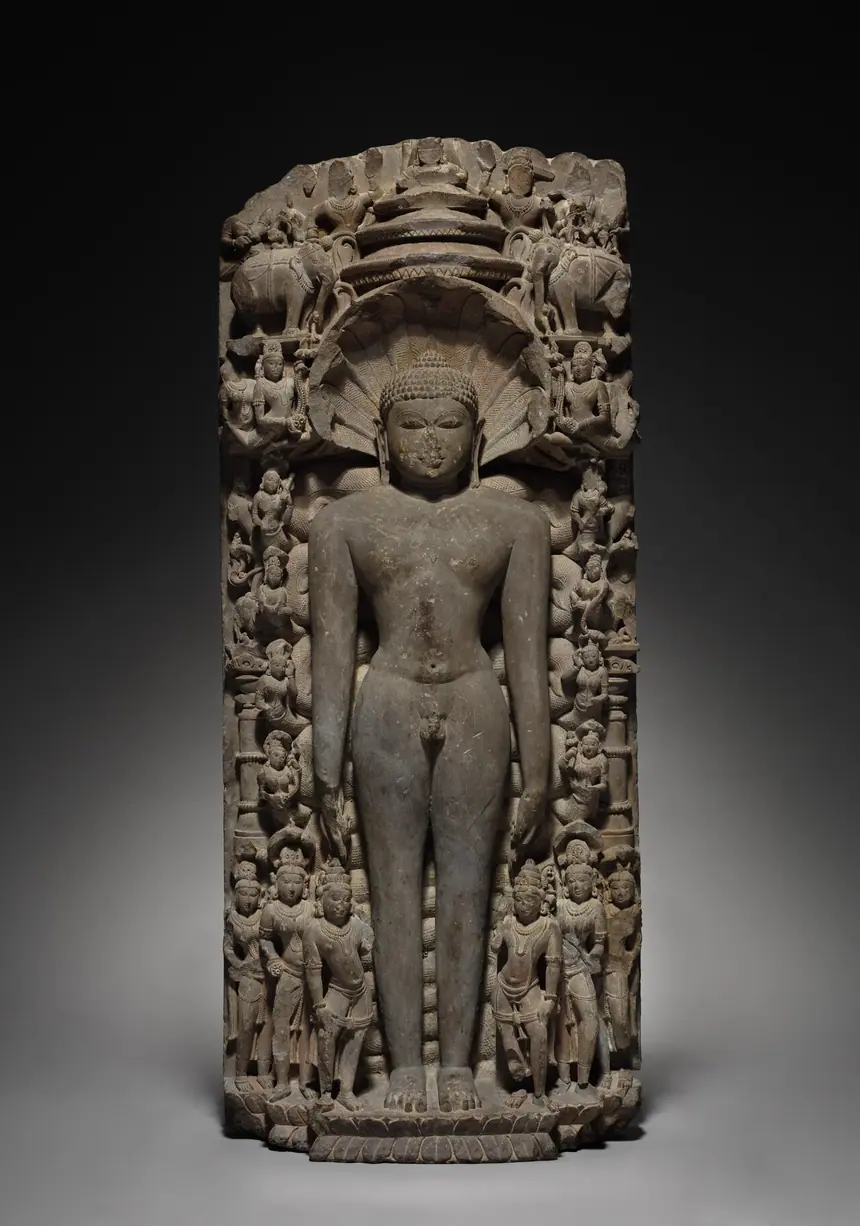
the twenty-thirdHow to recognize: A canopy of a many-headed serpent above him, usually seven headsHis image always appears with the serpent. Tradition tells that the serpent deity Dharanendra and the goddess Padmavati sheltered him while he meditated. Historians generally regard him as the earliest Tirthankara who was a historical figure. He should be distinguished from Suparshvanatha, the seventh, who also has a serpent canopy but with only five heads.


Mahavira
Vardhamana, the twenty-fourthHow to recognize: A lion on the pedestalThe last Tirthankara of the present age. JAINpedia gives his colour as yellow, his yaksha as Matanga and his yakshi as Siddhayika. Digambara images show him unclothed, seated in the lotus position, eyes closed or looking down, without crown or ornaments, with the shrivatsa on the chest. Svetambara images show him with ornaments and a tilaka mark on the forehead.
_LACMA_M.82.6.2.jpg)

Neminatha
Arishtanemi, the twenty-secondHow to recognize: A conch shell on the pedestal, often attended by the goddess AmbikaHis colour is black. His yakshi is Ambika. The Luna Vasahi temple at Dilwara is dedicated to him.

Shantinatha
the sixteenthHow to recognize: A deer on the pedestalAt Khajuraho there is a monolithic image of Shantinatha 4.6 metres high, with an inscription dated 1028 (1085 in the Vikram Samvat calendar). At Deogarh, the Shantinatha temple is the most famous Jain temple within the fort.

Mallinatha
the nineteenthHow to recognize: A water pot (kalasha) on the pedestalThe two traditions differ about this Tirthankara. The Svetambara hold that Mallinatha was a woman, named Malli. The Digambara depict Mallinatha as a man. The library does not yet have a suitable openly licensed photo of a Mallinatha image.
Source: Wikipedia, Mallinatha. JainWorld, The Tirthankaras (table of the twenty-four).Four faces looking out in four directions
One type of image particular to Jainism is the four-faced shrine, called chaumukha: four Jinas, or four images of one Jina, sit back to back and look out in the four directions. Jain texts tell that in the samavasarana, the preaching assembly of a Tirthankara, he sits facing east yet appears to be looking in all directions. Wikipedia states that the four-faced image at Ranakpur symbolizes the Tirthankara's conquest of the four directions, and so of the whole cosmos. At Kankali Tila in Mathura, four-faced images already existed from around the 1st century. The sanctum of the Ranakpur temple, a temple built of white marble, houses a four-faced image of Adinatha.
Source: Wikipedia, Samavasarana. Wikipedia, Jain sculpture. Wikipedia, Ranakpur Jain temple.,_Parshvanatha,_Neminatha,_and_Mahavira)_LACMA_M.85.55_(1_of_4).jpg)

IVImages of the two traditions and the branches without images
Jainism has two main traditions. Digambara means sky-clad: the male monks of this tradition wear no clothes. Svetambara means white-clad: the monks wear white robes. The difference shows clearly in their images.
Source: Britannica, Shvetambara. Metropolitan Museum of Art, Jain Sculpture.Digambara images
How to recognize: Unclothed, eyes closed or looking down, no ornamentsJAINpedia describes Digambara images as naked, carved very simply, with eyes closed and no ornaments, possibly with a mark on the forehead and the shrivatsa on the chest. This simplicity expresses the ideal of renunciation. In worship, Digambara Jains bathe the image but do not adorn it. The Pluralism Project notes that the Digambara prefer their images without the adornment of flowers and sandalwood paste.
Svetambara images
How to recognize: Eyes open, a line showing a loincloth, often painted and adornedJAINpedia describes Svetambara images as having open eyes and a loincloth, often painted and placed in richly carved shrines. The Jina is shown with ornaments, seated on a throne. Britannica notes that the Svetambara also adorn the images with clothing and ornaments in worship. According to Britannica, the earliest Tirthankara image carved with a lower garment comes from Akota, Gujarat, and is dated to the late 5th or the 6th century.

.jpg)
The branches that do not worship images
Sthanakvasi
a Svetambara branchHow to recognize: No images and no temples. Religious life centres on the hall (sthanak)Britannica states that this branch was founded by Lava of Surat in the 17th century, breaking away from the earlier Lonka movement, which also did not worship images. The reason they give is that the Jain scriptures do not mention image worship. The 15th-century reformer Lonka Shah also held that building temples and making offerings harms small living beings, against the vow of non-harm. Followers carry out their religious practice in the halls of the monks rather than in temples.
Source: Britannica, Sthanakavasi. Wikipedia, Murtipujaka. JAINpedia, Śvetāmbara.Svetambara Terapanthi
a branch of the SthanakvasiHow to recognize: No images, an emphasis on meditationFounded by Acharya Bhikshu in the 18th century. This branch also does not worship images. Note that the Digambara tradition also has a lay branch called Terapanth, and that branch does worship Jina images.
Source: Britannica, Sthanakavasi. JAINpedia, Śvetāmbara. JAINpedia, Digambara.Taran Panth
a Digambara branchHow to recognize: Scriptures placed on the altar instead of an imageFounded by Taran Svami in the Bundelkhand region of central India around 1505. Followers do not worship Jina images but revere scripture. Their shrines are called chaityalaya, and a book is placed on the altar instead of an image. The library does not yet have an openly licensed photo of such an altar.
Source: JAINpedia, Digambara. Wikipedia, Taran Panth.According to Wikipedia, the Murtipujaka monk Bhadrankaravijaya held that image worship cultivates moral life through praise of the qualities of the Tirthankaras, and that in the present age lay people can hardly contemplate the Tirthankaras without a support such as an image. Britannica also notes that early texts describe the gods paying homage to images and relics of the Tirthankaras. The library records both sides and does not choose between them.
Source: Wikipedia, Murtipujaka. Britannica, Jainism: Ritual practices and religious institutions.VBahubali, the image standing under the open sky
Bahubali is not a Tirthankara. He was a son of Rishabhanatha and a half-brother of Bharata. After defeating his brother in the contest for the throne, he gave everything up and stood motionless in meditation for a whole year in the kayotsarga posture. He stood so still that creepers wound up his arms and legs and anthills rose around his feet. That is also how to recognize his image: a figure standing upright with creepers twined around the arms and legs, sometimes with snakes and anthills as well.
Source: Britannica, Bahubali. JAINpedia, Bāhubali.The two traditions see him differently. The Digambara hold that Bahubali was the first person to attain liberation in the present age, and revere him on a par with the Jinas, especially from the 7th to the 8th century. Svetambara texts name Marudevi, the mother of Rishabhanatha, as the first to be liberated.
Source: JAINpedia, Bāhubali.
.jpg)


The most famous image stands on a hill at Shravanabelagola, Karnataka, carved from a single block of stone in the 10th century. Wikipedia gives granite, Britannica gives gneiss. Britannica gives its height as 57 feet, that is, 17.5 metres. JAINpedia gives nearly 18 metres. Wikipedia states that the statue was completed around 981 to 983 and was commissioned by Chavundaraya, a minister of the Western Ganga dynasty. This statue became the model for Bahubali images in southern India.
Source: Britannica, Bahubali. JAINpedia, Bāhubali. Wikipedia, Gommateshwara statue.Once every twelve years, the great festival of Mahamastakabhisheka, meaning the great anointing of the head, is held here. The whole statue is bathed with milk, curd, ghee and many other ritual liquids from more than a thousand vessels, before a great crowd of pilgrims. Another Britannica page gives the cycle as twelve to fourteen years. The most recent festival was in 2018, and the next is expected in 2030.
Source: Britannica, Bahubali. JAINpedia, Bāhubali. Wikipedia, Gommateshwara statue. Britannica, Jainism: Jainism and other religions.
The images of Bahubali and many standing Digambara Jina images are unclothed. For Jains, this is the image of complete renunciation, keeping back not even a garment.
VIYakshas, yakshis and goddesses
Each Jina has a pair of attendant deities: a male yaksha and a female yakshi. Together they are called shasanadevata, guardian deities of the teaching. JAINpedia describes them as protectors of the teachings of the Jinas and as intermediaries between the faithful and the Jinas. Britannica states that the association of each Tirthankara with a guardian goddess dates from around the 9th century. On images, these deities are usually smaller and placed below or on either side of the Jina.
Source: JAINpedia, Deities. Britannica, Jainism: Ritual practices and religious institutions. Metropolitan Museum of Art, Jain Sculpture.These deities are still within the cycle of birth and death and still have desires, quite unlike the liberated Jinas. Because the Jinas do not intervene in the world, many followers turn to the yakshas and yakshis when praying for worldly matters, and some of these deities have cults of their own. Their place is still debated among Jain communities. The Terapanth branch of the Digambara tradition does not worship images of beings who are not liberated, such as yakshas.
Source: JAINpedia, Deities. JAINpedia, Digambara.Ambika
yakshi of NeminathaHow to recognize: A mother with a small child beside her, holding a bunch of mangoes or standing under a mango tree, riding a lionThe Metropolitan Museum regards Ambika as an embodiment of motherhood and fertility. Besides attending Neminatha, Ambika is also worshipped as a goddess in her own right. The two traditions name her companion yaksha differently: the Digambara give Sarvanha, the Svetambara give Gomedha.

Padmavati
yakshi of ParshvanathaHow to recognize: Accompanies Parshvanatha and the serpent deity DharanendraPadmavati is worshipped independently with elaborate bathing rites. Together with the serpent deity Dharanendra, she is closely tied to the image of Parshvanatha.
.jpg)
Chakreshvari
yakshi of RishabhanathaHow to recognize: On the image from Mathura: many arms, holding wheelsJAINpedia counts Chakreshvari among the goddesses with a wide following. She is the yakshi of the first Tirthankara.

Sarasvati
goddess of knowledgeHow to recognize: Holding a book or manuscript, a lotus and a vina, with a swan or a peacockSarasvati is honoured by writers and students, especially in the yearly rites that celebrate knowledge. Jainism also honours the goddess Lakshmi, the deity of prosperity.

VIISymbols, diagrams and manuscript paintings
Ayagapata
votive tabletHow to recognize: A square stone tablet carved with symbols, sometimes with a small seated Jina in the centreAyagapata means tablet of homage. These are stone tablets offered to the Tirthankaras, found in large numbers at Kankali Tila near Mathura, some dating from the 1st century. They are carved with stupas, the wheel of the Dharma, the triratna and other auspicious signs, and some show a small Tirthankara. Many objects from Kankali Tila are now in the Mathura Museum and the Lucknow Museum. The tablet in the photo is in the National Museum, New Delhi.

Siddhachakra
also called navapadaHow to recognize: A round diagram of several ringsA sacred Jain diagram, often engraved on a metal plate or painted. The Jain Centre in Leicester observes the Navapad Oli period and describes it as a time of semi-fasting, with only one meal a day. The library has not yet read an authoritative source describing all parts of the diagram, so it gives no details.

Image of a siddha
How to recognize: A human figure that is only an empty spaceA siddha is a liberated soul with no body. There is a very distinctive way of depicting one: the figure of a person standing in kayotsarga is cut out of a metal sheet, leaving an empty space. The worshipper sees the form but no body. The Metropolitan Museum also calls Bahubali a siddha.
,_1333_AD,_western_India,_bronze_with_traces_of_gilding_and_silver_inlay_-_Freer_Gallery_of_Art_-_DSC05195.JPG)
Samavasarana
the preaching assemblyHow to recognize: Concentric walls, the Tirthankara seated in the middle, all beings gathered aroundThe samavasarana is the preaching hall of a Tirthankara, where gods, humans and animals come together to listen. It is a familiar subject of Jain painting.

Paintings of the Kalpasutra
Jains have a very long tradition of copying and illustrating scriptures. Copies on palm leaf survive from around the 10th to 11th centuries, and paper came into use later. Veneration of scripture (jnanapuja) is part of temple worship. The Kalpasutra, which tells the lives of the Jinas, holds a central place in the Svetambara festival of Paryushana. Its illustrations show the conception, the auspicious dreams, and the bathing after birth. The paintings have a deep red ground, and from the 15th century they use much gold leaf. The centre of book production was western India, that is, Gujarat and Rajasthan.
Source: Metropolitan Museum of Art, Jain Manuscript Painting.

The common symbol of Jainism
In 1975, on the 2,500th anniversary of Mahavira's nirvana, the Jain community chose an image as its common symbol. The outer outline is the shape of the universe according to Jain scripture. In the lower part is a raised hand with a wheel in the palm and the word ahimsa, meaning non-harm. Above the hand is a swastika, standing for the four destinies of rebirth: heavenly beings, humans, animals and hell beings. Above it are three dots for right faith, right knowledge and right conduct. At the top is a crescent with a dot, the abode of liberated souls. At the bottom is a phrase saying that all life is bound together by mutual support. Jains in North America use a version that replaces the swastika with the word Om.
Source: Pluralism Project (Harvard University), The Jain Symbol. Wikipedia, Jain symbols.The library describes this symbol only in words. Following the practice of the Hall of Myriad Paths, the page uses no photo whose main subject is a swastika, even though for Jains it is an ancient auspicious sign. Two real photos on the page show a swastika in a minor part of the frame, the festival photo at Shravanabelagola and the shrine photo in New York, and their captions say so.
VIIIThe earliest images
Britannica states that the earliest Tirthankara images were excavated at Mathura and date from the first centuries of the Common Era. All are unclothed and are identified by the inscriptions carved on them. The Kankali Tila mound at Mathura was extensively excavated in 1890 to 1891. A Jain stupa, ayagapata tablets, many Tirthankara images and four-faced images were found there. The finds are now in the Lucknow Museum and the Mathura Museum.
Source: Britannica, Jainism: Ritual practices and religious institutions. Wikipedia, Kankali Tila. Wikipedia, Jain sculpture.In 1937, at Lohanipur in Patna, a male torso of polished sandstone was found, without head, arms or legs. It is thought to represent a Tirthankara. Two scholars, K. P. Jayaswal and M. A. Dhaky, regarded it as the earliest Jain sculpture ever found. Its date is not settled: the Mauryan polish, together with Mauryan bricks and a coin found on the site, suggests the 3rd century BCE, while some other scholars date it later, to the Kushan period. The torso is now in the Patna Museum.
Source: Wikipedia, Lohanipur torso. Wikipedia, Jain sculpture.
Later, small bronze images for worship in temples and homes were cast in large numbers. The Metropolitan Museum mentions the Akota hoard in Gujarat, dating from the late 5th to the 10th century. Other hoards of bronzes have been found at Chausa (Bihar), Vasantgarh and Hansi.
Source: Metropolitan Museum of Art, Jain Sculpture. Wikipedia, Jain sculpture.IXTemples and how images are installed
Inside a temple
Jain temples have different names by region: derasar in Gujarat and Rajasthan, basadi or basti in Karnataka, jinalaya or mandir in the north. The traditional layout runs from outside to inside as in the diagram below.
Source: Wikipedia, Jain temple.The diagram was drawn by the library as a summary and is not the plan of any particular temple. In a chaumukha temple such as Ranakpur, the sanctum opens on four sides and the main image has four faces.


A new image is worshipped only after the installation ceremony (pratishtha). A Jain temple in the United States explains that installing the image in the temple is an image of installing the Lord in one's own heart. Before the ceremony, the image is regarded as stone. The Murtipujaka branch also has the anjana shalaka rite, in which a precious substance is applied to the eyes of the image with a golden stick.
Source: Pluralism Project (Harvard University), The Temple and Image. Natubhai Shah, Jainism: The World of Conquerors, section Svetambara Rituals (republished on HereNow4U). Wikipedia, Jain rituals.Worship before the image
Temple worship includes hymns, reciting the Namokar (Namaskara) Mantra and the names of the Tirthankaras, bathing the image and making offerings. The eightfold worship (ashtaprakari puja) uses eight things: water, sandalwood, flowers, incense, a lamp, rice, sweets and fruit. Sources list these eight in different orders. Each carries a meaning for spiritual practice. Rice, for example, is a grain that will not sprout again, standing for the wish to be reborn no more.
Source: Britannica, Jainism: Ritual practices and religious institutions. Pravin K. Shah, Jain Study Center of North Carolina, Ashta Prakari Puja (copy on Hinduwebsite). Wikipedia, Jain rituals.Worship among the Svetambara Murtipujaka
How to recognize: Touching the image, applying sandalwood, adorning the imageDr. Natubhai Shah divides worship into three stages. Anga puja is worship that touches the image: bathing it, applying sandalwood paste to parts of the body and offering flowers. Agra puja is worship before the image: offering incense, a lamp, rice, sweets and fruit. Bhava puja is worship with the mind. The Pluralism Project lists nine places on the image that are touched: the feet, knees, arms, shoulders, navel, heart, throat, forehead and crown of the head. On festival days the image is adorned (angi) with silver or gold leaf.
Worship among the Digambara
How to recognize: Bathing the image (abhisheka), without adorning itDigambara Jains bathe the image but do not put ornaments on it. Within this tradition, the Bisapanth group offers all eight offerings, including flowers and fruit, and performs the lamp rite. The Terapanth group does not offer things regarded as still alive, does not perform the lamp rite and stands while worshipping.
The great holy sites
Dilwara, Mount Abu (Rajasthan)
Five Svetambara temples of white marble, built from the 11th to the 16th century. The Vimal Vasahi temple (1026 to 1031) is dedicated to Rishabhanatha, the Luna Vasahi temple (1230) to Neminatha. The site is famous for its very fine marble carving of ceilings, pillars and shrines.
Ranakpur (Rajasthan)
The Adinatha temple, begun in the 14th century according to JAINpedia and in 1389 according to Wikipedia, is famous for its more than 1,400 carved marble pillars. The temple is built of white marble. Its sanctum houses a four-faced image of Adinatha, so it is also called the Chaumukha temple.
.jpg)

Mount Shatrunjaya, Palitana (Gujarat)
A hill covered with temples. Wikipedia gives 863 temples in its summary table and almost 900 large and small temples in its description. The main temple is dedicated to Rishabhanatha and is the holiest shrine of the Svetambara Murtipujaka. The earliest temples date from the 11th century, and most were rebuilt in the 16th to 19th centuries. Pilgrims climb about 3,500 stone steps. No one may stay on the hill overnight, not even the priests.


Shravanabelagola (Karnataka)
The holy site of the Digambara in the south, home to the monolithic image of Bahubali and to the great bathing festival held once every twelve years.
Ellora (Maharashtra)
Five Jain caves, nos. 30 to 34, were cut between the 9th and the 12th century beside the Buddhist and Hindu caves. UNESCO states that these caves belong to the Digambara tradition, with delicate carving and surviving wall paintings.

Gwalior (Madhya Pradesh)
Colossal Jina images carved directly into the rock face around the Gwalior fort, made in the 14th to 15th centuries under the Tomar dynasty. The images are both seated and standing. In 1527 many were defaced on the orders of the emperor Babur. Later, local Jains restored the heads of many of them.

Khajuraho (Madhya Pradesh)
UNESCO states that the twenty or so surviving temples at Khajuraho belong to two religions, Hinduism and Jainism, and were built under the Chandella dynasty in the 10th to 11th centuries. The three main Jain temples are the Parshvanatha, Adinatha and Shantinatha temples. Digambara monks still come here to meditate and preach.
Deogarh (Uttar Pradesh)
Thirty-one Jain temples inside an old fort, built from the 8th to the 17th century, with about 2,000 statues and reliefs. The Shantinatha temple predates 862.

Outside India
Most Jains live in India. Communities abroad build temples where they settle. In Leicester, England, the Jain community formed an association in 1973. The Jain Centre there has a Svetambara shrine, a Digambara shrine and a hall for Sthanakvasi monks and nuns. In Antwerp, Belgium, the Shankheshwar Parshvanath temple in Wilrijk was built in 1990. In the United States, most Jain centres place Digambara and Svetambara images in the same temple. The library has not yet read sources on the temples in Nairobi and East Africa, so it does not cover them.


XWhat the library is not sure of
Are you a Jain, a monk or nun, or a researcher, and have you found something that is not right, or do you have a photo of your own to contribute? Please send it with its source to thayungkhiem@gmail.com. The library will make the correction and credit the contributor.
XIPhotos and licences
Every photo on this page comes from Wikimedia Commons, under Public domain, CC0, CC BY or CC BY-SA licences. Authors and licences are given exactly as on the original file pages, read on 07/10/2026. The photos have only been reduced in size, with no change to their content. Click the name of a photo to go to its original file page. If you are an author and see an incorrect credit, please let the library know so it can be corrected.
XIISources
The pages above were read in October 2026. If a page has changed its address, please let the library know so it can be updated.
?Quick Questions
How does a Jina image differ from an image of the Buddha
A Jina image has only two postures: seated in meditation with the hands in the lap, or standing upright with the arms hanging down. The hands make no other gesture and hold nothing. The chest often bears the shrivatsa mark. Digambara images are unclothed, while images of the Buddha always wear a robe. The pedestal of a Jina image usually carries the emblem of that particular Jina.
How can you tell which Tirthankara an image shows
Look at the pedestal. A bull means Rishabhanatha, a lion Mahavira, a conch shell Neminatha, a deer Shantinatha. Parshvanatha is recognized by the serpent canopy over his head, and Rishabhanatha by the locks of hair falling onto his shoulders.
Why are some Jain images unclothed
They are Digambara images. The male monks of this tradition give up all possessions, including clothing, so the Jinas and Bahubali are carved the same way. Svetambara images show a line marking a loincloth, have open eyes and are often adorned for worship.
Do Jains pray to the Jinas for favours
According to Jain teaching, the Jinas are liberated, so they do not receive offerings and do not grant favours. Worshippers make offerings to purify themselves and to follow the virtues of the Jinas. Prayers about worldly matters usually go to the yakshas and yakshis, and not every branch accepts this either.
Do all Jains worship images
No. The Digambara tradition and the Murtipujaka branch of the Svetambara tradition worship images. The Sthanakvasi and Terapanthi branches of the Svetambara, and the Taran Panth branch of the Digambara, do not.
Why does this page use photos rather than drawings
Whether a sacred image is right or wrong lies in the details: the posture, the locks of hair, the emblem on the pedestal. Photos of real objects, with the place where they are kept and their date, preserve those details. The library does not draw portraits of holy figures. The only drawing on the page is a diagram.