
This page brings together the sacred images of Eastern Orthodox Christianity: what believers place before them when they pray, whom each image depicts, the signs that identify them, and how they are arranged in a church and in the home. The sacred images here are icons, flat images rather than statues in the round. The library uses photos of real icons, wall paintings and mosaics now kept in churches or museums, and does not redraw portraits of holy figures. The only drawing on the page is a diagram. Under each photo are the photographer's name and the licence. This page is still being expanded, and regions not yet covered will be added over time.
IWhy Orthodox Christians venerate icons
The sacred images of Orthodox Christianity are icons, from the Greek word for image: images of Christ, the Mother of God (Theotokos), the angels, the saints and events from the Bible. The Orthodox Church in America writes that icons are not just pictures or visual aids to prayer. Icons bear witness that God is present among people, and they are spiritually necessary because the Word became flesh and dwelt among us. Christ is called the icon of the invisible God, and that is the foundation of every icon.
Source: Orthodox Church in America (OCA), The Orthodox Faith: Icons. Britannica, Icon (religious art).More than a century of controversy over icons
In the 8th and 9th centuries the Byzantine Empire went through two waves of iconoclasm, the rejection of icons. The iconoclasts feared that people placed their veneration in the image itself rather than in the one depicted, and they cited the commandment against graven images in the Book of Exodus. Scholars also point to other causes, such as pressure from the rise of Islam and the emperors' wish to take control of the Church's power and property.
Source: Metropolitan Museum of Art, Icons and Iconoclasm in Byzantium. Britannica, Iconoclastic Controversy.Saint John of Damascus, the best known defender of icons, distinguished two things: veneration is given to icons, while worship belongs to God alone. He argued that believers do not worship matter but the Creator of matter, who took on flesh for the sake of humankind. He also pointed out that God himself commanded golden cherubim to be made for the Tabernacle. The council of 787 defined its teaching along these lines: icons deserve salutation and honour, but not the worship that belongs to God alone. The line most often quoted is that the honour paid to the image passes on to the one the image depicts.
Source: Orthodox Church in America (OCA), The Orthodox Faith: Iconoclasm (8th century). Britannica, Second Council of Nicaea. Wikipedia, Icon.

The icon of the Triumph of Orthodoxy in the British Museum, painted around 1400, is often regarded as the earliest known depiction of this subject. The museum notes that the icon has no signature or date, so its date and place of production rest on stylistic comparison alone and are still debated. In the upper row the icon of the Virgin Hodegetria stands on a stand, with Empress Theodora and her son Emperor Michael III on one side and Patriarch Methodios and clergy on the other. The lower row shows saints who defended icons.
Source: British Museum, Icon with the Triumph of Orthodoxy (1988,0411.1).IIWhat an icon is, and why not a statue in the round
An icon is not only a painting on a wooden panel. The Metropolitan Museum of Art lists marble, ivory, ceramic, precious stones, precious metals, enamel, textile, wall painting and mosaic. The most familiar technique is egg tempera on a wooden panel covered with a gesso ground, with haloes and backgrounds often in real gold leaf. The two 6th century icons at Sinai, however, are painted in encaustic, a technique rarely used later.
Source: Metropolitan Museum of Art, Icons and Iconoclasm in Byzantium. Britannica, Icon (religious art). Wikipedia, Christ Pantocrator (Sinai).

An icon does not show people and scenes as the eye sees them. Britannica calls it a symbolic art that uses line and colour to express doctrine. The figures are flat, the posture and features of each figure follow an established pattern, and painters rarely change them on their own. Most icons carry an inscription naming the saint or the event. Wikipedia gives the usual reading of the colours: gold is the radiance of heaven, red is divine life, blue is human life. This is why Christ usually wears a red undergarment and a blue outer garment, while the Mother of God wears the reverse.
Source: Britannica, Icon (religious art). Wikipedia, Icon.Orthodox churches have almost no statues in the round set up for veneration. Wikipedia notes that from early on statues in the round were avoided as being too close to pagan worship, and that this habit has continued to the present, apart from a few small-scale exceptions. The icon painter Aidan Hart writes in the Orthodox Arts Journal that no official canon forbids statues. In his view, the Seventh Council allows images in paint, in mosaic or in any other suitable material, but its wording favours flat images. A flat image does not occupy the viewer's own space, so it is less easily confused with the one depicted. He cites a few exceptions: small Byzantine ivory statues of the 11th century and a 14th century stone statue of the Mother of God still venerated in Kosovo. Some Orthodox writers also hold that the council's definitions include statues. Low relief, carved ivory and chased metal remain in wide use.
Source: Wikipedia, Icon. Aidan Hart, Can Statuary Act as Icon?, Orthodox Arts Journal, 2013.In English, many Orthodox Christians say that an icon is written rather than painted, because Greek uses the same verb for both. The art history professor John Yiannias disagrees: in his view the Greek and Slavonic root means to depict or represent, and "writing an icon" is a mistranslation. The library records both views and uses the word painting.
Source: Wikipedia, Icon. John Yiannias, Icons Are Not "Written", Orthodox History, 2010.IIIIcons of Christ
On icons of Christ, the halo around his head usually contains a cross, and many carry the three Greek letters Ο Ω Ν, meaning The One Who Is. On either side of his head there are usually the four Greek letters IC XC, an abbreviation of Jesus Christ.
Source: Wikipedia, Christ Pantocrator.Christ Pantocrator
Pantocrator · ΠαντοκράτωρHow to recognize: Half-length or enthroned, blessing with the right hand and holding the Gospel book in the leftPantocrator means the ruler of all. In a Byzantine church this image occupies the highest place: the central dome or the half-dome of the apse. On the iconostasis it is the icon placed beside the Holy Doors. The oldest surviving example is at Saint Catherine's Monastery, Sinai, painted in encaustic in the 6th century. The two halves of the face on this icon are not symmetrical. The scholar Kurt Weitzmann explains that the frontal pose expresses Christ's divinity, while the differences in the brows and eyes express his humanity. The scholar Manolis Chatzidakis, however, holds that this asymmetry comes from portrait techniques inherited from antiquity rather than from a symbolic intention. The monastery stands in the middle of the desert and had been under Arab rule since 640, so its icons escaped the period of iconoclasm.

The Saviour Not Made by Hands
Acheiropoietos · MandylionHow to recognize: Only the face of Christ, on a cloth or a gold background, with no neck and no shouldersTradition tells that King Abgar of Edessa asked Jesus to come and heal him. A later account says that Jesus pressed a cloth to his face and the image of his face was left on it. This cloth, called the Mandylion, was brought from Edessa to Constantinople in 944, and the Orthodox Church commemorates this event on 16 August. After the Crusaders took Constantinople in 1204, its whereabouts became unknown. The Metropolitan Museum of Art notes that images believed not to be made by human hands received special veneration.

The Saviour in the Deesis
How to recognize: The central panel of a row of icons, with the figures on either side all turned towards himWhen he stands at the centre of the Deesis tier of the iconostasis, Christ is the judge before whom the Mother of God and the saints intercede for humankind. The Saviour panel of the Zvenigorod set now keeps only the face. According to the Tretyakov Gallery text copied on the photo's file page, three half-length panels of this set survive: the Saviour, the Archangel Michael and the Apostle Paul.

IVIcons of the Mother of God
The Mother of God is almost always shown with the Christ Child. The types below differ in the pose of mother and child. Many famous icons take the name of the city where they are venerated, such as Vladimir, Smolensk, Kazan.
Source: Wikipedia, Russian icons.Hodegetria, She Who Shows the Way
ὉδηγήτριαHow to recognize: The Mother of God holds the Child on one arm and points to him with the other hand. The Child sits upright, raising his hand in blessingThe hand of the Mother of God points to the Child as the source of salvation. The original was venerated at the Hodegon monastery in Constantinople and was carried out to the people every Tuesday. It was lost when the city fell in 1453. Wikipedia places the Smolensk and Tikhvin icons in this line.


Eleousa, the Virgin of Tenderness
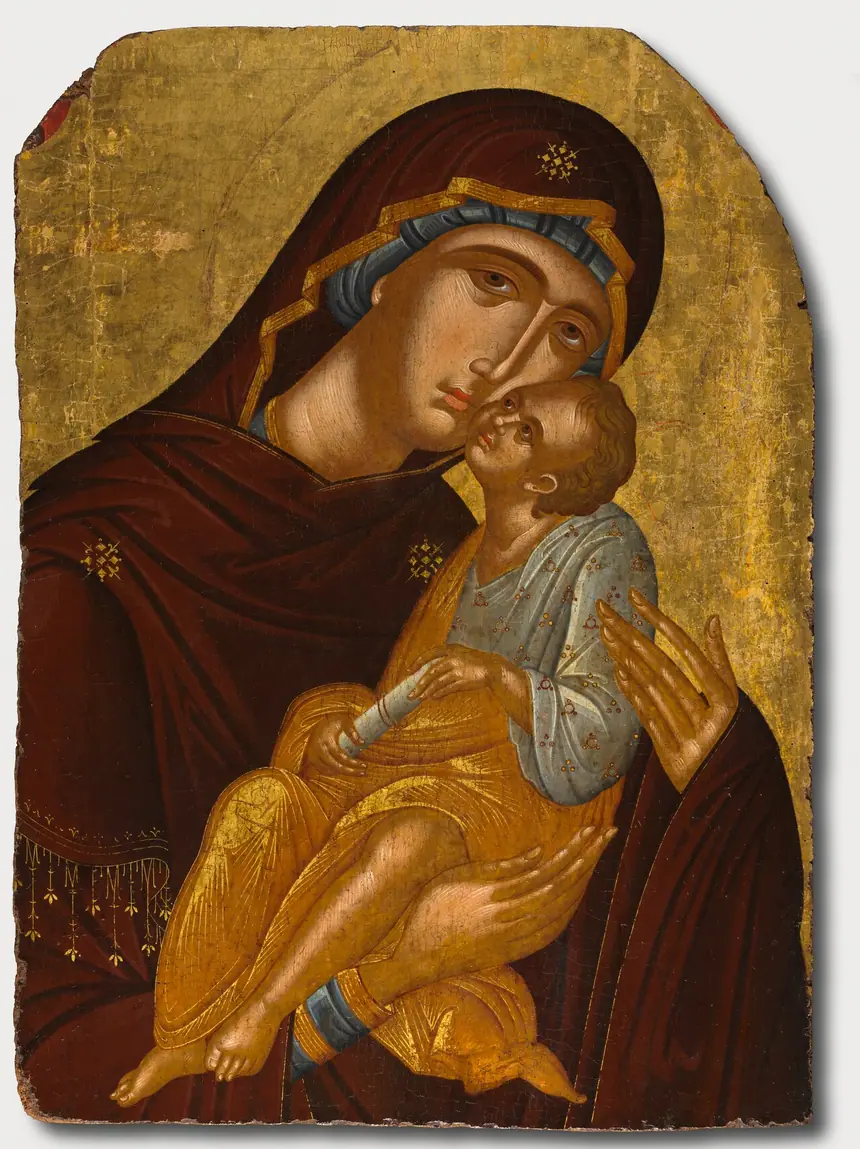
ἘλεούσαHow to recognize: The Child presses his cheek against his mother's cheekThe Greek name means tenderness or showing mercy. The best known example is the Theotokos of Vladimir, painted in the early 12th century, most likely in Constantinople. The icon was sent to Kiev around 1131, came to Vladimir in 1155, and according to tradition was brought to Moscow in 1395. Of the original paint, mainly the two faces survive. The Russian Church celebrates this icon three times a year.

Our Lady of the Sign
Znamenie · Oranta · PlatyteraHow to recognize: The Mother of God faces the viewer with both hands raised in prayer, and on her breast the Child appears within a circleThis image is linked to the words of Isaiah about the virgin who will conceive and bear a son named Emmanuel. The name Platytera means wider than the heavens, because the Mother of God carried the Creator in her womb. In a church this image is usually placed in the half-dome above the altar. The Znamenie icon of Novgorod is especially venerated because it is linked to the city's deliverance from a siege in 1170.

Our Lady of Kazan
How to recognize: A close view: the Mother of God inclines her head towards the Child, who stands upright, facing outwards, raising his hand in blessingIn 1579, after a great fire in Kazan, a young girl named Matrona saw the Mother of God in a dream showing her where the icon lay buried. On 8 July, mother and daughter dug up the icon from beneath the ashes. The priest who later wrote down this event was the future Patriarch Hermogenes. A second feast, on 22 October, recalls the liberation of Moscow in 1612. On the night of 29 June 1904 the icon was stolen from the monastery in Kazan and was probably destroyed. The icons venerated today are copies.

Our Lady of Tikhvin
How to recognize: Close to the Hodegetria type, with the Child seated in profile and his right foot turned underTradition tells that the icon appeared hovering over a lake near Tikhvin in 1383. Some art historians date it to about 1300 and attribute it to a Russian painter. During the Second World War the icon was taken away from Tikhvin, passed through Riga, and was brought to the United States in 1949 by Archbishop John Garklavs and kept in Chicago. In July 2004 it returned to the Dormition Monastery in Tikhvin.

Orthodox tradition holds that the Evangelist Luke was the first to paint the Mother of God, and many icons are linked to his name, among them the Hodegetria, the Vladimir icon and the Tikhvin icon. Wikipedia notes that the tradition naming Luke as the first icon painter dates from the 8th century, the time of the controversy over icons, and may not match the historical record. For the Vladimir icon, the first written account of Saint Luke painting it dates from 1512, while the icon itself is dated to the early 12th century.
Source: Wikipedia, Icon. Wikipedia, Our Lady of Vladimir. Wikipedia, Hodegetria. Orthodox Church in America (OCA), Wonderworking Tikhvin Icon Returns Home (news, 2004).VAngels, saints and the Trinity
Saint John the Forerunner
Prodromos · John the BaptistHow to recognize: A camel-hair garment, unkempt hair, a scroll in his hand. Many icons give him wings, and some show him holding a dish with his own headOrthodox Christianity calls him the Forerunner, the one who went ahead to prepare the way. St. Volodymyr Cathedral in Toronto explains that the wings express his role as a messenger of God, since the Greek word for angel originally means messenger, and also his life in the desert, as ascetic as the life of the angels. On icons he is called the Angel of the Desert. He stands beside Christ in the Deesis, and his icon usually has a place of honour on the iconostasis.

Deesis, the Prayer of Intercession
ΔέησιςHow to recognize: Christ in the centre, with the Mother of God and Saint John the Forerunner on either side, both bowing and raising their hands towards himDeesis means supplication: the Mother of God and Saint John intercede for humankind. The Mother of God stands at Christ's right hand and Saint John at his left. Larger sets add, in order, the Archangels Michael and Gabriel, then the Apostles Peter and Paul, then the Church Fathers. At first the set was placed on the beam of the sanctuary screen, and later it became a full tier of the iconostasis.


The Trinity by Andrei Rublev
TroitsaHow to recognize: Three winged angels seated around a table, with a cup in the middle of the tableThe icon depicts the three angels who visited Abraham at the oak of Mamre in the Book of Genesis. Rublev left out Abraham, Sarah and the preparation of the meal altogether, keeping only the three angels, the house, the oak and the mountain behind. The icon was painted in honour of Saint Sergius of Radonezh. In 1551 a council of the Russian Church held it up as a model for icon painters. Its date is still debated, with scholars proposing dates from 1408 to 1427. Which angel corresponds to which Person is also read in several ways. The Russian Church canonized Rublev in 1988.

Saint Nicholas
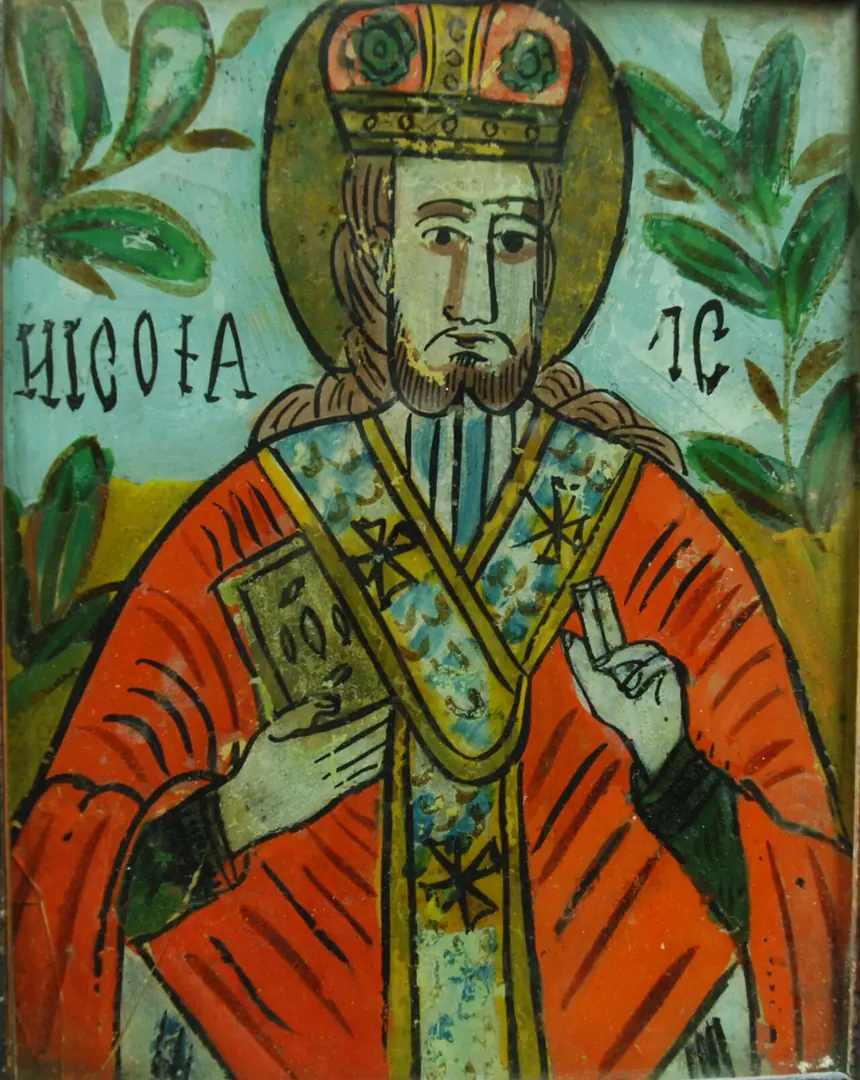
Bishop of MyraHow to recognize: An old man with a high forehead and a short white beard, in bishop's vestments with a stole marked with crosses, holding the Gospel bookSaint Nicholas was bishop of Myra in the 4th century, and his feast is on 6 December. He is the patron of sailors, merchants, travellers and children, and is very widely venerated in Russia. Many icons add two small figures at the level of his shoulders: Christ handing him the Gospel book and the Mother of God handing him the bishop's stole. These two figures recall a story about him at the Council of Nicaea.

Saint George
Great Martyr, Bearer of VictoryHow to recognize: A young beardless warrior in armour. In the first type he rides a white horse and spears a dragon, in the second he stands holding a spear and a swordAccording to tradition he was a Roman soldier, martyred around 303 under Emperor Diocletian for refusing to renounce his faith. His feast is on 23 April. He is the patron saint of Georgia and of the city of Moscow. The monastery named after him in Novgorod has a main icon painted around 1130, one of the oldest icons in Russia.


The Archangels Michael and Gabriel
Archistrategos · TaxiarchHow to recognize: Two young winged angels. Michael often wears armour and holds a sword or spear, and sometimes holds a staff and a sphereOrthodox Christianity calls Michael the Commander of the heavenly hosts. Gabriel is the one who brought the news to the Mother of God, so he appears in the Annunciation on the Holy Doors. The two are often painted on the two side doors of the iconostasis and stand on either side in the Deesis. The common feast of the angels is on 8 November. Gabriel also has his own feast on 26 March, the day after the Annunciation.
_-_Google_Art_Project.jpg)
.jpg)

VIThe twelve great feasts in icons
The Orthodox Church has twelve great feasts, each with its own type of icon, and the iconostasis often has a whole tier devoted to them. Easter (Pascha) is not counted among the twelve because it is regarded as the feast of feasts.
Source: Orthodox Church in America (OCA), The Orthodox Faith: The Church Year.The dates follow the list of the Orthodox Church in America. Churches that follow the old calendar celebrate on the same dates in the Julian calendar, which currently falls thirteen days behind the civil calendar. The recognition column is the library's own short description of the familiar icon of each feast, not the wording of the source.

.jpg)
.jpg)

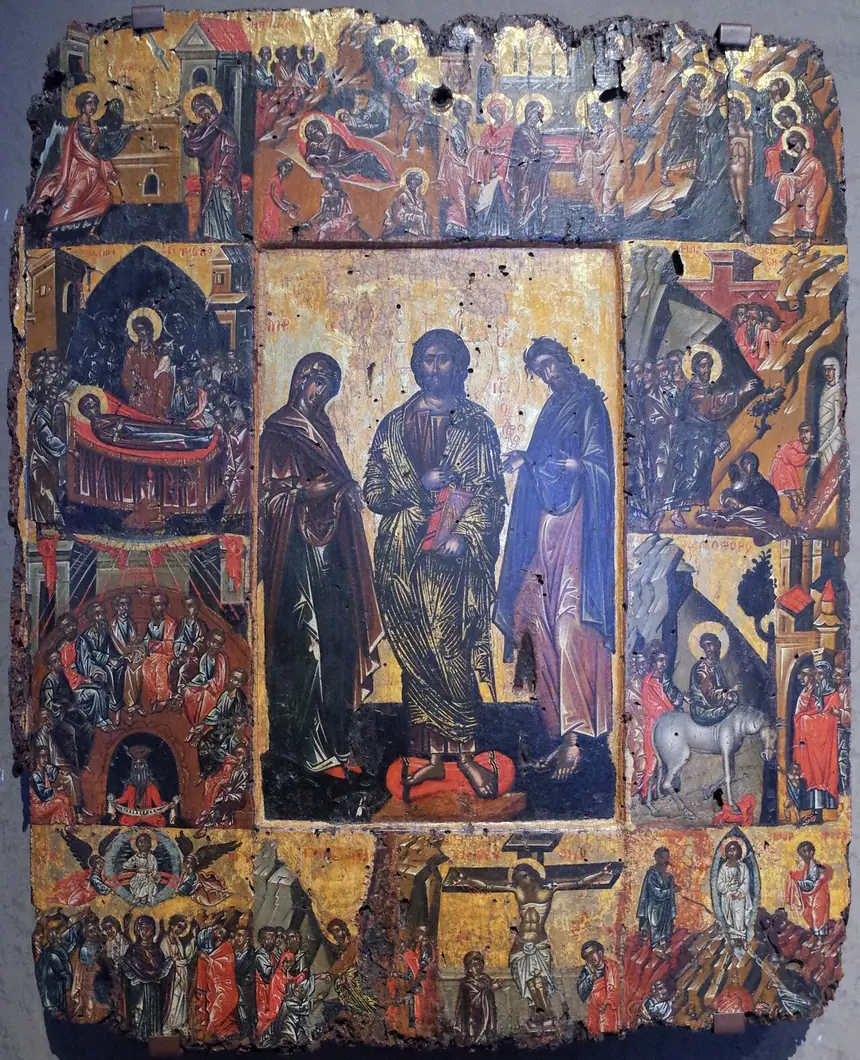
The two photos below are not among the twelve great feasts. The first is the Resurrection, in Greek Anastasis, on the wall of the Chora Church in Istanbul: Christ descends among the dead and takes Adam and Eve by the hand to raise them up. The second is the Crucifixion.


VIIThe iconostasis and the layout of the church
In an Orthodox church, between the nave and the sanctuary, stands a wall covered with icons called the iconostasis, that is, a screen of icons. At first it was only a low barrier, then it became a row of columns with icons placed between them, and by the 15th century it had become a solid wall. The Orthodox Church in America teaches that the iconostasis shows the unity of the community with Christ, the Mother of God, the angels and the saints, and notes that today many places have made the iconostasis open again, so that it joins the community to the altar rather than separating them.
Source: Britannica, Iconostasis. Wikipedia, Iconostasis. Orthodox Church in America (OCA), The Orthodox Faith: Icons.The diagram was drawn by the library to summarize a full Russian-style iconostasis. It does not show any particular church. Only the bottom tier is found everywhere. Wikipedia notes that the Deesis and feasts tiers can swap places, and that the upper tier may show the prophets and patriarchs or the apostles. A Greek iconostasis today often has only the bottom tier, sometimes with a row of small icons above it.

.jpg)
The bottom tier and the Holy Doors
The central doors are called the Holy Doors or the Royal Doors. They open directly onto the altar and have a curtain behind them. On the two leaves of the doors are the Annunciation and the four Evangelists. Above the doors there is usually the Mystical Supper. Lay people do not pass through the Holy Doors. The two smaller doors on either side show sainted deacons or the two Archangels Michael and Gabriel.
Source: Britannica, Iconostasis. Orthodox Church in America (OCA), The Orthodox Faith: Icons. Wikipedia, Iconostasis.The two large icons on either side of the Holy Doors have fixed places. Wikipedia states clearly that the sides are counted by someone standing in the nave and facing forward: the icon of Christ is to the right of the Holy Doors and the icon of the Mother of God with the Child to the left. Britannica gives the same right and left sides without saying from where they are counted, and explains that the icon of the Mother of God speaks of the Incarnation while the icon of Christ speaks of his second coming. Next come the icon of the saint or feast the church is named after, and often Saint John the Forerunner and Saint Nicholas.
Source: Wikipedia, Iconostasis. Britannica, Iconostasis.,_Arkhangelsk_Regional_Museum_of_Fine_Arts.JPG)

Inside the church
Beyond the iconostasis, icons cover the walls and vaults. By custom, the icon of Christ Pantocrator is at the centre of the church. The Mother of God with the Child is above the altar. The saints who composed the liturgies and hymns are painted in the sanctuary. The iconostasis of the Cathedral of the Annunciation in the Moscow Kremlin holds icons from the 14th to the 17th centuries, including some linked to the names of Theophanes the Greek, Andrei Rublev and Prokhor. The cathedral was badly damaged by fire in 1547, so which panels have survived intact from the start is still debated.
Source: Orthodox Church in America (OCA), The Orthodox Faith: Icons. Wikipedia, Cathedral of the Annunciation, Moscow. Wikipedia, Theophanes the Greek.The cross with three crossbars
The familiar cross of Russian Orthodoxy has three crossbars. The short top bar is Pilate's inscription. The slanted bottom bar is the footrest. The raised end is usually on Christ's right, the side of the penitent thief, and the lowered end on the side of the other thief. Byzantine art had a similar cross from the 6th century, but with the footrest slanting the other way. The Russian form has been used since the 16th century, and in 1551 it was first placed on church domes. Many other Orthodox churches use it too, but not all of them.
Source: Wikipedia, Russian Orthodox cross.
VIIIHow icons are venerated, and the icon corner at home
Orthodox Christians bow before icons and kiss them. The kiss is meant for the one depicted, not for the wood and paint. A guide reprinted in Orthodox America describes the familiar practice: make the sign of the cross and bow twice, kiss the icon, then make the sign of the cross and bow a third time. People kiss the hand, the foot, or the book or cross the saint holds, and not the face, since that would be overly familiar. A parish of the Orthodox Church in America gives the same advice and adds a request not to leave lipstick on icons.
Source: Orthodox America (archived on roca.org), Orthodox Practice on Venerating Icons. Christ the Saviour Orthodox Church (OCA), Harrisburg, A Guide to Church Etiquette. Wikipedia, Icon.Candles are lit as an offering that accompanies prayer. In front of an icon there is often a small oil lamp, called a lampada in Russian. Beeswax and olive oil are preferred because they burn cleanly. The same parish asks people not to go and light candles during the Epistle and Gospel readings, the processions, the Anaphora and the sermon.
Source: Wikipedia, Icon. Christ the Saviour Orthodox Church (OCA), Harrisburg, A Guide to Church Etiquette.
The icon corner at home
An Orthodox home has a corner for icons, which Russians call krasny ugol, the red or beautiful corner. The corner faces east and should be placed so that it is seen as soon as one enters the house. At the very least it holds an icon of Christ, an icon of the Mother of God and an icon of the family's patron saint. An oil lamp hangs in front of the icons. The corner also holds the Gospel book, a cross, candles, incense, holy water and branches from Palm Sunday. The whole family says morning and evening prayers there. By old custom, a guest entering the house venerates the icons first and only then greets the hosts. Russian icons are often covered with a chased metal cover called a riza or oklad, leaving only the faces and hands visible.
Source: Wikipedia, Icon corner. Wikipedia, Russian icons. Wikipedia, Icon._4Y1A8638_(28329466446).jpg)

IXIcons across regions and schools
The same patterns are painted in the manner of each land. Each region below has a few lines and one to three photos of real objects. Many places are still missing from the list, and the library will add them over time.
Sinai
Saint Catherine's Monastery, at the foot of Mount Sinai, founded in the 6th century, is the oldest Christian monastery still in continuous use for its original function. UNESCO notes that it holds some of the finest collections of early manuscripts and icons. Its 6th century encaustic panels are the oldest surviving icons.
Byzantium and Greece
After 843 the decoration of churches was arranged into a programme, and the portraits of the saints were standardized. The 11th and 12th centuries were the second golden age of Byzantine art, with gold-ground mosaics at Daphni, Hosios Loukas and Nea Moni. Mount Athos has been a centre of Orthodox monastic life since the 10th century and today has about twenty monasteries. The Protaton church there has wall paintings by Manuel Panselinos from about 1290. UNESCO notes that the Athonite school of painting shaped iconographic themes from Crete to the Balkans from the 16th century onwards.
Crete
After the fall of Constantinople in 1453, the island of Crete, under Venetian rule, became the centre of Greek painting until the Ottomans took the island in 1669. The style has precise outlines, flesh modelled with dark brown underpaint and dense tiny highlights, with added influence from the Italian Renaissance. Cretan workshops exported icons all over the Mediterranean, and a single order in 1499 was for 700 icons. The great names include Angelos Akotantos, Theophanes the Cretan, Michael Damaskinos and Emmanuel Tzanes.
Russia
Rus received the faith from Byzantium in 988 and received the art of the icon along with it. UNESCO calls Novgorod one of the oldest schools of painting in Russia. Theophanes the Greek came to Russia around 1370, and his wall paintings of 1378 in Novgorod are the only work attributed to him with certainty. Andrei Rublev (about 1360 to 1430) is regarded as Russia's greatest icon painter. Dionisius's wall paintings at the Ferapontov Monastery are his only cycle to survive intact. The evaluation report published on the UNESCO website calls Dionisius the leading Russian artist of the late 15th and early 16th centuries, while Wikipedia dates the paintings to about 1502 to 1503. After the reforms of the 17th century, the Old Believers kept the old manner of painting, while the official Church took in Western European influence.
Serbia
Wall painting is the pride of Serbian Orthodoxy. The Mileševa Monastery, founded by King Vladislav between 1234 and 1236, has the White Angel seated beside the tomb of Christ. The wall paintings of the Sopoćani Monastery, from about 1270 to 1276, are counted by UNESCO among the finest of Byzantine and medieval Serbian art.

Bulgaria
The Boyana Church on the outskirts of Sofia consists of three parts built in the 10th century, the early 13th century and the early 19th century. The layer of wall paintings of 1259 in the second part is regarded by UNESCO as one of the most important collections of medieval painting.

Georgia
The Gelati Monastery was founded by King David IV in 1106. The apse of its main church has a 12th century mosaic of the Mother of God holding the Child between two archangels. Georgians favour icons in chased gold and silver with cloisonné enamel. The Khakhuli triptych is 1.47 metres high and 2.02 metres wide when open, and carries 115 Georgian and Constantinopolitan enamels from the 8th to the 12th centuries. It was taken from Gelati in 1859, lost much of its gold and jewels, and only returned to Georgia in 1923.

Romania
Eight churches in Moldavia, built from the late 15th to the late 16th century, have wall paintings covering their entire exteriors and telling complete cycles of biblical subjects. The photo below shows the exterior wall of the Voroneț church. In 18th century Transylvania, icons painted on the back of glass, a folk tradition of their own, held a very important place in the lives of Orthodox peasants living under Habsburg rule.

Arabic-speaking Orthodox Christians
In Aleppo, Syria, under Ottoman rule, a school of icon painting was active from about 1645 to 1777. Its founder was the priest Yusuf al-Musawwir, that is, Joseph the Painter. The workshop drew on the Cretan tradition. The Last Judgement of 1703 is one of the best known works of the school.
.jpg)
A different communion: the Oriental Orthodox churches
The Coptic, Ethiopian, Armenian, Syriac and Malankara churches belong to the Oriental Orthodox family, also called the pre-Chalcedonian churches. This family separated from the rest after the Council of Chalcedon in 451 and is not in communion with the Eastern Orthodox Church that this page describes. The library gives only a few lines here so that readers do not confuse the two.
Source: Britannica, Oriental Orthodox church.Coptic (Egypt)
Coptic icons continue the art of late antique Egypt. Eyes and ears are drawn large, the mouth small, and the head larger than life. The panel of Christ and Abbot Mena in the Louvre, found at the monastery of Bawit and measuring 57 x 57 cm, is among the oldest surviving icons. In the mid 18th century icon painting revived in Egypt, and Yuhanna al-Armani is the best known name.


Ethiopia
In the 15th century Emperor Zara Yaqob (reigned 1434 to 1468) ordered that the Miracles of Mary be read and that the Mother of God be honoured on most feast days, and from then on icons of the Mother of God were painted in great numbers. Ethiopian icons are often diptychs or folding triptychs, with flat forms, large eyes and much geometric ornament.

Armenia
The characteristic sacred sign of the Armenians is the khachkar, an outdoor stone stele about 1.5 metres high, carved in the middle with a cross resting on a sun or a wheel, surrounded by plant and geometric motifs. Armenia has more than 50,000 khachkars, no two alike. UNESCO has inscribed the craft of carving khachkars on its list of intangible cultural heritage.

XWhat the library is not sure of
Are you an Orthodox Christian, a member of the clergy or a researcher, and have you found something inaccurate, or do you have a photo of your own to contribute? Please send it with its source to thayungkhiem@gmail.com. The library will correct the page and credit the contributor.
XIPhotos and licences
Every photo on this page comes from Wikimedia Commons, under Public domain, CC0, CC BY or CC BY-SA licences. Authors and licences are given exactly as on the original file pages, read on 07/10/2026. The photos have only been reduced in size, with no change to their content. Click the name of a photo to go to its original file page. If you are an author and see an incorrect credit, please let the library know so it can be corrected.
XIISources
The pages above were read in October 2026. If a page has changed its address, please let the library know so it can be updated.
?Quick Questions
Do Orthodox Christians worship icons
No. The Second Council of Nicaea in 787 made a clear distinction: icons are venerated, while worship belongs to God alone. The honour given to the image passes on to the one depicted.
Why are there no statues in Orthodox churches
No canon forbids statues, but from early on statues in the round were avoided because they were close to pagan worship. The tradition prefers flat images: panel paintings, wall paintings, mosaics, low relief. There are a few small-scale exceptions.
How can you recognize an icon of Christ
The halo around his head usually contains a cross, and the letters IC XC usually appear on either side of his head. In the Pantocrator type he blesses with his right hand and holds the Gospel book in his left.
Why does Saint John have wings in some icons
The wings express his role as a messenger of God, since the Greek word for angel originally means messenger, and his life in the desert, as ascetic as the life of the angels. This type of icon is called the Angel of the Desert.
Whose are the two icons on either side of the Holy Doors
For someone standing in the nave and facing forward, the icon of Christ is to the right of the Holy Doors and the icon of the Mother of God with the Child is to the left. On the doors themselves are the Annunciation and the four Evangelists.
What does the slanted bar on the Russian cross mean
It is the footrest. The raised end is usually on Christ's right, the side of the penitent thief. The short top bar is Pilate's inscription.