Đền Thờ Liệt Sĩ Bà Năm Nghĩa · formerly listed as Cô Năm Nghĩa's Memorial Hall · Comrades' Memory Museum
An Eight Mansions (Bát Trạch) plan drawn in 2011 and a hand drawing Mother Năm Nghĩa made from what fallen soldiers told her in dreams turn out to be the same. I record here what I saw with my own eyes on 9 October 2026.
UKNotes by Master Ung KhiemNotes written after the Bảo Lộc, Bà Rịa, Vũng Tàu field trip · Bà Rịa · 9 October 2026
Founded byMother Năm Nghĩaveteran Vũ Thị Minh Nghĩa, born 1953
Feng shui plan2011 to 2012drawn by Feng Shui Grand Master Thuận Thiên on Eight Mansions principles
Comrades' Memory MuseumBuilt in 2013beside National Route 56, Tam Long area, Bà Rịa
I
Eight Mansions Borne Out
Illustration of the eight trigrams and twenty four mountains, north at the top. This is not the site plan.
Study feng shui long enough and you grow used to two kinds of evidence. One is the book, the other is the land. The book teaches which direction is Life Generating (Sinh Khí) and which is Total Loss (Tuyệt Mệnh). The land keeps its silence, and only those who live on it for years learn whether the book was right. On the afternoon of 9 October 2026, in a garden beside National Route 56, I was shown a third kind of evidence, one I had never met in seven years of learning the craft.
That day I was travelling with the field-study group of Feng Shui Grand Master Thuận Thiên, on the way from Bảo Lộc down to Bà Rịa. He asked the whole group to stop and visit someone he had known for many years, Mother Năm Nghĩa, and a site he had drawn for her more than a decade earlier. I went along with no idea of the story I was about to hear.
Mother Năm Nghĩa's Account
Mother Năm Nghĩa is past seventy now. She speaks slowly and clearly. She told us that when she first began planning a place of worship for her comrades, the fallen soldiers came to her in dreams and instructed her on each matter, where the rock should be set, where there had to be a pond, where the main hall should stand, which corner the wind chime should hang from. She never studied feng shui. She simply remembered, and did as she was told.
In this line of work I have heard a good many dream stories. Most of them end with the telling, with nothing to check them against. Mother Năm Nghĩa's story differs in one respect. Running alongside the instructions from her dreams is a technical plan, made with a compass by someone who knew nothing of those instructions.
The 2011 Plan
Around 2011 to 2012, Master Thuận Thiên agreed to design the site for her. He drew the plan by Eight Mansions, the school of feng shui rooted in the eight trigrams. It divides a site into eight directions and assigns good or ill fortune to each through the du niên method. The four auspicious directions are Life Generating, Heavenly Doctor (Thiên Y), Longevity (Diên Niên) and Stability (Phục Vị). The four inauspicious ones are Total Loss, Five Ghosts (Ngũ Quỷ), Six Killings (Lục Sát) and Mishap (Họa Hại). Door, master and stove are the three essentials of a dwelling, and everything on the land must be placed so that each of the three sits where it belongs.
What follows is an old story that the two of them told our group together. When Master Thuận Thiên first came, the hall had not yet been built. Mother asked him to work out what should go where. He went back, refined the design and finished the plan, and some time later he came down again. This time Mother brought out a drawing of her own, made by hand. He felt hurt, thinking that she had asked him and then asked someone else as well. Mother told him she had asked no one. The fallen soldiers had told her which corner should hold what, and she had simply drawn it as they said.
Laid side by side, the place that needed a mountain, the place that needed a pond, the spot for the main hall and the spot for the wind chime, his Eight Mansions plan and her hand drawing were the same. He recalls being left speechless. One drawing came from a classical discipline, the other from instructions given across the divide, and they agreed point by point.
In 2013 the Comrades' Memory Museum was built on that land. More than a decade later, on the afternoon of 9 October 2026, the two of them sat down and told our group the old story, and then Master Thuận Thiên led the whole group around the site to see each feng shui placement in person, the rock, the pond, the main hall, the spot where the wind chime hangs.
Four points Master Thuận Thiên led the group to see on site. For each, there is the instruction from the dreams as Mother Năm Nghĩa recounted it, and the place he set by Eight Mansions reasoning.
01
The rock
Mountain anchor
Matches
Told in dreamsas Mother Năm Nghĩa recounts
The fallen soldiers told her to set the rock in one particular spot on the land.
On the planMaster Thuận Thiên, 2011
Seen from outside, the rock stands on the right, exactly where Master Thuận Thiên placed it on the plan. This is not the star-carved stone at the gate.
Eight Mansions reasoning
Stone is heavy and still. In feng shui it plays the part of the mountain, holding qi where qi tends to scatter and using stillness to check movement. Set in the wrong direction, a stone blocks the flow of vital qi, so its position can never be left to chance.
02
The pond
Gathered water
Matches
Told in dreamsas Mother Năm Nghĩa recounts
The fallen soldiers told her where there had to be a pond.
On the planMaster Thuận Thiên, 2011
The pond lies at the back, on the left, exactly where the plan puts it.
Eight Mansions reasoning
Qi halts when it meets water. Gathered water is where qi is held, so in the lineage I was taught, water belongs in the thriving direction of the dwelling. A pond dug in an inauspicious direction feeds the misfortune and lets it grow.
03
The main hall
Master of the dwelling
Matches
Told in dreamsas Mother Năm Nghĩa recounts
The fallen soldiers told her where the main hall should stand.
On the planMaster Thuận Thiên, 2011
The main hall on the plan stands in exactly that place.
Eight Mansions reasoning
The main hall is the master of the whole site, home to the altar and a thousand portraits. Of the three essentials, door, master and stove, the master must lie in an auspicious direction relative to the door for the dwelling to be at peace. This is the position that decides the fortune of the entire site.
04
The wind chime
Metal remedy
Matches
Told in dreamsas Mother Năm Nghĩa recounts
The fallen soldiers told her to hang a wind chime in one particular corner.
On the planMaster Thuận Thiên, 2011
The chime was a gift to Mother from the family of a fallen soldier living abroad, in thanks. Where she hung it is exactly the right feng shui position.
Eight Mansions reasoning
A chime is metal, and it is sound. Eight Mansions uses metal and sound to remedy an inauspicious direction, or to wake qi that has grown stagnant. Hung in the wrong place, its ringing stirs the very direction that needs quiet.
The original plan belongs to Master Thuận Thiên and Mother Năm Nghĩa, and the group did not view it. This page gives only positions as seen by eye, not the compass direction of each point. Anyone who wishes to check is asked to bring a compass and go there in person.
Our learning proved one hundred percent accurate. It matched exactly what the fallen soldiers had made known to Mother.
Master Thuận Thiên, at the memorial hall, 9 October 2026
A Note from the Writer
I do not write these lines to prove anything about the spiritual realm. That lies beyond what a student of feng shui can speak to. What I record is a story the two of them told together, and the places I was led to see with my own eyes. There were two sources with no connection to each other. One was a hand drawing by a woman who never studied feng shui, made from instructions given in her dreams. The other was a plan drawn with a compass by the Eight Mansions method. At all four points, they indicated the same place.
For practitioners, the matter worth thinking about lies in the discipline itself. Eight Mansions is often dismissed as simple, with its eight directions and its single du niên method. Yet that very simplicity, used faithfully from its roots, produced a layout that the person living on the land felt to be right. Master Thuận Thiên drew from what he had learned and studied at the source, and added nothing. The result on the ground is the answer.
II
The Woman Who Built This Place
Mother Năm Nghĩa, veteran Vũ Thị Minh Nghĩa
Mother Năm Nghĩa's real name is Vũ Thị Minh Nghĩa. She was born in 1953 in Thái Bình. At seventeen she enlisted and served as an army nurse. Those years left her with a debt to her comrades that she would carry for the rest of her life.
From 1996 she went back alone into the forests of the southeast (Đông Nam Bộ) to search for the remains of fallen soldiers and bring them together. At the time many people could not understand why a woman would go into the forest alone like that, and Tiền Phong newspaper ran a piece recounting those years. Her way of searching, which the press called psychic, has been debated from many sides. Today the remains of fallen soldiers are identified through DNA testing by the agencies responsible.
In 2003 the province of Bà Rịa Vũng Tàu granted her a plot of land beside National Route 56, in Hòa Long commune. Four construction companies gave their labour to build the first gratitude house (nhà tình nghĩa). From that house, the place gradually grew into the Comrades' Memory Museum it is today.
1953Born in Thái BìnhHer real name is Vũ Thị Minh Nghĩa.
1996Begins searching for her comradesReturns alone to the forests of the southeast.
2003Granted land beside National Route 56Four companies help build the first gratitude house.
2011 to 2012The Eight Mansions planMaster Thuận Thiên draws the plan, and on his return Mother shows him a hand drawing that matches it.
2013Comrades' Memory MuseumBuilt on Mother's land.
9 Oct 2026The field-study group visitsMother and Master Thuận Thiên retell the old story, and he leads the group to each placement.
III
The Main Hall and the Wall of Portraits
Past the gate, with its rock carved with a star and the four words Tổ quốc ghi công (The Fatherland Remembers Their Service), a brick path leads through a garden of large trees. Beneath one tree sits a white stone Buddha with an incense burner beside it. At the end of the path stands the front hall, its red tiled roof crowned with golden dragons above a row of vermilion columns. Before the porch are a stone incense burner, stone lanterns and a pair of cranes.
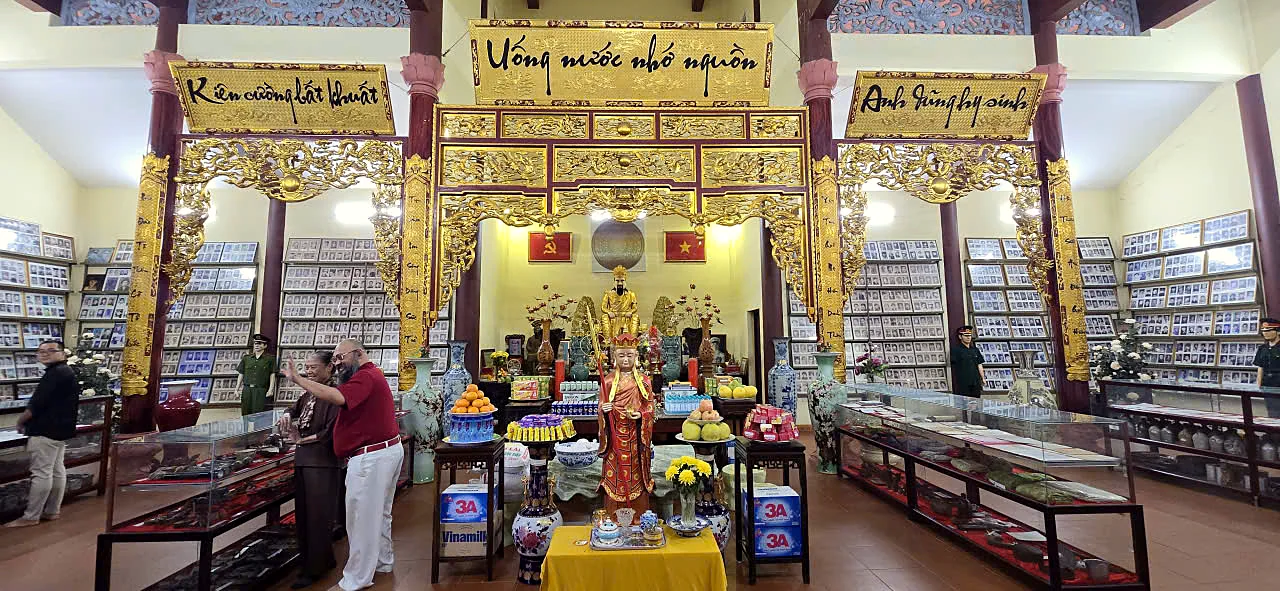
The main hall is tall and wide. Three carved and gilded wooden gateways stand in a row, each topped by a horizontal inscribed board reading Kiên cường bất khuất (Steadfast and Unbowed), Uống nước nhớ nguồn (When drinking water, remember its source), Anh dũng hy sinh (Fallen in Valour). The main altar honours all the fallen heroes together. In front of it stands a statue of Kṣitigarbha Bodhisattva (Địa Tạng) in a red robe trimmed with gold, the Bodhisattva to whom Vietnamese people pray that the souls of the departed may find release.
Thousands of framed portraits of fallen soldiers cover all four walls, row above row, people from every part of the country. For many of them, no family has yet been found, or they have not yet been brought home. In the middle of the room stand glass cases holding the keepsakes Mother Năm Nghĩa carried back from the forest, among them a dented canteen, a fountain pen engraved with a name, a comb cut from a scrap of metal, a rotted belt, and diary pages stained with earth.
The room next door is hung wall to wall with silk banners of thanks that the families of fallen soldiers have given her, from Thanh Hóa, Nghệ An, Hà Tĩnh and many other provinces.
IV
Remembrance Days Through the Year
The hall is open to visitors from near and far who come to burn incense. Incense smoke rises here all year round, but on certain days far more people come.
Date
Occasion
Calendar
27 July
Day of Wounded and Fallen Soldiers, when more people come than at any other time of year
Gregorian calendar
Full moon of the seventh month
Vu Lan, with Buddhist prayers for the release of the departed
Lunar calendar
22 December
Veterans' ceremony of gratitude
Gregorian calendar
Lunar New Year (Tết Nguyên Đán)
Incense offering at the start of the year
Lunar calendar
The main observances at the hall, from material gathered by Master Ung Khiem.
Visitors are asked to dress modestly, move and speak quietly in the main hall, and ask the caretaker before taking photographs. This is a place of worship, not a tourist site.
V
Photographs And Film
Photographs and film recorded on site by Master Ung Khiem and the group on 9 October 2026. The library only cropped and colour balanced them.
From the gate to the main hall, 66 seconds, silent
The gate, with the star stone inscribed Tổ quốc ghi công (The Nation Remembers)Kṣitigarbha Bodhisattva (Địa Tạng) before the main altarThe board Kiên cường bất khuất and the wall of portraitsCases of keepsakes Mother Năm Nghĩa brought back from the forestThe front hall with red tiled roof, censer and stone lanternsA seated Buddha beneath a tree in the garden
VI
The Visiting Group, 9 October 2026
The Bảo Lộc, Bà Rịa, Vũng Tàu field trip of the Institute for Research and Application of Feng Shui Architecture in Daily Life.
1Feng Shui Grand Master Thuận ThiênDirector of the Institute for Research and Application of Feng Shui Architecture in Daily Life, Feng Shui Practitioner Training Centre
2Artist Đức XuânDeputy Director, UNESCO Centre for Culture, Information and Communication
3Feng Shui Grand Master Vũ Phong
4Senior Brother Lôi Vũ
5Senior Sister Liên Thảo
6Master Tâm of Đà Nẵng
7, 8Master Nam and his wife
✦Master Ung Khiemauthor of these notes
The group with Mother Năm Nghĩa in the main hall. From the left, third Mother Năm Nghĩa, fourth Feng Shui Grand Master Thuận Thiên, fifth Master Ung Khiem, far right Feng Shui Grand Master Vũ PhongIn the room hung with thank you banners from soldiers’ families. From the left, third Artist Đức Xuân, fourth Mother Năm Nghĩa, fifth Master Thuận Thiên, seventh Master Ung KhiemMaster Ung Khiem with Mother Năm Nghĩa
VII
Acknowledgements
I bow my head in thanks to Feng Shui Grand Master Thuận Thiên, Director of the Institute for Research and Application of Feng Shui Architecture in Daily Life, Feng Shui Practitioner Training Centre. He has taught me Eight Mansions from my first days, let me join the Bảo Lộc, Bà Rịa, Vũng Tàu field trip, and brought me to this place to see what I had learned borne out on real ground.
I thank Feng Shui Grand Master Vũ Phong, who has also been my teacher on the path of this craft and guided the whole group throughout the field trip, and Artist Đức Xuân, Deputy Director of the UNESCO Centre for Culture, Information and Communication, who travelled with the group.
And with deep respect I give thanks to Mother Năm Nghĩa, who opened her home to us, told us this true story of real people, and for more than twenty years has kept a place for the fallen to come home to.
Master Ung Khiem · Bà Rịa, October 2026
VIII
The Place
Address
National Route 56, near Sông Cầu Bridge, Tam Long Ward (formerly Hòa Long Commune, formerly Bà Rịa City), Hồ Chí Minh City
Coordinates
10.55249, 107.20795
From central Bà Rịa, follow National Route 56 toward Châu Đức. The hall is on the right side of the road, near Sông Cầu Bridge and Châu Đức Industrial Park. At the gate stands a rock carved with a star and the words Tổ quốc ghi công.