
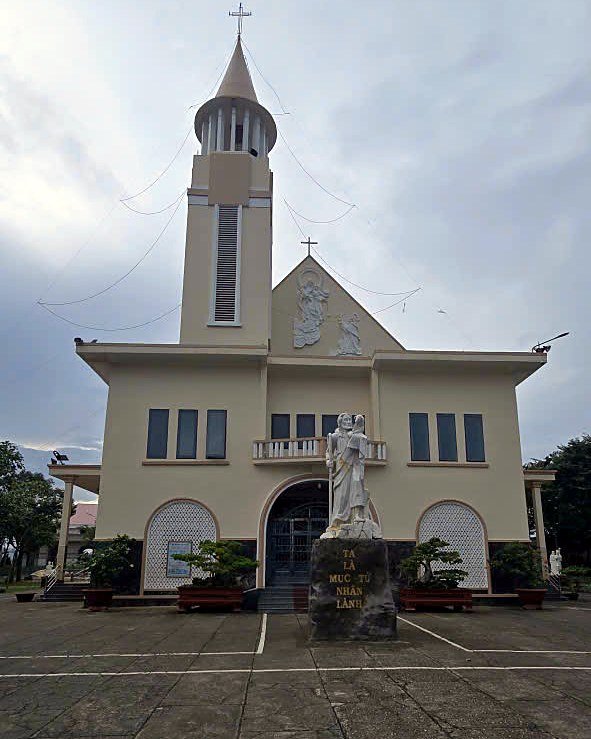
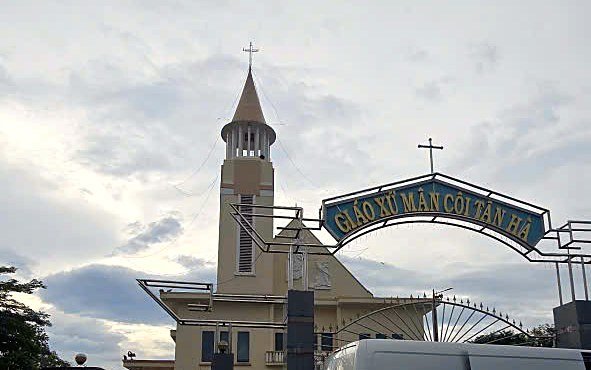
Follow any of the eight main roads of Tân Hà Village and you will be led to the same hilltop. There an arched iron gate bears the inscription Giáo xứ Mân Côi Tân Hà (Rosary Parish of Tân Hà), opening onto a wide pine-shaded courtyard, a cream-colored facade with a pointed bell tower set slightly to the left, and a white statue of Jesus the Good Shepherd before the main doors.
This is Tân Hà Church, a parish church of the Diocese of Đà Lạt dedicated to Our Lady of the Rosary. The building is modest in size and is not a ranked heritage monument. What earns it a dedicated entry is its setting, as the entire village founded in late 1954 was laid out around it with eight roads radiating from a single hub, a plan that villagers have preserved for more than seventy years. The founders borrowed the Eastern eight-trigram form and read its eight roads as the Eight Beatitudes of the Gospel.

ITân Hà, the Rosary, and the Eight Beatitudes
Tân Hà means New Hanoi. Tuổi Trẻ newspaper notes that the village's founders were largely from Hanoi and gave that name to their new settlement on the B'Lao plateau, the older name of the Bảo Lộc area. Công giáo và Dân tộc newspaper and the Diocese of Đà Lạt website specify that the first families came from Thái Hà Hamlet and Phùng Khoang Village in the Archdiocese of Hanoi, the same archdiocese as St. Joseph's Cathedral in Hanoi. Later on, families from Thái Bình, Bùi Chu, Bắc Ninh, and Thanh Hóa also joined the village.
The full name displayed on site is Nhà thờ Mân Côi Tân Hà (Rosary Church of Tân Hà), named after Our Lady of the Rosary, patroness of the parish. This is a parish church, not a cathedral. The cathedral of the Diocese of Đà Lạt is St. Nicholas Cathedral (Chicken Church).
The Rosary (Kinh Mân Côi) is a form of prayer using a string of beads. Worshippers move bead by bead, reciting one Our Father and ten Hail Marys for each decade while meditating on a mystery, meaning an event in the life of Jesus in which Mary was present, from the Nativity to the Passion and Resurrection. Catholics ask Mary to intercede for them before God rather than worshipping her as God.
The Eight Beatitudes (Tám mối phúc thật) are the eight blessings that open the Sermon on the Mount in chapter 5 of the Gospel of Matthew, blessing the poor in spirit, the meek, the merciful, the peacemakers, and four others. For Catholics, they summarize the way of life taught by Jesus.
Because the press often calls Tân Hà the eight-trigram village (làng bát quái), some visitors assume the settlement was laid out for geomantic divination or numerology. According to Công giáo và Dân tộc newspaper, that is not the case. The missionary priests and pioneer settlers intentionally borrowed the form of the Eastern eight trigrams for the street grid, while assigning it the meaning of their own faith, where eight roads evoke the Eight Beatitudes and all paths lead to the church. The eight-trigram nickname is an onlooker's comparison, whereas the Eight Beatitudes are what the founders intended to express.
IIFrom a thatched bamboo chapel to the church on the hilltop
The village originated with Catholic families who left Hanoi for the B'Lao plateau in late 1954. Accompanying them and organizing the settlement were two Redemptorist missionaries, Father Patrice Gagné (Vietnamese name Father Lợi) and Father François Laliberté (Vietnamese name Father Thái). Their first undertaking was to put up a thatched bamboo chapel, completed just before Christmas that year. In 1955, the villagers selected the highest point of the hill to build a permanent church (inaugurated on August 25, 1956), laid out the radiating village roads around it, and in 1970 to 1971 erected its bell tower.
- 1954Founding of Tân Hà Village and ParishThe Diocese of Đà Lạt website records October 7, 1954 (feast of Our Lady of the Rosary) as the parish founding date, and October 12, 1954 as the date the first group of 12 families led by the two priests arrived at kilometer 185 on National Highway 20.
- Late 1954First thatched bamboo chapelAccording to Tuổi Trẻ newspaper, the first thatched bamboo chapel (described by the Diocese of Đà Lạt website and Công giáo và Dân tộc as a thatch-and-leaf chapel) was completed before Christmas 1954.
- 1955 to 1956Building and inauguration of the hilltop churchVillagers chose the highest point of the settlement to build the church in 1955, inaugurating it on August 25, 1956, in the presence of Bishop Simon Hòa Nguyễn Văn Hiền and Monsignor Caprio, Representative of the Holy See. The eight-road layout was conceived by Father Patrice Gagné and drafted into a master plan by architect Nguyễn Văn Trọng.
- 1970 to 1971Construction of the bell tower and renovationsAccording to the Diocese of Đà Lạt website, during the pastorate of Father Giuse Nguyễn Minh Luân (1965 to 1973), assistant priest Father Phêrô Võ Trung Thành oversaw construction of the church's bell tower in 1970 to 1971 and added an upper story to the parish house in 1970. Công giáo và Dân tộc notes that the church underwent three construction and renovation phases while retaining its original facade, bell tower, and stone walls.
- 2024Seventieth anniversary of the parishIn October 2024, Bishop Đaminh Nguyễn Văn Mạnh of Đà Lạt presided over the Thanksgiving Mass celebrating the 70th anniversary of the parish (1954 to 2024). Villagers still maintain the original eight-road layout.
- 2025Parish statisticsIn early 2025, Công giáo và Dân tộc recorded 5,671 parishioners across roughly 1,300 households.
Points where sources differ are noted directly here. Regarding the two missionaries, Công giáo và Dân tộc, the Diocese of Đà Lạt website, and nhathothaiha.net all state that both priests were Canadian, whereas Tuổi Trẻ refers to Father Gagné as a French priest. Father Thái's name is spelled Françoise La Liberté in Công giáo và Dân tộc and François Laliberté in other sources, and this entry follows the latter spelling. Regarding the initial group of settlers, Công giáo và Dân tộc and the Diocese of Đà Lạt website record that the first convoy on October 12, 1954 consisted of 12 families, whereas Tuổi Trẻ and Dân Trí mention about 100 people. Both figures may refer to the initial pioneer group before subsequent waves arrived.
Regarding population, Công giáo và Dân tộc records 5,671 parishioners, Tiền Phong reports over 10,000 parishioners, and Tuổi Trẻ and Dân Trí state that the village has over 6,000 residents in roughly 1,500 households. The library records all three figures without choosing one. Regarding construction milestones, the Diocese of Đà Lạt website specifies the August 25, 1956 inauguration of the hilltop church and the 1970 to 1971 construction of the bell tower, while the exact year of the subsequent major renovation is not specified in press accounts.
IIIThe eight-road village and the church at its center
At Tân Hà, the primary work of architecture is the village itself. Công giáo và Dân tộc describes the parish as a giant octagon with the church at the center and eight roads radiating outward. According to Tuổi Trẻ, the eight main avenues are 10 meters wide with 6-to-8-meter paved carriageways, connected by smaller herringbone side lanes, so newcomers walking a circuit often find themselves back where they started. Công giáo và Dân tộc, the Diocese of Đà Lạt website, and Tiền Phong all note that the eight roads divide the hillside into seven zones. That figure of seven comes directly from the sources and is retained by the library. The site nhathothaiha.net notes that villagers agreed from the beginning to keep the church as the center without encroaching on the plan, and Tiền Phong quotes a local resident comparing the radial layout to the Arc de Triomphe district in Paris.
Architect Nguyễn Văn Trọng drew the village master plan. Who designed the church building itself, along with the exact height of the tower and dimensions of the nave, is not recorded in the sources consulted by the library. The architectural details below come from on-site observation based on photographs taken by Master Ưng Khiêm in October 2026.
An arched iron gate bearing the words Giáo xứ Mân Côi Tân Hà. Beside the gate stands a large boulder carved with calligraphic lettering.
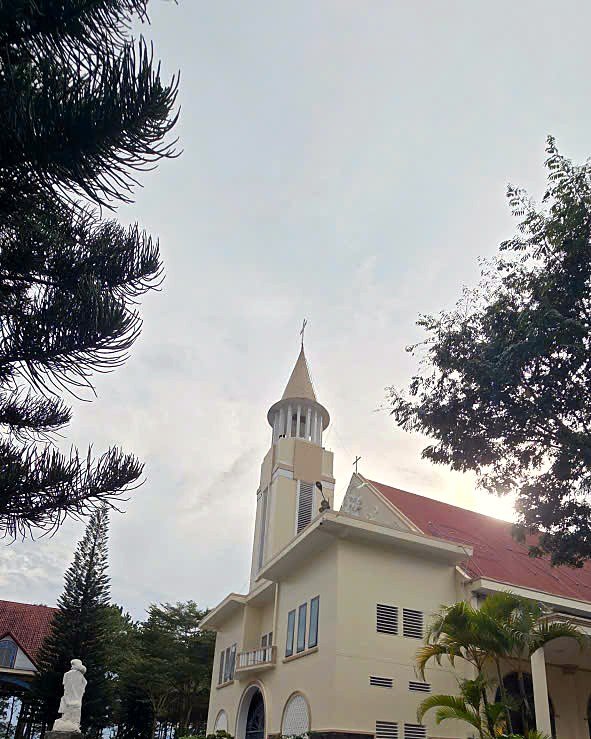
A cream-painted facade whose triangular gable features a relief of Our Lady holding the Child Jesus with a kneeling figure below, a classic motif of Our Lady of the Rosary, topped by a cross, with a balustraded balcony above the main entrance. The bell tower (built in 1970 to 1971) stands offset to the left when viewed from the courtyard, rising from a square shaft with vertical louvered slots to a circular belfry ringed by colonnettes and a pointed conical spire crowned with a cross.
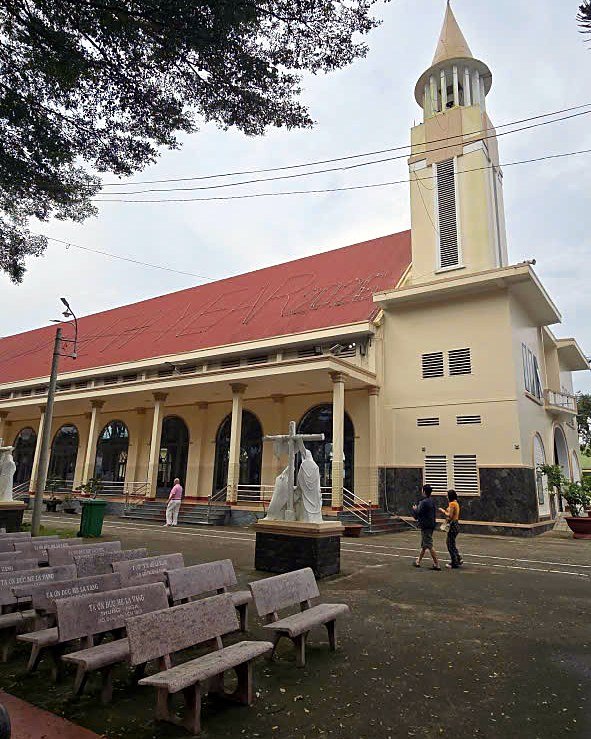
An elongated nave covered with a red tiled roof, flanked along the sides by columned corridors and tall arched windows.
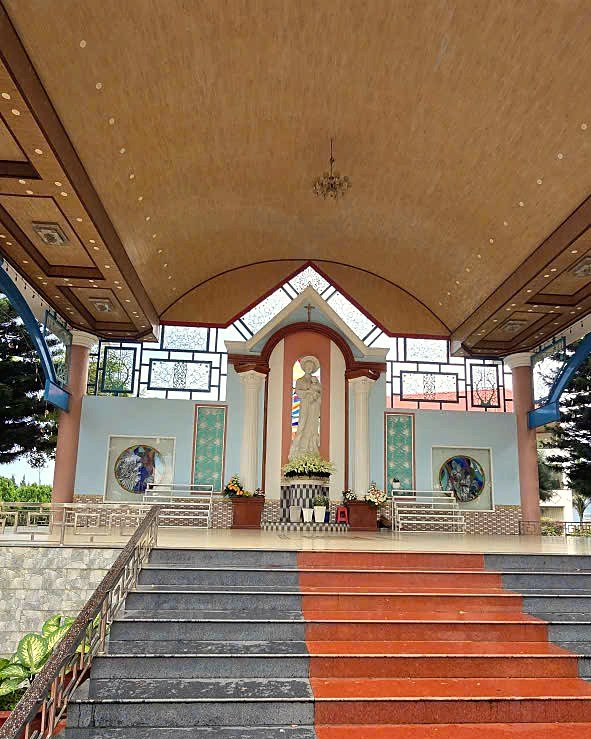
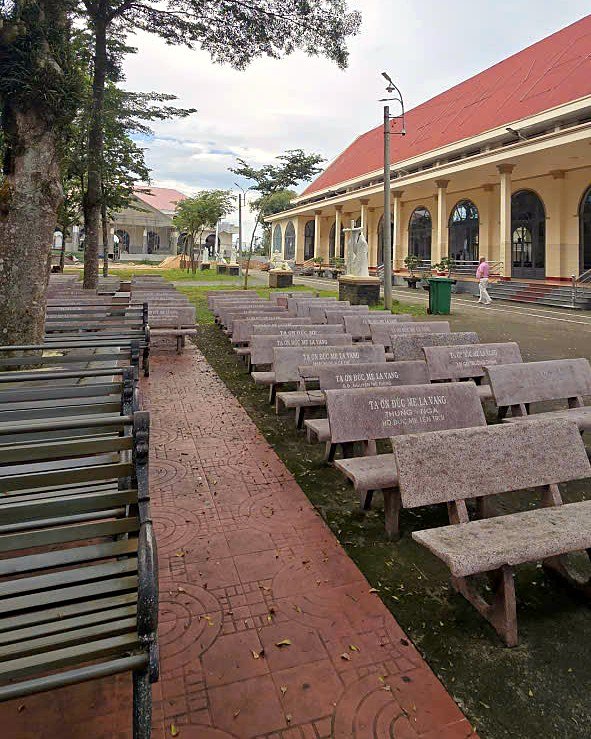
Before the main entrance stands a white statue of Jesus the Good Shepherd on a stone pedestal inscribed Ta là Mục Tử nhân lành (I am the Good Shepherd). In the courtyard stands an arched outdoor pavilion atop high steps, housing a central niche with a statue of Our Lady holding the Child Jesus, fronted by rows of stone and iron benches beneath the trees.
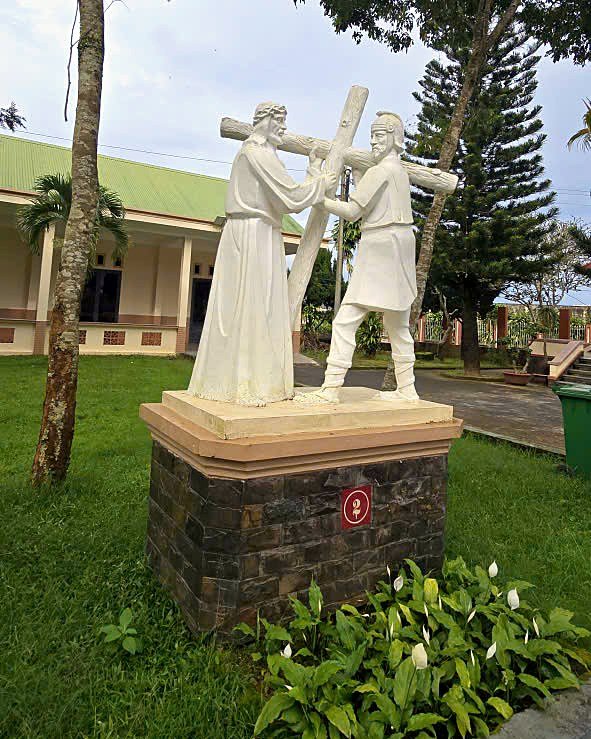
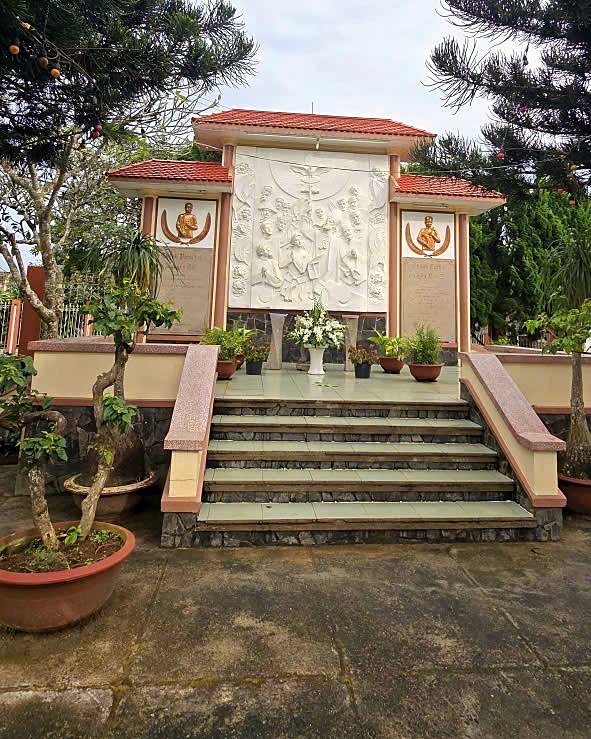
Stations of the Cross formed by white statues set on stone pedestals, including the station depicting Simon of Cyrene helping Jesus carry the cross. Nearby stands a stepped white relief monument depicting figures around the cross, flanked by two bronze-toned bust statues.
A wide paved courtyard surrounds the church, shaded by pines and tall trees. Adjacent to the grounds stands the catechetical school named Chân Lý (Truth), alongside a new structure under construction.
IVThe lie of the land and orientation
To state clearly at the outset, the Catholic Church does not teach feng shui. Churches traditionally follow liturgical orientation, and their siting also adapts to local terrain. Tân Hà has a distinctive feature in that, as Công giáo và Dân tộc records, the founding priests and settlers intentionally borrowed the Eastern eight-trigram form for the village layout while assigning it the Christian meaning of the Eight Beatitudes. Borrowing a geometric diagram is not the same as practicing geomantic divination. Regarding the compass orientation of the facade, written sources do not record a bearing and the library did not take a compass measurement on site, so no specific direction is stated. What follows is the library's reading through the lens of traditional Vietnamese geomancy rather than parish documentation, offered as a point of comparison for readers familiar with that tradition.
The first element to read is the hilltop setting. The church stands at the highest point of the village on the B'Lao plateau at an elevation of roughly 840 meters, with the terrain sloping gently downward on all four sides. Classical texts describe this as a high seat looking out over lower ground, comparable to the siting of Domaine de Marie Church in Đà Lạt. Gently sloping hill ground allows rainwater to drain evenly in all directions, keeping the foundation dry, a practical advantage in a high-rainfall highland region.
The second element is the eight evenly radiating roads. Viewed through traditional eyes, eight avenues extending toward eight directions resemble eight trigrams arranged around a central palace, where roads act as channels guiding qi. Both people and vital energy follow the avenues from eight directions to converge at the center where the church stands. The village founders read those eight roads as the Eight Beatitudes, while reading them as eight palaces surrounding a center is the library's geomantic comparison.
The third element is the bright hall (minh đường). The broad paved courtyard surrounding the church forms a level platform atop the hill where people ascending the slopes pause before entering the sanctuary, fulfilling the classical role of an open forecourt where energy gathers before a hall.
A hilltop seat also has a vulnerability, namely exposure to wind, as strong winds disperse gathered qi. The rows of pines and tall trees ringing the courtyard therefore serve as a windbreak, keeping the central forecourt calm. This is an observation on topography rather than a fortune-telling pronouncement for anyone.
VAnnual feast days at Rosary Parish
Tân Hà Church follows the general liturgical calendar of the Catholic Church reckoned by the solar calendar, together with special observances tied to its title of Our Lady of the Rosary. This article lists feast dates only, while Mass times are posted on the noticeboard at the church.
| Time | Feast | Calendar | Significance at Tân Hà |
|---|---|---|---|
| October 7 | Our Lady of the Rosary | Catholic liturgical calendar, solar, fixed date | Patronal feast and founding anniversary of the parish (October 7, 1954), celebrated under the church's title. |
| October | Month of the Rosary | Solar calendar | Entire month dedicated to praying the Rosary, coinciding with the month of the patronal feast. |
| May | Month of Flowers in honor of Mary | Solar calendar | Month of floral offerings to Our Lady. The Diocese of Đà Lạt website reports parish celebrations closing the Month of Flowers. |
| November 24 | Vietnamese Martyrs | Catholic liturgical calendar, solar, fixed date | Common feast celebrated across Vietnamese parishes. |
| December 25 | Christmas | Catholic liturgical calendar, solar, fixed date | The village's first thatched bamboo chapel was completed just in time for Christmas 1954. |
| March or April | Paschal Triduum and Easter | Catholic liturgical calendar, movable date | The most solemn liturgical celebrations of the Church year. |
Alongside the church interior, the parish grounds provide dedicated spaces for outdoor devotion, including the Marian pavilion with rows of benches beneath the pines and the Stations of the Cross in the garden. The Way of the Cross involves walking from station to station while meditating on the Passion of Jesus, a devotion especially practiced during Lent.
VIOn-site photographs
The nine photographs and short video clip below were recorded by Master Ưng Khiêm and his delegation when visiting Tân Hà Church in early October 2026 on a cloudy afternoon. Click any image to view it at full size.

Photographs and video recorded by Master Ưng Khiêm and delegation, October 2026. The library only cropped frames and balanced color, without adding or removing any details in the scene.
VIILocation And How To Get There
- Address
- Số 54A đường Phan Chu Trinh, Phường 3 Bảo Lộc (phường Lộc Tiến cũ, thành phố Bảo Lộc cũ), tỉnh Lâm Đồng
- Getting there
- The church is located at 54A Phan Chu Trinh Street, Ward 3 Bảo Lộc (formerly Lộc Tiến Ward, former Bảo Lộc City), Lâm Đồng Province. Upon reaching Tân Hà Village, following any of the eight main radial roads uphill leads directly to the church at the summit.
- Coordinates
- 11.5374, 107.7789
This is an active parish church rather than a tourist attraction. Visitors are asked to dress modestly, remove hats upon entering, walk quietly, and refrain from stepping onto the sanctuary platform. If arriving during Mass, please sit toward the back and do not photograph the congregation. The outdoor Marian pavilion and the Stations of the Cross in the garden are places of prayer, so please maintain silence when parishioners are praying. Mass times can be checked on the noticeboard at the church.
Nearby places in the library
VIIIContribute To This Page
Contribute photos, information or video for Tan Ha Church
Góp ảnh, thông tin hoặc video cho Nhà thờ Tân HàEveryone is welcome to enrich this page: a photo you took, a detail the page misses, a short video. Every contribution is read and answered.
Thầy Ưng Khiêm mời cộng đồng cùng làm giàu trang này. Ảnh chụp tận nơi, một chi tiết lịch sử chưa được nhắc, một đoạn video ngắn: mọi đóng góp đều được đọc và trả lời.
No community contribution yet. You could be the first. Chưa có đóng góp nào từ cộng đồng. Bạn có thể là người đầu tiên.
?Quick Questions
Where is Tân Hà Church in Bảo Lộc located
The church stands on the highest hilltop of Tân Hà Village at 54A Phan Chu Trinh Street, Ward 3 Bảo Lộc (formerly Lộc Tiến Ward, former Bảo Lộc City), Lâm Đồng Province. Situated at an elevation of about 840 meters on the B'Lao plateau, it is the hub toward which all eight main roads of the village converge.
Why is Tân Hà called the eight-trigram village
Because the village was laid out with the church at the center and eight roads radiating outward, resembling the eight-trigram diagram. According to Công giáo và Dân tộc newspaper, the founders intentionally borrowed that Eastern cultural form while assigning it the Christian meaning of the Eight Beatitudes in the Gospel rather than geomantic divination.
When was Tân Hà Church built
The village was founded in October 1954, its first thatched bamboo chapel was completed before Christmas that year, and in 1955 the church was built on the hilltop and inaugurated on August 25, 1956. The bell tower was built in 1970 to 1971, and the church has undergone three construction and renovation phases while retaining its original facade, bell tower, and stone walls.
Whom does Tân Hà Church venerate and when is its patronal feast
The church is dedicated to Our Lady of the Rosary, giving it the full name Rosary Church of Tân Hà (Nhà thờ Mân Côi Tân Hà). Its patronal feast falls on October 7 on the solar Catholic liturgical calendar, and the entire month of October is observed as the Month of the Rosary. It is a parish church of the Diocese of Đà Lạt, not a cathedral.
Who founded Tân Hà Village and what does the name Tân Hà mean
Tân Hà means New Hanoi, named by Catholic families from Hanoi who settled on the B'Lao plateau in October 1954. The settlement was organized by two Redemptorist missionaries, Father Patrice Gagné and Father François Laliberté, while architect Nguyễn Văn Trọng drafted the eight-road master plan based on Father Gagné's concept.