
Shinto is a religion in which the kami, as a rule, are not carved in a form for worshippers to look at. In the most solemn place of a shrine there is a closed door, and behind it is the shintai: a mirror, a sword, a jewel, sometimes an entire mountain. This page explains why, following Shinto's own sources, and then shows what visitors actually see: torii gates, straw ropes, pairs of komainu, the foxes of Inari, offering boxes, mirrors, gohei. It also covers the kami statues and paintings made in the age when kami and buddhas were treated as one, the household altar and the styles of main sanctuary. The photos show real objects, and the only drawing is a text diagram. The library publishes no photo or drawing of the three sacred treasures.
IThe kami take no visible form
Shinto venerates the kami. Jinja Honchō (the Association of Shinto Shrines) writes that the kami include both ancestors and spirits of nature. The Encyclopedia of Shinto of Kokugakuin University stresses one point: the kami are basically invisible, and only dwell for a time in natural objects or in ritual objects such as mirrors and gohei, and sometimes possess a human being. That is why there is no statue for worshippers to look up to in the most solemn place of a shrine.
Source: Jinja Honchō (Association of Shinto Shrines), What is Shinto. Kokugakuin University, Encyclopedia of Shinto: Kami, Definitions and Typology.The Metropolitan Museum of Art writes that before Buddhism spread, the Japanese did not depict kami in human form at all. The kami were seen in mountains, rivers and ancient trees. Statues of kami appeared later, but they were kept out of sight in the inner sanctuary, while worshippers still expressed their devotion at the entrance by clapping their hands.
Source: The Metropolitan Museum of Art, Shinto.What is venerated is called the shintai (神体, also goshintai or mitamashiro): an object in which the kami dwells. The shintai is kept in the main sanctuary (honden), the most sacred building of the shrine. Britannica describes the shintai as usually wrapped in cloth or placed in a box, kept in a small room or cupboard whose doors are seldom opened.
Source: Kokugakuin University, Encyclopedia of Shinto: Shintai. Jinja Honchō, The Jinja Precinct. Britannica, Shintai.


At the Ise Grand Shrine, the Holy Mirror, the symbol of Amaterasu Ōmikami, is enshrined in the main sanctuary in the innermost courtyard. The main sanctuary is enclosed by four rows of wooden fences, and worshippers usually pray in front of the gate of the third row. At Izumo Ōyashiro, the main sanctuary stands behind a fence with the Yatsuashi Gate, and only priests and people taking part in special prayer services may pass through it.
Source: Ise Grand Shrine (Ise Jingū), About Ise Jingu. Izumo Ōyashiro, Shrine Precincts.Saying that Shinto has no images at all is not the whole story. From the end of the Nara period, under the influence of Buddhism, wooden statues of kami (shinzō) were carved. The Encyclopedia of Shinto states that because they were placed deep inside the main sanctuary, these statues did not become direct objects of worship as Buddhist statues did. The same encyclopedia also counts kami statues as one form of shintai, alongside mirrors, swords, jewels and gohei. The section Kami statues and paintings below goes into more detail.
Source: Kokugakuin University, Encyclopedia of Shinto: Shinzō. Kokugakuin University, Encyclopedia of Shinto: Shintai.IIShintai: the object in which the kami dwells
There are two kinds of shintai. Those made by people are usually mirrors, swords or jewels. Those found in nature are a rock, a mountain, a waterfall. Jinja Honchō writes that before shrines had permanent buildings, the kami were believed to reside in trees and great rocks, either permanently or only for the duration of a ritual.
Source: Kokugakuin University, Encyclopedia of Shinto: Shintai. Britannica, Shintai. Jinja Honchō, Veneration of Nature.Mirror
kagami, shinkyōHow to recognize: A round metal mirror with a pattern cast on the backThe Encyclopedia of Shinto notes that since ancient times mirrors, together with swords and jewels, have carried deep religious meaning, and they have been used as objects for the kami to dwell in at shrines. The most famous mirror is the Yata no Kagami at Ise. The library has no photo of a mirror that is serving as a shintai, because a shintai is never brought out to be photographed. The one in the photo is a sacred mirror displayed in the Treasure Hall of Itsukushima Shrine.
_-_DSC02205.JPG)
Mountain
shintaizanHow to recognize: A shrine with no main sanctuary, its worship hall facing straight toward the mountainA shintaizan is a mountain venerated because a kami dwells in it. The example usually cited is Ōmiwa Shrine in Sakurai, Nara Prefecture. The shrine venerates Mount Miwa. Behind the worship hall is an area closed to human entry, and no main sanctuary has been built, because the mountain itself is the body of the kami. Mount Fuji and Mount Nantai at Nikkō also belong to this type.


Waterfall
NachiHow to recognize: A waterfall dropping in a single straight fall from a high cliffNachi Falls in Wakayama Prefecture has a drop of 133 metres and is believed to house the kami Hiryū Gongen, venerated at Kumano Nachi Taisha. UNESCO includes the Kumano area in the Kii Mountain Range World Heritage Site and notes that the sacred sites here reflect a fusion of Shinto, rooted in nature worship, with Buddhism.

Trees and rocks
shinbokuHow to recognize: A tree trunk or rock wrapped with a straw rope and white paperAlmost every shrine has a sacred forest. A tree singled out for special reverence is called a shinboku, and it often has a shimenawa rope tied around it. A rope like this around a tree or a rock shows that it is sacred.

The three sacred treasures
The three sacred treasures (Sanshu no shinki) are the mirror Yata no Kagami, the sword Kusanagi no Tsurugi and the jewel Yasakani no Magatama. According to legend, Amaterasu gave these three objects to her grandson Ninigi when he descended to earth, and they were handed down as symbols of the imperial throne. The Encyclopedia of Shinto records that the original mirror is enshrined at the Ise Grand Shrine and the sword at Atsuta Jingū, while the jewel has been kept by successive emperors. A replica of the mirror is enshrined in the Kashikodokoro in the imperial palace.
Source: Kokugakuin University, Encyclopedia of Shinto: Sanshu no shinki. Ise Grand Shrine (Ise Jingū), About Ise Jingu. Atsuta Jingū, Introduction.The three treasures are never shown to the public. According to Wikipedia, by tradition only the emperor and certain priests see them, and during enthronement ceremonies they remain hidden in boxes and wrappings. The library therefore publishes no image of them, not even a conjectural drawing. The Encyclopedia of Shinto also records that the palace sword was lost at sea with the child emperor Antoku in the final battle between the Minamoto and Taira houses, and another sword later had to be used in its place.
Source: Wikipedia, Imperial Regalia of Japan. Kokugakuin University, Encyclopedia of Shinto: Sanshu no shinki.IIIWhat a visitor sees at a shrine
Because the shintai is behind closed doors, what visitors see are signs that mark the ground as sacred. The diagram below goes from the outside in, following the way Jinja Honchō describes a shrine precinct.
Source: Jinja Honchō, The Jinja Precinct. Kokugakuin University, Encyclopedia of Shinto: History and Typology of Shrine Architecture.Not every shrine has all these layers. Some shrines have no worship hall, and some have no main sanctuary because the shintai is an entire mountain.
Torii gate
鳥居How to recognize: Two upright pillars and two crossbeams, the upper beam extending past the pillarsA torii marks the entrance to sacred ground. Jinja Honchō writes that the presence of a torii is a clear sign of a shrine. Torii are sometimes painted vermilion and are usually made of wood or stone. Two common types are the myōjin torii, whose upper beam curves upward, and the shinmei torii, which is unpainted with a straight upper beam. The Encyclopedia of Shinto notes that the origin of the torii is still debated, and it is not known whether it is native to Japan or was brought from abroad. At Fushimi Inari, offering a torii had become widespread by the start of the Edo period, and today there are about 10,000 gates of all sizes along the mountain paths.


Shimenawa rope and shide paper
How to recognize: A twisted straw rope hung with white zigzag paper streamersA shimenawa is a straw rope hung in front of or around a place to mark it as sacred and pure space: before the inner sanctuary, at the entrance to the shrine, around a ritual site. The rope is usually twisted to the left, with loose stalks of straw hanging from it in places, and shide paper streamers may be attached. The Encyclopedia of Shinto explains that the word shime originally referred to a sign that something was owned.

Komainu
狛犬How to recognize: A pair of lion-like animals, one with its mouth open, one with its mouth closedKomainu are a pair of guardian statues placed at the entrance to shrine buildings, beside a torii or along the approach. Most are of stone, but some pairs are of wood, bronze, iron or ceramic. The open and closed mouths are called a-un. The name literally means Korean lions. The Encyclopedia of Shinto suggests that the word may simply have been used to mark them as animals from abroad, and that the type of statue found in Japan follows Tang dynasty models. The Cleveland Museum of Art calls the open-mouthed animal a karashishi (Chinese lion) and the closed-mouthed one a komainu. Komainu are not kami.


Foxes at Inari shrines
kitsuneHow to recognize: A pair of seated foxes in place of komainu, some holding a key in the mouth, some wearing a red bibAt shrines of the kami Inari, the guardian position belongs to foxes. Fushimi Inari Taisha writes that the foxes are messengers of Inari Ōkami and not the kami itself, and that they are invisible white foxes, not the ordinary foxes of the hills. The Jinja Honchō page, by contrast, writes that the fox is thought to be a symbol of the kami itself. The library records both ways of putting it and follows the shrine itself: the fox is a messenger.

.jpg)
Worship hall and offering box
haiden, saisenbakoHow to recognize: The front building, with a slatted wooden box for coinsThe worship hall is where ceremonies are held and is the building a visitor sees most clearly on entering. In front of it stands the saisenbako. The usual way of praying, according to Jinja Honchō, is to drop in a coin, bow deeply twice, clap twice and bow once more. Izumo Ōyashiro has its own custom of two bows, four claps and one bow.

The mirror in front of the sanctuary
How to recognize: A round mirror on a stand, in the middle of the hall, facing the worshipperLooking into many shrines, the thing at the very centre of view is a round mirror on a stand. The Encyclopedia of Shinto notes that mirrors are used as objects for the kami to dwell in and also as shrine treasures. The library has not yet read any official source that explains this outer mirror in particular, so it only describes what the photo shows.
-%E6%8B%9D%E6%AE%BF%E5%86%85%E9%83%A8inabajinja006.jpg)
Gohei and ōnusa
How to recognize: A wooden stick with zigzag paper streamersA gohei is an upright stick with strips of paper or cloth folded in zigzags hanging down on either side. Britannica describes the gohei as an offering to the kami, and according to one point of view also a sign that the kami is present in the shrine. The Encyclopedia of Shinto lists the gohei among the forms of shintai. The ōnusa is a wand with many paper streamers that a priest waves over the participants and offerings in the purification rite (oharai).


Sakaki branch and tamagushi
How to recognize: A green leafy branch tied with white paperA tamagushi is a sakaki branch with folded paper tied to it. The worshipper holds it in front of the chest with the leaves upward, prays silently, then places it on the table with the stem pointing away and the leaves toward them. Common offerings to the kami are rice, sake, rice cakes, fish, vegetables, fruit, salt and water.

IVOfuda, amulets and prayer plaques
Visitors do not take images of the kami home. What they take home are objects bearing the name of the kami or of the shrine. Jinja Honchō writes that ofuda and omamori carry the power of the kami. Ofuda are placed on the household altar to protect the family, while omamori are carried on the person.
Source: Jinja Honchō, Taking It Home.


The Encyclopedia of Shinto records that throughout the early modern period, the travelling priestly agents (oshi) of the Ise Grand Shrine distributed sacred plaques called Jingū taima across the country. The same encyclopedia says that mamorifuda amulets originated in talismans made by onmyōdō diviners and at Buddhist temples, and only later came to be produced at Shinto shrines as well.
Source: Kokugakuin University, Encyclopedia of Shinto: Shinsatsu, Mamorifuda.VKami statues and paintings
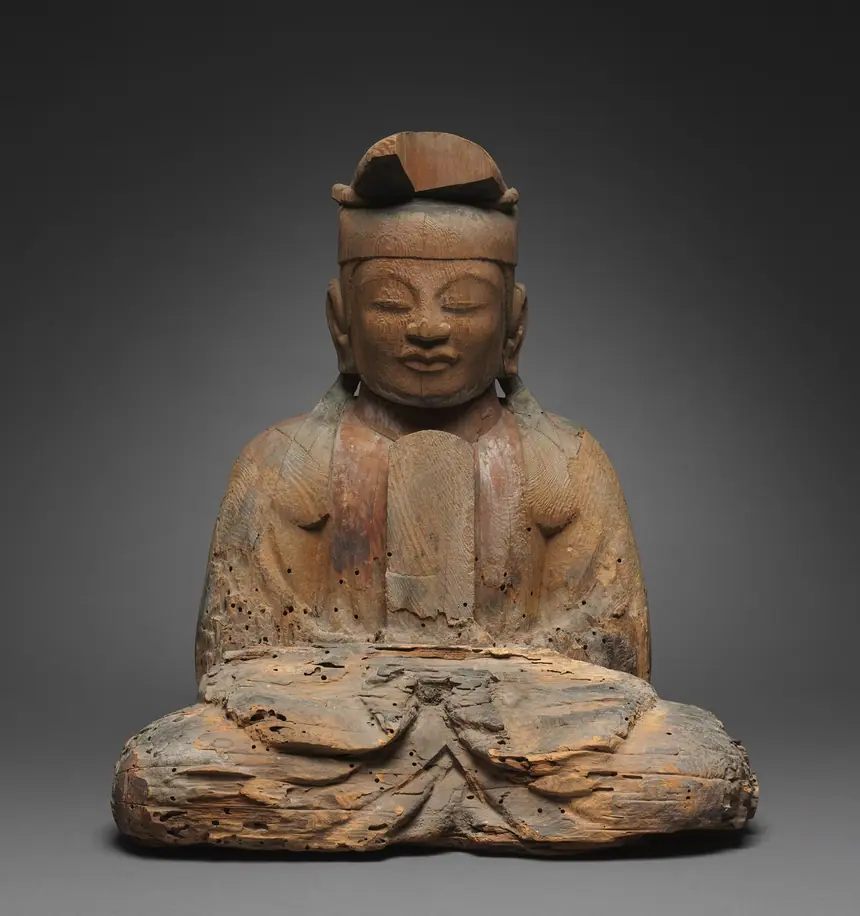
Kami statues (shinzō, 神像) are wooden images carved from the end of the Nara period, modelled on Buddhist sculpture. In the Heian period, as the tendency to identify kami with buddhas (shinbutsu shūgō) grew stronger, kami statues were installed in shrines together with statues of the buddhas identified with those kami. Kami statues take two forms: as a Buddhist monk (sōgyō) in a robe with a surplice, and as a lay person (zokutai) in court dress. Male kami wear a tall formal headpiece and a wide-sleeved robe. Female kami have their hair bound in a topknot with the rest falling down the back. From the 11th century the statues gradually became smaller.
Source: Kokugakuin University, Encyclopedia of Shinto: Shinzō.The statues below were originally kept hidden. The photos on this page are photos printed long ago in art books, or photos published by museums. The library does not place these statues in the shrines of the Main Hall.
The three kami statues of Matsunoo Taisha
KyotoHow to recognize: A male kami in a court cap, a female kami with flowing hair, seated cross-leggedThe Shinzōkan statuary hall of Matsunoo Shrine (also read Matsuo) holds 21 statues, among them three large wooden Heian period statues believed to portray the shrine's main kami. A text from Japan's Ministry of Land, Infrastructure, Transport and Tourism counts these three among the oldest and best preserved Shinto statues.
_Matsunoo-taisha.jpg)
The Hachiman triad at Yakushi-ji
NaraHow to recognize: Hachiman as a monk, flanked by two goddesses in coloured robesThe triad consists of Hachiman as a monk, Empress Jingū and Nakatsuhime, in painted wood, made around 889 to 898 and enshrined at the temple's guardian shrine. The statues are all small, under 40 centimetres tall. The list of National Treasures on Wikipedia calls them the oldest statues of their kind in Japan.

Kaikei's Hachiman in the guise of a monk
Sōgyō Hachiman, Tōdai-jiHow to recognize: A monk seated on a lotus pedestal, holding a staff, with a halo behind the headTōdai-ji describes it as a secret image, carved by Kaikei in 1201 and enshrined in the Hachiman Hall at the rear of the Kanjin-sho compound. The temple describes eyes looking slightly upward and raised eyebrows, carved naturalistically yet with the authority of a kami. The statue is 87.1 centimetres tall and is a National Treasure. According to Wikipedia, it is shown to the public once a year, in October.
.jpg)
Tamayorihime at Yoshino Mikumari Shrine
NaraHow to recognize: A seated goddess with crystal eyesA statue of joined wooden blocks with crystal eyes, 83 centimetres tall, dated 1251, in the Kamakura period, and a National Treasure. The library has not found a large enough openly licensed photo, so no photo is shown.
Source: Wikipedia, List of National Treasures of Japan (sculptures).Kami statues in museums
How to recognize: A small wooden statue, carved from a single block, in court dress, its colours fadedMany kami statues are now in museums and often have lost their names. The Cleveland Museum of Art holds two 10th century figures said to have been made for the Usa Hachiman shrine in Kyushu, and states plainly that it is not known who they are.

Kami paintings and shrine mandalas
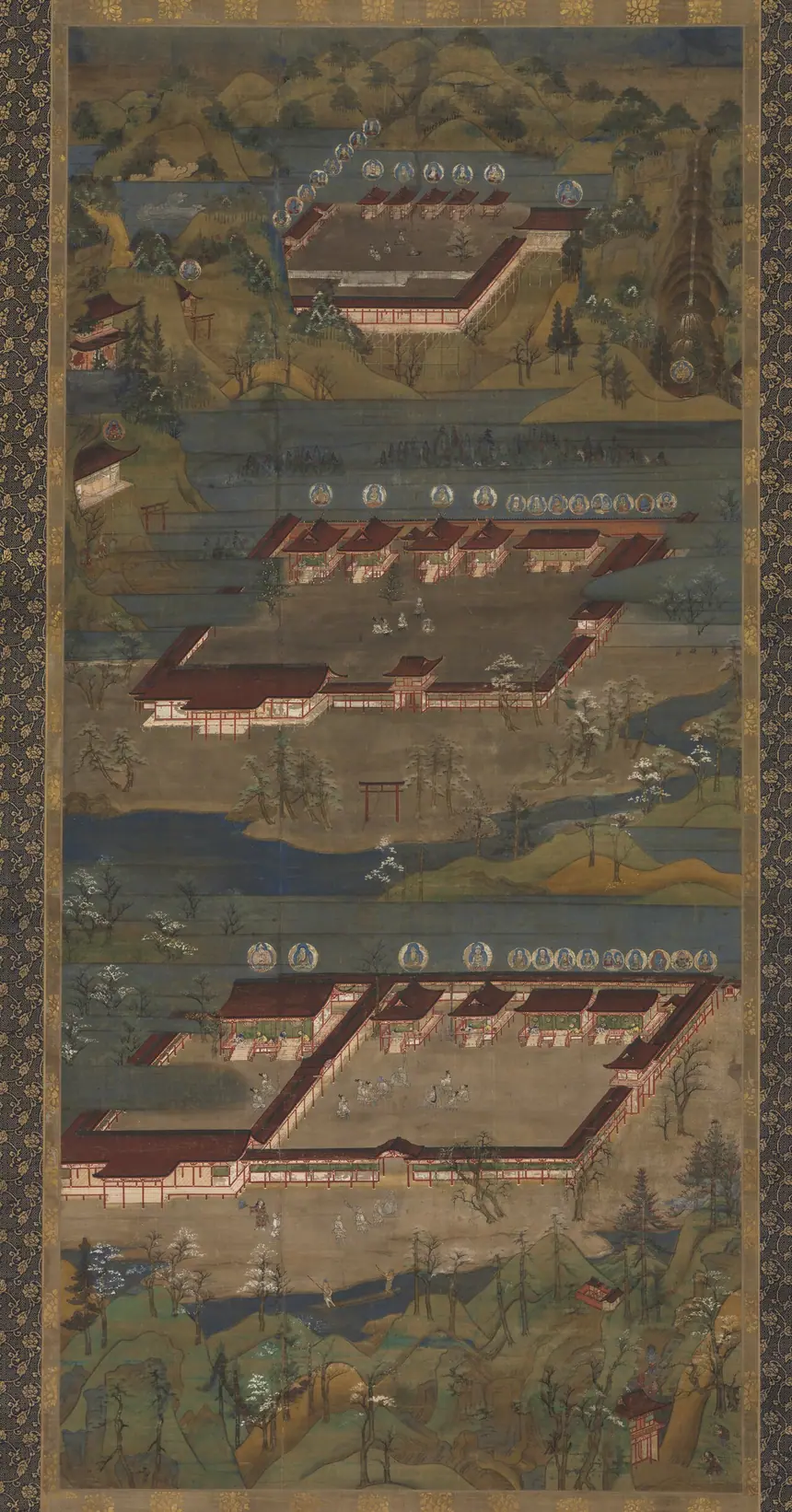
Shinto devotional paintings of the medieval period usually show the shrine rather than the face of the kami. The Metropolitan Museum of Art describes a late 14th century Kasuga Deer Mandala: the deer is the mount of the kami Takemikazuchi, and its saddle supports a sakaki tree entwined with wisteria vines, topped by a golden disc holding five buddhas and bodhisattvas. The painting in the Nara National Museum shown here is of the same type, made in the Kamakura period, 13th to 14th century.
Source: The Metropolitan Museum of Art, Deer Mandala of Kasuga Shrine. National Institutes for Cultural Heritage (Japan), e-Kokuhō, 春日鹿曼荼羅 (Kasuga Deer Mandala).The Kumano Mandala shows the three Kumano shrines from a bird's-eye view. According to the Cleveland Museum of Art, the buddha identified with the kami of each shrine hall is painted in a disc directly above that hall. The Nachi Waterfall painting in the Nezu Museum is a National Treasure: the museum calls it the only suijaku painting that depicts nothing but the waterfall, which is the shintai of the kami Hiryū Gongen.
Source: The Cleveland Museum of Art, Mandala of the Three Shrines at Kumano (1953.16). The Metropolitan Museum of Art, Kumano Mandala. Nezu Museum, 那智瀧図 (Nachi Waterfall)..jpg)

In the late Heian period, people began engraving images of kami, or of the buddhas identified with them, on mirrors and dedicating them to shrines. These are called mishōtai.
Source: Kokugakuin University, Encyclopedia of Shinto: Kagami.The honji suijaku theory holds that the buddhas are the original ground, appearing provisionally as the kami of Japan to save sentient beings. From the 10th century the theory spread gradually across the country, and by the end of the Heian period the kami of each shrine had been assigned a buddha: Dainichi Nyorai for the kami of Ise, the Eleven-Headed Kannon for the kami of Mount Hakusan. From the end of the Kamakura period some schools reversed this, treating the kami as the original and the buddhas as the manifestations. In 1868 the Meiji government ordered the separation of kami and buddhas (shinbutsu bunri): Buddhist monks serving at shrines were made to return to lay life, Buddhist titles such as gongen were banned for kami, and Buddhist statues could no longer serve as shintai. In many localities these orders turned into a movement to destroy temples and images, which lasted until 1871. The Encyclopedia of Shinto notes that because of this separation, very few shrines today still keep kami statues.
Source: Kokugakuin University, Encyclopedia of Shinto: Honjisuijakusetsu. Kokugakuin University, Encyclopedia of Shinto: Bukka Shintō. Kokugakuin University, Encyclopedia of Shinto: Shinbutsu Bunri. Kokugakuin University, Encyclopedia of Shinto: Shinzō.VIThe household kami altar
A kamidana is a shelf set aside as a sacred space in the home, where the kami are venerated all year round. Jinja Honchō recommends placing it somewhere clean and bright where the household gathers, slightly above eye level, facing east or south if possible. It also writes that being easy to reach to tend the altar matters more than facing the right direction.
Source: Jinja Honchō, Household Matsuri.There are no statues on the shelf. The kami are venerated through ofuda plaques obtained from shrines. Most households enshrine the ofuda in a small wooden shrine called a miyagata. The most important plaque is the Jingū taima of the Ise Grand Shrine, through which people venerate Amaterasu Ōmikami. Next comes the ofuda of the local tutelary kami (ujigami), and then those of other shrines. In a miyagata with three compartments, the Jingū taima goes in the centre.
Source: Jinja Honchō, Household Matsuri. Britannica, Kamidana.According to Jinja Honchō, salt goes on the right and water on the left, as seen by the person standing in front of the altar. The shimenawa rope and green branches follow Britannica.


Britannica notes that many Japanese homes have both a kami altar and a Buddhist altar (butsudan) in the same house.
Source: Britannica, Kamidana.VIIStyles of main sanctuary and the great shrines
In the beginning there were almost no permanent shrine buildings. Rituals were held outdoors, at places with sacred trees or rocks, under a temporary roof. Shrines came into being when those roofs were left in place instead of being taken down after the ritual. Once the style of a shrine's main sanctuary was set, it usually stayed almost unchanged, especially at shrines with a custom of periodic rebuilding.
Source: Kokugakuin University, Encyclopedia of Shinto: The History of Shrines. Kokugakuin University, Encyclopedia of Shinto: Introduction, Jinja. Kokugakuin University, Encyclopedia of Shinto: History and Typology of Shrine Architecture.Ise Grand Shrine
It comprises 125 shrines, centred on the Inner Shrine (Naikū), dedicated to Amaterasu Ōmikami, and the Outer Shrine (Gekū), dedicated to Toyouke no Ōmikami, the kami responsible for Amaterasu's food offerings. Every twenty years the main sanctuary is rebuilt on the adjacent site with exactly the same dimensions, and the Holy Mirror is carried over to it. This rite is called Shikinen Sengū (式年遷宮), first held in 690 in the reign of Empress Jitō. The 62nd took place in 2013, and the next will be in 2033.
Izumo Ōyashiro
It venerates Ōkuninushi no Kami, the kami of nation building and of the bonds between people. The present main sanctuary dates from a rebuilding in 1744. The Encyclopedia of Shinto records that this sanctuary dwarfs those of other shrines, and that Heian period records give its height as about 48 metres.
Sumiyoshi Taisha and the two Kamo shrines
Sumiyoshi-zukuri is one of the three styles that predate the Nara period, along with shinmei and taisha. From the Nara to the Heian period, shrine roofs began to curve. Nagare-zukuri, the style of the two Kamo shrines in Kyoto, became the most common style across Japan.


Itsukushima
UNESCO records that the island of Itsukushima has been a holy place of Shinto since the earliest times. In 1168 the main shrine buildings were rebuilt on a larger scale, setting the scale and layout that later rebuildings followed. Most of the buildings standing today date from the rebuilding completed in 1241. The buildings stand right over the water, with the sea in front and the mountains behind.

Fushimi Inari Taisha
The shrine venerates Inari Ōkami, the kami of harvests, of household safety and of business prosperity. In 942 Inari was granted the highest rank for a kami. The shrine is famous for its rows of torii offered by worshippers and for its statues of fox messengers.
Meiji Jingū
Founded in 1920 in Tokyo to commemorate Emperor Meiji and Empress Shōken, in a forest covering 70 hectares. It is an example of a shrine to historical people venerated as kami.

VIIIPortable shrines, shrines abroad and a neighbouring tradition
The mikoshi portable shrine
On festival days, the kami leaves the shrine in a palanquin called a shin'yo, commonly known as a mikoshi. It is a miniature shrine of wood, usually lacquered black, with a base, a body and a roof, topped by a phoenix and set on wooden poles for carrying. The Encyclopedia of Shinto notes that the origin of the mikoshi is unknown. Records state that when the Great Buddha of Nara was built, completed in 750, a purple palanquin was used to carry the kami of the Usa Hachiman shrine from Kyushu to the capital. By the Heian period mikoshi were in use throughout the country. Even then, people in the streets do not see the kami: they see the closed palanquin.
Source: Kokugakuin University, Encyclopedia of Shinto: Shin'yo. Britannica, Shintō: Ritual practices and institutions.
Shrines abroad
Jinja Honchō records about 80,000 shrines in Jinja Shinto (Shrine Shinto) in Japan, and outside Japan there are shrines in places with Japanese immigrant communities, such as Hawaii and Brazil. The Izumo Taishakyō shrine in Honolulu was founded in 1906, and its present building was completed in 1922 in the taisha-zukuri style. It venerates Ōkuninushi.
Source: Jinja Honchō, Q&A. Wikipedia, Izumo Taishakyo Mission of Hawaii.
Ryukyu: a tradition of its own
The utaki sacred sites of Okinawa are not Shinto shrines. UNESCO calls them an exceptional example of an indigenous form of nature and ancestor worship that has survived into the modern age alongside the established world religions. Sēfa Utaki was the religious centre of the whole Ryukyu Kingdom. UNESCO describes it as essentially a densely wooded hill with rocks, with very few man-made traces. The library mentions it here so that readers do not confuse the two, and does not count it as part of Shinto.
Source: UNESCO, Gusuku Sites and Related Properties of the Kingdom of Ryukyu. UNESCO (ICOMOS), advisory body evaluation, Gusuku Sites and Related Properties of the Kingdom of Ryukyu, no. 972.
IXWhat the library is not sure of
Are you a Shinto priest, a practitioner of Shinto or a researcher, and have you found something inaccurate, or do you have a photo of your own to contribute? Please send it with its source to thayungkhiem@gmail.com. The library will correct the page and credit the contributor.
XPhotos and licences
Every photo on this page comes from Wikimedia Commons, under Public domain, CC0, CC BY or CC BY-SA licences. Authors and licences are given exactly as on the original file pages, read on 07/10/2026. The photos have only been reduced in size, with no change to their content. Click the name of a photo to go to its original file page. If you are an author and see an incorrect credit, please let the library know so it can be corrected.
XISources
The pages above were read in October 2026. If a page has changed its address, please let the library know so it can be updated.
?Quick Questions
Does Shinto worship statues
Basically, no. The kami are considered invisible. What is venerated is the shintai, an object in which the kami dwells, kept hidden in the main sanctuary. From the end of the Nara period there were wooden kami statues under Buddhist influence, but they too were kept deep inside the sanctuary and not displayed for worshippers to look at.
What is inside the main sanctuary of a shrine
The shintai, usually a mirror, a sword or a jewel, wrapped in cloth or kept in a box. At some shrines the shintai is an entire mountain or waterfall, and such a shrine needs no main sanctuary. Visitors may not enter and may not look.
Is the fox at an Inari shrine a kami
According to Fushimi Inari Taisha, no. The fox is a messenger of the kami Inari. The kami venerated is Inari Ōkami, the kami of harvests and prosperity.
Why are there no photos of the three sacred treasures
The mirror Yata no Kagami, the sword Kusanagi and the jewel Yasakani no Magatama are never shown to the public. During enthronement ceremonies they remain hidden in boxes and wrappings. The library does not publish conjectural drawings.
What is placed on a household kami altar
A small wooden shrine holding ofuda plaques, with the Jingū taima of the Ise Grand Shrine in the place of highest honour. In front are offerings of rice, salt and water, sometimes with sake and green branches. There are no statues.
Why does this page still show photos of kami statues
Because these statues are a real part of the history of Shinto and have been printed in art books or published by museums. The page states clearly that they were originally kept hidden, and the library does not use them as images in the shrines of the Main Hall.