HALL OF MYRIAD PATHSVẠN ĐẠO ĐƯỜNGTiếng ViệtVIMaster Ưng Khiêm's site
HALL OF MYRIAD PATHS

Sacred images in Taoism

· Statues and paintings in Taoist temples

Photos of real objects, under open licences, with the photographer named. Every point carries its source. Where the library is not sure, it says so.

Photos
49
photos of real objects, nothing redrawn
Countries and regions
6
Vietnam, China, Taiwan, Hong Kong, Korea, Japan
Sources
56
Taoist institutions, museums, UNESCO, research journals

This page brings together the sacred images of Taoism: which deities are worshipped, the signs that identify them, and how they are arranged in a Taoist temple. The library uses photos of real statues and paintings now kept in temples or museums, and does not redraw portraits of holy figures. The only drawing on the page is a diagram. Under each photo are the photographer's name and the licence. The doctrinal material follows the Taoist Culture Centre of Fung Ying Seen Koon (Hong Kong) and the Taoist Federation (Singapore). The Vietnamese material follows the journal Religious Studies Review (Nghiên cứu Tôn giáo) and the Vietnamese press. This page is still being expanded.

IThe early period without images

Taoism has not always had statues. The scholar Christine Mollier writes that, according to the common understanding, orthodox Taoism did not use images for about two centuries, up to the 5th century. The earliest surviving Taoist deities in human form are on Northern Wei steles from Mount Yaowang, Yao county, Shaanxi province, dated from 424 to 533. The earliest is the stele of Wei Wenlang, dated the first year of the Shiguang era, that is, 424. Mollier herself notes that the dating of this stele is still debated.

Source: Christine Mollier, Iconizing the Daoist-Buddhist Relationship, Daoism: Religion, History and Society, no. 2, 2010 (Chinese University of Hong Kong).

According to Mollier, the craftsmen of that time borrowed the models of Buddhist statues but still created a visual language of their own. Laojun, that is, Laozi elevated to a deity, usually has a topknot, a beard, and a long-sleeved robe with a V-shaped collar and ties, and holds a fan or a fly whisk in his right hand. The stele in the Musée Guimet shown below dates from the same period as this group: limestone, Yong'an era of the Northern Wei (528 to 532), brought back by the Paul Pelliot expedition.

Source: Christine Mollier, Iconizing the Daoist-Buddhist Relationship, Daoism: Religion, History and Society, no. 2, 2010 (Chinese University of Hong Kong). Wikimedia Commons, file page of stele EO 1324 in the Musée Guimet (transcribing the museum label).
Laojun with two attendants, limestone, Shaanxi, Northern Wei dynasty, about 500 to 535. Museum of Far Eastern Antiquities (Östasiatiska museet), Stockholm.
Laojun with two attendants, limestone, Shaanxi, Northern Wei dynasty, about 500 to 535. Museum of Far Eastern Antiquities (Östasiatiska museet), Stockholm.Photo: Daderot, CC0, Wikimedia Commons
Taoist votive stele, limestone, northern China (probably Shaanxi), Northern Wei dynasty, Yong'an era (528 to 532). One figure sits in the middle with an attendant standing on each side. Musée Guimet, Paris, EO 1324. The museum label calls it a stele of the Three Pure Ones.
Taoist votive stele, limestone, northern China (probably Shaanxi), Northern Wei dynasty, Yong'an era (528 to 532). One figure sits in the middle with an attendant standing on each side. Musée Guimet, Paris, EO 1324. The museum label calls it a stele of the Three Pure Ones.Photo: Marie-Lan Nguyen, CC BY 4.0, Wikimedia Commons
Laojun seated between two attendants, stone, Shaanxi, 564, Northern Zhou dynasty. Date and identification follow the photographer's caption. The photographer's description does not name the museum, but the file page places it among Chinese objects at the Field Museum, Chicago.
Laojun seated between two attendants, stone, Shaanxi, 564, Northern Zhou dynasty. Date and identification follow the photographer's caption. The photographer's description does not name the museum, but the file page places it among Chinese objects at the Field Museum, Chicago.Photo: Mary Harrsch, CC BY-SA 4.0, Wikimedia Commons
Taoist stele with an inscription dated 572, limestone, Northern Zhou dynasty. Arthur M. Sackler Gallery, Washington.
Taoist stele with an inscription dated 572, limestone, Northern Zhou dynasty. Arthur M. Sackler Gallery, Washington.Photo: Daderot, CC0, Wikimedia Commons
A word to read carefully

Mollier uses the words "is said to" when speaking of the two centuries without images. The library has not yet read any Taoist source that states clearly whether the early period forbade images or simply had no custom of making them. This page therefore records only what is certain: the earliest surviving objects are the 5th century steles.

Source: Christine Mollier, Iconizing the Daoist-Buddhist Relationship, Daoism: Religion, History and Society, no. 2, 2010 (Chinese University of Hong Kong).

IIThe Three Pure Ones, the highest deities

The Three Pure Ones (三清, Tam Thanh) are the three Celestial Worthies at the head of the Taoist pantheon: Yuanshi Tianzun in the realm of Jade Purity, Lingbao Tianzun in the realm of Highest Purity, and Daode Tianzun in the realm of Great Purity. In a Taoist temple the three sit in a row in the Hall of the Three Pure Ones, with Yuanshi Tianzun in the middle. To tell them apart, look at what each one holds.

Source: Taoist Culture Centre (Fung Ying Seen Koon, Hong Kong), The Primeval Lord of Heaven. Taoist Culture Centre, The Heavenly Lord of the Numinous Treasure. Taoist Culture Centre, The Heavenly Lord of Dao and its Virtue. Metropolitan Museum of Art, Daoism and Daoist Art.
DeityRealmObject heldFeast day according to the sources
Yuanshi Tianzun (元始天尊)Jade PurityThe Hunyuan pearlThe first days of the lunar new year, in some places the winter solstice
Lingbao Tianzun (靈寶天尊)Highest PurityA ruyi scepter (如意)The summer solstice
Daode Tianzun (道德天尊)Great PurityA feather fanThe 15th day of the 2nd lunar month
Source: Taoist Culture Centre (Fung Ying Seen Koon, Hong Kong), The Primeval Lord of Heaven. Taoist Culture Centre, The Heavenly Lord of the Numinous Treasure. Taoist Culture Centre, The Heavenly Lord of Dao and its Virtue. Taoist Federation (Singapore), Taoist Gods.

Yuanshi Tianzun

元始天尊 · Yuanshi Tianzun · Jade PurityHow to recognize: Seated in the very middle, holding a round pearl

The head of the Three Pure Ones. Taoist texts say he was born from natural qi before heaven and earth existed and dwells in the realm of Jade Purity, above the other thirty-five heavens. His statues hold the Hunyuan pearl, which stands for the time when heaven and earth were not yet divided. In the set of paintings at the White Cloud Temple he wears a Taoist priest's robe, his hand forms a gesture similar to the mudra of a Buddha statue, and a halo of many colours surrounds his body. The Ming stoneware statue in the British Museum holds a black pearl on the right side, raises the left hand, and has a long beard. The museum suggests it may be Yuanshi Tianzun.

Yuanshi Tianzun, one of a set of three paintings of the Three Pure Ones, ink, colour and gold on silk, Ming dynasty, 16th century. Minneapolis Institute of Art.
Yuanshi Tianzun, one of a set of three paintings of the Three Pure Ones, ink, colour and gold on silk, Ming dynasty, 16th century. Minneapolis Institute of Art.Photo: Unknown, Ming dynasty, Public domain, Wikimedia Commons
A Taoist deity seated on a throne, stoneware with polychrome glazes, Ming dynasty. British Museum, London. The museum suggests it may be Yuanshi Tianzun.
A Taoist deity seated on a throne, stoneware with polychrome glazes, Ming dynasty. British Museum, London. The museum suggests it may be Yuanshi Tianzun.Photo: Osama Shukir Muhammed Amin FRCP(Glasg), CC BY-SA 4.0, Wikimedia Commons
Source: Taoist Culture Centre (Fung Ying Seen Koon, Hong Kong), The Primeval Lord of Heaven. Taoist Federation (Singapore), Taoist Gods. Joseph Adler, Kenyon College, San Qing: The Three Purities (paintings at the White Cloud Temple). British Museum, figure of a Taoist deity, 1930,0719.62. Wikimedia Commons, file page of the Three Pure Ones painting in the Minneapolis Institute of Art.

Lingbao Tianzun

靈寶天尊 · Lingbao Tianzun · Highest PurityHow to recognize: Holds a ruyi scepter whose curved head is shaped like a lingzhi mushroom

His name is tied to the Lingbao scriptures composed in the 5th century. He is regarded as the one who spreads the teaching widely. The object that identifies him is the ruyi scepter. His feast day is the summer solstice.

Lingbao Tianzun, one of a set of three paintings of the Three Pure Ones, Ming dynasty, 16th century. Minneapolis Institute of Art.
Lingbao Tianzun, one of a set of three paintings of the Three Pure Ones, Ming dynasty, 16th century. Minneapolis Institute of Art.Photo: Unknown, Ming dynasty, Public domain, Wikimedia Commons
Statue of one of the Three Pure Ones, Ming dynasty, holding a ruyi scepter. Identification follows the photographer's caption. Former Anhui Museum, Hefei, photographed in 2012.
Statue of one of the Three Pure Ones, Ming dynasty, holding a ruyi scepter. Identification follows the photographer's caption. Former Anhui Museum, Hefei, photographed in 2012.Photo: Gary Todd from Xinzheng, China, CC0, Wikimedia Commons
Source: Taoist Culture Centre, The Heavenly Lord of the Numinous Treasure. Joseph Adler, Kenyon College, San Qing: The Three Purities (paintings at the White Cloud Temple). Taoist Federation (Singapore), Taoist Gods.

Daode Tianzun, Taishang Laojun

道德天尊 · Daode Tianzun · Great PurityHow to recognize: An old man with white hair and a white beard, holding a feather fan

Daode Tianzun is Laozi elevated to a deity, also called Taishang Laojun since the Northern Wei. His name comes from the Tao Te Ching. Statues and paintings show him as an old man with white hair and beard, holding a fan. In the set of paintings at the White Cloud Temple, Zhang Daoling, the first Celestial Master, stands in attendance on him.

Daode Tianzun, one of a set of three paintings of the Three Pure Ones, Ming dynasty, 16th century. Minneapolis Institute of Art.
Daode Tianzun, one of a set of three paintings of the Three Pure Ones, Ming dynasty, 16th century. Minneapolis Institute of Art.Photo: Unknown, Ming dynasty, Public domain, Wikimedia Commons
Source: Taoist Culture Centre, The Heavenly Lord of Dao and its Virtue. Joseph Adler, Kenyon College, San Qing: The Three Purities (paintings at the White Cloud Temple). Taoist Federation (Singapore), Taoist Gods.
Left or right

The Taoist Culture Centre source places Lingbao Tianzun on the "left" and Daode Tianzun on the "right" of Yuanshi Tianzun, but does not say whether this is counted from the worshipper or from the statue. This page therefore records only the deity in the middle. Wikipedia adds that the three are often painted in robes of three different colours. The library has not seen a Taoist source that confirms this.

Source: Taoist Culture Centre, The Heavenly Lord of the Numinous Treasure. Taoist Culture Centre, The Heavenly Lord of Dao and its Virtue. Wikipedia, Three Pure Ones.
Head of a statue of one of the Three Pure Ones, sandstone with traces of pigment, from the cave temples at Haotianguan, Shanxi, Yuan dynasty, about 1295. Museum of Far Eastern Antiquities, Stockholm. This is a fragment separated from the original statue.
Head of a statue of one of the Three Pure Ones, sandstone with traces of pigment, from the cave temples at Haotianguan, Shanxi, Yuan dynasty, about 1295. Museum of Far Eastern Antiquities, Stockholm. This is a fragment separated from the original statue.Photo: Daderot, CC0, Wikimedia Commons
Shrine of the Three Pure Ones Daoist Patriarchs in Qingyun Hall, Ruifang, Taiwan. Recent statues, photographed in 2025.
Shrine of the Three Pure Ones Daoist Patriarchs in Qingyun Hall, Ruifang, Taiwan. Recent statues, photographed in 2025.Photo: 阿道, CC BY-SA 4.0, Wikimedia Commons

IIILaojun, the Jade Emperor and the heavenly sovereigns

Laozi, Taishang Laojun

老子 · Laozi · LaojunHow to recognize: An old man with a long, thick beard

Laozi is the author to whom tradition attributes the Tao Te Ching. The Metropolitan Museum notes that he can be recognized by his long, thick beard. The museum's small gilded statue was cast in 1438, and an inscription under the hem of the robe says that an official on the northwestern frontier commissioned it as a gift for his mother in Nanjing. On Mount Qingyuan in Quanzhou there is a statue of Laojun carved from stone in the Song dynasty, regarded as the largest stone statue of Laozi from that period.

Laozi, gilt bronze alloy, cast by Chen Yanqing in 1438, Ming dynasty, 19 cm high. Metropolitan Museum of Art, New York.
Laozi, gilt bronze alloy, cast by Chen Yanqing in 1438, Ming dynasty, 19 cm high. Metropolitan Museum of Art, New York.Photo: Chen Yanqing, CC0, Wikimedia Commons
Statue of Laojun carved from a single block of stone on Mount Qingyuan, Quanzhou, Fujian, Song dynasty. The statue stands outdoors, in its original location.
Statue of Laojun carved from a single block of stone on Mount Qingyuan, Quanzhou, Fujian, Song dynasty. The statue stands outdoors, in its original location.Photo: N509FZ, CC BY-SA 4.0, Wikimedia Commons
Source: Metropolitan Museum of Art, Daoist immortal Laozi, Chen Yanqing, 1438. Wikipedia, Mount Qingyuan. Taoist Culture Centre, The Heavenly Lord of Dao and its Virtue.

The Jade Emperor

玉皇大帝 · Yudi, Yuhuang ShangdiHow to recognize: Seated on a throne in a dragon robe, wearing a crown with a fringe of jade beads, holding a jade tablet in both hands

Britannica calls the Jade Emperor the most venerated and most familiar of the Taoist deities, the head of a heavenly court organized like the court on earth. His worship was officially recognized by the emperors of the Song dynasty (960 to 1279). According to Taoist sources, the Jade Emperor ranks below the Three Pure Ones and governs the realms of heaven and earth and all the deities. His feast day is the 9th day of the first lunar month. At Sơn Nam Quán, a Taoist temple in Vietnam, the Jade Emperor's altar has Nam Tào and Bắc Đẩu (the deities of the Southern and Northern Dipper) on either side.

The Jade Emperor, ink, colour and gold on silk, Ming dynasty, 16th century, 396.2 x 255.6 cm. Museum of Fine Arts, Boston.
The Jade Emperor, ink, colour and gold on silk, Ming dynasty, 16th century, 396.2 x 255.6 cm. Museum of Fine Arts, Boston.Photo: Unknown, Public domain, Wikimedia Commons
Statue of the Jade Emperor in the Jade Emperor Pagoda (Phước Hải Tự), Ho Chi Minh City. Photographed in 2013.
Statue of the Jade Emperor in the Jade Emperor Pagoda (Phước Hải Tự), Ho Chi Minh City. Photographed in 2013.Photo: Bùi Thụy Đào Nguyên, CC BY-SA 3.0, Wikimedia Commons
The Jade Emperor in the Lingxiao Hall, Tianyun Temple, Miaoli, Taiwan. A recent statue, photographed in 2024.
The Jade Emperor in the Lingxiao Hall, Tianyun Temple, Miaoli, Taiwan. A recent statue, photographed in 2024.Photo: 阿道, CC BY-SA 4.0, Wikimedia Commons
One of a pair of statues of Nam Tào and Bắc Đẩu, lacquered wood, Nguyễn dynasty. Museum of Vietnamese History, Ho Chi Minh City. The original file page does not say which of the two this is.
One of a pair of statues of Nam Tào and Bắc Đẩu, lacquered wood, Nguyễn dynasty. Museum of Vietnamese History, Ho Chi Minh City. The original file page does not say which of the two this is.Photo: Phương Huy, CC BY-SA 4.0, Wikimedia Commons
Source: Britannica, Yudi. Taoist Culture Centre, The Great Jade Emperor. Chu Văn Tuấn, Đối tượng thờ cúng trong một số cơ sở Đạo giáo ở khu vực Đồng bằng Bắc Bộ hiện nay, the journal Religious Studies Review (Nghiên cứu Tôn giáo), no. 9, 2020.

The Four Sovereigns

四御How to recognize: Worshipped in a hall of their own called the Hall of the Four Sovereigns

Four deities who help the Three Pure Ones watch over heaven and earth: the Jade Emperor, the Great Emperor Ziwei of the North Pole, the Great Emperor Gouchen of the Heavenly Sovereign, and Houtu, the deity of the Earth. Taoist sources record two readings of the Jade Emperor's rank: as the first of the Four Sovereigns, or as standing above all four. Sino-Vietnamese (Hán Nôm) texts recording the Lý and Trần periods in Vietnam also mention the Three Pure Ones and the Four Sovereigns.

Source: Taoist Culture Centre, The Four Heavenly Ministers. Taoist Culture Centre, The Great Jade Emperor. Hoàng Thị Thu Hường, Phạm Minh Phương, Đạo giáo ở Việt Nam thời Lý, Trần qua một số tác phẩm Hán Nôm tiêu biểu, Religious Studies Review, no. 12, 2021.

The Three Officials

三官大帝 · Heaven Official, Earth Official, Water OfficialHow to recognize: Three officials of heaven, earth and water, worshipped as a set

The Heaven Official bestows blessings, the Earth Official pardons sins, and the Water Official frees people from misfortune. Their worship goes back to the Way of the Celestial Masters in the Eastern Han: a sick person wrote three confessions, placing one on a mountain as an offering to Heaven, burying one in the ground, and putting one into water. Their three feast days are the 15th day of the first, seventh and tenth lunar months.

The Heaven Official, one of a set of paintings of the Three Officials, Jin to Yuan dynasty, 12th to 13th century, traditionally attributed to Wu Daozi. Museum of Fine Arts, Boston.
The Heaven Official, one of a set of paintings of the Three Officials, Jin to Yuan dynasty, 12th to 13th century, traditionally attributed to Wu Daozi. Museum of Fine Arts, Boston.Photo: Wu Daozi (traditionally attributed), Public domain, Wikimedia Commons
Source: Taoist Culture Centre, The Three Great Emperor-Officials. Britannica, Sanguan.

IVHuyền Thiên Trấn Vũ (Zhenwu)

The guardian deity of the North has three common names. Xuanwu (玄武) is the original name, which is also the name of the northern constellation of the tortoise and snake. Zhenwu (真武) is the name adopted in the Northern Song to avoid the taboo character Xuan. Xuantian Shangdi (玄天上帝), the Supreme Emperor of the Dark Heaven, is his honorific title. Vietnamese people call him Huyền Thiên Trấn Vũ or Đức Thánh Trấn Vũ.

Source: Wikipedia, Xuanwu (god). Taoist Culture Centre, The Great Perfect Warrior Emperor. Wikipedia, Quán Thánh Temple.

How to recognize a statue of Zhenwu

真武大帝 · Zhenwu · Xuantian ShangdiHow to recognize: Loose hair, bare feet, armour under the robe, a sword in hand, a tortoise and snake under his feet

The Art Institute of Chicago explains that the loose hair and bare feet recall the story of his years of cultivation on Mount Wudang in Hubei, no longer bound by everyday ritual, while the armour showing under the robe marks him as a warrior deity. The Metropolitan Museum notes that the sign to look for is a snake coiled around a tortoise. Wikipedia describes him holding a sword in his right hand and forming a mudra with his left. His feast day is the 3rd day of the 3rd lunar month.

Zhenwu, Supreme Emperor of the Dark Heaven, gilt bronze, cast by Chen Yanqing in 1439, Ming dynasty, 34.3 cm high. Art Institute of Chicago.
Zhenwu, Supreme Emperor of the Dark Heaven, gilt bronze, cast by Chen Yanqing in 1439, Ming dynasty, 34.3 cm high. Art Institute of Chicago.Photo: Chen Yanqing (陳彥清), CC0, Wikimedia Commons
Zhenwu, Cizhou-type stoneware, northern China, 1522 to 1600, Ming dynasty. British Museum, London.
Zhenwu, Cizhou-type stoneware, northern China, 1522 to 1600, Ming dynasty. British Museum, London.Photo: 14GTR, CC0, Wikimedia Commons
Small porcelain shrine with polychrome glazes: Zhenwu seated in the middle with an attendant on each side, northern China, Ming dynasty. Asian Art Museum of San Francisco.
Small porcelain shrine with polychrome glazes: Zhenwu seated in the middle with an attendant on each side, northern China, Ming dynasty. Asian Art Museum of San Francisco.Photo: Daderot, CC0, Wikimedia Commons
Source: Art Institute of Chicago, Taoism and the Arts of China, entry on Zhenwu. Metropolitan Museum of Art, Daoism and Daoist Art. Wikipedia, Xuanwu (god). Taoist Culture Centre, The Great Perfect Warrior Emperor.

Mount Wudang and the Ming dynasty

How to recognize: The sacred mountain of Zhenwu in Hubei province

Tradition says that Zhenwu cultivated himself on Mount Wudang for forty-two years before attaining the Tao. The Yongle Emperor of the Ming had an entire complex of palaces and temples built on the mountain. UNESCO lists this complex as World Heritage. The 1994 ICOMOS evaluation submitted to UNESCO records that the Ming works comprised 9 palaces, 9 temples, 36 monasteries and 72 cliff temples.

Source: Taoist Culture Centre, The Great Perfect Warrior Emperor. UNESCO, Ancient Building Complex in the Wudang Mountains. ICOMOS, advisory body evaluation of the Ancient Building Complex in the Wudang Mountains for UNESCO, 1994.

The Trấn Vũ statue at Quán Thánh Temple, Hanoi

How to recognize: A very large black bronze statue seated on a stone base, hair loose, the right hand resting a sword on the back of a tortoise, a snake coiled around the sword

Quán Thánh Temple (Đền Quán Thánh), also called Trấn Vũ Quán, is the northern guardian among the four guardian temples of Thăng Long. The statue was cast in 1677, under King Lê Hy Tông, and was recognized as a National Treasure in 2016. The magazine Luật sư Việt Nam (Vietnam Lawyers) describes the statue with a square face, a long beard, loose hair and no hat, wearing a Taoist priest's robe, the left hand forming a ritual hand sign, and the right hand resting on a sword with a snake coiled around it, the point of the sword resting on the back of a tortoise. As for who made it, this source says many believe the master craftsman was Trùm Trọng, while Tuổi Trẻ newspaper names the person who oversaw the casting as Vũ Công Chấn, Duke of Luân. The sources do not agree on the measurements, see the section What the library is not sure of.

Statue of Huyền Thiên Trấn Vũ, black bronze, cast in 1677, at Quán Thánh Temple, Hanoi. A National Treasure.
Statue of Huyền Thiên Trấn Vũ, black bronze, cast in 1677, at Quán Thánh Temple, Hanoi. A National Treasure.Photo: Christophe95, CC BY-SA 4.0, Wikimedia Commons
Close view of the statue of Huyền Thiên Trấn Vũ at Quán Thánh Temple: loose hair, no hat, the left hand forming a ritual hand sign in front of the chest. Photographed in 2017.
Close view of the statue of Huyền Thiên Trấn Vũ at Quán Thánh Temple: loose hair, no hat, the left hand forming a ritual hand sign in front of the chest. Photographed in 2017.Photo: Richard Mortel from Riyadh, Saudi Arabia, CC BY 2.0, Wikimedia Commons
Source: Phương Hạnh, Thăng Long tứ trấn, những điều chưa biết, the magazine Luật sư Việt Nam (Vietnam Lawyers), 05/01/2021. Thái Lộc, Bí ẩn người làm bảo vật quốc gia, part 1, Tuổi Trẻ newspaper, 20/05/2023. Wikipedia, Quán Thánh Temple. Department of Cultural Heritage (Vietnam), List of National Treasures (no. 115, Decision 2496/QĐ-TTg of 22 December 2016).

Hanoi has another large statue of Huyền Thiên Trấn Vũ at Trấn Vũ Temple in Thạch Bàn ward, Long Biên district. Casting began in 1788 and was finished in 1802, and it was recognized as a National Treasure at the end of 2015. The library does not yet have an openly licensed photo of this statue.

Source: Nhân Dân newspaper, Đón bằng Bảo vật quốc gia cho tượng Huyền Thiên Trấn Vũ. Pháp luật Việt Nam newspaper, Pho tượng long bào đen hơn 200 tuổi trở thành Bảo vật quốc gia, 10/04/2016.

VThe Eight Immortals, goddesses and temple guardians

The Eight Immortals

八仙 · BaxianHow to recognize: Eight immortals travelling together, each with a different look and a different object

The eight are Zhongli Quan, Lü Dongbin, Li Tieguai, Zhang Guolao, He Xiangu, Lan Caihe, Han Xiangzi and Cao Guojiu. The group took shape in the Song and Yuan dynasties and was familiar from the 12th century. The list became fixed only after the Ming novel Journey to the East (Dongyou ji). The sources consulted record the marks of six of them: Zhongli Quan holds a fan, Li Tieguai leans on an iron crutch and carries a gourd, He Xiangu holds a lotus flower, Han Xiangzi plays a flute, Lan Caihe goes begging with a pair of castanets, and Zhang Guolao rides a donkey sitting backward. The eight include men and women, old and young, high and low, so people easily see themselves among them. The Eight Immortals are often painted travelling together to offer birthday wishes.

Painting of the Eight Immortals above clouds and waves. Sichuan University Museum, Chengdu. The original file page gives no date.
Painting of the Eight Immortals above clouds and waves. Sichuan University Museum, Chengdu. The original file page gives no date.Photo: Daderot, CC0, Wikimedia Commons
Li Tieguai, hanging scroll by Yan Hui, ink and colour on silk, 131.8 x 67 cm, 13th century. Palace Museum, Beijing.
Li Tieguai, hanging scroll by Yan Hui, ink and colour on silk, 131.8 x 67 cm, 13th century. Palace Museum, Beijing.Photo: Yan Hui (顏輝), Public domain, Wikimedia Commons
The Eight Immortals, hanging scroll, colour on silk, by Tani Bunchō, Japan, 1803.
The Eight Immortals, hanging scroll, colour on silk, by Tani Bunchō, Japan, 1803.Photo: Tani Bunchō, Public domain, Wikimedia Commons
Source: Britannica, Baxian. Taoist Culture Centre, The Eight Immortals. Metropolitan Museum of Art, Daoism and Daoist Art. Wikipedia, Eight Immortals.

Lü Dongbin and Zhongli Quan

呂洞賓 · Lü DongbinHow to recognize: Lü Dongbin has the look of a scholar, Zhongli Quan holds a fan

Lü Dongbin is regarded as the leader of the Eight Immortals. The Yongle Palace in Shanxi was built to worship him. On the walls of its Chunyang Hall there is still a Yuan painting of Zhongli Quan transmitting the Tao to Lü Dongbin. At Fung Ying Seen Koon in Hong Kong, Patriarch Lü is worshipped together with Taishang Laojun and Patriarch Qiu.

Lü Dongbin, hanging scroll, ink and colour on silk, Ming dynasty, 16th century, 97 x 37 cm. Philadelphia Museum of Art.
Lü Dongbin, hanging scroll, ink and colour on silk, Ming dynasty, 16th century, 97 x 37 cm. Philadelphia Museum of Art.Photo: Unknown, Public domain, Wikimedia Commons
Zhongli Quan transmitting the Tao to Lü Dongbin, mural in the Chunyang Hall, Yongle Palace, Shanxi, workshop of Zhu Haogu, completed by 1358, Yuan dynasty. Small-size image.
Zhongli Quan transmitting the Tao to Lü Dongbin, mural in the Chunyang Hall, Yongle Palace, Shanxi, workshop of Zhu Haogu, completed by 1358, Yuan dynasty. Small-size image.Photo: Atelier of Zhu Haogu, Public domain, Wikimedia Commons
Source: Wikipedia, Eight Immortals. Wikipedia, Yongle Gong. China Daily (Shanxi), Yongle Palace. Fung Ying Seen Koon, history.

Xiwangmu, the Queen Mother of the West

西王母 · XiwangmuHow to recognize: A beautiful queen, associated with the peaches of immortality

The oldest texts describe a half human, half beast figure with a leopard's tail and a tiger's teeth linked to Xiwangmu. Many read it as Xiwangmu herself, while the Taoist source takes it to be her envoy. She later became a beautiful goddess on Mount Kunlun who keeps an orchard of peaches that bear fruit only once every three thousand years. Images of her with Dongwanggong, the King Father of the East, already appear on Han bronze mirrors. Her feast day is the 3rd day of the 3rd lunar month or the 18th day of the 7th lunar month. Chu Văn Tuấn notes that at one present-day Taoist temple in Vietnam, Xiwangmu is understood as the wife of the Jade Emperor.

Bronze mirror cast with Dongwanggong and Xiwangmu, Eastern Han dynasty, 25 to 220. Museum of Far Eastern Antiquities, Stockholm.
Bronze mirror cast with Dongwanggong and Xiwangmu, Eastern Han dynasty, 25 to 220. Museum of Far Eastern Antiquities, Stockholm.Photo: Daderot, CC0, Wikimedia Commons
Part of an eight-panel screen showing the banquet of Xiwangmu (Korean: Seowangmo), ink, colour and gold on silk, Korea (Joseon), 18th to 19th century. Los Angeles County Museum of Art.
Part of an eight-panel screen showing the banquet of Xiwangmu (Korean: Seowangmo), ink, colour and gold on silk, Korea (Joseon), 18th to 19th century. Los Angeles County Museum of Art.Photo: Unknown, Public domain, Wikimedia Commons
Source: Britannica, Xiwangmu. Taoist Culture Centre, The Queen Mother of the West. Chu Văn Tuấn, Đối tượng thờ cúng trong một số cơ sở Đạo giáo ở khu vực Đồng bằng Bắc Bộ hiện nay, the journal Religious Studies Review (Nghiên cứu Tôn giáo), no. 9, 2020.

Doumu Yuanjun

斗姆 · DoumuHow to recognize: A many-armed goddess who looks like a Bodhisattva

Doumu is the mother of the stars of the Northern Dipper. The seven visible stars and two invisible ones are called the Nine Sovereigns, her nine children. Since the Tang dynasty, Doumu has been identified with the Buddhist Bodhisattva Marici, which is why her statues take the form of a many-armed Bodhisattva. Chu Văn Tuấn describes the statue of Doumu at Sơn Nam Quán (Hưng Yên) as having eight arms, the two front hands in a gesture similar to that of Cundi.

Many-armed Doumu seated on a lotus throne, Dehua white porcelain, China, Qing dynasty. Asian Art Museum of San Francisco.
Many-armed Doumu seated on a lotus throne, Dehua white porcelain, China, Qing dynasty. Asian Art Museum of San Francisco.Photo: Daderot, CC0, Wikimedia Commons
Statue of a many-armed Doumu, the two uppermost hands raising two discs, on an altar at the White Cloud Temple, Beijing. Photographed in 2007.
Statue of a many-armed Doumu, the two uppermost hands raising two discs, on an altar at the White Cloud Temple, Beijing. Photographed in 2007.Photo: Gary Todd from Xinzheng, China, CC0, Wikimedia Commons
Table screen cast with Doumu and her entourage, gilt bronze, Ming or Qing dynasty, about 1500 to 1700. Asian Art Museum of San Francisco.
Table screen cast with Doumu and her entourage, gilt bronze, Ming or Qing dynasty, about 1500 to 1700. Asian Art Museum of San Francisco.Photo: Daderot, CC0, Wikimedia Commons
Source: Wikipedia, Doumu. Chu Văn Tuấn, Đối tượng thờ cúng trong một số cơ sở Đạo giáo ở khu vực Đồng bằng Bắc Bộ hiện nay, the journal Religious Studies Review (Nghiên cứu Tôn giáo), no. 9, 2020.

Wang Lingguan

王靈官How to recognize: Red face, upturned beard, armour, an iron whip raised in his hand

The guardian of the altar who keeps the gate of the Taoist temple. His statue faces the entrance, and people entering the temple pay respects to him first. Taoist sources describe him as having fiery eyes that see through truth and falsehood.

Statue of Wang Lingguan raising an iron whip at Baopu Daoist Temple, Hangzhou. Photo from an article in the journal Religions, published in 2024.
Statue of Wang Lingguan raising an iron whip at Baopu Daoist Temple, Hangzhou. Photo from an article in the journal Religions, published in 2024.Photo: Zhaoquan He, Xiaorong Meng, CC BY 4.0, Wikimedia Commons
Source: Taoist Culture Centre, Numinous Official Wang. Chu Văn Tuấn, Đối tượng thờ cúng trong một số cơ sở Đạo giáo ở khu vực Đồng bằng Bắc Bộ hiện nay, the journal Religious Studies Review (Nghiên cứu Tôn giáo), no. 9, 2020.

Celestial Master Zhang

張道陵 · Zhang DaolingHow to recognize: In the set of paintings of the Three Pure Ones at the White Cloud Temple, he stands in attendance beside Daode Tianzun

Zhang Daoling founded the Way of the Celestial Masters in the Eastern Han. The office of Celestial Master passed down the family line, from him to his son Zhang Heng and then to his grandson Zhang Lu. The Zhengyi school honours him as its founder.

Celestial Master Zhang, ink on paper by Luo Ping, 1776, Qing dynasty. Asian Art Museum of San Francisco.
Celestial Master Zhang, ink on paper by Luo Ping, 1776, Qing dynasty. Asian Art Museum of San Francisco.Photo: Daderot, CC0, Wikimedia Commons
Source: Britannica, Zhang Daoling. Chu Văn Tuấn, Đối tượng thờ cúng trong một số cơ sở Đạo giáo ở khu vực Đồng bằng Bắc Bộ hiện nay, the journal Religious Studies Review (Nghiên cứu Tôn giáo), no. 9, 2020. Hong Kong Memory, Intangible Cultural Heritage of Hong Kong: history of the Zhengyi school. Joseph Adler, Kenyon College, San Qing: The Three Purities (paintings at the White Cloud Temple).

VIHow a Taoist temple is laid out

A large Taoist temple consists of many halls set one after another along an axis. The White Cloud Temple in Beijing, the ancestral seat of the Quanzhen Longmen school, is an example described by a Taoist source itself. The diagram below lists the halls on the central axis that this source names.

Source: Taoist Culture Centre, White Cloud Temple (Baiyunguan), Beijing.
Near the gateLingguan Hall (靈官殿)Wang Lingguan guards the gate, and people entering the temple pay respects to him first
NextHall of the Old Precepts (老律堂)Worships the Seven Perfected of Quanzhen, with Qiu Chuji in the middle
Centre of the templeHall of Patriarch Qiu (邱祖殿)Worships the patriarch Qiu Chuji and is regarded as the heart of the White Cloud Temple
Further inHall of the Four Sovereigns (四御殿)Built in 1428, worships the Jade Emperor together with the Great Emperors
At the topPavilion of the Three Pure Ones (三清閣)Rebuilt in 1662, worships the three Celestial Worthies

The library drew this diagram to summarize one particular temple. It is not a floor plan and not a general rule for every Taoist temple.

Statue of a many-armed Doumu, the two uppermost hands raising two discs, on an altar at the White Cloud Temple, Beijing. Photographed in 2007.
Statue of a many-armed Doumu, the two uppermost hands raising two discs, on an altar at the White Cloud Temple, Beijing. Photographed in 2007.Photo: Gary Todd from Xinzheng, China, CC0, Wikimedia Commons

The murals of the Yongle Palace

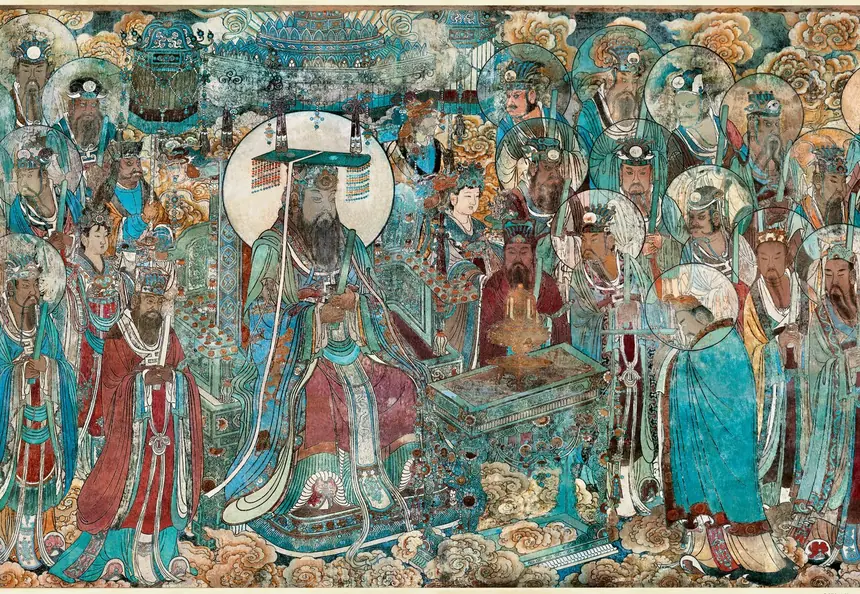
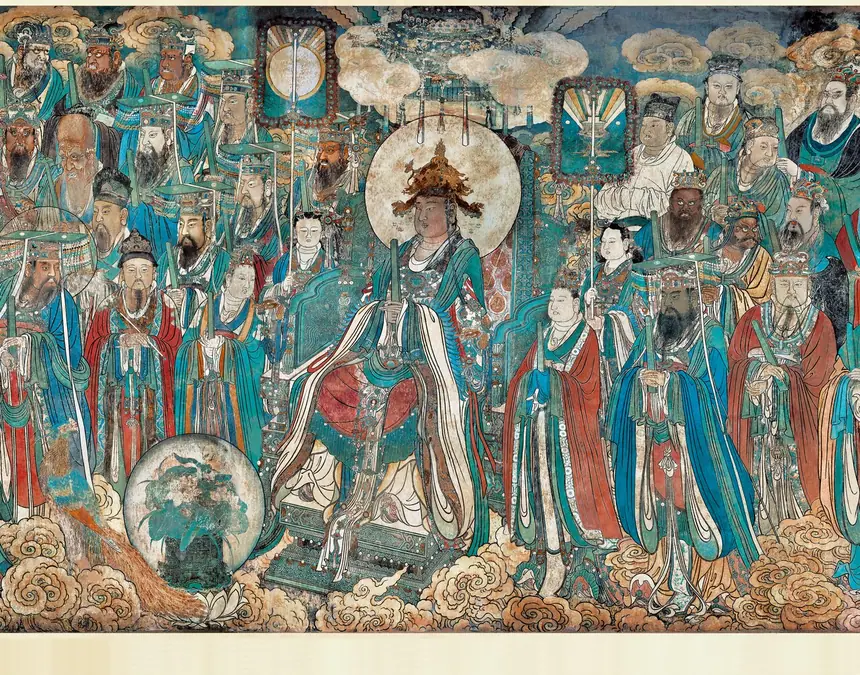
The Yongle Palace in Ruicheng, Shanxi, was built in the Yuan dynasty to worship Lü Dongbin. On the walls of its Hall of the Three Pure Ones is the Chaoyuan tu (Audience with the Origin), which shows a multitude of deities going to pay homage to Yuanshi Tianzun: 286 figures gathered around eight great emperors and empresses, completed in 1325 by the workshop of Ma Junxiang. The whole palace was taken apart and moved brick by brick and panel by panel to a new site to make way for the reservoir of the Sanmenxia Dam. China Daily dates the move from 1959 to 1964, Wikipedia from 1958 to 1966.

Source: China Daily (Shanxi), Yongle Palace. Wikipedia, Yongle Gong. Wikimedia Commons, file page of the Chaoyuan tu, section 2.
The Wuji Hall, that is, the Hall of the Three Pure Ones, the main building of the Yongle Palace, Ruicheng, Shanxi. The Chaoyuan tu is inside.
The Wuji Hall, that is, the Hall of the Three Pure Ones, the main building of the Yongle Palace, Ruicheng, Shanxi. The Chaoyuan tu is inside.Photo: Patrick20242023, CC BY-SA 4.0, Wikimedia Commons
Chaoyuan tu (Audience with the Origin), mural in the Hall of the Three Pure Ones, Yongle Palace, Shanxi, painted by the workshop of Ma Junxiang in 1325, Yuan dynasty. The second section counting from the right end.
Chaoyuan tu (Audience with the Origin), mural in the Hall of the Three Pure Ones, Yongle Palace, Shanxi, painted by the workshop of Ma Junxiang in 1325, Yuan dynasty. The second section counting from the right end.Photo: (Ma Junxiang & others) 马君祥等, Public domain, Wikimedia Commons
Chaoyuan tu, mural in the Hall of the Three Pure Ones, Yongle Palace, 1325. The ninth section counting from the right end.
Chaoyuan tu, mural in the Hall of the Three Pure Ones, Yongle Palace, 1325. The ninth section counting from the right end.Photo: 马君祥等, Public domain, Wikimedia Commons
Taoist mural of a procession of deities going to pay homage, probably from a Taoist temple in Shanxi, Yuan dynasty, about 1300. Royal Ontario Museum, Toronto. The mural has been removed from its original wall.
Taoist mural of a procession of deities going to pay homage, probably from a Taoist temple in Shanxi, Yuan dynasty, about 1300. Royal Ontario Museum, Toronto. The mural has been removed from its original wall.Photo: Daderot, CC0, Wikimedia Commons

Quanzhen and Zhengyi

Taoism today has two major schools. The Quanzhen school was founded by Wang Chongyang in 1167. Its priests are monastics who live in temples and keep strict precepts. The Zhengyi school continues the line of the Celestial Masters. Its priests live at home with their families and perform rituals for their communities. The sources consulted do not point to any difference in pantheon between the two schools. Quanzhen temples also worship their own patriarchs, such as Lü Dongbin, Qiu Chuji and the Seven Perfected of Quanzhen.

Source: Britannica, Quanzhen. Fabrizio Pregadio (ed.), The Encyclopedia of Taoism, entry Quanzhen, on Golden Elixir. Hong Kong Memory, Intangible Cultural Heritage of Hong Kong: history of the Zhengyi school. Taoist Culture Centre, White Cloud Temple (Baiyunguan), Beijing. Fung Ying Seen Koon, history.
In the jiao ritual, the Three Pure Ones are present through paintings

In the jiao ritual held at a village temple, the main altar is reserved for the Three Pure Ones. The three are present through hanging scrolls that depict them, put up for the ceremony. The deities normally worshipped in the temple withdraw to the altar of the Three Realms (heaven, earth, water) as guests. So Taoist sacred images are not only fixed statues but also sets of paintings hung up for the rite.

Source: Laurence G. Thompson, entry Jiao, Encyclopedia of Religion, 1987 (version on Encyclopedia.com).
Jiangyi, the ceremonial robe of a Taoist priest, silk embroidered with metallic thread, China, late 18th to early 19th century, Qing dynasty. The Textile Museum, George Washington University.
Jiangyi, the ceremonial robe of a Taoist priest, silk embroidered with metallic thread, China, late 18th to early 19th century, Qing dynasty. The Textile Museum, George Washington University.Photo: Daderot, CC0, Wikimedia Commons

VIITaoist sacred images country by country

Each place below has a few lines and one to four photos. The Vietnamese section draws on the journal Religious Studies Review (Nghiên cứu Tôn giáo) and the Vietnamese press. Many places are still missing from the list, and the library will add them over time.

Vietnam

Under the Đinh and Early Lê dynasties, the best known place of worship was the Thiên Tôn grotto at Hoa Lư. Today the grotto still worships Huyền Thiên Thượng Đế (Xuantian Shangdi) and a set of statues of the Three Pure Ones. Under the Lý, the Thái Thanh Palace was built in 1011 along with many other Taoist temples. In the Đoài region, west of Hanoi, the temples of Hội Linh, Hưng Thánh, Linh Tiên and Lâm Dương still stand, their floor plans changing from the shape of the Chinese character for "three" in the 16th century to the shape of the character for "work" in the 17th century. Chu Văn Tuấn observes that most of the old Taoist temples long ago turned into shrines, Buddhist pagodas and village communal houses. Recently a few new establishments have begun worshipping the Three Pure Ones, the Jade Emperor, Huyền Thiên Trấn Vũ, Doumu and the Three Officials. Bích Câu Đạo Quán in Hanoi now worships Buddhist, Taoist and Mother Goddess figures together, and is linked to the legend of Tú Uyên meeting the fairy Giáng Kiều. In Ho Chi Minh City, the Jade Emperor Pagoda (Chùa Ngọc Hoàng) was built in 1909 by Chinese of Cantonese origin and has been called Phước Hải Tự since 1984.

Statue of Huyền Thiên Trấn Vũ, black bronze, cast in 1677, at Quán Thánh Temple, Hanoi. A National Treasure.
Statue of Huyền Thiên Trấn Vũ, black bronze, cast in 1677, at Quán Thánh Temple, Hanoi. A National Treasure.Photo: Christophe95, CC BY-SA 4.0, Wikimedia Commons
Courtyard and front of Bích Câu Đạo Quán, Cát Linh street, Hanoi. The library does not yet have an openly licensed photo of the statues inside.
Courtyard and front of Bích Câu Đạo Quán, Cát Linh street, Hanoi. The library does not yet have an openly licensed photo of the statues inside.Photo: Phan Minh Tuấn, CC BY-SA 4.0, Wikimedia Commons
Main hall of the Jade Emperor Pagoda, Ho Chi Minh City: the Jade Emperor sits in the middle, with divine generals standing in attendance on both sides. Photographed in 2013.
Main hall of the Jade Emperor Pagoda, Ho Chi Minh City: the Jade Emperor sits in the middle, with divine generals standing in attendance on both sides. Photographed in 2013.Photo: Gary Todd from Xinzheng, China, CC0, Wikimedia Commons
Statue of the Jade Emperor in the Jade Emperor Pagoda (Phước Hải Tự), Ho Chi Minh City. Photographed in 2013.
Statue of the Jade Emperor in the Jade Emperor Pagoda (Phước Hải Tự), Ho Chi Minh City. Photographed in 2013.Photo: Bùi Thụy Đào Nguyên, CC BY-SA 3.0, Wikimedia Commons
Source: Hoàng Thị Thu Hường, Phạm Minh Phương, Đạo giáo ở Việt Nam thời Lý, Trần qua một số tác phẩm Hán Nôm tiêu biểu, Religious Studies Review, no. 12, 2021. Minh Hà, Dấu ấn văn hóa đặc sắc trong dòng chảy tín ngưỡng Việt Nam (review of a book by Dr. Nguyễn Thế Hùng), Văn Hóa newspaper, 02/07/2025. Chu Văn Tuấn, Đối tượng thờ cúng trong một số cơ sở Đạo giáo ở khu vực Đồng bằng Bắc Bộ hiện nay, the journal Religious Studies Review (Nghiên cứu Tôn giáo), no. 9, 2020. Vũ Đoàn, Huyền thoại thần tiên hạ phàm tại Bích Câu đạo quán, Pháp luật Việt Nam newspaper, 16/03/2021. Wikipedia, Jade Emperor Pagoda.

Ritual paintings of the Dao people

The Dao people (also known as Yao) of the northern mountains keep their Taoist sacred images in the form of paintings. According to Hoàng Thị Thu Hường, a set of paintings of the Dao Quần Chẹt group has 19 to 21 scrolls. The Three Pure Ones set has 12 scrolls: Yuanshi Tianzun, Lingbao Tianzun, Daode Tianzun, the Holy Lord (Thánh Chủ), the Jade Emperor, the courts of heaven, earth and water, the Ten Kings of the Underworld, the marshals and the celestial masters. The Hành Say set has 3 scrolls, including Hải Phan. The paintings are hung in a fixed order with Yuanshi Tianzun at the centre, and are used in the ordination rite (lễ cấp sắc), the dancing festival (Tết nhảy) and funerals. Most of the figures in the paintings have Taoist origins. Pháp luật Việt Nam newspaper reports that the painter must stay in a separate room, receive no visitors, and take three to four months to finish one set.

Ritual painting showing deities in many tiers, northern Vietnam, 1945, the top inscribed "Nam Hoa linh quan" (南華靈官). National Gallery Prague, Vm 5817. The original file page does not say which ethnic group the painting belongs to.
Ritual painting showing deities in many tiers, northern Vietnam, 1945, the top inscribed "Nam Hoa linh quan" (南華靈官). National Gallery Prague, Vm 5817. The original file page does not say which ethnic group the painting belongs to.Photo: Zde, CC BY-SA 3.0, Wikimedia Commons
Ritual paintings of a Dao (in China called Yao) ritual master. Yunnan Nationalities Museum, Kunming. These are paintings of the Dao people in China. The library does not yet have openly licensed photos of Dao ritual paintings in Vietnam.
Ritual paintings of a Dao (in China called Yao) ritual master. Yunnan Nationalities Museum, Kunming. These are paintings of the Dao people in China. The library does not yet have openly licensed photos of Dao ritual paintings in Vietnam.Photo: Daderot, Public domain, Wikimedia Commons
Crown of a Dao ritual master, painted paper, each panel showing a deity, mid to late 19th century, from Thailand, China or Vietnam. Fernbank Museum of Natural History, Atlanta.
Crown of a Dao ritual master, painted paper, each panel showing a deity, mid to late 19th century, from Thailand, China or Vietnam. Fernbank Museum of Natural History, Atlanta.Photo: Daderot, CC0, Wikimedia Commons
Source: Hoàng Thị Thu Hường, Tranh thờ, đám chay và thần linh của người Dao Quần chẹt, Religious Studies Review, no. 11, 2021. Thùy Dương, Tranh thờ, báu vật của người Dao, Pháp luật Việt Nam newspaper, 07/01/2023.

China

The earliest Taoist sacred images are 5th and 6th century stone steles in Shaanxi. The Song dynasty left the stone statue of Laojun in Quanzhou. The Yuan dynasty produced the murals of the Yongle Palace. In the Ming, the Yongle Emperor built the Wudang complex, and museums still hold many Ming statues of Zhenwu in bronze, stoneware and porcelain. The White Cloud Temple in Beijing is a Quanzhen temple still in active worship.

Laojun with two attendants, limestone, Shaanxi, Northern Wei dynasty, about 500 to 535. Museum of Far Eastern Antiquities (Östasiatiska museet), Stockholm.
Laojun with two attendants, limestone, Shaanxi, Northern Wei dynasty, about 500 to 535. Museum of Far Eastern Antiquities (Östasiatiska museet), Stockholm.Photo: Daderot, CC0, Wikimedia Commons
Statue of Laojun carved from a single block of stone on Mount Qingyuan, Quanzhou, Fujian, Song dynasty. The statue stands outdoors, in its original location.
Statue of Laojun carved from a single block of stone on Mount Qingyuan, Quanzhou, Fujian, Song dynasty. The statue stands outdoors, in its original location.Photo: N509FZ, CC BY-SA 4.0, Wikimedia Commons
Chaoyuan tu (Audience with the Origin), mural in the Hall of the Three Pure Ones, Yongle Palace, Shanxi, painted by the workshop of Ma Junxiang in 1325, Yuan dynasty. The second section counting from the right end.
Chaoyuan tu (Audience with the Origin), mural in the Hall of the Three Pure Ones, Yongle Palace, Shanxi, painted by the workshop of Ma Junxiang in 1325, Yuan dynasty. The second section counting from the right end.Photo: (Ma Junxiang & others) 马君祥等, Public domain, Wikimedia Commons
Zhenwu, Supreme Emperor of the Dark Heaven, gilt bronze, cast by Chen Yanqing in 1439, Ming dynasty, 34.3 cm high. Art Institute of Chicago.
Zhenwu, Supreme Emperor of the Dark Heaven, gilt bronze, cast by Chen Yanqing in 1439, Ming dynasty, 34.3 cm high. Art Institute of Chicago.Photo: Chen Yanqing (陳彥清), CC0, Wikimedia Commons
Source: Christine Mollier, Iconizing the Daoist-Buddhist Relationship, Daoism: Religion, History and Society, no. 2, 2010 (Chinese University of Hong Kong). Wikipedia, Mount Qingyuan. China Daily (Shanxi), Yongle Palace. UNESCO, Ancient Building Complex in the Wudang Mountains. Taoist Culture Centre, White Cloud Temple (Baiyunguan), Beijing.

Taiwan

The worship of Xuantian Shangdi came to Taiwan with people from Fujian and Guangdong at the end of the Ming. Under the Zheng regime (1662 to 1683), 26 temples were built, 7 of them dedicated to Xuantian Shangdi. The two photos below show the Jade Emperor in the Lingxiao Hall at Miaoli and the shrine of the Three Pure Ones Daoist Patriarchs at Ruifang.

The Jade Emperor in the Lingxiao Hall, Tianyun Temple, Miaoli, Taiwan. A recent statue, photographed in 2024.
The Jade Emperor in the Lingxiao Hall, Tianyun Temple, Miaoli, Taiwan. A recent statue, photographed in 2024.Photo: 阿道, CC BY-SA 4.0, Wikimedia Commons
Shrine of the Three Pure Ones Daoist Patriarchs in Qingyun Hall, Ruifang, Taiwan. Recent statues, photographed in 2025.
Shrine of the Three Pure Ones Daoist Patriarchs in Qingyun Hall, Ruifang, Taiwan. Recent statues, photographed in 2025.Photo: 阿道, CC BY-SA 4.0, Wikimedia Commons
Source: Wikipedia, Xuanwu (god).

Hong Kong

Fung Ying Seen Koon in Fanling was founded in 1929 and belongs to the Quanzhen Longmen school, which came from Guangzhou. Its main hall, called the Palace of Tushita (Doushuai Gong), worships Taishang Laojun, Patriarch Lü and Patriarch Qiu. The Zhengyi school in Hong Kong has two distinct ritual traditions, one in the New Territories and one in the urban area.

Inside the main hall of Fung Ying Seen Koon, Fanling, Hong Kong, a temple of the Quanzhen Longmen school. Photographed in 2024.
Inside the main hall of Fung Ying Seen Koon, Fanling, Hong Kong, a temple of the Quanzhen Longmen school. Photographed in 2024.Photo: BURYDLA 603 MPPOA, CC0, Wikimedia Commons
Source: Fung Ying Seen Koon, history. Hong Kong Memory, Intangible Cultural Heritage of Hong Kong: history of the Zhengyi school.

Korea

Maya Stiller writes that no record shows Korea ever had a nationwide system of Taoist temples and priests. Taoist deities were worshipped in Buddhist temples, in folk shrines and in a government office. The Sogyeokseo (昭格署) was that office: in the 16th century its officials made offerings to the Jade Emperor, Laozi and King Yama. The Sogyeokseo was destroyed in the Imjin War (1592 to 1598) and never rebuilt. One explanation of the name Samcheong-dong in Seoul is that a hall of the Three Pure Ones once stood there. Taoist immortals remain present in Joseon painting.

The Heaven Official with seven stars and jade maidens, Korean painting. Detroit Institute of Arts. The original file page gives no date.
The Heaven Official with seven stars and jade maidens, Korean painting. Detroit Institute of Arts. The original file page gives no date.Photo: Unknown, Public domain, Wikimedia Commons
Zhongli Quan and Liu Hai, hanging scroll, ink and colour on paper, Korea (Joseon), 18th century. Los Angeles County Museum of Art.
Zhongli Quan and Liu Hai, hanging scroll, ink and colour on paper, Korea (Joseon), 18th century. Los Angeles County Museum of Art.Photo: Unknown, Public domain, Wikimedia Commons
Part of an eight-panel screen showing the banquet of Xiwangmu (Korean: Seowangmo), ink, colour and gold on silk, Korea (Joseon), 18th to 19th century. Los Angeles County Museum of Art.
Part of an eight-panel screen showing the banquet of Xiwangmu (Korean: Seowangmo), ink, colour and gold on silk, Korea (Joseon), 18th to 19th century. Los Angeles County Museum of Art.Photo: Unknown, Public domain, Wikimedia Commons
Source: Maya Stiller, Warrior Gods and Otherworldly Lands: Daoist Icons and Practices in Late Chosŏn Korea, Religions, 2022. Mark Peterson, Visiting Bukchon, The Korea Times, 14/12/2025.

Japan

Seitenkyū in Sakado, Saitama prefecture, is one of the largest Taoist buildings in Japan. It was built over fifteen years by a Taiwanese businessman, opened in 1995, and worships the Three Pure Ones. The Eight Immortals painted by Tani Bunchō in 1803 shows that Taoist immortals also appear in Japanese painting.

Altar of the Three Pure Ones in the main hall of Seitenkyū, Sakado, Saitama prefecture, Japan. The temple was built by a Taiwanese and opened in 1995.
Altar of the Three Pure Ones in the main hall of Seitenkyū, Sakado, Saitama prefecture, Japan. The temple was built by a Taiwanese and opened in 1995.Photo: Zairon, CC BY-SA 4.0, Wikimedia Commons
The Eight Immortals, hanging scroll, colour on silk, by Tani Bunchō, Japan, 1803.
The Eight Immortals, hanging scroll, colour on silk, by Tani Bunchō, Japan, 1803.Photo: Tani Bunchō, Public domain, Wikimedia Commons
Source: Wikipedia, Seitenkyū.

VIIIWhat the library is not sure of

·The library reads its sources online. The book Quán Đạo giáo với một số vấn đề lịch sử và tôn giáo ở Việt Nam (Taoist temples and some historical and religious questions in Vietnam) by Dr. Nguyễn Thế Hùng (2025) has so far been read only through a review in Văn Hóa newspaper, not the book itself. This page therefore cannot yet describe the statues in the temples of Hội Linh, Hưng Thánh, Linh Tiên and Lâm Dương.
·Which side the Three Pure Ones sit on: the Taoist source places Lingbao Tianzun on the left and Daode Tianzun on the right of Yuanshi Tianzun without saying from where this is counted. This page records only the deity in the middle.
·The feast day of Yuanshi Tianzun: the Taoist Culture Centre gives the first days of the lunar new year, the Taoist Federation (Singapore) gives the winter solstice.
·How tall and how heavy the Trấn Vũ statue at Quán Thánh Temple is: English Wikipedia gives 3.96 metres and about 3,600 kg. The magazine Luật sư Việt Nam cites old books giving 8 thước 2 tấc (3.48 metres) and 6,600 cân (traditional Vietnamese units), and a modern measurement of 3.07 metres. This page does not choose between these figures.
·The figures of 3.96 metres and 4 tonnes are also given by Nhân Dân newspaper and Pháp luật Việt Nam newspaper for the Trấn Vũ statue at Thạch Bàn. The library does not know whether the two statues share the same measurements or whether the sources have mixed them up. English Wikipedia gives 9 tonnes for the statue in Gia Lâm (now part of Long Biên).
·The year the Quanzhen school was founded: this page gives 1167, like the main Taoism page, following the Taoist encyclopedia edited by Fabrizio Pregadio. Some sources give 1163. The founding unfolded over several years, so any single date is a convention.
·Who cast the Quán Thánh statue: one source names the master craftsman Trùm Trọng, another names Vũ Công Chấn as the overseer. Both may be correct, and the library records both.
·The White Cloud Temple: the summary the library was able to read does not say clearly where the Jade Emperor Hall stands on the central axis, so the diagram does not include it. The Vietnamese names of the halls are the library's own Sino-Vietnamese readings.
·The objects held by the Eight Immortals: the sources consulted do not clearly record those of Lü Dongbin and Cao Guojiu, so this page does not yet give them.
·Stele EO 1324 in the Musée Guimet: the museum label calls it a stele of the Three Pure Ones, but the stele shows one figure seated between two attendants. The library keeps the museum's name and describes exactly what the photo shows.
·Several photos have only the photographer's caption and have not been checked against museum records: the statue of 564, the statue at the Anhui Museum, the Eight Immortals painting at Sichuan University, and the Heaven Official painting in Detroit.
·The painting "Nam Hoa linh quan" in Prague: the original file page gives only northern Vietnam, 1945. The library does not know which ethnic group's set of ritual paintings it belongs to.
·The library does not yet have openly licensed photos of: the statues in Bích Câu Đạo Quán and Linh Tiên Quán, ritual paintings of the Dao people in Vietnam, the Trấn Vũ statue at Thạch Bàn, and the statue of Zhenwu in the Golden Hall on Mount Wudang.
·For Korea, this page relies on one research article and one newspaper article. For Japan and Taiwan it relies so far only on English Wikipedia. The library will replace these when better sources are available.
·Chinese characters are given only for names that appear in the sources.

Are you a Taoist priest, a follower of Taoism or a researcher, and have you found something inaccurate, or do you have a photo of your own to contribute? Please send it with its source to thayungkhiem@gmail.com. The library will correct the page and credit the contributor.

IXPhotos and licences

Every photo on this page comes from Wikimedia Commons, under Public domain, CC0, CC BY or CC BY-SA licences. Authors and licences are given exactly as on the original file pages, read on 07/10/2026. The photos have only been reduced in size, with no change to their content. Click the name of a photo to go to its original file page. If you are an author and see an incorrect credit, please let the library know so it can be corrected.

1Votive stele Three Pure Ones Guimet EO1324.jpg · Marie-Lan Nguyen · CC BY 4.0
2Laozi with attendants, front, China, Shaanxi province, Xiangu, near X'ian, Northern Wei dynasty, c. 500-535 AD, limestone - Östasiatiska museet, Stockholm - DSC09390.JPG · Daderot · CC0
3Daoist stela, view 1, China, Northern Zhou dynasty, inscribed and dated 572 AD, limestone - Arthur M. Sackler Gallery - DSC05929.JPG · Daderot · CC0
4Stone sculpture Laozi in the pose of the Buddha 564 CE Northern Zhou period (557-581 CE Shaanxi Province.jpg · Mary Harrsch · CC BY-SA 4.0
5The Three Purities, one of three - Yuanshi Tianzun.jpg · Unknown, Ming dynasty · Public domain
6The Three Purities, one of three - Lingbao Tianzun.jpg · Unknown, Ming dynasty · Public domain
7The Three Purities, one of three - Daode Tianzun.jpg · Unknown, Ming dynasty · Public domain
8Stoneware figure of a Daoist deity.From China, Ming Dynasty, 16th century CE. The British Museum.jpg · Osama Shukir Muhammed Amin FRCP(Glasg) · CC BY-SA 4.0
9Ming Statue of One of Three Clarities (9974081785).jpg · Gary Todd from Xinzheng, China · CC0
10Three Pure Ones, Daoist deities, 2 of 3, China, Shanxi province, cave temples at Haotianguan, Yuan dynasty, c. 1295 AD, sandstone with traces of pigments - Östasiatiska museet, Stockholm - DSC09292.JPG · Daderot · CC0
11MET DP156671.jpg · Chen Yanqing · CC0
12Stone statue of Lao Tzu at Qingyuanshan (20200930154027).jpg · N509FZ · CC BY-SA 4.0
13Jade Emperor. Ming Dynasty.jpg · Unknown · Public domain
14Tượng Ngọc hoàng.jpg · Bùi Thụy Đào Nguyên · CC BY-SA 3.0
15Jade Emperor Pagoda (9982008616).jpg · Gary Todd from Xinzheng, China · CC0
16天雲廟凌霄寶殿玉皇上帝 20241021.jpg · 阿道 · CC BY-SA 4.0
17Bảo tàng Lịch sử TP (cổ vật nhà Nguyễn, tượng Nam Tào-Bắc Đẩu) (1).jpg · Phương Huy · CC BY-SA 4.0
18Quán Thánh Temple 4.jpg · Christophe95 · CC BY-SA 4.0
19Quan Thanh Taoist Temple, Hanoi, 11th century and later (17) (24624704118).jpg · Richard Mortel from Riyadh, Saudi Arabia · CC BY 2.0
20Figure of Zhenwu, British Museum.jpg · 14GTR · CC0
21Daoist God Zhenwu (Perfected Warrior), Supreme Emperor of the Dark Heaven.jpg · Chen Yanqing (陳彥清) · CC0
22The Taoist deity Zhenwu, the Perfected Warrior, Northern China, Ming dynasty, porcelain with polychrome glazes and gold decoration - Asian Art Museum of San Francisco - DSC01643.JPG · Daderot · CC0
23Eight Immortals - Sichuan University Museum - Chengdu, China - DSC06248.jpg · Daderot · CC0
24The Daoist Immortal Lü Dongbin.jpg · Unknown · Public domain
25Zhu Haogu's atelier. Zhongli Quan Instructing Lu Dongbin. completed by 1358. Chunyangdian, Yonlegong, Shanxi Province.jpg · Atelier of Zhu Haogu · Public domain
26Ya Hui-Li Xian.jpg · Yan Hui (顏輝) · Public domain
27Daoist deity Doumu, Dehua ware, China, Qing dynasty, 1644-1911, porcelain, mold-impressed with sculpted decoration - Asian Art Museum - San Francisco, CA - DSC07562.jpg · Daderot · CC0
28Table screen depicting the Taoist deity Doumu and her entourage, China, Ming or Qing dynasty, approx. 1500-1700 AD, gilt bronze - Asian Art Museum of San Francisco - DSC01647.JPG · Daderot · CC0
29White Cloud Temple (9868505853).jpg · Gary Todd from Xinzheng, China · CC0
30Mirror with Dongwanggong (King Father of the East) and Xi Wangmu (Queen Mother of the West), China, Han dynasty, 25-220 AD, bronze - Östasiatiska museet, Stockholm - DSC09581.JPG · Daderot · CC0
31The Banquet of Seowangmo (Xiwangmu), Queen Mother of the West LACMA M.2000.15.31a-h (4 of 13).jpg · Unknown · Public domain
32Wu Daozi. The Daoist Official of Heaven. Jin-Yuan dynasty. 12-13 cent. MFA, Boston..jpg · Wu Daozi (traditionally attributed) · Public domain
33Unknown (Korean) - Daoist Official of Heaven with Seven Stars and Jade Maidens - 2015.6 - Detroit Institute of Arts.jpg · Unknown · Public domain
34元 马君祥等 朝元图(永乐宫三清殿壁画)分段2.tif · (Ma Junxiang & others) 马君祥等 · Public domain
35元 马君祥等 朝元图(永乐宫三清殿壁画)分段9.tif · 马君祥等 · Public domain
36Homage to the Highest Power, probably Longmen Monastery, Shanxi Province, China, Yuan Dynasty, c. 1300 - Royal Ontario Museum - DSC09827.JPG · Daderot · CC0
37无极之殿正照.jpg · Patrick20242023 · CC BY-SA 4.0
38Wang Lingguan’s statue at Baopu Daoist Temple.png · Zhaoquan He, Xiaorong Meng · CC BY 4.0
39Sakado Seitenkyu Haupthalle Innen Altar 3.jpg · Zairon · CC BY-SA 4.0
40HK ND 粉嶺 Fanling 百和路 Park Wo Road 蓬瀛仙館 Fung Ying Sen Koon temple main hall interior May 2024 R12S 608.jpg · BURYDLA 603 MPPOA · CC0
41瑞芳青雲殿三清道祖 20250703.jpg · 阿道 · CC BY-SA 4.0
42Chùa An Quốc - Bích Câu Đạo Quán, Hà Nội 003.JPG · Phan Minh Tuấn · CC BY-SA 4.0
43Vietnamese painting, Deities of the Taoist Pantheon, 1945, NG Vm 5817, 142203.jpg · Zde · CC BY-SA 3.0
44Folk Arts in the Yunnan Nationalities Museum - DSC03770.JPG · Daderot · Public domain
45Daoist crown, Yao peoples, Thailand, China, or Vietnam, mid to late 19th century, paper, paint, dyes - Fernbank Museum of Natural History - DSC00090.JPG · Daderot · CC0
46Daoist priest's robe (jiangyi), China, Qing dynasty, late 18th to early 19th century AD, silk, metal-wrapped silk, view 1 - Textile Museum, George Washington University - DSC09658.JPG · Daderot · CC0
47Ascending to the Top of Clouds (Zhang Tianshi), by Luo Pin, Qing dynasty, Qianlong emperor, 1776, ink on paper - Asian Art Museum - San Francisco, CA - DSC07448.jpg · Daderot · CC0
48Zhongli Quan (Chongni Kwon) with Liu Hai (Yu Hae), Two Chinese Daoist Immortals LACMA M.2000.15.34.jpg · Unknown · Public domain
498 daoist immortals by Tani Buncho.jpg · Tani Bunchō · Public domain

XSources

1Christine Mollier, Iconizing the Daoist-Buddhist Relationship, Daoism: Religion, History and Society, no. 2, 2010 (Chinese University of Hong Kong)
2Wikimedia Commons, file page of stele EO 1324 in the Musée Guimet (transcribing the museum label)
3Wikimedia Commons, file page of the Three Pure Ones painting in the Minneapolis Institute of Art
4Taoist Culture Centre (Fung Ying Seen Koon, Hong Kong), The Primeval Lord of Heaven
5Taoist Culture Centre, The Heavenly Lord of the Numinous Treasure
6Taoist Culture Centre, The Heavenly Lord of Dao and its Virtue
7Taoist Culture Centre, The Great Jade Emperor
8Taoist Culture Centre, The Four Heavenly Ministers
9Taoist Culture Centre, The Great Perfect Warrior Emperor
10Taoist Culture Centre, The Eight Immortals
11Taoist Culture Centre, The Queen Mother of the West
12Taoist Culture Centre, The Three Great Emperor-Officials
13Taoist Culture Centre, Numinous Official Wang
14Taoist Culture Centre, White Cloud Temple (Baiyunguan), Beijing
15Taoist Federation (Singapore), Taoist Gods
16Joseph Adler, Kenyon College, San Qing: The Three Purities (paintings at the White Cloud Temple)
17Wikipedia, Three Pure Ones
18British Museum, figure of a Taoist deity, 1930,0719.62
19Metropolitan Museum of Art, Daoism and Daoist Art
20Metropolitan Museum of Art, Daoist immortal Laozi, Chen Yanqing, 1438
21Art Institute of Chicago, Taoism and the Arts of China, entry on Zhenwu
22Britannica, Yudi
23Britannica, Baxian
24Britannica, Xiwangmu
25Britannica, Sanguan
26Britannica, Quanzhen
27Britannica, Zhang Daoling
28Wikipedia, Xuanwu (god)
29Wikipedia, Eight Immortals
30Wikipedia, Doumu
31Wikipedia, Quán Thánh Temple
32Wikipedia, Mount Qingyuan
33Wikipedia, Yongle Gong
34Wikipedia, Jade Emperor Pagoda
35Wikipedia, Seitenkyū
36UNESCO, Ancient Building Complex in the Wudang Mountains
37China Daily (Shanxi), Yongle Palace
38Wikimedia Commons, file page of the Chaoyuan tu, section 2
39Laurence G. Thompson, entry Jiao, Encyclopedia of Religion, 1987 (version on Encyclopedia.com)
40Hong Kong Memory, Intangible Cultural Heritage of Hong Kong: history of the Zhengyi school
41Fung Ying Seen Koon, history
42Maya Stiller, Warrior Gods and Otherworldly Lands: Daoist Icons and Practices in Late Chosŏn Korea, Religions, 2022
43Mark Peterson, Visiting Bukchon, The Korea Times, 14/12/2025
44Phương Hạnh, Thăng Long tứ trấn, những điều chưa biết, the magazine Luật sư Việt Nam (Vietnam Lawyers), 05/01/2021
45Thái Lộc, Bí ẩn người làm bảo vật quốc gia, part 1, Tuổi Trẻ newspaper, 20/05/2023
46Nhân Dân newspaper, Đón bằng Bảo vật quốc gia cho tượng Huyền Thiên Trấn Vũ
47Pháp luật Việt Nam newspaper, Pho tượng long bào đen hơn 200 tuổi trở thành Bảo vật quốc gia, 10/04/2016
48Chu Văn Tuấn, Đối tượng thờ cúng trong một số cơ sở Đạo giáo ở khu vực Đồng bằng Bắc Bộ hiện nay, the journal Religious Studies Review (Nghiên cứu Tôn giáo), no. 9, 2020
49Hoàng Thị Thu Hường, Phạm Minh Phương, Đạo giáo ở Việt Nam thời Lý, Trần qua một số tác phẩm Hán Nôm tiêu biểu, Religious Studies Review, no. 12, 2021
50Hoàng Thị Thu Hường, Tranh thờ, đám chay và thần linh của người Dao Quần chẹt, Religious Studies Review, no. 11, 2021
51Thùy Dương, Tranh thờ, báu vật của người Dao, Pháp luật Việt Nam newspaper, 07/01/2023
52Vũ Đoàn, Huyền thoại thần tiên hạ phàm tại Bích Câu đạo quán, Pháp luật Việt Nam newspaper, 16/03/2021
53Minh Hà, Dấu ấn văn hóa đặc sắc trong dòng chảy tín ngưỡng Việt Nam (review of a book by Dr. Nguyễn Thế Hùng), Văn Hóa newspaper, 02/07/2025
54Department of Cultural Heritage (Vietnam), List of National Treasures (no. 115, Decision 2496/QĐ-TTg of 22 December 2016)
55Fabrizio Pregadio (ed.), The Encyclopedia of Taoism, entry Quanzhen, on Golden Elixir
56ICOMOS, advisory body evaluation of the Ancient Building Complex in the Wudang Mountains for UNESCO, 1994

The pages above were read in October 2026. If a page has changed its address, please let the library know so it can be updated.

?Quick Questions

Who are the Three Pure Ones and how can they be recognized

Yuanshi Tianzun, Lingbao Tianzun and Daode Tianzun. The one seated in the middle holding a pearl is Yuanshi Tianzun. The one holding a ruyi scepter is Lingbao Tianzun. The one with white hair and beard holding a fan is Daode Tianzun, that is, Taishang Laojun.

Is Taishang Laojun the same as Laozi

According to Taoist sources, Daode Tianzun is Laozi, and the title Taishang Laojun dates from the Northern Wei. Among the Three Pure Ones, he is the third.

Who ranks higher, the Jade Emperor or the Three Pure Ones

Taoist sources place the Jade Emperor below the Three Pure Ones, as the one who governs the realms of heaven and earth and all the deities. In popular religion, however, the Jade Emperor is the best known of them.

Why does the statue of Zhenwu have loose hair and bare feet

The Art Institute of Chicago explains that these two features recall the story of his years of cultivation on Mount Wudang, no longer bound by everyday ritual. The tortoise and snake under his feet are the emblem of the North.

Did early Taoism have statues

The earliest surviving objects are 5th century stone steles in Shaanxi. The scholar Christine Mollier writes that for about two centuries before that, Taoism is said not to have used images.

Why does this page use photos instead of drawings

Whether a sacred image is right or wrong lies in the details: the object held, the clothing, the hand gesture. Photos of real objects, with their location and date recorded, preserve those details. The library does not draw portraits of holy figures. The only drawing on the page is a diagram.

›Read Next