
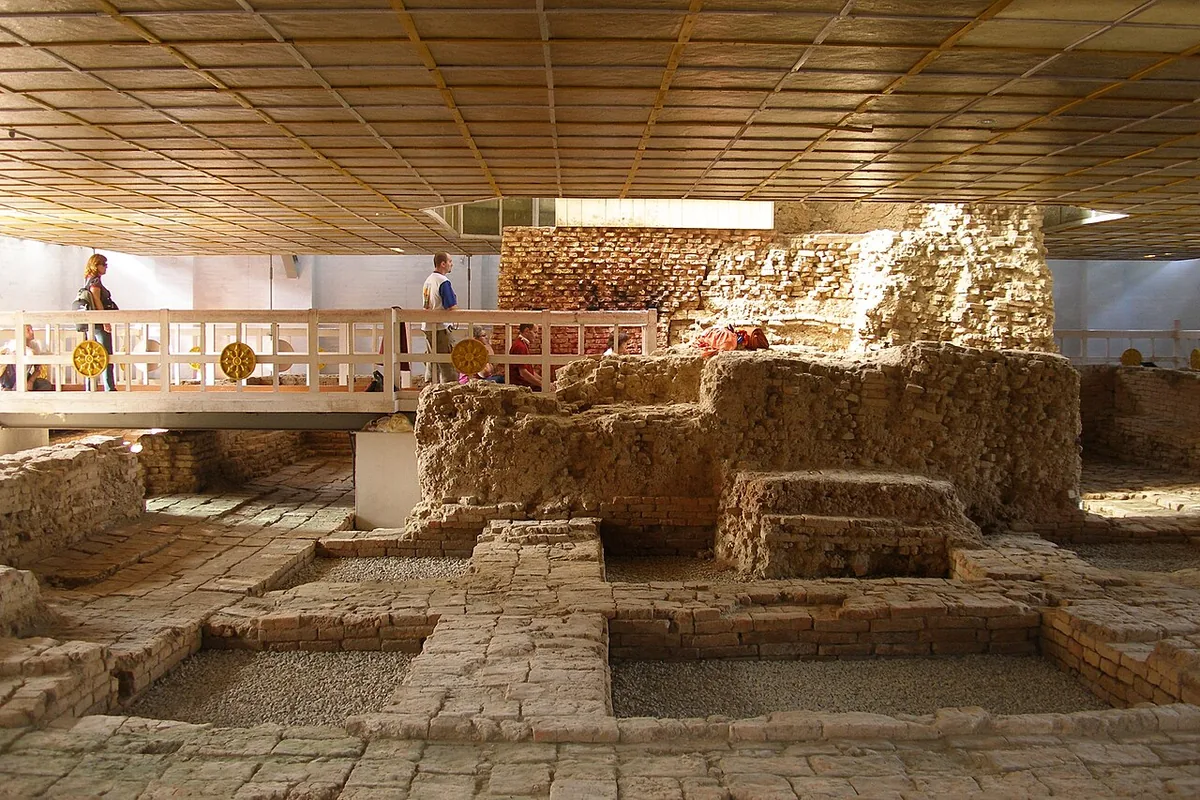
Visitors walk across a flat park of green grass and tall trees toward a plain white temple with a low roof and no spire. Beside it lies a brick-lined square pond of still water and a large tree strung with five-colored prayer flags. Set slightly to one side stands a gray-brown stone pillar surrounded by a protective railing. Stepping inside the temple, visitors do not encounter an ornate altar hall, but rather excavated layers of ancient brick walls encircled by a wooden boardwalk, and at the center, beneath a sheet of glass, a small stone slab resting deep in the floor.
This is Lumbini (known in Sino-Vietnamese Buddhist texts as Lâm Tỳ Ni), in Rupandehi District, Lumbini Province, southern Nepal, and the white structure is the Maya Devi Temple, named after Queen Maya, mother of the Buddha. The stone slab beneath the floor is the Marker Stone, pinpointing the exact spot where Buddhist tradition holds that Shakyamuni Buddha was born.
IThe Birthplace, Opening Stage of the Four Sacred Sites
Nepal is a land where Hindu and Buddhist spiritual life intertwine, with temples and monasteries standing side by side across the Kathmandu Valley. Yet if one had to choose a single place that puts Nepal in the heart of every Buddhist around the world, from Sri Lanka to Japan, from Tibet to Vietnam, that place is Lumbini. For this reason, the library selects Lumbini as the representative site for Nepal: it is a shared sanctuary recognized equally by Theravada, Mahayana, and Vajrayana Buddhism.
Lumbini is the first of the four sacred places known to Vietnamese Buddhists as the Four Great Pilgrimage Sites (Tứ Động Tâm): the places of birth, enlightenment, the first discourse, and parinirvana. The library has separate entries on Bodh Gaya, the site of enlightenment, and Sarnath, the site of the first discourse, so this entry focuses on the opening chapter of that journey.
According to the life story of the Buddha recounted across Buddhist traditions, Queen Maya (Ma Da), a princess of the Koliya kingdom and chief consort of King Suddhodana of Kapilavastu (whose capital is associated with the archaeological site of Tilaurakot, about 28 to 30 kilometers west of Lumbini), was traveling toward her parents' home in Devdaha to give birth in keeping with custom when she stopped to rest in the grove of Lumbini. Holding onto the branch of a sal tree (Shorea robusta) while supported by her sister Mahapajapati Gotami, she gave birth to Prince Siddhartha. Tradition relates that the newborn prince took seven steps, with a lotus flower blooming beneath each step. In Buddhist doctrine, the nativity represents the moment a Bodhisattva, after countless lifetimes of cultivation, enters his final existence to attain Buddhahood. When Vietnamese Buddhists perform the Bathing the Buddha ritual each Vesak season, they are recalling the scene in this grove.
What sets Lumbini apart from many other ancient pilgrimage places is epigraphic evidence carved in stone. UNESCO records that Emperor Ashoka erected a sandstone pillar here in 249 BCE bearing an inscription in Brahmi script that documents his royal pilgrimage to the Buddha's birthplace. The most cited phrase in the inscription, transliterated into Latin script as hida Budhe jāte Sakyamunī, translates in standard readings as: here the Buddha, the sage of the Sakyas, was born. The inscription also records that the emperor reduced taxes for the village of Lumbini. Nearly nine centuries later, in 636 CE, the Chinese pilgrim Xuanzang visited the site and noted that the birth spot lay 25 paces north of the sacred pond.
Two misunderstandings are common. First, many people assume Lumbini is in India because the majority of the Four Great Pilgrimage Sites circuit runs through Indian territory. It is not: Lumbini lies in Nepal, on the Terai plains near the Indian border. Second, visitors often assume the white Maya Devi Temple is an ancient building. In fact, the current building was constructed in 2003 as a protective shelter over the ancient brick foundations and early timber shrine traces beneath. The antiquity lies underfoot rather than in the roof overhead.
IIFrom Emperor Ashoka's Pillar to the Stone Beneath the Floor
The history of Lumbini is a story of remembrance, gradual obscurity, and rediscovery. Emperor Ashoka's pillar marked the spot in the 3rd century BCE, pilgrims continued to visit for centuries afterward, and the site eventually receded into the forest until archaeological work brought it back to light at the end of the 19th century.
- c. 6th century BCETimber tree shrine beneath the templeArchaeological excavations conducted from 2010 to 2013 and co-directed by Robin Coningham (Durham University) alongside UNESCO, Nepal's Department of Archaeology, and the Lumbini Development Trust uncovered postholes of a timber shrine enclosing a tree space dated to around the 6th century BCE (c. 550 BCE), directly beneath the Ashokan-era brick temple.
- 249 BCEEmperor Ashoka's PillarEmperor Ashoka visited Lumbini, built a brick platform to protect the birth spot, and erected a sandstone pillar inscribed in Brahmi script confirming the Buddha's birthplace. Near the upper shaft of the pillar is a later inscription by Prince Ripu Malla dated 1234 Saka Era (1312 CE) with the mantra Om mani padme hum.
- 3rd century BCE to 15th century CEMonasteries and stupasUNESCO dates the excavated vihara (monastery) foundations from the 3rd century BCE to the 5th century CE, and the stupas from the 3rd century BCE to the 15th century CE.
- 636Xuanzang's pilgrimageThe Chinese pilgrim monk visited Lumbini and recorded the birth spot 25 paces north of the sacred bathing pond.
- 1896 to 1939Rediscovery of the pillar and early excavationsIn December 1896, former Nepalese general Khadga Shamsher Rana and German archaeologist Alois Anton Führer rediscovered the Ashoka Pillar. In 1899, Indian archaeologist P. C. Mukherji excavated the site and uncovered the main section of the 4th-century Nativity Sculpture. Between 1933 and 1939, General Keshar Shumsher excavated the temple mound and reconstructed the Maya Devi Temple.
- 1972 to 1978Kenzo Tange Master PlanJapanese architect Kenzo Tange prepared the master plan for the 4.8-by-1.6-kilometer Lumbini development zone in cooperation with the United Nations, according to UNESCO.
- 1993Foundation of Viet Nam Phat Quoc TuVenerable Thích Huyền Diệu received approval and land from King Birendra and the Government of Nepal in the West Monastic Zone to begin building Việt Nam Phật Quốc Tự, the first international monastery at the Lumbini sacred site.
- 1996Discovery of the Marker StoneIn December 1996, a joint archaeological team from Nepal's Department of Archaeology, the Lumbini Development Trust, and the Japanese Buddhist Federation uncovered the Marker Stone resting on a platform of seven layers of 3rd-century BCE bricks.
- 1997UNESCO World Heritage SiteInscribed as Lumbini, the Birthplace of the Lord Buddha, under criteria iii and vi, with a core zone of 1.95 hectares and a buffer zone of 22.78 hectares.
- 2003Rebuilding of the Maya Devi TempleThe Lumbini Development Trust completed the present protective temple structure over the excavated foundations and manages the sacred precinct.
Regarding the year of the Buddha's birth, the UNESCO nomination file cites 623 BCE. That date represents one among several chronological traditions. Historians and different Buddhist traditions propose dates that vary by decades or even centuries, and Buddhist calendars across Asia do not count from the same baseline year. The library notes UNESCO's figure alongside this caveat rather than treating it as an undisputed date. What historical and archaeological evidence establishes with certainty is that by 249 BCE the site was already revered enough as the birthplace for an emperor to erect an inscribed pillar, and that the 2013 excavations revealed traces of a 6th-century BCE timber shrine beneath the brick temple.
IIIMaya Devi Temple, the Marker Stone, and the International Monastic Zone
The core sanctuary today is called the Sacred Garden. At its center stands the Maya Devi Temple, inside which UNESCO notes cross-wall brick structures built in successive phases from the 3rd century BCE to the 20th century, with traces of the 6th-century BCE timber shrine at the lowest level. Each era built a layer atop the preceding one, and the white temple completed in 2003 forms the outermost shell, designed to shelter and preserve the ancient layers below rather than replace them.
Extending outward from the Sacred Garden is the 4.8-by-1.6-kilometer north-south Lumbini Master Plan designed by Kenzo Tange, divided into three zones: the Sacred Garden in the south, the Monastic Zone in the center, and the Cultural Center and New Lumbini Village in the north. The Monastic Zone flanks a central water canal: the East Monastic Zone houses Theravada monasteries, while the West Monastic Zone houses Mahayana and Vajrayana monasteries. In the West Monastic Zone stands Việt Nam Phật Quốc Tự, founded in 1993 by Venerable Thích Huyền Diệu as the first international monastery built in Lumbini, featuring traditional Vietnamese curved roofs, a triple-arched gate, and a replica of Hanoi's One Pillar Pagoda.
According to the Kathmandu Post, this sandstone-based conglomerate slab measuring 70 x 40 x 10 cm was uncovered in December 1996 atop a seven-layer brick platform from the 3rd century BCE. Archaeologists hold two views on who placed it: either Emperor Ashoka or residents of the nearby ancient village of Lumbini Game (where settlement traces date back to c. 1300 BCE, about 400 meters southwest of the temple).
A sandstone pillar erected in 249 BCE bearing a Brahmi inscription that confirms the Buddha's birthplace. It remains one of the earliest inscribed monuments linking a specific geographic spot to the historical life of the Buddha.
The brick-lined square pond beside the temple. Tradition holds that Queen Maya bathed here before giving birth and that the newborn prince received his first bath in its waters. Xuanzang used this pond as his reference point to record the birth spot.
Brick foundations of viharas dating from the 3rd century BCE to the 5th century CE and votive stupas from the 3rd century BCE to the 15th century CE scattered around the temple, according to UNESCO.
Rebuilt in 2003 by the Lumbini Development Trust with an interior wooden walkway over the excavated ruins leading to the Marker Stone and the 4th-century red sandstone Nativity Sculpture of the Mathura school (discovered by P. C. Mukherji in 1899), depicting Queen Maya holding a sal branch while supported by Mahapajapati Gotami.
IVLandform and Orientation
No geomancer selected this site. According to the scriptures, the Buddha was born along a journey in a grove where the queen paused to rest, not on a plot surveyed in advance to build a sanctuary. Later temples were erected simply to mark a spot already given by history. Nor does Buddhism teach geomancy. The observations below represent the library's reading of Lumbini through the lens of traditional Vietnamese landform analysis (phong thủy), offered as a familiar point of reference for readers rather than as Buddhist doctrine or heritage documentation.
The first feature is the open plain. Lumbini lies on the Terai, the low alluvial belt running along the foot of the Himalayas. In the traditional Vietnamese way of reading flatlands such as the Red River Delta, when no near hill stands behind a site, a distant mountain range serves as its backing. Here the highest mountain range on earth rises to the north beyond the horizon, forming the grand rear backing (hậu chẩm) for the entire plain.
The second feature is water to the south. According to Xuanzang's account, the birth spot lies 25 paces north of the sacred pond, meaning the pond sits directly south of the birth spot. Read in traditional Vietnamese terms, this forms the classic configuration of water in front and mountain behind (tiền thủy hậu sơn): the distant Himalayas to the north, the calm pond close by to the south, and the birth spot between them. Vietnamese tradition favors a southern exposure, and here the most sacred point faces a still sheet of water to the south, a layout traditionally regarded as gathering vital energy.
The third feature is the tree. Tradition recounts that the queen held onto the branch of a tree while giving birth, and a great tree beside the pond today is draped with prayer flags. In the Five Phases (Ngũ hành), Wood governs birth and growth, corresponding to the east and to spring. A birth beneath a living tree accords with the Wood phase, while the water of the nearby pond nourishes Wood in a mutually generative cycle (Water generates Wood).
Finally, there is the stone pillar. In traditional landform reading, an upright monolith standing on flat ground acts as an anchoring marker (điểm trấn) that keeps the energy of a place from dispersing. Emperor Ashoka's pillar has stood here for more than two thousand two hundred years, fulfilling the exact role of a landmark that prevented later generations from forgetting the spot. The library notes this correspondence simply as one way of looking at the landscape.
VVesak at the Place of the Nativity
The largest annual observance at Lumbini is Buddha Jayanti, celebrating the Buddha's birth on the full moon day of the month of Vaisakh in the Nepalese lunar calendar. Pilgrims from many countries gather in the Sacred Garden on this day. Because Lumbini is a shared sanctuary, each delegation conducts services according to its own liturgical tradition. The table below lists dates without specific hours.
| Date | Calendar | Observance | Description |
|---|---|---|---|
| Full moon of Vaisakh | Nepalese lunar calendar, usually falling in April or May | Buddha Jayanti (Vesak) | The largest annual festival at Lumbini, commemorating the birth of the Buddha at the very spot of his nativity. |
| 15th day of the 4th lunar month | Vietnamese lunar calendar | Vietnamese Buddhist Vesak | The full moon day on which Vietnamese Buddhists celebrate the Buddha's birthday, often coinciding with or falling close to Nepal's Buddha Jayanti. Vietnamese pilgrimage groups visiting Lumbini typically gather at Việt Nam Phật Quốc Tự and perform the Bathing the Buddha ritual in the Sacred Garden. |
| 8th day of the 4th lunar month | East Asian lunar calendar (Korea and certain Mahayana traditions) | East Asian Mahayana Buddha's Birthday | Korean Buddhists and several other East Asian Mahayana traditions celebrate the Buddha's birthday on this day, one week before the full moon. |
Differences in the date of the Buddha's birthday across countries reflect calendar systems rather than doctrinal division. Theravada countries and Nepal reckon by the full moon of Vaisakh in the ancient Indian calendar. Vietnam observes the full moon of the fourth lunar month. Korea observes the eighth day of the fourth lunar month, while Japan, since adopting the Gregorian calendar, celebrates on April 8. At Lumbini, where all traditions converge, visitors can witness each of these observances within a single season, and Vietnamese monastics and lay pilgrims visiting the birthplace regularly stay or gather at Việt Nam Phật Quốc Tự in the West Monastic Zone before walking to the Maya Devi Temple.
VILocation And How To Get There
- Address
- Khu Vườn Thiêng (Sacred Garden), Lumbini Sanskritik, huyện Rupandehi, tỉnh Lumbini
- Getting there
- Lumbini is located in Rupandehi District, Lumbini Province, southern Nepal, near the Indian border and about a 30-minute drive from Gautam Buddha International Airport in Bhairahawa. The Maya Devi Temple stands in the Sacred Garden at the southern end of the Lumbini Master Plan axis.
- Coordinates
- 27.4696, 83.2758
The Sacred Garden is an active sanctuary whose rules follow standard Buddhist pilgrimage etiquette: remove shoes before entering the Maya Devi Temple, dress modestly, and maintain silence inside the shrine. Do not touch the ancient brick foundations or toss coins or offerings onto the Marker Stone enclosure. Circumambulate the temple and the Ashoka Pillar clockwise. Hang prayer flags only in designated areas.
Nearby places in the library
VIIContribute To This Page
Contribute photos, information or video for Lumbini
Góp ảnh, thông tin hoặc video cho Lâm Tỳ Ni (Lumbini), đền Maya DeviEveryone is welcome to enrich this page: a photo you took, a detail the page misses, a short video. Every contribution is read and answered.
Thầy Ưng Khiêm mời cộng đồng cùng làm giàu trang này. Ảnh chụp tận nơi, một chi tiết lịch sử chưa được nhắc, một đoạn video ngắn: mọi đóng góp đều được đọc và trả lời.
No community contribution yet. You could be the first. Chưa có đóng góp nào từ cộng đồng. Bạn có thể là người đầu tiên.
?Quick Questions
Which country is Lumbini in
Lumbini is in Nepal, located in Rupandehi District, Lumbini Province, on the Terai plains of southern Nepal near the Indian border. It is the birthplace of Shakyamuni Buddha and the first of the Four Great Pilgrimage Sites of Buddhism, while the other three sites lie in India.
What is the Maya Devi Temple
Named after Queen Maya, mother of the Buddha, the Maya Devi Temple is a white protective structure rebuilt in 2003 over brick foundations dating from the 3rd century BCE onward and 6th-century BCE timber shrine traces beneath. Inside are the Marker Stone discovered in 1996 and a 4th-century red sandstone Nativity Sculpture.
What does Emperor Ashoka's pillar at Lumbini record
Erected in 249 BCE, Emperor Ashoka's sandstone pillar bears a Brahmi inscription recording the emperor's visit to the Buddha's birthplace and his reduction of taxes for the village of Lumbini. Its famous line translates as: here the Buddha, the sage of the Sakyas, was born. It provides direct epigraphic proof identifying the birthplace.
In what year was the Buddha born
No single year is universally agreed upon. The UNESCO dossier for Lumbini cites 623 BCE, but historians and different Buddhist traditions propose dates that vary considerably. What is certain is that 2013 excavations uncovered traces of a 6th-century BCE timber shrine beneath the temple floor, and that by 249 BCE Emperor Ashoka erected an inscribed pillar recognizing the spot as the Buddha's birthplace.
When is Vesak celebrated at Lumbini
The main festival at Lumbini is Buddha Jayanti on the full moon of Vaisakh in the Nepalese lunar calendar, usually falling in April or May and often coinciding with the full moon of the fourth lunar month in Vietnam. Pilgrims from around the world gather in the Sacred Garden, and Vietnamese pilgrims often visit Việt Nam Phật Quốc Tự (founded in 1993 in the West Monastic Zone).