
Stepping through the gate of the archaeological park, visitors first encounter a wide, level lawn across which rise the low red-brick foundations of monasteries that lost their roofs centuries ago. Pilgrims walk unhurriedly along the paths in saffron, brown, and grey robes. At the far end of the lawn stands a massive, solid cylindrical tower, its lower casing of grey stone carved with floral and geometric bands, its upper drum of dark brickwork ending without a pointed spire. That monument is the Dhamek Stupa. Around its base people sit chanting scriptures at almost every hour of the day, while others press thin squares of gold leaf onto the stone surface.
In Vietnamese this sanctuary is called Vườn Lộc Uyển or Lộc Dã Uyển, meaning the Deer Park. In India it is known as Sarnath (Sārnāth), while Pali scriptures call it Isipatana. There is no ancient tree at the center of the ruin and no soaring spire, yet this lawn is one of the four most sacred pilgrimage sites in Buddhism because it was here that the Buddha first spoke aloud the truth he had realized.
IThe First Discourse and the Five Ascetics
This place bears several names, each preserving a layer of meaning. Isipatana in Pali and Rishipatana in Sanskrit mean the place where sages alight or gather, reflecting its role as a retreat for ascetics even before the Buddha's time. Mrigadava, meaning Deer Park, is the name rendered into Vietnamese as Lộc Uyển. The modern name Sarnath is explained as a contraction of Saranganatha, Lord of the Deer. UNESCO cites all three ancient names in its inscription announcement.
If Bodh Gaya is where the Buddha attained awakening, Sarnath is where he began to teach. The account of the night of awakening beneath the Bodhi Tree is covered in the entry on Bodh Gaya, while this article traces the next step of the journey.
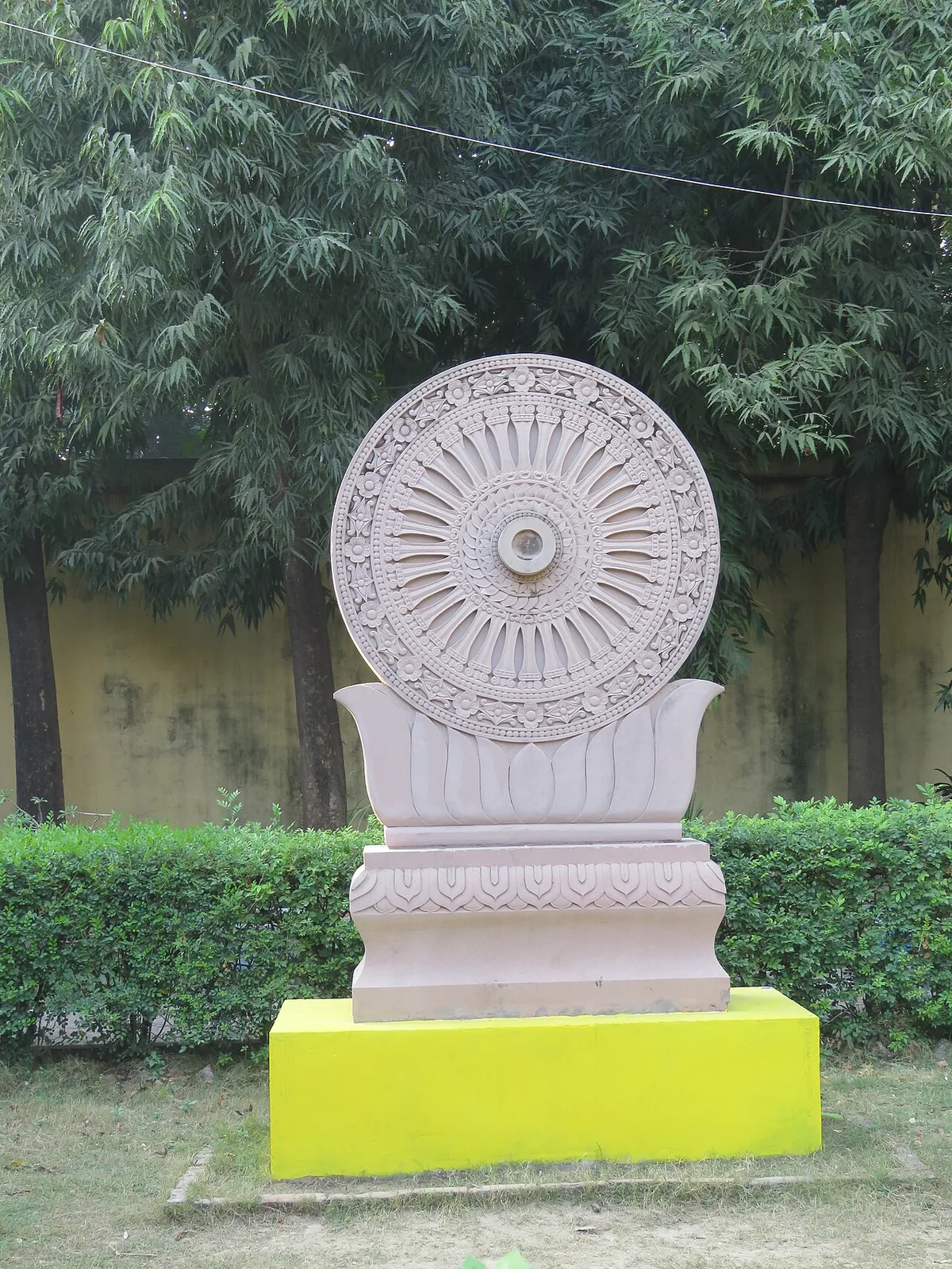
According to Buddhist scriptures, after attaining enlightenment, the Buddha walked to Isipatana to seek out the five ascetics who had practiced austerity with him: Kaundinya (Koṇḍañña, known in Vietnamese as Kiều Trần Như), Assaji (Ác Bệ), Bhaddiya (Bạt Đề), Vappa (Thập Lực Ca Diếp), and Mahanama (Ma Ha Nam Câu Ly). Those five companions had left him when he gave up self-mortification. In the Deer Park, he delivered to them the discourse known to tradition as the Setting in Motion of the Wheel of the Dharma (Dhammacakkappavattana Sutta): avoiding the two extremes of sensual indulgence and self-mortification, walking the Middle Way (the Noble Eightfold Path), and comprehending the Four Noble Truths of suffering, its origin, its cessation, and the path leading to its cessation.
The scriptures relate that Kaundinya was the first to gain the spotless eye of the Dharma, and the five ascetics were ordained as the first five bhikkhus (monks). From that moment, Buddhist tradition holds that the Three Jewels were complete for the first time: the Buddha, the Dharma, and the Sangha. The phrase turning the Wheel of Dharma signifies setting the wheel of true teaching rolling in the world. Here too the Buddha spent his first rains retreat (vassa), and the monastic community grew to sixty arahants before he sent them out in all directions to teach.
A common misconception: many visitors think the standing Dhamek Stupa was built directly by Emperor Ashoka in the 3rd century BCE. According to archaeological records summarized by Indian tourism authorities, the current Dhamek Stupa dates to around 500 CE during the Gupta period, encasing and replacing an earlier Mauryan monument. The surviving structures directly attributable to Ashoka are the brick core of the Dharmarajika Stupa and the inscribed sandstone pillar. As for the exact spot where the Buddha sat while preaching, the stupas mark the traditional loci rather than a pinpoint verifiable to the footstep.
IISixteen Centuries of Building and Two Rediscoveries
According to Uttar Pradesh heritage documentation and the UNESCO dossier, architectural layers at Sarnath span nearly sixteen centuries, from the Mauryan era through the 12th century CE. Successive dynasties erected stupas, shrines, and monastic quadrangles, turning Sarnath into a major center of Buddhist learning. Chinese pilgrim monks such as Faxian in the early 5th century and Xuanzang in the 7th century recorded thriving monastic communities here. After the 12th century the monastic center fell into ruin and its brick structures were gradually buried beneath the soil until the site drew scholarly attention again at the end of the 18th century.
- 3rd century BCEEmperor Ashoka erects stupas and stone pillarEmperor Ashoka builds the Dharmarajika Stupa and a polished sandstone pillar inscribed with an edict against schism in the Sangha. Indian tourism records state that the precursor stupa on the site of the Dhamek was also founded by Ashoka in 249 BCE.
- Around 500 CEConstruction of the Gupta-era Dhamek StupaThe present Dhamek Stupa is erected over earlier foundations, featuring fine Gupta-period floral and geometric stone carvings around its base while its upper brick drum remains unfinished.
- 12th centuryDecline of the monastic centerThe latest ancient structural additions at the complex belong to this century, after which monastic activity ceases and the site lies abandoned.
- 1794Dismantling of Dharmarajika Stupa and relic discoveryWorkmen dismantling bricks from the Dharmarajika Stupa for building material uncover a stone box containing a relic casket inside the core, drawing modern archaeological attention back to Sarnath.
- 1931Inauguration of Mulagandhakuti ViharaOn 11 November 1931, the new temple built by Anagarika Dharmapala and the Maha Bodhi Society (funded largely by Hawaiian benefactor Mary Robinson Foster) is inaugurated and receives sacred Buddha relics presented by the Archaeological Survey of India. The next day, 12 November, a Bodhi Tree sapling from Anuradhapura, Sri Lanka, is planted beside it.
- 1936Completion of the interior muralsJapanese artist Kōsetsu Nōsu completes the frescoes depicting scenes from the life of the Buddha on the interior walls of Mulagandhakuti Vihara in May 1936.
- 1958National monument protectionThe two monument clusters are placed under highest national protection under the Ancient Monuments and Archaeological Sites and Remains Act of 1958, managed by the Archaeological Survey of India (ASI).
- 2026UNESCO World Heritage SiteOn 25 July 2026, at the 48th session of the World Heritage Committee in Busan, Ancient Buddhist Site, Sarnath is inscribed under criteria (iii) and (vi) (core zone 8.05 ha, buffer zone 72.2 ha), becoming India's 45th World Heritage property.
On the modern temples surrounding the ruins: Mulagandhakuti Vihara, built by Anagarika Dharmapala and the Maha Bodhi Society, was inaugurated on 11 November 1931, as recorded by both the Maha Bodhi Society and the Uttar Pradesh tourism portal (Pawan Path). Meanwhile, the date February 1908 listed on Pawan Path refers to the construction of the Migadawun Myanmar Temple, the oldest foreign Buddhist temple in Sarnath. Readers scanning tourism summaries quickly sometimes conflate the 1908 Burmese temple date with Mulagandhakuti Vihara.
On the Ashoka Pillar: the polished Chunar sandstone column was excavated by engineer F. O. Oertel during the 1904 to 1905 season. Indian tourism and archaeological sources note that the original shaft stood roughly 50 to 55 feet high (about 15.25 to 16.8 meters), while today the lower stump of about 2.03 to 2.4 meters remains standing in situ beneath a protective enclosure, and the broken upper shaft segments and the famous Lion Capital are preserved in the Sarnath Archaeological Museum.
IIIDhamek Stupa, the Dharmarajika Base, and the Modern Temple
The UNESCO nomination divides the heritage property into four components: Chaukhandi Stupa, Dhamek Stupa, Dharmarajika Stupa, and the surrounding archaeological ruins collectively known as the Deer Park. Most of what visitors see across the lawn consists of foundations: low brick walls of monastic cells arranged around square courtyards, shrine plinths, and brick-paved walkways. Rising high above ground level are the cylindrical mass of the Dhamek Stupa and the distant mound of Chaukhandi.
Also spelled Dharma Chakra Stupa, the Stupa of the Wheel of Dharma. According to Indian tourism sources, it stands about 43.6 meters high and 28 meters in diameter. Its lower stone facing bears Gupta-period floral and geometric carvings with eight projecting niches around the drum, while the upper brickwork remains uncapped.
Originally built by Emperor Ashoka and enlarged in six successive phases over the centuries. Only its circular brick base survives today after the superstructure was dismantled for bricks in 1794, when the relic casket inside was discovered.
A polished Mauryan sandstone column inscribed with Emperor Ashoka's schism edict warning against dividing the Sangha. The lower stump remains standing in situ while the upper fragments are housed in the site museum.
A terraced brick stupa mound about 800 meters southwest of the main park, marking the spot where the Buddha first met his five ascetic companions again. An octagonal brick tower was added atop the mound in 1588 during the Mughal era.
The modern temple inaugurated in 1931 about 200 meters east of the Dhamek Stupa according to Buddhistdoor. Named after the ancient fragrant chamber where the Buddha spent his first rains retreat, it enshrines authentic Buddha bone relics (unearthed at Taxila and Nagarjunakonda) and interior frescoes by Japanese painter Kōsetsu Nōsu.
Planted on 12 November 1931 beside Mulagandhakuti Vihara from a sapling of the Jaya Sri Maha Bodhi in Anuradhapura, Sri Lanka, which itself grew from a branch of the original Bodhi Tree at Bodh Gaya.
Visitors accustomed to Vietnamese pagodas will notice how different the Dhamek Stupa is from an East Asian multi-tiered pagoda tower. Vietnamese stupas rise in multiple eaves with hollow chambers or niches holding the relics of eminent monks. The Dhamek Stupa is a solid cylindrical mass with no interior chamber to enter, so pilgrims venerate it by walking around the exterior. That is the classic form of the Indian stupa, originating from ancient burial mounds raised over relics and evolving into an architectural symbol of the awakened mind and body of the Buddha.
IVLandform and Orientation
Buddhist scriptures do not describe the Buddha surveying geomantic landforms before walking into the Deer Park. He came to Isipatana because his five former companions were staying there, and he taught where he met them. What follows is the library's reading of the park through traditional Vietnamese geomancy (phong thủy), just as the library reads other sacred sites for comparative purposes, rather than anything recorded in Buddhist scriptures, the UNESCO dossier, or Archaeological Survey of India publications. Because exact compass bearings for each ancient foundation are not published in the heritage summaries, this reading focuses on macro-landform and structural shape.
The first feature noticed by a traditional geomantic eye is flat plain without mountains. Sarnath lies on the Gangetic plain, level in every direction without a single hill to serve as a rear backing peak. In traditional Vietnamese flatland geomancy, water serves as the dragon vein: major rivers carry and guide the flow of vital energy. Here the Varuna River curves to the southwest before joining the great Ganges flowing past Varanasi to the south (together with the Assi River giving Varanasi its name), while the Deer Park occupies slightly elevated ground safe from seasonal flooding, within reach of the river currents without sitting on the eroding bank.
Second is stillness beside motion. Varanasi is one of the busiest sacred cities of Hinduism, its river ghats, markets, and cremation fires active day and night. The Deer Park lies about ten kilometers northeast of the city center, close enough for seekers to reach on foot yet far enough to preserve quietude. Traditional East Asian reading calls this posture seclusion beside the city (thị ẩn), withdrawing from noise without cutting off the world, fitting for the place where the Dharma first stepped out into human society.
Third is the form of the Dhamek Stupa. A wide-based, heavy, solid cylinder belongs to the Metal (Kim) shape resting upon level Earth (Thổ) ground, where Earth generates Metal in a harmonious cycle according to Five Elements theory. Because the upper brick drum was left uncapped by a pointed spire, the rounded cylinder remains self-contained without a sharp Fire peak shooting upward. Traditional form-reading interprets such a profile as a vessel that holds and consolidates energy rather than dispersing it outward. Of course, the hemispherical and cylindrical stupa is a two-thousand-year-old convention of Indian Buddhist architecture, so its overlap with Five Elements shape theory is a visual parallel rather than the builders' intent.
Finally, there is the forecourt (minh đường). The broad open lawn in front of the stupa, where the low brick foundations of ancient monastery courtyards lie side by side, acts as a bright, open gathering court. In traditional geomancy, a spacious forecourt is what allows people to assemble. At the very place where Buddhist tradition says the Sangha first came into being, that wide open court matches the historical meaning of the ground. Once again, this is the library's comparative reading rather than a calculation made by the ancient builders.
VThree Great Full-Moon Observances at the Deer Park
Sarnath does not follow a single unified liturgical calendar. Each national monastery surrounding the archaeological park conducts services according to its own home tradition. The three largest annual gatherings all fall on full-moon days calculated by the Indian lunisolar calendar, so their Gregorian dates shift each year. The table below records the days without fixed clock hours.
| Date | Calendar system | Observance | Details |
|---|---|---|---|
| Full moon of Vaisakha, around May | Indian lunisolar calendar | Buddha Purnima (Vesak) | One of the two annual occasions when the sacred Buddha bone relics enshrined at Mulagandhakuti Vihara are brought out for public veneration, according to The Statesman. |
| Full moon of Asadha, around July | Indian lunisolar calendar | Asalha Puja (Dharma Day) | Commemorates the Buddha's first discourse delivered right here in the Deer Park and marks the start of the three-month rains retreat (vassa). Buddhistdoor notes services and relic blessings at Mulagandhakuti Vihara, regarded as the second most sacred day after Buddha Purnima. |
| Full moon of Kartik, around November | Indian lunisolar calendar | Anniversary of Mulagandhakuti Vihara | The largest annual gathering in Sarnath. The sacred relics are carried in a golden casket procession around the town and displayed for pilgrims by the Maha Bodhi Society, according to The Statesman. |
| Winter, November to February | Gregorian calendar | Pilgrimage season | During the cool dry winter months, pilgrimage groups following the Four Great Pilgrimage Sites circuit regularly visit Sarnath after Bodh Gaya. |
For Buddhist practitioners, the full moon of Asadha carries a special resonance at Sarnath: it commemorates the exact event that took place on this very ground rather than an event from another site. Pilgrims regularly gather around the Dhamek Stupa to chant the Dhammacakkappavattana Sutta, reciting the words that tradition holds were first spoken here. Regarding the Vietnamese Buddhist community at Sarnath, a November 2025 report in The Statesman noted that the 94th anniversary celebration of Mulagandhakuti Vihara on Kartik Purnima was organized by the Maha Bodhi Society of India in collaboration with the Vietnamese Sangha and devoted followers from Hanoi, welcoming more than 22,000 pilgrims from Vietnam, Sri Lanka, Thailand, Laos, Cambodia, and Myanmar to venerate the two sacred bone relics of the Buddha.
VILocation And How To Get There
- Address
- Sarnath Archaeological Site, Sarnath, Varanasi, Uttar Pradesh 221007, India
- Getting there
- The archaeological complex is located in the town of Sarnath, about 10 kilometers northeast of the city center of Varanasi, Uttar Pradesh state, India. Taxis and auto-rickshaws run directly to Sarnath from Varanasi railway stations and Lal Bahadur Shastri International Airport.
- Coordinates
- 25.3809, 83.0246
Because the archaeological park is managed by the Archaeological Survey of India, heritage preservation rules apply alongside religious etiquette. Do not climb on the ancient brick foundations or stupa drums, and do not affix offerings or gold leaf outside permitted areas. Circumambulate the Dhamek Stupa clockwise, keeping the monument to your right. When entering Mulagandhakuti Vihara, remove footwear, dress modestly, maintain silence during chanting, and refrain from photographing people who are prostrating or meditating without permission.
Nearby places in the library
VIIContribute To This Page
Contribute photos, information or video for Sarnath
Góp ảnh, thông tin hoặc video cho Vườn Lộc Uyển (Sarnath)Everyone is welcome to enrich this page: a photo you took, a detail the page misses, a short video. Every contribution is read and answered.
Thầy Ưng Khiêm mời cộng đồng cùng làm giàu trang này. Ảnh chụp tận nơi, một chi tiết lịch sử chưa được nhắc, một đoạn video ngắn: mọi đóng góp đều được đọc và trả lời.
No community contribution yet. You could be the first. Chưa có đóng góp nào từ cộng đồng. Bạn có thể là người đầu tiên.
?Quick Questions
where is sarnath deer park located
Sarnath (known in Vietnamese as Vườn Lộc Uyển, the Deer Park) is a town located about 10 kilometers northeast of the center of Varanasi in Uttar Pradesh state, India. It is where the Buddha delivered his first discourse after attaining enlightenment, making it one of the four primary pilgrimage sites of Buddhism.
what did the buddha teach at sarnath
According to Buddhist scriptures, the Buddha preached the Dhammacakkappavattana Sutta (Setting in Motion the Wheel of the Dharma) to his five former ascetic companions (Kaundinya, Assaji, Bhaddiya, Vappa, and Mahanama), teaching the Middle Way (the Noble Eightfold Path) and the Four Noble Truths. The five became the first ordained monks, completing the Three Jewels of Buddha, Dharma, and Sangha.
how tall is the dhamek stupa and who built it
According to Indian tourism records, the Dhamek Stupa stands about 43.6 meters high and 28 meters in diameter, rebuilt around 500 CE during the Gupta period over an earlier stupa founded by Emperor Ashoka. Its lower stone casing bears carved floral and geometric panels, while the upper brick drum was left unfinished.
when was sarnath inscribed as a unesco world heritage site
Ancient Buddhist Site, Sarnath was inscribed on the UNESCO World Heritage List on 25 July 2026 during the 48th session of the World Heritage Committee in Busan under criteria (iii) and (vi), covering a core zone of 8.05 hectares and a buffer zone of 72.2 hectares. The property comprises Chaukhandi Stupa, Dhamek Stupa, Dharmarajika Stupa, and the excavated monastic ruins of the Deer Park.
how does sarnath differ from bodh gaya
Bodh Gaya in Bihar state is where the Buddha attained enlightenment beneath the Bodhi Tree. Sarnath near Varanasi in Uttar Pradesh is where he subsequently delivered his first sermon, setting the Wheel of Dharma in motion. Both belong to the Four Great Pilgrimage Sites alongside Lumbini (birth) and Kushinagar (parinirvana).