
IColours
Colour used for this page of the library: Vermilion red #9D2933. Every colour code is approximate, since most paths name their colours without publishing codes.
Principal colour the colour of the path
A coat of Vietnamese lacquer mixed with red cinnabar covers the incense tables, horizontal plaques, parallel sentences, thrones and spirit tablets in lineage halls and on family altars. The hex code borrows the nearest named color yanzhi 胭脂 (rouge).
Gold leaf applied over the vermilion ground. Together with vermilion it forms the red lacquer and gold leaf style of ritual objects.
Place of worship real sanctuaries
Ritual colours by occasion and season
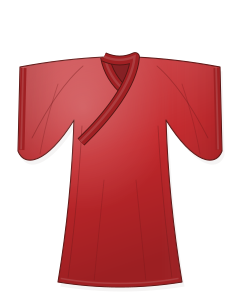
Following the traditional sacrificial pattern, the chief officiant wears red. The source describes the village communal house sacrifice, which lineages follow in the same pattern.
Assistant officiants wear green according to one source and purple according to another.
No source found setting a specific color for death anniversaries. Offerings include rice, eggs, salt, rice wine, incense and a written prayer.
Mourning and avoided colours
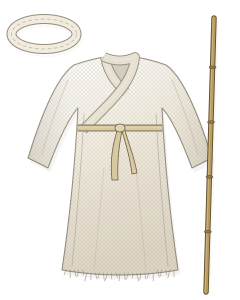
The traditional Vietnamese mourning color, unlike the European use of black. White headbands are worn by children and spouses.
For grandchildren through a son.
For grandchildren through a daughter.
For great grandchildren.
Many places now use a black armband in the European style.
IIRanks
Ancestor Worship is a belief of the family and the lineage. It has no church, no clergy and no clerical ranks. Its actual organization is the family (the eldest son keeps the worship and the ancestral estate) and the lineage (the lineage head, branch heads, the family council, the ancestral hall). Almost every Vietnamese family has an ancestral altar, including many families that follow other religions.
- 1Lineage head族長
- 2Family councilno original name found
- 3Branch head, sub lineage head支長 派長
- 4Eldest son and heir of worship (eldest son, eldest grandson of the main line)長男 承祀 嫡孫
- 5Chief officiant, assistant officiants and ritual attendants at the ancestral sacrifice主祭 陪祭 執事
- 1Lineage head 族長 · Clan head
By old custom the eldest son of the main line, not elected. He decides lineage affairs, keeps the ancestral estate and the ancestral hall, and presides over the ancestral sacrifices. At a sacrifice the lineage head is the chief officiant even if he is young. Today many lineages elect a head who leads a standing committee.
- 2Family council no original name found · Clan council
Made up of the elders of each branch and an executive board. It looks after ancestor worship, organizes weddings, funerals and sacrifices, manages the ancestral hall and keeps the genealogy. It is now often established because the authority of the lineage head is no longer as binding as before.
- 3Branch head, sub lineage head 支長 派長 · Branch head
Heads a branch or sub lineage when the lineage grows large, still under the authority of the main lineage.
- 4Eldest son and heir of worship (eldest son, eldest grandson of the main line) 長男 承祀 嫡孫 · Eldest son as ritual heir
Keeps the altar and the death anniversary rites of one household. When the father dies before the grandfather, the eldest grandson stands in for his father and calls himself "thừa trọng tôn" (grandson bearing the heavy duty) in the prayer text.
- 5Chief officiant, assistant officiants and ritual attendants at the ancestral sacrifice 主祭 陪祭 執事 · Ritual officiants
A sacrificial team is formed for each rite. By custom the chief officiant is the lineage head. Assistant officiants and attendants help offer incense and wine and read the prayer.
Followers: Descendants, members of the lineage. There is no separate term for believers.. There are no grades of believers. Rank follows position in the lineage (generation, branch, senior or junior line).
IIIForms of address
| Rank | Spoken address | In writing | Self reference | Original term |
|---|---|---|---|---|
| Person making offerings (child) | Written in the prayer text as "Hiếu tử" (filial son) | Refers to self as "Tín chủ con là ..." (your faithful host, named ...), or as "hiếu tử" (filial son), "cô tử" (fatherless son), "ai tử" (motherless son) or "cô ai tử" (orphaned son), depending on whether the father or mother is living or dead | 孝子 孤子 哀子 孤哀子 | |
| Person making offerings (grandchild) | Written as "Hiếu tôn" (filial grandson) or "thừa trọng tôn" (grandson bearing the heavy duty) | Refers to self as "Hiếu tôn" (filial grandson) or "thừa trọng tôn" (grandson bearing the heavy duty) | 孝孫 承重孫 | |
| Deceased father and mother | Addressed as "Cha", "mẹ", "thầy", "u" and so on (father, mother), following family usage | Written as "Hiển khảo" (late father) and "hiển tỷ" (late mother) | 顯考 顯妣 | |
| Deceased grandparents, great grandparents, great great grandparents | Addressed as "Ông bà" (grandparents), "cụ" (great grandparent), "kỵ" (great great grandparent) | Written as "Tổ khảo, tổ tỷ" (grandfather, grandmother), "tằng tổ" (great grandparent), "cao tổ" (great great grandparent) | 祖考 祖妣 曾祖 高祖 | |
| Lineage head | no source found for a standard form of address | Written as "Tộc trưởng" or "trưởng họ" (lineage head) | no source found | 族長 |
IVVestments by rank
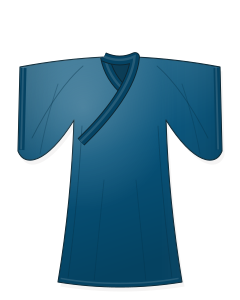
Flat drawings made from the descriptions in the sources, with no people shown. Colours are approximate.
VLine of succession
Ancestor worship has no founder, no church and no head. At the national level, the Vietnamese revere the Hùng Kings as the National Ancestors, and the state presides over the Hùng Kings' Commemoration at the Hùng Temple. Within each household and each lineage, worship passes down the senior line. The eldest son keeps the ancestral worship, the eldest son of the main line becomes lineage head, and the rites follow family ritual books such as Zhu Xi's Family Rituals and the Thọ Mai Family Rites.
The Hùng Kings as national ancestors and their commemoration
- legendary, eighteen reigns of the kingdom of Văn LangThe Hùng Kings (National Ancestors) 雄王
Legendary founders of Văn Lang, venerated as the common ancestors of the Vietnamese at the Hùng Temple.
- 1470The Hồng Đức era jade genealogy of the Hùng Kings 雄王玉譜
The 1470 Hồng Đức genealogy, the earliest surviving text on the Hùng Temple cult.
- 1917Setting the Commemoration on the 10th day of the 3rd lunar month
The Nguyễn court fixed the 10th day of the third lunar month as the national commemoration.
- 1946Decree 22/SL
The Democratic Republic of Vietnam made the Hùng Kings' day a public holiday for officials.
- 1954The words spoken at the Hùng Temple
In 1954 the words calling on all to keep the country the Hùng Kings built were spoken at the temple.
- 2007Paid public holiday
The labour code made the day a paid holiday.
- 2012UNESCO inscription
Worship of the Hùng Kings in Phú Thọ inscribed on the UNESCO Representative List.
- Today: the state presides over the Commemoration at the Hùng Temple Historical Site
There is no head of the cult. The state and Phú Thọ province host the rites at the Hùng Temple historic site.
Family ritual manuals and textual milestones
- Zhou to Han periodThe Ritual Classics (Yili, Liji) 儀禮 禮記
Confucian classics on ancestral, funeral and wedding rites, the root of later family manuals.
- 1130 to 1200Zhu Xi and Zhu Xi's Family Rituals (Wengong Jiali) 朱熹 朱子家禮
Zhu Xi's Family Rituals set the ancestral hall, four generation tablets and the capping, wedding, funeral and sacrificial rites for all East Asia.
- 15th centuryThe Penal Code of the Dynasty (Hồng Đức Code) 國朝刑律
The Lê Code set rules for incense and fire land and the heir who keeps the ancestral cult.
- 17th centuryHồ Sĩ Dương and the Family Rites of Minister Hồ 胡士揚 胡尚書家禮
A Vietnamese adaptation of Zhu Xi's rites by Minister Hồ Sĩ Dương, the core of Vietnamese family ritual literature.
- many manuscript and printed editions, date of composition unclearThọ Mai Family Rites 壽梅家禮
The most widely used popular manual for funerals, weddings and death anniversaries, still reprinted today.
- published from 1915Phan Kế Bính and Vietnamese Customs 潘繼炳 越南風俗
Records ancestor worship, anniversaries, ancestral halls and inheritance of the cult in early 20th century Vietnam.
Succession within each family and clan
- Founding ancestor 始祖
The first recorded ancestor of a clan, worshipped in its ancestral hall.
- Successive lineage heads 族長
By old custom the eldest son of the senior line, generation after generation. Keeps the hall, land and genealogy and leads the rites.
- Branch head, sub lineage head 支長 派長
Heads of branches handle branch rites under the clan head.
- The eldest son or eldest grandson keeps the household worship 長子 嫡孫
In each household the eldest son keeps the altar and leads the anniversaries, the senior grandson taking over if his father died first.
- The family council today
Many clans now elect a head and a council with written bylaws instead of strict primogeniture.
- Today: no common head
Each clan has its own head. No person or body leads ancestor worship nationally.
A venerated figure: the library shows no portrait, only the name inside a round seal.
VIOrdination and transmission
There is no ordination or consecration. Worship passes down the senior line. The eldest son keeps the worship of the household, and the eldest son of the main line becomes head of the lineage. Today many lineages elect a lineage head and a family council instead of hereditary succession.
- Taking on the worship of the householdRequirement: Being the eldest son, or the eldest grandson of the main line when the father has died firstRite: Serving as chief mourner, then presiding over death anniversaries, and calling oneself filial son or grandson bearing the heavy duty in the prayer text
- Becoming lineage headRequirement: By old custom, the eldest son of the main line. Under many present day lineage rules, by electionRite: no source found for an installation rite
- Becoming chief officiant at the ancestral sacrificeRequirement: By custom the lineage head, even if youngRite: The three offerings (incense and wine), and reading the prayer text
VIIWhere the sources disagree
- Lineage head: Hội An documents say he is the eldest son of the main line, not elected. The rules of the Trần lineage of Hải Phúc provide for electing a standing committee every five years, led by the lineage head. Both are real and vary by period and by lineage.
- Wikipedia says Vietnamese women have long taken part in and co presided over ancestral rites, unlike the Chinese Confucian custom that allowed only sons. This softens the hierarchy of the eldest son as heir of worship.
- Color of the assistant officiant's robe: one source gives green, another purple.
- Mourning headband colors by kinship position differ between regions. The tangle247 source gives red for grandchildren through a son, blue for grandchildren through a daughter and yellow for great grandchildren. Not yet checked against the original Thọ Mai Family Rites.
- Vietnam has no standard hex code table for vermilion. The code used here is the nearest Chinese color name. The old colors #8C1F14 and #8C1C13 in mau-sac.json and mau-that.json match no original color name but lie in the same vermilion family, so their direction is not wrong.
- The kampatour source in mau-that.json is a travel website with low reliability. It should be replaced with a museum or research source when one is available.
- The authorship of the Thọ Mai Family Rites is debated. The book is usually linked to Hồ Sĩ Dương, but scholars distinguish the Family Rites of Minister Hồ (the original, whose finest edition was printed in 1739) from the Thọ Mai Family Rites that circulated later. Sources give different dates for Hồ Sĩ Dương (1621 to 1681 or 1652 to 1682), so only the 17th century is given.
- Zhu Xi has bac_thieng set to true for consistency with the Confucianism file, since he is honored in the Confucian Temple.
- A Cần Thơ source mixes the year 1470 with the Trần period. The jade genealogy is usually described as compiled in the Hồng Đức era of the Lê dynasty, not under the Trần.
- No head has been invented. This belief has no head. The final milestones are institutions and roles, not persons.
- No images needed. No one with bac_thieng false is a living figure.
VIIISources
25 sources
- https://www.vietnam.vn/en/tinh-hoa-lang-nghe-dieu-khac-son-son-thep-vang-son-dong
- https://www.vjol.info/son-son-thep-vang-la-gi
- https://kampatour.com/ancestor-worship-vietnam
- https://boxingp.github.io/traditional-chinese-colors/
- https://huongcanh.wordpress.com/2012/02/28/nghi-l%E1%BB%85-m%E1%BB%99t-bu%E1%BB%95i-t%E1%BA%BF-dinh/
- https://dothogiadinh.vn/le-te-nhung-dieu-can-biet.html
- https://hoianheritage.net/vi/trao-doi-chuyen-nganh/chuyen-de-nghien-cuu-trao-doi/vai-tro-va-cach-thuc-to-chuc-cua-toc-ho-o-hoi-an-967.html
- https://hokhuatvietnam.org/phong-tuc-cua-nguoi-viet-nam-cung-gio-va-tho-phung-to-tien
- https://dangnho.com/kien-thuc/phong-tuc/nam-hang-tang-phuc-ngu-phuc-la-gi.html
- https://www.tangle247.vn/kien-thuc-nghanh-tang-le/huong-dan-chung-ve-tang-phuc-do-tang.html
- https://www.sachhayonline.com/tua-sach/mot-tram-dieu-nen-biet-ve-phong-tuc-viet-nam/48-vai-tro-toc-truong-xua-va-nay-khac-nhau-nhu-the-nao/516
- https://hotran.org.vn/quy-uoc.html
- https://giaphatphcm.com/huong-dan-hoat-dong-hoi-dong-gia-toc-o-cac-xa-ap
- https://voh.com.vn/thuong-thuc/cach-xung-ho-trong-van-cung-622142.html
- https://luatvietnam.vn/dan-su/chau-dich-ton-la-gi-568-97868-article.html
- https://en.wikipedia.org/wiki/Veneration_of_the_dead
- http://svhttdl.phutho.gov.vn/tin/gio-to-hung-vuong-net-doc-dao-cua-van-hoa-viet_24.html
- https://ich.unesco.org/en/RL/worship-of-hung-kings-in-phu-tho-00735
- https://pbgdpl.cantho.gov.vn/lich-su-y-nghia-ngay-gio-to-hung-vuong
- https://ussh.vnu.edu.vn/vi/dao-tao/luan-an/ttla-nghien-cuu-tac-pham-ho-thuong-thu-gia-le-18970.html
- https://vi.wikipedia.org/wiki/Gi%E1%BB%97_T%E1%BB%95_H%C3%B9ng_V%C6%B0%C6%A1ng
- https://vi.wikipedia.org/wiki/Qu%E1%BB%91c_tri%E1%BB%81u_h%C3%ACnh_lu%E1%BA%ADt
- https://vi.wikipedia.org/wiki/Vi%E1%BB%87t_Nam_phong_t%E1%BB%A5c
- https://www.trithuctrebooks.com/products/nho-giao-va-van-hoa-dong-ho-van-ban-ho-thuong-thu-gia-le
- https://zh.wikipedia.org/zh-hans/%E6%9C%B1%E5%AD%90%E5%AE%B6%E7%A6%AE
?Quick Questions
What is the principal colour of Ancestor Veneration?
Vermilion red (sơn son), #9D2933. The vermilion of the red lacquer and gold leaf style is the actual color of ancestral incense tables, horizontal plaques and parallel sentences, and it has its own name in the Vietnamese lacquer craft. The code #9D2933 borrows the nearest named color yanzhi 胭脂. The old color #8C1F14 is in the same family, slightly darker, and can still be used as a dark variant.
How many ranks does Ancestor Veneration have?
The library records 5 ranks, from highest to lowest: Lineage head, Family council, Branch head, sub lineage head, Eldest son and heir of worship (eldest son, eldest grandson of the main line), Chief officiant, assistant officiants and ritual attendants at the ancestral sacrifice.
Who leads Ancestor Veneration today?
In the line of The Hùng Kings as national ancestors and their commemoration, the most recent milestone is Today: the state presides over the Commemoration at the Hùng Temple Historical Site. There is no head of the cult. The state and Phú Thọ province host the rites at the Hùng Temple historic site.