
IColours
Colour used for this page of the library: Blue (deep blue) #E29C45. Every colour code is approximate, since most paths name their colours without publishing codes.
Principal colour the colour of the path
The first stripe of the Buddhist flag. According to Wikipedia it stands for universal compassion. According to an article on phatgiao.org.vn it stands for the faculty of concentration. The hex code is approximate. The Buddhist flag has no official color codes.
The second stripe. The Middle Way according to Wikipedia, the faculty of mindfulness according to phatgiao.org.vn. The hex code is approximate. The Buddhist flag has no official color codes.
The third stripe. The blessings of practice according to Wikipedia, the faculty of energy according to phatgiao.org.vn. The hex code is approximate. The Buddhist flag has no official color codes.
The fourth stripe. The purity of the Dharma according to Wikipedia, the faculty of faith according to phatgiao.org.vn.
The fifth stripe. Wisdom according to Wikipedia, the faculty of wisdom according to phatgiao.org.vn. The sixth stripe is the five colors stacked horizontally. The hex code is approximate. The Buddhist flag has no official color codes.
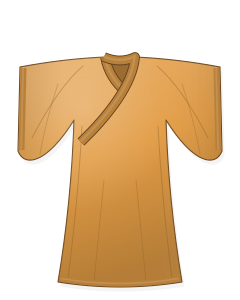
The robe color of Vietnamese monks and nuns is a dark, dulled yellow. Dulled means dyed to remove brightness so it does not arouse attachment, and to distinguish monastics from lay people dressed in white. The hex code borrows the name huanglu 黃櫨 (smoke tree yellow) and is approximate.
Place of worship real sanctuaries
Ritual colours by occasion and season
The Charter sets the flag of the Sangha as the international five color Buddhist flag, with six vertical stripes in the order blue, yellow, red, white, orange.
Those whose mothers are living wear a red rose.
Those whose mothers have died wear a white rose.
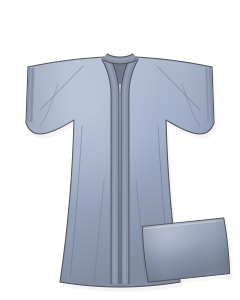
Monks wear the yellow ceremonial gown ("áo hậu") and a yellow kasaya. Nuns wear a blue long robe ("áo tràng") and a yellow kasaya.
Mourning and avoided colours
Vietnamese Buddhists mourn according to the general Vietnamese custom, in white mourning clothes of gauze. No Sangha document found that sets a separate mourning color.
Monastic robes must be dyed to a dulled color and may not use bright, vivid colors. This is a rule on robe color, not a color forbidden to lay Buddhists.
IIRanks
World Buddhism has no central church. In Vietnam, the Vietnam Buddhist Sangha is the common organization. It includes the Northern (Mahayana) tradition, the Southern (Theravada) tradition in its Khmer and Kinh branches, and the Mendicant ("Khất sĩ") tradition, and is governed by a Charter. The Council of Patronage is the spiritual leadership body headed by the Supreme Patriarch. The Executive Council is the highest administrative body.
- 1Supreme Patriarch法主
- 2Most Venerable (monks), Most Venerable Nun (nuns)和尚 尼長
- 3Venerable (monks), Venerable Nun (nuns)上座 尼師
- 4Reverend (monks), Sister (nuns)大德 師姑
- 5Probationary nun, sikkhamana (nuns only)式叉摩那
- 6Novice monk (monks), novice nun (nuns)沙彌 沙彌尼
- 1Supreme Patriarch 法主 · Supreme Patriarch
Head of the Council of Patronage. Must be an Elder Most Venerable aged at least seventy five with at least fifty years since full ordination. This is an office, not a separate monastic rank.
- 2Most Venerable (monks), Most Venerable Nun (nuns) 和尚 尼長 · Most Venerable
The highest monastic rank. The standard is about sixty years of age and forty years since full ordination. From the Sanskrit upadhyaya, a guiding teacher.
- 3Venerable (monks), Venerable Nun (nuns) 上座 尼師 · Venerable
The standard is about forty five years of age and twenty five years since full ordination. From the Sanskrit sthavira, Pali thera, an elder.
- 4Reverend (monks), Sister (nuns) 大德 師姑 · Bhikkhu, Bhikkhuni
Monks and nuns who have received full ordination, from the age of twenty. The monk's title is from the Sanskrit bhadanta. It is not a rank conferred by promotion.
- 5Probationary nun, sikkhamana (nuns only) 式叉摩那 · Probationary nun
A stage of precept training before full ordination as a nun, for ages eighteen to sixty.
- 6Novice monk (monks), novice nun (nuns) 沙彌 沙彌尼 · Novice
Has received the novice precepts, at the age set by the Vinaya.
Followers: Buddhists ("Phật tử"). Those who have taken refuge in the Three Jewels and received precepts are called lay followers. Upasaka (men) and upasika (women) are lay followers who support the Three Jewels.
IIIForms of address
| Rank | Spoken address | In writing | Self reference | Original term |
|---|---|---|---|---|
| Most Venerable | Addressed as "Bạch Hòa thượng" (Most Venerable). Lay followers refer to themselves as "con" (your child). | Written as "Hòa thượng Thích" (Most Venerable Thích) followed by the Dharma name, abbreviated "HT." | Refers to self as "Tôi" (I), or "Thầy" (Teacher) when speaking to lay followers | 和尚 |
| Venerable, Reverend | Addressed as "Bạch Thầy" (Teacher). Lay followers refer to themselves as "con" (your child). | Written as "Thượng tọa Thích ..." (Venerable), abbreviated "TT.", and "Đại đức Thích ..." (Reverend), abbreviated "ĐĐ." | Refers to self as "Tôi" (I), "bần tăng" (this humble monk), or "Thầy" (Teacher) when speaking to lay followers | 上座 大德 |
| Most Venerable Nun | Addressed as "Bạch Ni trưởng" (Most Venerable Nun). Lay followers refer to themselves as "con" (your child). | Written as "Ni trưởng Thích nữ" (Most Venerable Nun) followed by the Dharma name, abbreviated "NT." | Refers to self as "Tôi" (I) | 尼長 |
| Venerable Nun | Addressed as "Bạch Ni sư" (Venerable Nun). Lay followers refer to themselves as "con" (your child). | Written as "Ni sư Thích nữ ..." (Venerable Nun), abbreviated "NS." | Refers to self as "Tôi" (I) | 尼師 |
| Sister (fully ordained nun) | Addressed as "Bạch Sư cô" (Sister). Lay followers refer to themselves as "con" (your child). | Written as "Sư cô Thích nữ ..." (Sister), abbreviated "SC." | Refers to self as "Tôi" (I) | 師姑 |
| Novice monks, novice nuns | No official source found. By custom novice monks are addressed as "chú" or "chú tiểu" (little brother) and novice nuns as "cô" (sister). | Written as "Sa di Thích ..." (novice monk) and "Sa di ni Thích nữ ..." (novice nun) | no source found | 沙彌 |
| Among monks and nuns | Disciples address their ordaining teacher as "Thầy" (Teacher) or "Tôn sư" (Venerable Teacher). Fellow practitioners call each other "sư huynh" (elder Dharma brother) and "sư đệ" (younger Dharma brother). | Refers to self as "Tôi" (I). Monks and nuns call lay followers "đạo hữu" (Dharma friend). Those with fewer precepts show respect to those with more, regardless of age. | 師兄 師弟 |
IVVestments by rank
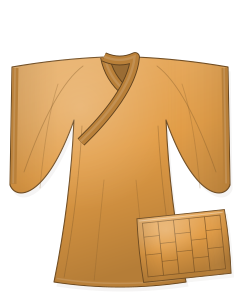
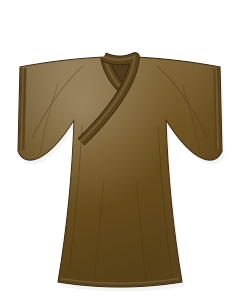
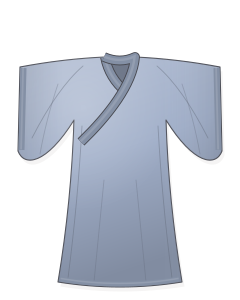
Flat drawings made from the descriptions in the sources, with no people shown. Colours are approximate.



VLine of succession
Buddhism is transmitted from teacher to disciple. The teacher passes on the precepts, the Dharma and the mind seal to the student, so there are many parallel lineages and no single head for the whole world. The Chan (Zen) school traces its patriarchs from the Buddha through twenty eight Indian and six Chinese patriarchs, after which it divided into many schools. In Vietnam, meditation schools succeeded one another through the ages, and since 1981 the Vietnam Buddhist Sangha has had a Supreme Patriarch heading its Council of Patronage.
Chan lineage: 28 Indian and 6 Chinese patriarchs
- about 6th to 5th century BCEShakyamuni Buddha 釋迦牟尼 Śākyamuni
Founder of Buddhism. Chan tradition says he transmitted the mind seal to Mahākāśyapa.
- #India 1 · 5th century BCEMahakashyapa 摩訶迦葉 Mahākāśyapa
First patriarch, presided over the first council.
- #India 2 · 5th century BCEAnanda 阿難 Ānanda
Second patriarch, the Buddha's attendant who recited the sutras.
- #India 12 · about 1st to 2nd centuryAshvaghosha 馬鳴 Aśvaghoṣa
Twelfth patriarch, Buddhist poet and philosopher.
- #India 14 · about 2nd to 3rd centuryNagarjuna 龍樹 Nāgārjuna
Fourteenth patriarch, founder of the Madhyamaka school.
- #India 21Vasubandhu 婆修盤頭 Vasubandhu
Twenty first patriarch in the Chan list.
- #India 28, China 1 · ? to about 535Bodhidharma 菩提達磨 Bodhidharma
Twenty eighth Indian patriarch who brought Chan to China, its first Chinese patriarch.
- #China 2 · 487 to 593Huike 慧可
Second Chinese patriarch.
- #China 3 · ? to 606Sengcan 僧璨
Third Chinese patriarch, traditionally author of the Xinxin Ming.
- #China 4 · 580 to 651Daoxin 道信
Fourth Chinese patriarch.
- #China 5 · 602 to 675Hongren 弘忍
Fifth Chinese patriarch, passed the robe and bowl to Huineng.
- #China 6 · 638 to 713Huineng (Sixth Patriarch) 慧能
Sixth patriarch of the Platform Sutra. After him the robe was no longer passed on and Chan divided into the Five Houses.
- ? to 866Linji Yixuan 臨濟義玄
Founder of the Linji school, today the largest Zen line in Vietnam. Chan has no single head today.
Full list of 34 holders
- India 1Mahākāśyapa
- India 2Ānanda
- India 3Śāṇakavāsa
- India 4Upagupta
- India 5Dhṛtaka
- India 6Miccaka
- India 7Vasumitra
- India 8Buddhanandi
- India 9Buddhamitra
- India 10Pārśva
- India 11Puṇyayaśas
- India 12Aśvaghoṣa
- India 13Kapimala
- India 14Nāgārjuna
- India 15Kāṇadeva
- India 16Rāhulata
- India 17Saṅghanandi
- India 18Gayaśata
- India 19Kumārata
- India 20Jayata
- India 21Vasubandhu
- India 22Manorhita
- India 23Haklenayaśas
- India 24Siṃha Bhikṣu
- India 25Basiasita
- India 26Puṇyamitra
- India 27Prajñātāra
- India 28Bodhidharma? to about 535
- China 1Bodhidharmaarrived in China about 520
- China 2Huike487 to 593
- China 3Sengcan? to 606
- China 4Daoxin580 to 651
- China 5Hongren602 to 675
- China 6Huineng638 to 713
Vietnamese Zen lineages: from Vinītaruci to Liễu Quán
- ? to 594, arrived in Vietnam in 580Vinitaruci 毘尼多流支 Vinītaruci
South Indian monk who reached Vietnam in 580 and founded its first Zen line, lasting nineteen generations.
- ? to 1018Vạn Hạnh 萬行
Twelfth generation master of the Vinītaruci line and teacher of the founder of the Lý dynasty.
- ? to 826, arrived in Vietnam in 820Vô Ngôn Thông 無言通
Disciple of Baizhang, came to Kiến Sơ temple in 820 and founded the second Zen line, lasting seventeen generations.
- 933 to 1011Khuông Việt 匡越
Fourth generation master of the Vô Ngôn Thông line, first Buddhist primate of Vietnam.
- arrived in Thăng Long in 1069Caotang (Thảo Đường) 草堂
Chinese monk taken captive in the Champa campaign, made National Teacher, founder of the Thảo Đường line with Emperor Lý Thánh Tông as disciple.
- 1230 to 1291Tuệ Trung Thượng Sĩ 慧中上士
Lay Zen master who taught Trần Nhân Tông.
- #Trúc Lâm 1 · 1258 to 1308Trần Nhân Tông (Điều Ngự Giác Hoàng) 陳仁宗 調御覺皇
Trần emperor who led resistance to the Mongols, became a monk at Yên Tử in 1299 and founded the Trúc Lâm school. Venerated as the Buddha Emperor.
- #Trúc Lâm 2 · 1284 to 1330Pháp Loa 法螺
Second Trúc Lâm patriarch, organised the sangha and printed the canon.
- #Trúc Lâm 3 · 1254 to 1334Huyền Quang 玄光
Third Trúc Lâm patriarch, a laureate scholar turned monk and poet.
- #Lâm Tế 33 · 1648 to 1728Nguyên Thiều 元韶
Cantonese master of the 33rd Linji generation who brought Linji to southern Vietnam.
- #Lâm Tế 35 · 1667 to 1742Liễu Quán 了觀
Master from Phú Yên who founded the Liễu Quán branch of Linji, the largest Vietnamese Zen line in the centre and south.
- #Liễu Quán 8 · 1926 to 2022Thích Nhất Hạnh 釋一行
Forty second Linji generation, eighth of the Liễu Quán line, founder of Plum Village.
- 1924 to 2022Thích Thanh Từ 釋清慈
Revived the Trúc Lâm school in modern times. Vietnamese Zen lines today have no single head.
Supreme Patriarchs of the Vietnam Buddhist Sangha
- November 1981, Quán Sứ Pagoda, HanoiConference for the Unification of Vietnamese Buddhism
Nine Buddhist organisations united to form the Vietnam Buddhist Sangha, with a Patriarch heading the Council of Elders.
- #1 · 1897 to 1993, Supreme Patriarch 1981 to 1993Most Venerable Thích Đức Nhuận 釋德潤
First Supreme Patriarch, from 1981 until his death in 1993.
- #2 · 1915 to 2005, Supreme Patriarch 1997 to 2005Most Venerable Thích Tâm Tịch 釋心寂
Second Supreme Patriarch, elevated at the fourth congress in 1997, died 2005.
- #3 · 1917 to 2021, Supreme Patriarch 2007 to 2021Most Venerable Thích Phổ Tuệ 釋普慧
Third Supreme Patriarch from 2007, died October 2021 aged 105.
- from December 2021Acting Supreme Patriarch after the passing of Thích Phổ Tuệ
The Council of Elders named Thich Tri Quang acting Patriarch until the ninth congress.
- #4 · born 1940, Acting Supreme Patriarch from December 2021, Supreme Patriarch since 29 November 2022Most Venerable Thích Trí Quảng 釋智廣
Fourth Supreme Patriarch, acting from December 2021 and elevated on 29 November 2022. Still in office in September 2026.
Full list of 4 holders
- 1Thích Đức Nhuận1981 to 1993
- 2Thích Tâm Tịch1997 to 2005
- 3Thích Phổ Tuệ2007 to 2021
- 4Thích Trí Quảngsince 2022, acting from December 2021
A venerated figure: the library shows no portrait, only the name inside a round seal.
VIOrdination and transmission
Transmission is by ordination in stages, novice, probationary nun (for nuns) and full ordination, at a Grand Ordination Platform organized by the Monastic Affairs Committees at each level. Monastic ranks are then conferred according to age, years since ordination and conduct. The Theravada and Mendicant traditions keep their own traditional ordination methods within the framework of the Sangha.
- Leaving home, receiving the novice preceptsRequirement: Age as set by the Vinaya, with a root teacherRite: Head shaving and going forth rite, receiving the ten novice precepts
- Probationary nun (nuns only)Requirement: Aged eighteen to sixtyRite: Receiving the probationary precepts at a Grand Ordination Platform
- Full ordination as monk or nunRequirement: Aged twenty to sixty, at least two years as a noviceRite: Ordination at a Grand Ordination Platform organized by the Monastic Affairs Committee
- Promotion to Venerable, Venerable NunRequirement: At the Ninth Congress: born in 1978 or earlier and fully ordained in 1998 or earlierRite: The Monastic Affairs Committee prepares the dossier, the Executive Council reviews it, and the rank is conferred at a Congress or annual conference
- Promotion to Most Venerable, Most Venerable NunRequirement: At the Ninth Congress: born in 1963 or earlier and fully ordained in 1983 or earlierRite: As above, under Articles 53 to 56 of the Charter and Circular 030 of the Executive Council
VIIWhere the sources disagree
- The five flag colors have two interpretations. Wikipedia follows the Sri Lankan tradition (compassion, the Middle Way, blessings, purity, wisdom), while phatgiao.org.vn links them to the Five Faculties (concentration, mindfulness, energy, faith, wisdom). The Charter sets only the order of colors, not their meaning or color codes.
- Age for Venerable: most sources give forty five years of age and twenty five years since ordination, but an article from Bạc Liêu Buddhism gives forty and twenty. Circular 030 for the Ninth Congress matches forty five and twenty five.
- Color of the novice "nhật bình" robe: Giác Ngộ gives blue, phatgiao.org.vn gives brown in the North. Both may be correct by region.
- The yellow long robe for the Most Venerable is only a proposal in a research article. No Sangha document has been found setting this rule.
- No complete source found on the Khmer names of Khmer Theravada monastic grades or on Khmer forms of address.
- The old color in mau-sac.json cites the yellow robe and the golden tone of statues. The yellow robe part is correct. The statue tone should not be used as a basis under the house rule on sacred images. The code #8A5A10 does not match any original color name.
- The hex code for lay blue (#A1AFC9) borrows the name lanhui 藍灰 (blue grey) from the Chinese palette, and brown (#6E511E) borrows hese 褐色. Vietnam has no standard code table for these color names.
- The list of twenty eight Indian patriarchs is a tradition of Chinese Chan (the Jingde Record of the Transmission of the Lamp). Scholars regard most of it as a later reconstruction. Theravada and Tibetan traditions have other lineages, which this page does not yet record.
- The table sets bac_thieng to true for the Buddha, Kashyapa, Ananda, Ashvaghosha, Nagarjuna, Bodhidharma, Huineng and Trần Nhân Tông because they are honored on patriarch altars. Other patriarchs are set to false according to the rule.
- There are vacancies between Supreme Patriarchs, from 1993 to 1997 and from 2005 to 2007. Some sources say Thích Tâm Tịch was Supreme Patriarch from 1993, while the main biographical source gives his acclamation as 1997.
- Sources give Nguyên Thiều's arrival in Vietnam as 1665 or 1677, so no year is given.
- Images: the Wikimedia Commons file pages could not be opened to check licenses (the domain was blocked), so all anh fields are null. Manual checking should prioritize images of Thích Trí Quảng, Thích Phổ Tuệ, Thích Nhất Hạnh and Thích Thanh Từ.
VIIISources
43 sources
- https://giacngo.vn/toan-van-hien-chuong-giao-hoi-phat-giao-viet-nam-sua-doi-lan-thu-vii-post66133.html
- https://en.wikipedia.org/wiki/Buddhist_flag
- https://phatgiao.org.vn/y-nghia-5-mau-tren-la-co-phat-giao-d40105.html
- https://giacngo.vn/phap-phuc-phat-giao-bac-truyen-viet-nam-post59105.html
- https://www.phattuvietnam.net/mau-sac-phap-phuc/
- https://boxingp.github.io/traditional-chinese-colors/
- https://havecamerawilltravel.com/field-notes/tran-quoc-pagoda-hanoi-vietnam/
- https://www.vietnam.vn/en/tinh-hoa-lang-nghe-dieu-khac-son-son-thep-vang-son-dong
- https://thanhnien.vn/thang-7-vu-lan-bao-hieu-y-nghia-bong-hong-do-hong-trang-hong-vang-cai-ao-1851484475.htm
- https://chuaxaloi.vn/thong-tin/phap-phuc-phat-giao-bac-truyen-viet-nam/3513.html
- https://phatgiao.org.vn/phap-phuc-phat-giao-viet-nam-hien-hanh-d40005.html
- https://thuvienphatquang.com/tim-hieu-y-phuc-tu-si-cua-phat-giao-nam-tong-khmer-va-bac-tong-o-tra-vinh/
- https://phatgiaodaklak.org/nghien-cuu/phat-phap-ung-dung/mot-so-suy-nghi-ve-phap-phuc-pgvn-thong-nhat-trong-da-dang.html
- https://giacngo.vn/noi-quy-ban-tang-su-tu-khoa-viii-2017-2022-post45165.html
- https://giacngo.vn/tim-hieu-phap-phuc-phat-giao-viet-nam-post9663.html
- https://www.tangle247.vn/kien-thuc-nghanh-tang-le/huong-dan-chung-ve-tang-phuc-do-tang.html
- https://giacngo.vn/trung-uong-ghpgvn-huong-dan-tan-phong-giao-pham-tai-dai-hoi-phat-giao-toan-quoc-lan-thu-ix-post60720.html
- https://phatgiao.org.vn/dai-duc-thuong-toa-va-hoa-thuong-co-nghia-la-gi-d32554.html
- https://phatgiaodongnai.org/danh-xung-va-cach-xung-ho-trong-phat-giao.html
- https://phatgiaobaclieu.com/hcach-xung-ho-trong-phat-giao-viet-nam-thich-chan-tue/
- https://en.wikipedia.org/wiki/Bodhidharma
- https://en.wikipedia.org/wiki/Huineng
- https://en.wikipedia.org/wiki/Thich_Nhat_Hanh
- https://en.wikipedia.org/wiki/Zen_lineage_charts
- https://giacngo.vn/duc-phap-chu-ghpgvn-khai-dao-gioi-tu-cac-he-phai-trong-dai-gioi-dan-thanh-kiem-post80986.html
- https://giacngo.vn/tieu-su-duc-de-nhat-phap-chu-ghpgvn-post23844.html
- https://giacngo.vn/tieu-su-va-hanh-trang-to-su-thiet-dieu-lieu-quan-1667-1742-post69846.html
- https://giadinhphattu.vn/tu-lieu-tham-khao/tim-hieu-lich-su-phat-giao-viet-nam-qua-cac-dong-thien.html
- https://langmai.org/tang-kinh-cac/vien-sach/giang-kinh/viet-nam-phat-giao-su-luan/chuong-05-thien-phai-ty-ni-da-luu-chi/
- https://nguoiphattu.com/tin-tuc/tieu-su-dai-lao-hoa-thuong-thich-tam-tich-phap-chu-giao-hoi-phat-giao-viet-nam-1915-2005-.d-7230.aspx
- https://phatgiao.org.vn/lich-su-giao-hoi-phat-giao-viet-nam-d8708.html
- https://phatgiao.org.vn/net-dac-trung-cua-thien-phai-truc-lam-yen-tu-d18502.html
- https://phatgiao.org.vn/thien-su-thuong-chieu-nguoi-co-cong-giao-nhap-3-dong-thien-phai-cua-phat-giao-viet-nam-the-ky-xiii-d33075.html
- https://phatgiao.org.vn/tu-dien-phat-hoc-online/nhi-thap-bat-to-k38868.html
- https://phatgiao.org.vn/ve-ngoi-vi-phap-chu-giao-hoi-phat-giao-viet-nam-d89383.html
- https://tapchinghiencuuphathoc.vn/thien-phai-lieu-quan-su-truyen-thua-va-phat-trien.html
- https://tuoitre.vn/duc-phap-chu-giao-hoi-phat-giao-viet-nam-thich-pho-tue-vien-tich-sau-105-nam-tru-the-20211021082819394.htm
- https://tuoitre.vn/truong-lao-hoa-thuong-thich-tri-quang-lam-quyen-phap-chu-giao-hoi-phat-giao-viet-nam-20211231144748914.htm
- https://vi.wikipedia.org/wiki/Nguy%C3%AAn_Thi%E1%BB%81u
- https://vi.wikipedia.org/wiki/Nh%E1%BB%8B_th%E1%BA%ADp_b%C3%A1t_t%E1%BB%95
- https://vi.wikipedia.org/wiki/T%C3%AC-ni-%C4%91a-l%C6%B0u-chi
- https://vi.wikipedia.org/wiki/Th%C3%ADch_Thanh_T%E1%BB%AB
- https://vnexpress.net/hoa-thuong-thich-tri-quang-duoc-suy-ton-phap-chu-giao-hoi-phat-giao-4541810.html
?Quick Questions
What is the principal colour of Buddhism?
Blue (deep blue) (nīla (Pali)), #E29C45. Dulled yellow is the kasaya color of all three traditions in Vietnam and the color of the monks' ceremonial gown in rites. Buddhism itself regards it as the mark of a monastic. The hex code borrows the nearest named color huanglu 黃櫨. When a dark shade is needed for text, use a deep brown from the same color family, such as the old color #8A5A10.
How many ranks does Buddhism have?
The library records 6 ranks, from highest to lowest: Supreme Patriarch, Most Venerable (monks), Most Venerable Nun (nuns), Venerable (monks), Venerable Nun (nuns), Reverend (monks), Sister (nuns), Probationary nun, sikkhamana (nuns only), Novice monk (monks), novice nun (nuns).
Who leads Buddhism today?
In the line of Chan lineage: 28 Indian and 6 Chinese patriarchs, the most recent milestone is Linji Yixuan (? to 866). Founder of the Linji school, today the largest Zen line in Vietnam. Chan has no single head today.