
IColours
Colour used for this page of the library: Yellow (color of the Way, "Thái" branch) #E0A91B. Every colour code is approximate, since most paths name their colours without publishing codes.
Principal colour the colour of the path
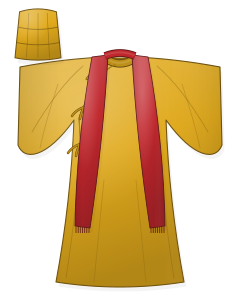
The top stripe of the Caodai flag, corresponding to the "Thái" branch and symbolizing Buddhism. The Religious Constitution calls yellow the color of the Way. The Pope's crown is also yellow.
The middle stripe of the Caodai flag, corresponding to the "Thượng" branch and symbolizing the Way of the Immortals (Taoism). The vestments of the "Thượng" branch are given as sky blue.
The bottom stripe of the Caodai flag, corresponding to the "Ngọc" branch and symbolizing the Way of the Sages (Confucianism).
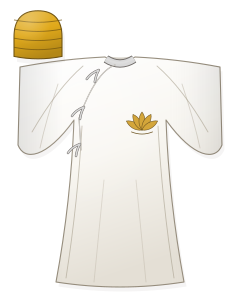
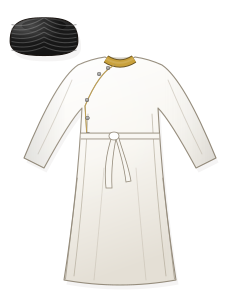
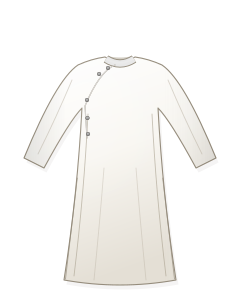
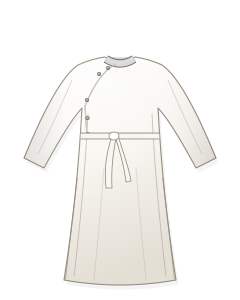
The color of the long robe of all adherents and of lay officers. It symbolizes purity and universal harmony, since white contains all colors.
Place of worship real sanctuaries
Ritual colours by occasion and season
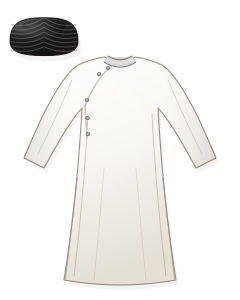
Male and female adherents wear a white long robe for rites, and men wear a black turban. The Three Treasures are offered: flowers for essence, wine for vital energy, tea for spirit.
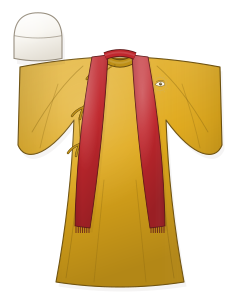
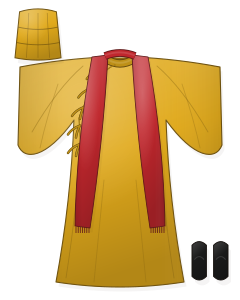
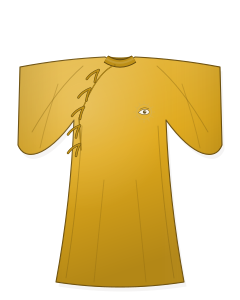
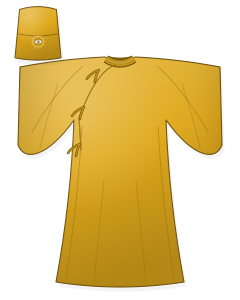
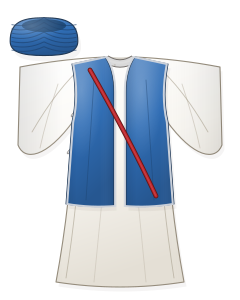
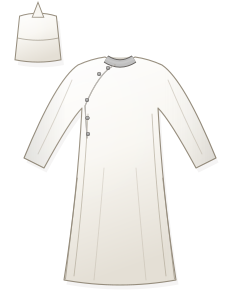
Dignitaries of the Nine Sphere Palace wear full vestments in the color of their branch. The hex code is the yellow of the "Thái" branch. For the other two colors see mau_chu_dao.
The banners hung at the Holy See show two dragons facing the sun, with twelve tails. The religious banners use the three sacred colors.
Mourning and avoided colours
Adherents who die are shrouded in the white religious dress. Dignitaries and lay officers are shrouded in the full vestments of their rank. No primary source of the religion found on the color of mourning clothes for relatives.
IIRanks
The Great Way of the Third Period of Salvation ("Đại Đạo Tam Kỳ Phổ Độ") was founded in 1926 in Tây Ninh and teaches the return of the Three Teachings to a common source. It is organized according to the Religious Constitution ("Pháp Chánh Truyền") into three palaces. The Eight Trigrams Palace ("Bát Quái Đài") is the sacred body under the Supreme Being. The Heavenly Union Palace ("Hiệp Thiên Đài") holds communion with the divine and the law. The Nine Sphere Palace ("Cửu Trùng Đài") handles administration and propagation. There is no single central church. The Caodai Sacerdotal Council of the Tây Ninh Holy See is the largest body, alongside many other independent councils and branches.
- 1Pope教宗
- 2Censor Cardinal掌法
- 3Cardinal頭師
- 4Principal Archbishop正配師
- 5Archbishop配師
- 6Bishop教師
- 7Priest教友
- 8Student Priest禮生
- 9Chief Village Dignitary正治事
- 10Vice Village Dignitary副治事
- 11Village Law Officer通事
- 12Adherent信徒
- 1Heavenly Union Palace: Guardian of the Law護法
- 2Heavenly Union Palace: "Thượng Phẩm" and "Thượng Sanh"上品, 上生
- 3Heavenly Union Palace: the Twelve Zodiacal Dignitaries十二時君
- 4Heavenly Union Palace: the Juridical Body
- 1Pope 教宗 · Pope
Head of the Nine Sphere Palace, a single person who guides the worldly side on behalf of the Supreme Being. Equal in rank to the Guardian of the Law of the Heavenly Union Palace.
- 2Censor Cardinal 掌法 · Censor Cardinal
Three persons, one for each branch ("Thái", "Thượng", "Ngọc"), who review laws and rules before they are issued.
- 3Cardinal 頭師 · Cardinal
Three persons, one for each branch, who govern both the religious and the worldly affairs of the Nine Sphere Palace.
- 4Principal Archbishop 正配師 · Principal Archbishop
Three persons chosen from the thirty six Archbishops, one for each branch, heading the Archbishops of their branch.
- 5Archbishop 配師 · Archbishop
Thirty six persons, twelve for each branch.
- 6Bishop 教師 · Bishop
Seventy two persons, twenty four for each branch, in charge of registers and rites.
- 7Priest 教友 · Priest
Three thousand persons, one thousand for each branch, closest to the adherents and in charge of propagating the faith.
- 8Student Priest 禮生 · Student Priest
Unlimited in number, chosen from among the disciples, in charge of rites.
- 9Chief Village Dignitary 正治事 · Chief Village Dignitary
A lay officer who heads the Administrative Committee of the village parish, elected by the adherents of the village.
- 10Vice Village Dignitary 副治事 · Vice Village Dignitary
A lay officer in charge of administration in the village parish, called the "younger Pope". Elected by the adherents of the village.
- 11Village Law Officer 通事 · Village Law Officer
A lay officer in charge of the law in the village parish, called the "younger Guardian of the Law". Elected by the adherents of the village.
- 12Adherent 信徒 · Adherent
A person who has been initiated, makes the four daily offerings and wears a white long robe for rites.
- 1Heavenly Union Palace: Guardian of the Law 護法 · Hộ Pháp, Guardian of the Law
Head of the Heavenly Union Palace, in charge of communion with the divine and the law, equal in rank to the Pope. Commands the Law branch.
- 2Heavenly Union Palace: "Thượng Phẩm" and "Thượng Sanh" 上品, 上生 · Thượng Phẩm, Thượng Sanh
The two assistants of the Guardian of the Law. The "Thượng Phẩm" commands the Religious branch and the "Thượng Sanh" commands the Secular branch. This grade is counted within the Heavenly Union Palace only.
- 3Heavenly Union Palace: the Twelve Zodiacal Dignitaries 十二時君 · Twelve Zodiacal Dignitaries
Twelve persons divided into three branches. Law branch: "Bảo Pháp", "Hiến Pháp", "Khai Pháp", "Tiếp Pháp". Religious branch: "Bảo Đạo", "Hiến Đạo", "Khai Đạo", "Tiếp Đạo". Secular branch: "Bảo Thế", "Hiến Thế", "Khai Thế", "Tiếp Thế".
- 4Heavenly Union Palace: the Juridical Body Lower dignitaries of Hiệp Thiên Đài
"Tiếp Dẫn Đạo Nhơn" (receiver of followers), "Chưởng Ấn" (keeper of the seal), "Cải Trạng" (advocate), "Giám Đạo" (inspector), "Thừa Sử" (archivist), "Truyền Trạng" (investigator), "Sĩ Tải" (clerk), "Luật Sự" (law student).
Followers: Caodai adherents, fellow adherents ("đạo hữu"). no source found on how adherents are graded
IIIForms of address
| Rank | Spoken address | In writing | Self reference | Original term |
|---|---|---|---|---|
| Pope, Guardian of the Law | Addressed as "Đức Giáo Tông" (His Holiness the Pope), "Đức Hộ Pháp" (His Holiness the Guardian of the Law), or "Ngài" (His Eminence) | Written as "Đức Hộ Pháp" (His Holiness the Guardian of the Law) or "Đức Quyền Giáo Tông" (His Holiness the Interim Pope) | Refers to self as "Bần đạo" (this humble follower of the Way) | 貧道 |
| Censor Cardinals, Cardinals | Addressed as "Ngài" (His Eminence) | Written as "Ngài Đầu Sư" (His Eminence the Cardinal) or "Ngài Chưởng Pháp" (His Eminence the Censor Cardinal) | Refers to self as "Tinh tế" (humble self, used by Cardinals) | |
| Principal Archbishops, Archbishops | Addressed as "Ngài" (His Eminence) | Written as "Ngài Phối Sư" (His Eminence the Archbishop) | Refers to self as "Tiện minh" (humble self, used by Archbishops) | |
| Bishops | Addressed as "Ngài" (His Excellency) | Written as "Ngài Giáo Sư" (His Excellency the Bishop) | Refers to self as "Tiện hiền" (humble self, used by Bishops) | |
| Priests | Addressed as "Ông" (Mr.), or "Bà" (Mrs.) for the female branch | Written as "Ông Giáo Hữu" (Reverend Priest) | Refers to self as "Tiện đệ" (humble younger brother) | |
| Student Priests | Addressed as "Ông" (Mr.), or "Bà" (Mrs.) for the female branch | Written as "Ông Lễ Sanh" (Student Priest) | Refers to self as "Thiểu phẩm" (one of lesser rank) | |
| Lower dignitaries to higher dignitaries | Addressed as "Hiền huynh" (worthy elder brother), or "Hiền tỷ" (worthy elder sister) for women | Written as "Hiền huynh" (worthy elder brother) | Refers to self as "Tiện đệ" (humble younger brother), or "Tiện muội" (humble younger sister) for women | |
| Lay officers and adherents | Addressed as "Ông" (Mr.), "Bà" (Mrs.), "hiền huynh" (worthy elder brother), "hiền tỷ" (worthy elder sister) | Written as "Ông Chánh Trị Sự" (Mr. Chief Village Dignitary) or "đạo hữu" (fellow adherent) | no source found for a specific rule |
IVVestments by rank
Flat drawings made from the descriptions in the sources, with no people shown. Colours are approximate.


VLine of succession
Caodaists believe that the Supreme Being founded the religion directly through spirit writing, so the highest dignitaries are regarded as appointed by Heaven. At the Tây Ninh Holy See, after Interim Pope Lê Văn Trung and "Hộ Pháp" (Guardian of the Law) Phạm Công Tắc, no one has held the rank of Pope or Guardian of the Law. The Sacerdotal Council has been run by acting heads and, since 1979, by a Governing Council. Beyond Tây Ninh there are many parallel councils and branches, each with its own head.
Cao Đài Holy See of Tây Ninh: leaders through the periods
- Opened the religion in the "Bính Dần" year, 1926The Supreme Being, the Jade Emperor, "Cao Đài Tiên Ông Đại Bồ Tát Ma Ha Tát" 高臺仙翁大菩薩摩訶薩
The Supreme Being believed to have founded the religion through séances and ordained the first disciples.
- From 1926Li Bai (Lý Thái Bạch), First Spiritual Head and invisible Pope 李太白
Believed to hold the spiritual papacy of the Third Amnesty.
- #1 · 1878 to 1932. According to Caodai history he received the vision of the Divine Eye on Phú Quốc in 1921Ngô Văn Chiêu 吳文昭
First disciple of Cao Đài. He declined the papacy, left in 1926 and founded the Chiếu Minh branch.
- #2 · 1876 to 1934, Interim Pope 1926 to 1934Lê Văn Trung, Interim Pope, holy name "Thượng Trung Nhựt" 黎文忠
Ordained Cardinal then Acting Pope, the only person to exercise the papal office at Tây Ninh.
- #3 · 1888 to 1929Cao Quỳnh Cư, "Thượng Phẩm" 高瓊璩
One of the three original mediums of 1925, held the rank of Thượng Phẩm in the Hiệp Thiên Đài.
- #4 · 1890 to 1959, head of the Heavenly Union Palace and also of the Nine Sphere Palace from 1935Phạm Công Tắc, "Hộ Pháp" (Guardian of the Law) 范公稷
Head of the Hiệp Thiên Đài who led both councils after 1935. Exiled to Madagascar 1941 to 1946, left for Cambodia in 1956, died in Phnom Penh 1959.
- #5 · 1901 to 1971, head of the Heavenly Union Palace from 1956Cao Hoài Sang, "Thượng Sanh" 高懷
One of the three original mediums, led the Hiệp Thiên Đài after the Hộ Pháp left in 1956.
- #6 · Issued instructions from 1963 to 1971Trương Hữu Đức, "Hiến Pháp" 張有德
Head of the Legal Department and of the Hiệp Thiên Đài in the post Hộ Pháp period.
- #7 · 1888 to 1980Trần Ngọc Sáng, Cardinal of the "Thượng" branch, holy name "Thượng Sáng Thanh" 陳玉創
Cardinal of the Cửu Trùng Đài, co-signed the 1979 ordinance of the Holy See.
- #8 · Head in 1979, brought before a review in 1983Hồ Tấn Khoa, "Bảo Đạo", Head of the Heavenly Union Palace 胡進科
Signed the 1979 ordinance as head administrator. Put before a denunciation meeting in 1983 and asked to step down.
- #9 · Established on 4 June 1979 by decision 124/QĐ-UBGoverning Council
Collective body replacing the former structure. In 1997 the Holy See was recognised by the State with a new charter.
- #10 · Born April 1936, serving as Head as of September 2026Nguyễn Thành Tám, Cardinal, holy name "Thượng Tám Thanh", Head of the Sacerdotal Council 阮成三
Current head of the Tây Ninh Holy See, who marked his 90th birthday in April 2026.
Main Cao Đài branches and their founders
- Separated from 1926, recognized in 1996Chiếu Minh Tam Thanh Vô Vi (Chiếu Minh Long Châu): Ngô Văn Chiêu
Esoteric branch following Ngô Văn Chiêu, without the Tây Ninh administrative hierarchy.
- Founded in the early 1930s in Mỹ Tho, recognized in 2000Minh Chơn Lý (Caodai Sacerdotal Council of Chơn Lý): Nguyễn Văn Ca 阮文歌
One of the earliest branches to separate from Tây Ninh.
- Founded in the 1930s in Bến Tre, recognized in 1995Tiên Thiên: Lê Kim Tỵ 黎金巳
Branch focused on self-cultivation, now a separate church.
- Founded in the 1930s in Bạc Liêu, recognized in 1996Minh Chơn Đạo: Trần Đạo Quang, then Cao Triều Phát 高朝發
Branch strong in the far southwest.
- Separated in 1934, recognized in 1997Ban Chỉnh Đạo (Bến Tre): Nguyễn Ngọc Tương 阮玉相
Separated from Tây Ninh after the death of Lê Văn Trung.
- Recognized in 1996Caodai Missionary Church (Đà Nẵng)
Church that spread the faith in central Vietnam.
- Recognized in 1998Bạch Y Liên Đoàn Chơn Lý
A state recognised Cao Đài church.
- Recognized in 2000Cầu Kho Tam Quan
A state recognised Cao Đài church.
A venerated figure: the library shows no portrait, only the name inside a round seal.
VIOrdination and transmission
Dignitaries are promoted to ranks. There is no monastic ordination. There are two kinds of promotion. Heavenly promotion is a rank granted by the Supreme Being through spirit writing, and human promotion is a rank granted by people. Lay officers are elected by the adherents of their village. Religious administration runs from the central level to the regional, provincial, district, village and hamlet parishes.
- Initiation as an adherentRequirement: Voluntary. No primary source found on detailed requirements.Rite: Initiation ceremony at a Holy House ("Thánh Thất")
- Lay officer (Village Law Officer, Vice Village Dignitary, Chief Village Dignitary)Requirement: Elected by all the adherents of the village, observant of the religious law and of good conductRite: no detailed source found
- Student Priest, rising through Priest, Bishop and ArchbishopRequirement: Heavenly promotion through spirit writing, or review of merit and seniority by the Sacerdotal Council. No detailed source found on the criteria for promotion.Rite: Promotion ceremony. No detailed source found.
VIIWhere the sources disagree
- The color of the "Ngọc" branch is inconsistent. The flag gives red, while the vestments in the Religious Constitution are pink. The page should use red for the flag and pink for the vestments of the "Ngọc" branch.
- The "Thượng" Censor Cardinal wears all white, not blue like the "Thượng" Cardinal. The daotam.info source states this clearly.
- Orientation of the flag stripes: English Wikipedia describes the three color flag of yellow, blue and red as vertical. The Charter of the Missionary Sacerdotal Council gives three colors parallel along the length, that is horizontal stripes, with yellow on top, blue in the middle and red at the bottom. Different councils use different flag designs.
- The old color in mau-sac.json, deep #8C6408, is a dark yellow for reading text and works as a text color. The identity yellow should be brighter. The proposal is #E0A91B.
- The old place of worship colors in mau-that.json (ceiling #8DBFE8, pillars #D9869B) match the source descriptions. For the exterior walls the source only says pastel colors, and these have not been measured.
- All descriptions of vestments here follow the Sacerdotal Council of the Tây Ninh Holy See. Other branches may differ.
- Grade numbers for the Heavenly Union Palace are counted within that palace only. There is a source only for the Guardian of the Law being equal to the Pope. No source found comparing the lower grades with the Nine Sphere Palace.
- The Eight Trigrams Palace is the sacred body under the Supreme Being and the Divinities, Saints, Immortals and Buddhas. It has no human ranks and so is not listed in the hierarchy.
- The ten_en values of the ranks are common translations in English language documents, not official names.
- After 1975 a group of Tây Ninh dignitaries and adherents, in Vietnam and abroad, did not accept the Governing Council and the Sacerdotal Council recognized in 1997 as legitimate, calling it the 1997 Branch. The VNFORB source (from that side) records that in 2015 the Legislative Body of the traditional Sacerdotal Council publicly separated itself. The library records both sides without judgment.
- Ngô Văn Chiêu: the Wikipedia page on Caodaism says he signed the Declaration of the Founding of the Religion on 7 October 1926, while the Wikipedia page about him says he did not sign. Caodai sources agree that he declined the office of Pope.
- No sufficiently reliable source found for the heads of the Governing Council between 1983 and the time of Mr. Nguyễn Thành Tám. It is also unclear in which year Mr. Tám became Head.
- The dates of Cao Quỳnh Cư (1888 to 1929) and the Divine Eye vision on Phú Quốc in 1921 follow common Caodai history and have not been checked against primary sources in this session.
- The founding years of branches before 1975 are given by decade, since sources differ by a few years. Years of recognition follow nhipcautamgiao.net. That source also lists 19 other independent Caodai organizations recognized from 1998 to 2008.
- The Chinese characters of Cao Hoài Sang's name have not been fully checked. The last character is left in transcription.
- No images obtained: the server blocked access to Wikimedia Commons in this session, so all anh entries are null. Retry for Phạm Công Tắc, Lê Văn Trung, Ngô Văn Chiêu and Cao Hoài Sang.
VIIISources
31 sources
- https://www.daotam.info/booksv/daophucchucsac/daophuccuachucsac.htm
- https://www.daotam.info/booksv/pct-02.htm
- https://www.daotam.info/booksv/pdf/NguyenThanhBinh/ynghiamautrang.pdf
- https://www.daotam.info/booksv/bdhd/nvhbdhd19.htm
- https://www.daotam.info/booksv/THKQVCaoDaiGiao/THKQVCaoDaiGiaocenter1.htm
- https://www.daotam.info/booksv/pdf/ChanhKien/cacloaiphuon/cacloaiphuong.html
- https://www.daotam.info/booksv/QuachVanHoa/NghiThucYNghiaTangLe/nghithuctangle-chucviecdaohuu.htm
- https://www.daotam.info/booksv/thienphongphamphongtuphong/thienphongphamphongtuphong.html
- https://en.wikipedia.org/wiki/Hi%E1%BB%87p_Thi%C3%AAn_%C4%90%C3%A0i
- https://en.wikipedia.org/wiki/List_of_religious_flags_of_Vietnam
- https://www.tiktok.com/@caodaitruyengiao/video/7346060255672962322
- https://localvietnam.com/tay-ninh/tay-ninh-holy-see-cao-dai-temple/
- https://www.ncpedia.org/media/colorful-columns-and-hall-cao
- https://tapchinghiencuuphathoc.vn/y-nghia-cac-bieu-tuong-trong-toa-thanh-tay-ninh.html
- https://dantoctongiao.vn/nghi-le-trong-dao-cao-dai-1770170335956.htm
- https://www.cd-online.net/caodai/cdos/showId/23450
- https://en.wikipedia.org/wiki/Caodaism
- https://en.wikipedia.org/wiki/L%C3%AA_V%C4%83n_Trung
- https://en.wikipedia.org/wiki/Ph%E1%BA%A1m_C%C3%B4ng_T%E1%BA%AFc
- https://en.wikipedia.org/wiki/Ng%C3%B4_V%C4%83n_Chi%C3%AAu
- https://en.wikipedia.org/wiki/Cao_Ho%C3%A0i_Sang
- https://www.daotam.info/booksv/dnddctd5.htm
- https://www.khoinhonsanh.org/2020/07/3151-ao-linh-011979.html
- https://www.daocaodai.info/booksv/BuiVanTiep/HoiLenAnNgaiBaoDaoHTK/HoiLenAnNgaiBaoDaoHTK.htm
- https://www.rfa.org/vietnamese/in_depth/Caodaism_part3_RFA-06202008152600.html
- https://baoquankhu7.vn/quan-khu-7-chuc-mung-sinh-nhat-lan-thu-90-ngai-dau-su-thuong-tam-thanh-1980632155-0058448s40210gs
- https://baoquankhu7.vn/quan-khu-7-chuc-mung-hoi-thanh-cao-dai-toa-thanh-tay-ninh-nhan-dip-hoi-yen-dieu-tri-cung-1780596816-0052656s34510gs
- https://vnforb.org/cardinal-nguyen-thanh-tam-6703/
- https://nhipcautamgiao.net/cao-dai/lich-su-cao-dai/cac-chi-phai-cao-dai-giao-tai-viet-nam/
- https://www.daotam.info/booksv/pdf/pdf3/huantucuahienphaphtdtruonghuuduc.pdf
- https://www.caodai.com.vn/vn/news-detail/ban-ton-giao-chinh-phu-viet-nam-chao-tham-va-chuc-xuan-hoi-thanh-cao-dai-toa-thanh-tay-ninh.html
?Quick Questions
What is the principal colour of Caodaism?
Yellow (color of the Way, "Thái" branch) (hoàng), #E0A91B. The Religious Constitution calls yellow the color of the Way. It is the top stripe of the Caodai flag and the color of the Pope's crown. Blue and red serve as secondary colors by branch, and white serves as the background after the adherents' robes.
How many ranks does Caodaism have?
The library records 16 ranks, from highest to lowest: Pope, Censor Cardinal, Cardinal, Principal Archbishop, Archbishop, Bishop, Priest, Student Priest, Chief Village Dignitary, Vice Village Dignitary, Village Law Officer, Adherent, Heavenly Union Palace: Guardian of the Law, Heavenly Union Palace: "Thượng Phẩm" and "Thượng Sanh", Heavenly Union Palace: the Twelve Zodiacal Dignitaries, Heavenly Union Palace: the Juridical Body.
Who leads Caodaism today?
In the line of Cao Đài Holy See of Tây Ninh: leaders through the periods, the most recent milestone is Nguyễn Thành Tám, Cardinal, holy name "Thượng Tám Thanh", Head of the Sacerdotal Council (Born April 1936, serving as Head as of September 2026). Current head of the Tây Ninh Holy See, who marked his 90th birthday in April 2026.