
IColours
Colour used for this page of the library: Dà (reddish brown) #7B3B26. Every colour code is approximate, since most paths name their colours without publishing codes.
Principal colour the colour of the path
Colour of the religious flag and the altar cloth. According to the church, dà harmonises all colours. It symbolises harmony among all people regardless of race, skin colour or language.
Gold border around the round emblem on a dà background.
White lotus at the centre of the emblem, with the four initials PGHH.
Place of worship real sanctuaries
Ritual colours by occasion and season
Only three offerings: clean water (purity), flowers (cleanliness) and incense (serenity). No other offerings, no meat offerings and no burning of votive paper.
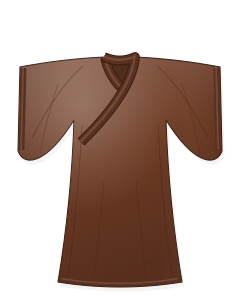
Those entering worship put on a brown robe that hangs ready behind the altar area.
The two largest feasts of the faith. The dà religious flag is usually flown alongside the national flag.
Mourning and avoided colours
The altar cloth was originally vermilion red and changed to dà around 1940. This was a change of rule, not a forbidden colour.
The teaching keeps the Vietnamese custom of wearing mourning clothes but names no colour. It forbids burning paper gold and silver, hiring ritual masters, drums and horns, and killing animals for grave offerings.
IIRanks
Founded in 1939 by Prophet Founder Huỳnh Phú Sổ in Hòa Hảo village, An Giang. It teaches learning the Buddha's way while cultivating human virtue. Practice takes place at home, and there is no clergy or monastic hierarchy. The central body is the Hòa Hảo Buddhist Church, recognised by the State in 1999. It is run by the Central Executive Board based at the An Hòa Temple, the mother temple. Below it are provincial Representative Boards and commune or ward Executive Boards. All titles are administrative posts elected by congresses of adherents for fixed terms. They are not clerical ranks.
- 1Chairman of the Central Executive Board
- 2Standing Vice Chairman, Vice Chairmen
- 3Standing Committee members, heads of specialised departments, members of the Central Executive Board
- 4Head of the Provincial Hòa Hảo Buddhist Representative Board
- 5Commune, ward or township Executive Board: Chairman, Vice Chairman, Secretary, Members
- 6Adherent
- 1Chairman of the Central Executive Board Chairman of the Central Executive Board
Heads the Church. Elected by the all faith congress of adherent delegates for a 5 year term. For the 2024 to 2029 term the holder is Mr Nguyễn Tấn Đạt.
- 2Standing Vice Chairman, Vice Chairmen Standing Vice Chairman, Vice Chairmen
Assist the Chairman. Members of the Standing Committee of the Central Executive Board.
- 3Standing Committee members, heads of specialised departments, members of the Central Executive Board Standing Committee members, Central Board members
The Sixth Congress elected 25 full members and 5 alternates. Departments include Organisation and Personnel.
- 4Head of the Provincial Hòa Hảo Buddhist Representative Board Head of Provincial Representative Board
Represents the Central Executive Board in provinces with many adherents.
- 5Commune, ward or township Executive Board: Chairman, Vice Chairman, Secretary, Members Commune Executive Board
From 3 to 9 people, elected by the commune conference of adherent delegates. Members are in charge of teaching, social charity, finance, oversight, reception and ritual.
- 6Adherent Adherent
Practises at home, does not shave the head and does not take monastic vows.
Followers: Hòa Hảo Buddhist adherents, fellow believers. No grades. About 1.5 million adherents, concentrated in the Mekong Delta of southwestern Vietnam.
IIIForms of address
| Rank | Spoken address | In writing | Self reference | Original term |
|---|---|---|---|---|
| Founder | Addressed as "Đức Thầy" (The Master) | Written as "Đức Huỳnh Giáo Chủ" (the Prophet Founder Huỳnh) | Not applicable | |
| Executive Board members at all levels | Addressed as "ông" or "bà" (Mr or Mrs) with the title | Written as "Ông Nguyễn Văn A, Trưởng ban Ban Trị sự Trung ương" (Mr Nguyễn Văn A, Chairman of the Central Executive Board) | no source found | |
| Adherents among themselves | Addressed as "đồng đạo" or "đạo hữu" (fellow believer, co-religionist) | Written as "đồng đạo" or "tín đồ" (fellow believer, adherent) | no source found |
IVVestments by rank
Flat drawings made from the descriptions in the sources, with no people shown. Colours are approximate.

VLine of succession
Hòa Hảo Buddhism was founded in 1939 by Prophet Founder Huỳnh Phú Sổ. It continues the Bửu Sơn Kỳ Hương line of the Buddha Master of Tây An. The Founder passed his position to no one, and adherents have named no successor. The organisation continues through elections. Before 1975 it was the Executive Board. Since 1999 it has been the Central Executive Board of the Hòa Hảo Buddhist Church, elected every 5 years by a congress of adherent delegates.
The Bửu Sơn Kỳ Hương lineage leading to Hòa Hảo Buddhism
- 1807 to 1856, founded Bửu Sơn Kỳ Hương in 1849Buddha Master of Tây An, Đoàn Minh Huyên 段明暄
Founder of Bửu Sơn Kỳ Hương, whose teaching Hòa Hảo regards as its root.
- Died 1873Venerable Commander Trần Văn Thành 陳文成
Leading disciple of the Buddha Master, led the Bảy Thưa resistance against the French.
- Died 1875Venerable Phật Trùm
Counted by Hòa Hảo followers among the predecessors after the Buddha Master.
- 1831 to 1890Venerable Master Ngô Lợi 吳利
Founder of Tứ Ân Hiếu Nghĩa, venerated by Hòa Hảo followers as a predecessor.
- Born 15 January 1920 (25th day of the 11th month, Kỷ Mùi year). Founded the faith on the 18th day of the 5th month, Kỷ Mão year, that is 4 July 1939. Absent since April 1947Prophet Founder Huỳnh Phú Sổ 黃富數
Founder of Hòa Hảo Buddhism, teaching simple home worship and moral practice.
Hòa Hảo Buddhist Church organisation: Executive Boards and their heads
- Founded the faith in 1939Prophet Founder Huỳnh Phú Sổ 黃富數
Founder, who appointed no successor.
- President in 1964Lương Trọng Tường, President of the Hòa Hảo Buddhist Executive Board 梁仲祥
Head of the Executive Board when the church administration formally began in 1964.
- Mid 1975Dissolution of the Executive Boards
Representatives announced the dissolution of the boards after April 1975.
- #I · Chosen on 28 May 1999, recognised by Decision 21/QĐ-TGCP of 11 June 1999Nguyễn Văn Tôn (Mười Tôn), Head of the Hòa Hảo Buddhist Representative Board 阮文尊
First head of the state recognised organisation in 1999, term I 1999 to 2004.
- #II and III · 2004 to 2014Chairmen for term II (2004 to 2009) and term III (2009 to 2014)
Names not yet found in reliable sources.
- #IV · 22 May 2014 at An Hòa TempleFourth Congress adopts the Church Charter
Charter of 7 chapters and 33 articles adopted at An Hòa Temple.
- #IV to VI · Chairman since at least term IV (2014 to 2019), re-elected on 5 June 2019 and on 18 to 19 December 2024 for the 2024 to 2029 termNguyễn Tấn Đạt, Chairman of the Central Executive Board 阮進達
Current head of the Hòa Hảo Buddhist Church, re-elected at the Sixth Congress.
A venerated figure: the library shows no portrait, only the name inside a round seal.
VIOrdination and transmission
There is no ordination or conferral of precepts. The Founder passed his position to no one. The organisation continues through elections. Every 5 years the all faith congress of adherent delegates elects the Central Executive Board, and commune conferences elect commune boards. The authorities then recognise the result.
- Becoming an adherentRequirement: Voluntarily keeping the Eight Prohibitions and worshipping at homeRite: no source found on an admission rite
- Joining a commune Executive BoardRequirement: Elected by the commune conference of adherent delegatesRite: Ceremony announcing the recognition decision
- Joining the Central Executive BoardRequirement: Elected by the all faith congress of adherent delegatesRite: Congress held at the An Hòa mother temple
VIIWhere the sources disagree
- The term red altar cloth in the brief is an old name. According to hoahao.org the altar cloth was originally vermilion red and changed to dà around 1940. Today the correct term is dà altar cloth.
- The hex code for dà is an estimate. Church sources only say dà, and English Wikipedia says maroon. No official colour chart with codes was found.
- The old colour in mau-sac.json (#6B4E2E) is an olive greyish brown. It lacks red and so departs from dà. Proposed change to #7B3B26. The old altar cloth colours in mau-that.json (#A0613F, #8B4A2B) are closer but somewhat light.
- Besides the Church recognised in 1999, other Hòa Hảo groups operate separately, both in Vietnam and abroad. The hierarchy here follows only the Central Executive Board at An Hòa Temple.
- For 1973 hoahao.org records a Central Executive Council and Executive Boards at province, district, commune and hamlet level. The present structure is leaner: central, provincial Representative Board, commune Executive Board.
- No source found on Executive Board uniforms, on an admission rite or on a specific mourning colour.
- Many Hòa Hảo adherents do not accept that the Prophet Founder has died and say only that he has been absent since 1947. Historical sources state he was killed by the Việt Minh on 16 or 18 April 1947. His birth year is also given as 1919 or 1920, depending on how the lunar date 25th day of the 11th month, Kỷ Mùi year, is converted.
- Besides the Church recognised by the State in 1999, there are unregistered Hòa Hảo groups. These include Pure Hòa Hảo Buddhism, the former Central Executive Board of Mr Lê Quang Liêm, and Quang Minh Temple. Human rights sources say the recognised body is led by Party members. The library records both sides without judgement.
- No source found for the Chairmen of term II (2004 to 2009) and term III (2009 to 2014). It is also unclear in which year Mr Nguyễn Tấn Đạt began. Sources only say he was chosen again in 2019.
- The line of the Buddha Master of Tây An, the Venerable Commander, Phật Trùm, the Venerable Master and the Prophet Founder is how Hòa Hảo adherents see their transmission. It is not an organisational succession. Tứ Ân Hiếu Nghĩa is a separate faith and may honour these figures differently.
- The Central Executive Board notice of 1 July 2025 on suspending religious activity at An Hòa Temple exists only as an image. Its reason could not be read, so it is not listed as a milestone.
- Before 1975 there were military leaders of Hòa Hảo origin such as Trần Văn Soái, Lê Quang Vinh (Ba Cụt) and Nguyễn Giác Ngộ. They did not head the church and so are not listed as milestones.
- No images obtained: the server blocked access to Wikimedia Commons in this session, so every anh field is null.
VIIISources
27 sources
- https://www.hoahao.org/a3735/i-cach-tho-phuong
- https://hoahao.org/a272/6-co-dao-huy-hieu
- https://www.hoahao.org/a3737/iii-tang-le
- https://hoahao.org/a4186/7-phan-nghi-le
- https://www.hoahao.org/a277/11-phu-ban-he-thong-ban-tri-su-phat-giao-hoa-hao
- https://en.wikipedia.org/wiki/List_of_religious_flags_of_Vietnam
- https://tapchinghiencuuphathoc.vn/khai-quat-ve-phat-giao-hoa-hao.html
- https://tapchinghiencuuphathoc.vn/quy-che-lam-viec-cua-ban-tri-su-giao-hoi-phat-giao-hoa-hao-xa-phuong-thi-tran-nhiem-ky-2019-2024.html
- https://vusta.vn/tinh-gian-di-trong-giao-luat-va-giao-le-cua-dao-hoa-hao-p70165.html
- https://phatgiao.org.vn/tham-to-dinh-phat-giao-hoa-hao-d18611.html
- https://nhandan.vn/dai-hoi-dai-bieu-tin-do-phat-giao-hoa-hao-cap-toan-dao-lan-thu-6-post851457.html
- https://pghh.org.vn/news/?ID=1631&CatID=63
- https://pghh.org.vn/news/?ID=1924&CatID=63
- https://bantongiao.cantho.gov.vn/common/baiviet/idbv/688
- https://en.wikipedia.org/wiki/H%C3%B2a_H%E1%BA%A3o
- https://en.wikipedia.org/wiki/Hu%E1%BB%B3nh_Ph%C3%BA_S%E1%BB%95
- https://vi.wikipedia.org/wiki/Ph%E1%BA%ADt_gi%C3%A1o_H%C3%B2a_H%E1%BA%A3o
- https://nghiencuulichsu.com/2024/11/13/phat-thay-tay-an-va-giao-phai-buu-son-ky-huong/
- https://pghh1939.blogspot.com/2018/10/duc-bon-su-ngo-loi-1831-1890.html
- https://thuonghylenien.org/luu-tru/6129
- https://www.rfa.org/vietnamese/binhluan/12921-19990630.html
- https://vnforb.org/wp-content/uploads/sites/5/2024/04/THE-HOAHAO-BUDDHIST-CHURCH.pdf
- https://tapchinghiencuuphathoc.vn/hien-chuong-giao-hoi-phat-giao-hoa-hao-nhiem-ky-2014-2019.html
- https://www.pghh.org.vn/news/?ID=1924&CatID=63
- https://baoangiang.com.vn/dai-hoi-dai-bieu-tin-do-phat-giao-hoa-hao-cap-toan-dao-lan-thu-v-nhiem-ky-2019-2024-thanh-cong-tot-a247590.html
- https://phatgiaohoahao.org.vn/news/?ID=2774&CatID=157
- https://www.ecoi.net/en/document/2057132.html
?Quick Questions
What is the principal colour of Hòa Hảo Buddhism?
Dà (reddish brown) (màu dà), #7B3B26. Dà is the only colour of the religious flag and altar cloth, set by the church itself. A red leaning brown was chosen to match the word dà and the word maroon in sources, as opposed to a greyish brown.
How many ranks does Hòa Hảo Buddhism have?
The library records 6 ranks, from highest to lowest: Chairman of the Central Executive Board, Standing Vice Chairman, Vice Chairmen, Standing Committee members, heads of specialised departments, members of the Central Executive Board, Head of the Provincial Hòa Hảo Buddhist Representative Board, Commune, ward or township Executive Board: Chairman, Vice Chairman, Secretary, Members, Adherent.
Who leads Hòa Hảo Buddhism today?
In the line of The Bửu Sơn Kỳ Hương lineage leading to Hòa Hảo Buddhism, the most recent milestone is Prophet Founder Huỳnh Phú Sổ (Born 15 January 1920 (25th day of the 11th month, Kỷ Mùi year). Founded the faith on the 18th day of the 5th month, Kỷ Mão year, that is 4 July 1939. Absent since April 1947). Founder of Hòa Hảo Buddhism, teaching simple home worship and moral practice.